
‘Falling off the Wagon’, is a phrase that originated in the Temperance Movement, according to Wikipedia.
Meaning falling of the water wagon back into alcoholism. Getting back onto the wagon means getting sober again. I’m sure I’m not telling you anything new.
Every so often I fall off my gluten free, dairy free, lowFODMAP and sugar free penny-farthing-bicycle and then I am in pain and discomfort.
Getting back onto my penny-farthing bicycle is a matter of figuring out where the bad stuff has crept in. While one teaspoon of gluten-containing flour in a loaf of bread is not going to cause any problems, a cup of 100% wheat flour will. And I’ve been mixing spelt flour in my baked goods to encourage yeast action.
And having that bread daily. Having anything you’re sensitive to daily, is another no-no for people with a lot of allergies, intolerances and sensitivities.
Having a particular food once every three days usually prevents a build up of the bad chemicals in the body. But sometimes all I want is to be able to eat something without worrying what it will do to my chemistry.
That’s when my penny-farthing slams to the ground and I fall by the wayside.
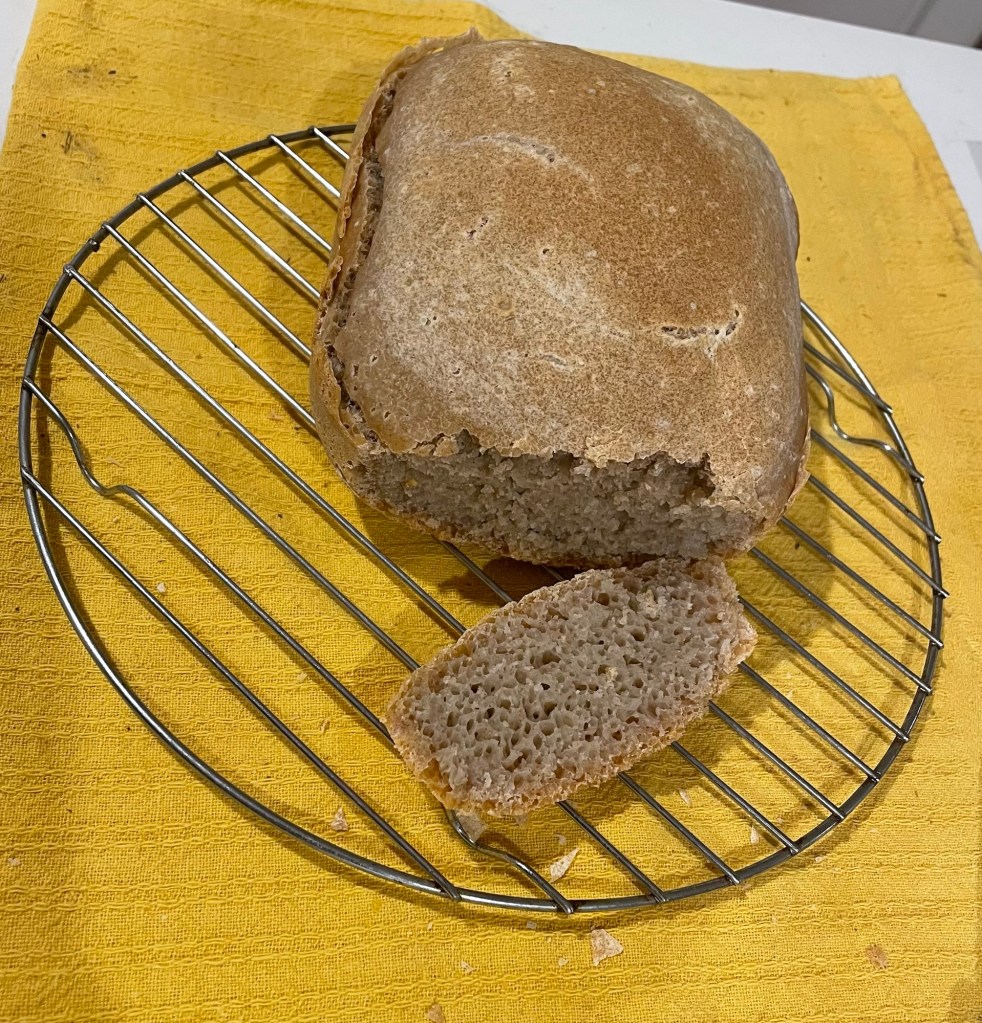
Which is why I’ve started experimenting with baking my own bread. Commercial gluten free breads tend to have a ‘stampede of ingredients’, and the breads that are any good aren’t always available. The phrase ‘stampede of ingredients’ … so appropriate to food intolrances … comes from the MooGoo people, who make natural skin care products.
Cutting gluten-containing flour from my diet only half-fixed my problem. I came to the conclusion yesterday it has to be a capsule filler causing me grief. I’m now taking 0.9 mg LDN daily, either a (3 x 0.2 + 3 x 0.1) dose equaling 6 capsules, or (4 x 0.2 + 1 x 0.1) equaling 5 capsules.
Meaning, I’m taking a lot of Avicel cellulose filler. And I’ve been reading in a pertinent group that this stuff gives a lot of people grief. They either have their capsules compounded with a different filler and that’s a minefield I don’t want to go into right now, or they throw the contents of their capsules in water. The LDN dissolves and the Avicel is the residue at the bottom of the glass, and then drinking the water.
That’s what I’ll be doing. I still have about one hundred and fifty capsules to work through before I can ask for a different filler. It’s a real “Good Grief, Charley Brown!” situation.

Lunch … couldn’t wait any longer. Wilted greens, avocado, a few olives and the equivalent of approx 2 slices of newly-baked bread. A third of an apple. A jug of hot salted water.
After stopping the bread machine for a minute, I hauled out the bucket and scooped out the equivalent of two slices of bread. Bucket back in to finish the cycle, 28 minutes to go. Going on the texture of the bread, it looks like it will be my most successful loaf yet.






 Rita de Heer