Cat Diary 33

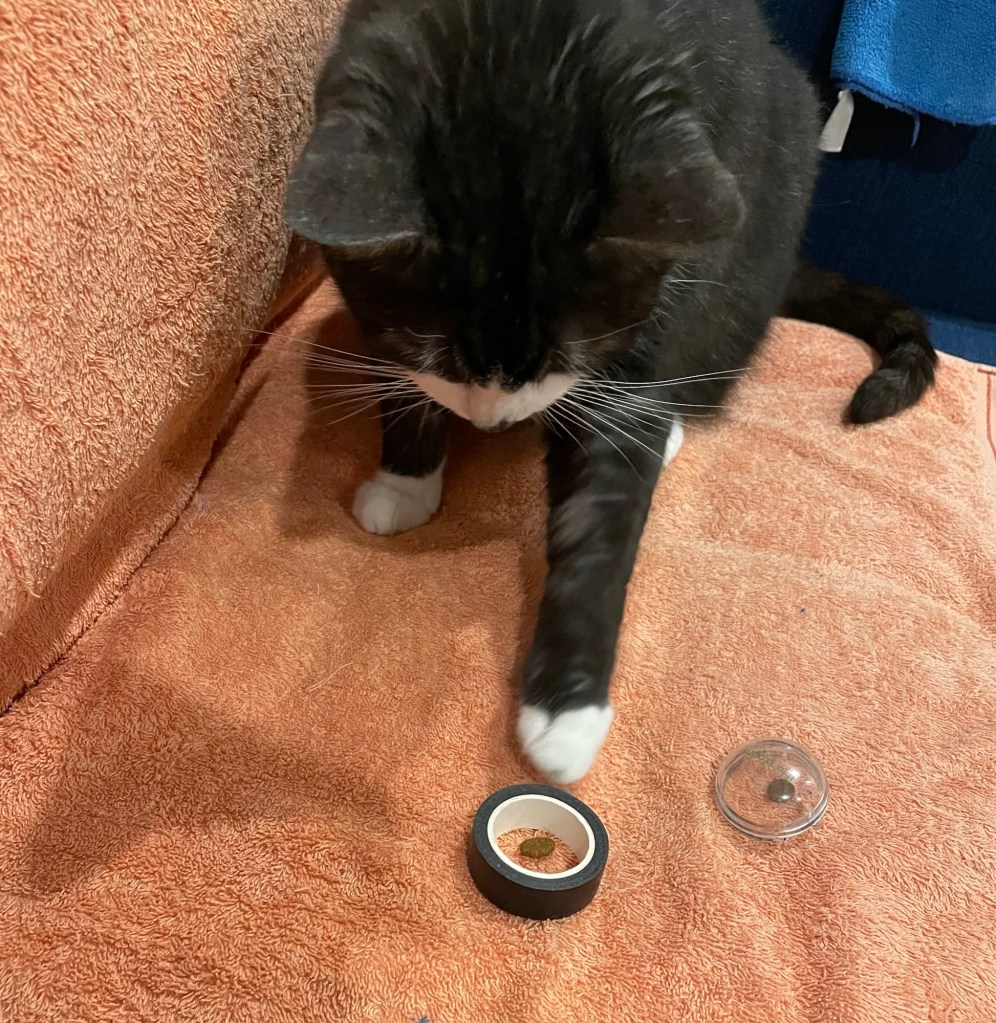
Did I tell you I’ve been learning under? As in a kibble under a piece of paper. Too easy. Then a kibble under a little plastic dome. Not so easy.

Now it’s all about a kibble in a thing too small to get my nose into. Or my tongue.

See the kibble in that thing? It’s harder than it looks. Harder than the kibble under the little dome. That one you just shove along with your nose and eventually the kibble gets left behind and you can eat it.

The black thing took me ages to work out coz it isn’t slippery. It just sat there when I pushed it with my nose.

Did it!

Sedges

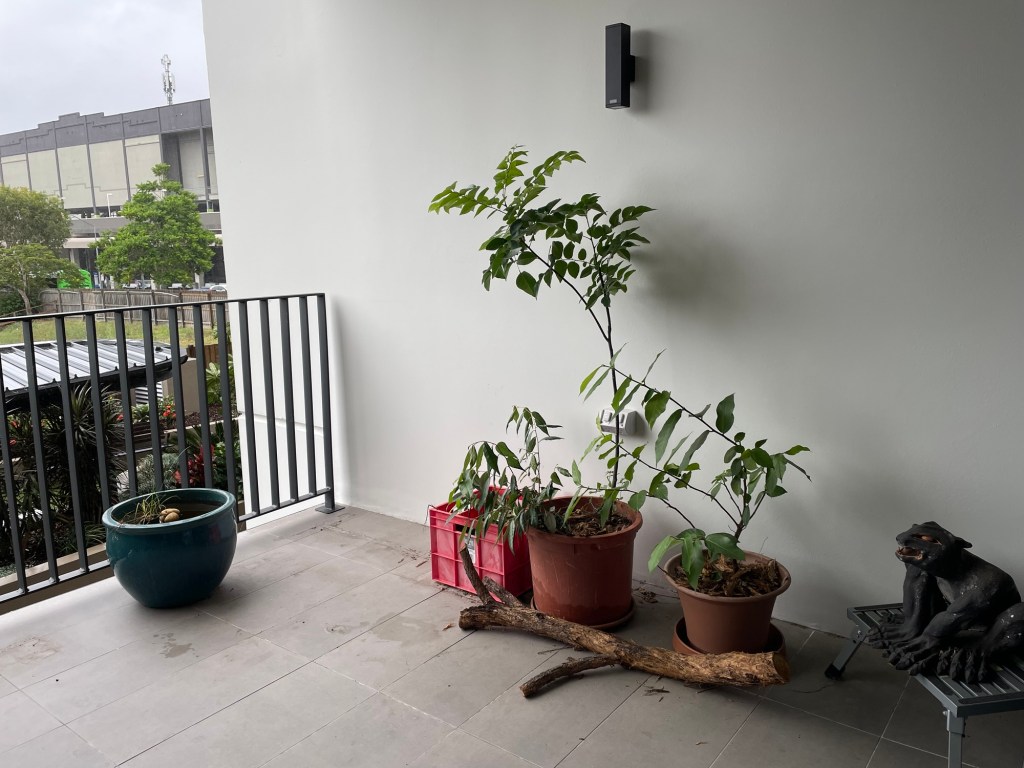
Out of sheer frustration trying to keep my fish pond/pot going, I intro’ed a couple of baby sedges after most of the so-called water plants died, and even the duckweed gave up.

Sedges will grow half in water, and in my past life, when I had a frog pond going for years, swamp plants were a strong feature. These often have their roots and soil substrate in the water, and their leaves above. s

I suspect they somehow condition the water, enabling other plants to grow. I certainly never had any problem keeping either Azolla water fern or duck weed alive and used to raise dozens of tadpoles to frog-dom.

If I knew anyone with karamat I’d go and beg a cutting but haven’t seen it since leaving the Byron Shire. Both these sedges are usually quite weedy though the little one at the back as far as I know is native to Australia.

‘Weeded’ them both from the local verges while out walking. One of them from the creek overflow. About ten days in their new position they don’t look like they’re dying.

The pebbles are to provide an island for bees and other insects to drink. (Though I need to top up the water.) And if I pour the water onto the pebbles there is hardly any disturbance in the water.

There’s one lone Pacific Blue Eye remaining of the seven fish I got for my birthday 10 months ago.

Algorithm Researches

Yesterday I ‘interacted’ with two sites by Liking them, sites that are apparently being used by Zberg’s AI bots to learn their trade on. So I get this in my Messages this morning … this is a screenshot, there are ‘six’ pages of it …

I didn’t ask for it and I resent the bot using my interaction, electricity, internet plan, adding to my carbon footprint unasked. those are my feelings about the matter. It’s good to have informed opinions, though.

These are the facts

As well as the full instructions on how to solve a Rubrik cube, of about six pages, there were a further four pages with an explanation of an astronomical event I’d taken an interest in. Talk about information overload!

This is an example of a summary composed after ‘scraping’ knowledge requisite to the topic from around the internet. It’s not even the first time that we’ve been training bots. Remember teaching GoogleSpelling?

You have to accept this is a far more accurate process than the primitive efforts of the spelling bot.

But it is not yet a sentient bot. Doing a light edit, I discovered a lot of unnecessary repetitions, unseen by the bot. Lama 3.2 cannot think for itself.

Below the copy-and-paste about my comet inquiry. Interestingly, I googled my inquiry and this reply came by way of one of Zberg’s platforms.

Comet C/2024 G3 (ATLAS) has been visible in the Southern Hemisphere’s evening sky since early 2025, and its visibility has improved as it moves farther from the Sun. Although it’s currently dimmer than it was at perihelion on January 13, 2025, it’s still a great target for binoculars or cameras ¹.

Here are some key visibility dates for Comet C/2024 G3 (ATLAS) and other comets in 2025:

  • Comet C/2024 G3 (ATLAS): Visible in the Southern Hemisphere’s evening sky since early 2025, with improved visibility as it moves farther from the Sun. Its brightness peaked at magnitude -3.4 on January 13, 2025 ¹.
  • 210P/Christensen: Expected to be visible via large binoculars in November 2025, with its closest approach to Earth on November 8, 2025 ².
  • 24P/Schaussman: Will reach its brightest point in early 2026, with its closest approach to Earth on January 4, 2026. It may be visible with large binoculars ².
  • C/2024 E1 (Wierzchos): May become visible through small telescopes or large binoculars in the autumn of 2025, with its closest approach to Earth on February 17, 2026 ².

Then there are the facts of what it all costs … more research needed.

Storm Watching

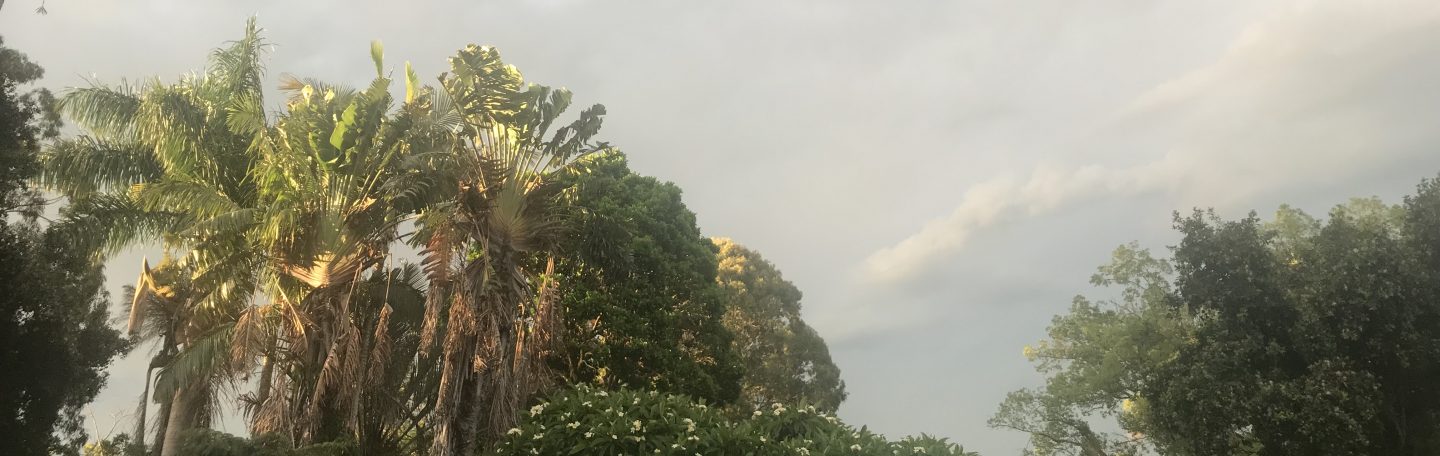
Looking south and up there’s an amazing storm happening … a stupendous display of lightning with the sun setting to my right.

No thunder!

These clouds …

Are so paintable.

Moggy has been sitting under the bed for hours already today, away from any windows.

Just now there’s a flurry of rain and a bit of rain. I assume due to the action happening so high above us. Which makes us lucky, there have been many extreme storm events around us lately.

Umbrellas … the physical objects

[I see I’ve been resting on my laurels a bit, with my last post five days ago.]

I first became interested in umbrellas when as a ten or eleven-year-old when as a special treat I was allowed to use the family’s Indonesian bamboo and oil-paper umbrella, called a ‘pajong’ to walk to a friend’s house through the rain.

We lived in Sumatra at the time (1958), in a small village called Indarung. [I looked it up on Google Earth and it still exists, but now as an outer suburb of Padang. In the 1950s it was a clearing in the forest.] And tropical downpours were a daily feature in the wet season.

The most fascinating part about the pajong was the way the spokes were joined to the center and the ribs.

The above Japanese umbrella is way more complex than a simple ‘pajong’ made in a Sumatran village. Our umbrella had a greenish interior bamboo frame, oiled paper canopy, with a gold painted trim and point, with none of the extra basket-weaving in the above example. I remember the smell above all, of the oil applied to the paper to make it waterproof.

Both my present umbrellas have seen better days. The sun umbrella that I’m not calling a parasol as it isn’t dainty enough, has been all but unusable for years already, with one of the spokes bent and another broken. I’m hanging on to it as I aim to repair it.

My fold-up rain umbrella was blown inside-out last summer and was a mess of bent spokes and torn-away fabric. Most people throw such wrecks straight into the bin but I can’t bear it. Fold-up umbrellas are amazing technological marvels. If you have one, have a good look, it’s fascinating.

This is mine, photo by me. It’s a fairly ordinary design, I could’ve maybe gone for something a bit snazzier but this one was the only pattern on hand when I needed shelter. The threads hanging down are me having a go at fixing it. So far, I’ve reconnected all the innermost hinges to the fabric. When I’ve done all the hinges I’ll dot the repaired places with glue, maybe super glue. Then cut off the excess thread.

The long threads make it very easier to knot the threads after passing them twice through the holes in the spokes and twice through the fabric, then once around the sub-spoke. I’ve bypassed the really finicky job of sewing the spokes to the inner seam and instead have sewn the spoke to the fabric by drawing the thread to the outside and back in again. Similar to sewing on a button.

This all made me wonder how much assembly there had to have been by nimble young fingers? While I can see the frame being produced by machines, sewing the canopy to the frame … a machine? Not a chance.

Another form of intricate but boring labor by the modern enslaved workforce … I imagine each person in an assembly line having to sew an unending line of spokes to canopies … have you ever seen/been in an umbrella factory?