Sedges

Out of sheer frustration trying to keep my fish pond/pot going, I intro’ed a couple of baby sedges after most of the so-called water plants died, and even the duckweed gave up.

Sedges will grow half in water, and in my past life, when I had a frog pond going for years, swamp plants were a strong feature. These often have their roots and soil substrate in the water, and their leaves above. s

I suspect they somehow condition the water, enabling other plants to grow. I certainly never had any problem keeping either Azolla water fern or duck weed alive and used to raise dozens of tadpoles to frog-dom.

If I knew anyone with karamat I’d go and beg a cutting but haven’t seen it since leaving the Byron Shire. Both these sedges are usually quite weedy though the little one at the back as far as I know is native to Australia.

‘Weeded’ them both from the local verges while out walking. One of them from the creek overflow. About ten days in their new position they don’t look like they’re dying.

The pebbles are to provide an island for bees and other insects to drink. (Though I need to top up the water.) And if I pour the water onto the pebbles there is hardly any disturbance in the water.

There’s one lone Pacific Blue Eye remaining of the seven fish I got for my birthday 10 months ago.

Caterpillars

Six of these little critters are chomping down on my bolwarra bush. Not their usual food as far as I can make out.

Reading Helen Scwenke’s & Frank Jordan’s Create More Butterflies tells me that an Orchard Swallowtail will lay her eggs on any tree or bush in the citrus family.

Yet I thought I saw a large blackish butterfly in this bush. The caterpillars somewhat resemble the instars on p33 and there is a very small sandfly bush beside the bolwarra.

The caterpillars as you can see have a much closer resemblance to those of the Fuscous Swallowtail on p20. There’s only the lime berry mentioned for host plants for thst variety of swallowtail.

Here’s one doing its weird standing-up-in-the-sun move. Never seen that before.

The whole event is pretty exciting and was one of the reasons—the possibility that butterflies would visit my balcony garden—that I decided on a level two apartment rather than, say, a level seven place.

To top it all off, me getting an in house companion in the form of a cat is what made it possible for butterflies to visit. Before I got Moggy noisy miners, a pernicious sort of bird visited the balcony despite my efforts to keep them away, and clean out all insects good and bad. They even had a go at catching my fish. Moggy keeps them away and the caterpillars are safe.

New Growth

I’m just boasting here … not that I did any of the growing myself. These plants don’t seem to mind standing around on a south facing balcony …

Australian native fig (proper name later)

This is a rainforest species and starts in the undergrowth, so the conditions probably right up its alley.

Bolly gum … it’s reaching for the outdoor light I’ve been leaving on for the fishpond. It’s grown over 30 cm in 6 months. A sprig of its new growth.

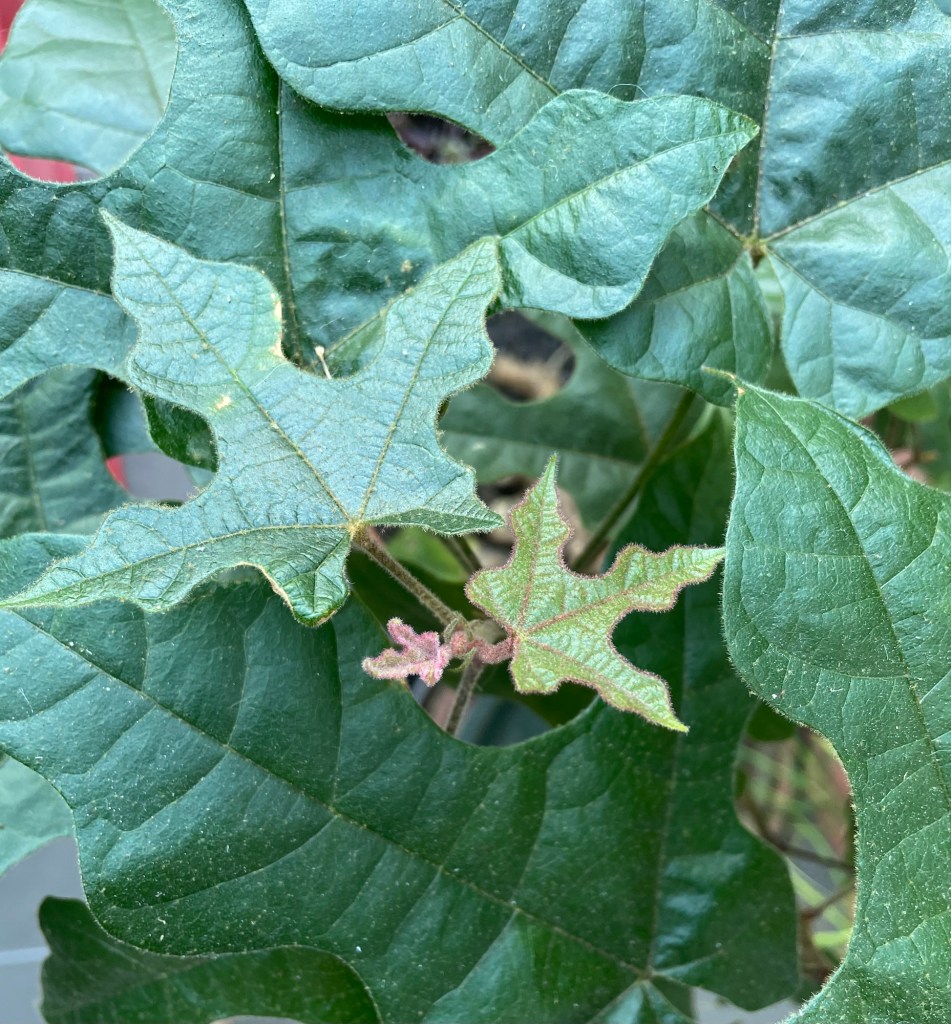
This velvety kurrajong is also putting out new growth. I think I finally found the place it likes.

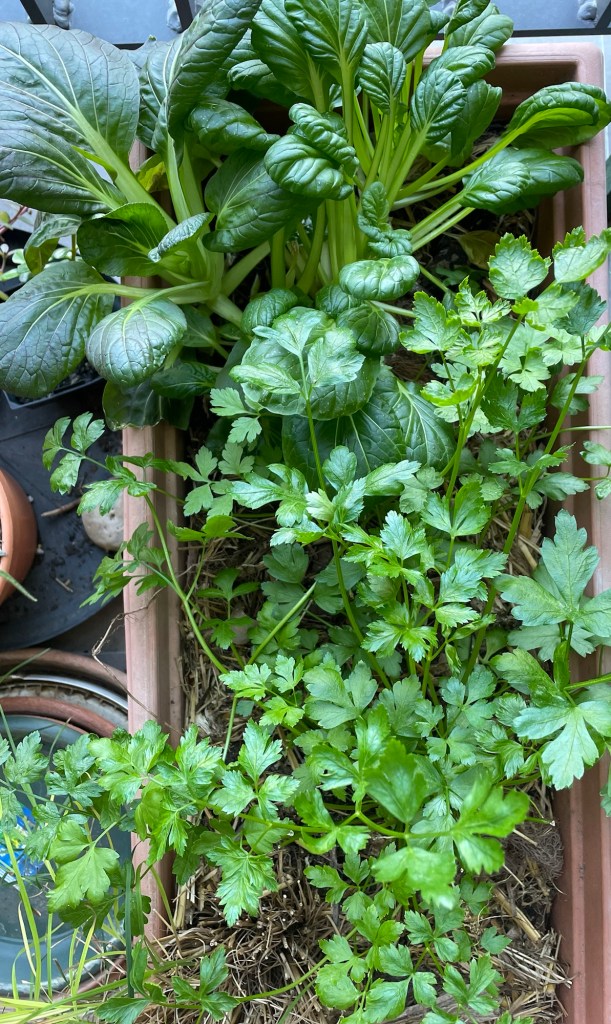
Isn’t that a lush and verdant growth of parsley and Chinese cabbage? I suspect that their success is more to do more with growing in thinly covered composting vegetables.

Most of the rest of the plants are struggling in various different ways. But never mind, I heard from my neighbours that we do get sun for a few weeks! Maybe then there will be various growth spurts. We’ll see.

Duckweed …

As you can see when you zoom in, most of the duckweed is white and dead.

I’ve been keeping fish and frog ponds for about fifteen years and I’ve never had such a wholesale dieback that even the duckweed carked it.

The feathery green plant seems okay so far. Fingers crossed that they make it. And, I hope that both the Azolla waterfern and the duckweed have left spores and seeds behind, that hopefully will sprout when we leave winter behind.

While you are zoomed in you may be able to spot the two remaing fish. Though they look like leprosy warmed up in the photo, in their analogue state they‘re stockier than they were, but at least still alive.

I moved their habitat back under the outdoor light, in the hope that that gives the plants enough light to survive until I get my grow lights. An added bonus is that I can sometimes see the fish flitting about from inside my living room.

A Clue

I was glad to see this tiny patch of native moss among the giant south American exotics. Even better the clue to another species of birds to discover …

A scribbled sculptural form …

One a a pair of twins …

Its mate. They guard a pebbled through-way

In Brazil, or wherever they originate, there would’ve been a froglet living in the little pool in the heart of the floret. More on them after I re-read Wings by Terry Pratchett (1990).