Colours/colors …

What do you see?

I see a warm red and a warm green watercolour reaching out for a 50/50 agreement.

I might be wrong though. The red is warm, I have no doubts on that score. But the green?

Apparently if a green leans to its yellow side on the colour wheel it’s classified as warm. And cool if it leans to the blue side.

Light yellowish green has always seemed greener to me, and so cooler. Blueish green on the other hand, felt richer and lush, and so warmer.

I’m about to do that exercise again using Alazarin Crimson, which leans towards its blue neighbour so is classified as cool, and Hooker’s Green wich also leans to the blue side.

And after that, a second trial with the so-called warm versions of red and green. I assume I’ll need to use a scarlet and green made with a warm blue and a warm yellow.

I expect neither of these exercises to resemble the above but we’ll see what we’ll see.

Sedges

Out of sheer frustration trying to keep my fish pond/pot going, I intro’ed a couple of baby sedges after most of the so-called water plants died, and even the duckweed gave up.

Sedges will grow half in water, and in my past life, when I had a frog pond going for years, swamp plants were a strong feature. These often have their roots and soil substrate in the water, and their leaves above. s

I suspect they somehow condition the water, enabling other plants to grow. I certainly never had any problem keeping either Azolla water fern or duck weed alive and used to raise dozens of tadpoles to frog-dom.

If I knew anyone with karamat I’d go and beg a cutting but haven’t seen it since leaving the Byron Shire. Both these sedges are usually quite weedy though the little one at the back as far as I know is native to Australia.

‘Weeded’ them both from the local verges while out walking. One of them from the creek overflow. About ten days in their new position they don’t look like they’re dying.

The pebbles are to provide an island for bees and other insects to drink. (Though I need to top up the water.) And if I pour the water onto the pebbles there is hardly any disturbance in the water.

There’s one lone Pacific Blue Eye remaining of the seven fish I got for my birthday 10 months ago.

The Gisnep Puzzle

Welcome to Gisnep

Unfolds like origami in reverse

— — — —

Ironic Sans continues to shine. Every time I solve the daily Gisnep puzzle, I learn of another interesting person by way of a link to Wikipedia, this time the brother of the man who invented the concept–and word–of ROBOT, more than a hundred years ago now. Though the brother himself is the subject …. Lol, just trying not to drop too many clues.

The Gesso Project …

Finally able to do a bit more work on my big painting project. Out on the balcony it’s been either too hot 36 degree Celsius, or too wet, or both.

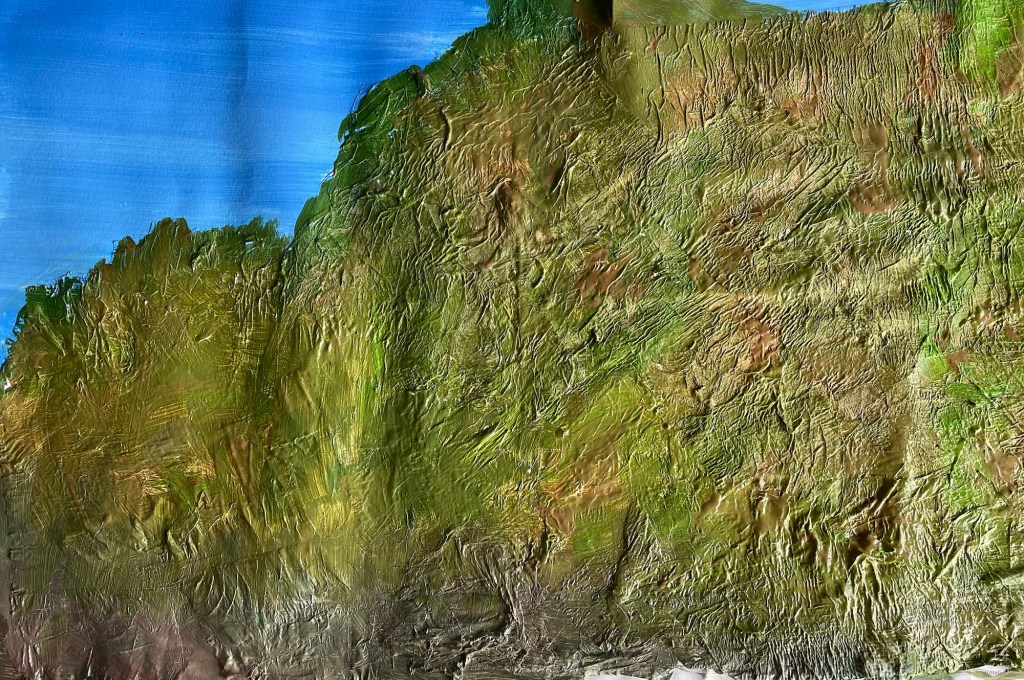
Today an early thunderstorm and short period of rain cleared the air. Painted the sky, a plain blue. Half of the mountainous mid-ground, a variegated green and brown.

As it’s drying, I notice hundreds of places where the paint hasn’t touched, or the paint is shrinking back. It will need a third coat.

It’s meant to be a backdrop for my brick stories.

Next time …

Gesso’ing …

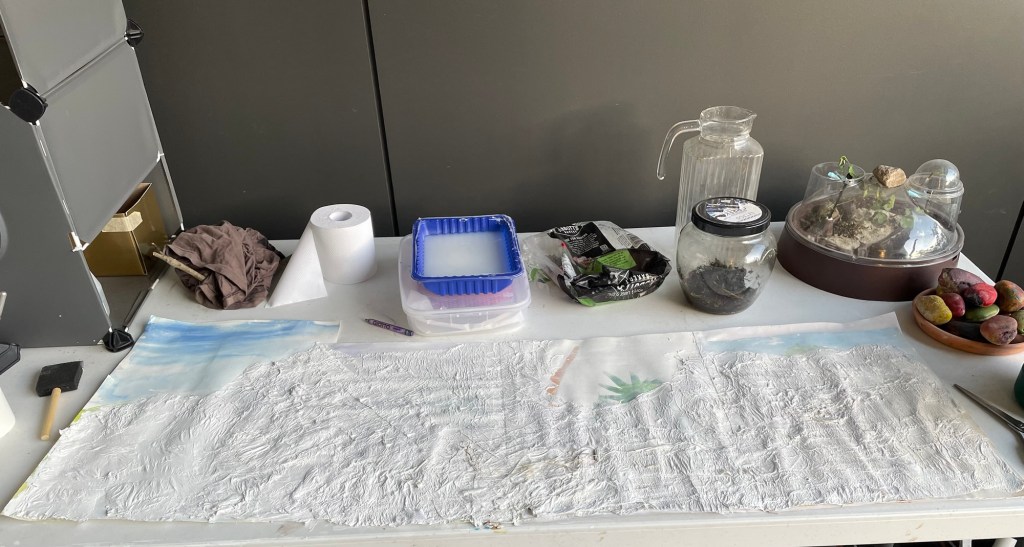
Starting a large new project with a four x A3 length of gesso and tissue paper …

In other words, laying down a landscape and at the same time attempting to camouflage the joins.

The whole thing sodden with a mix of water and gesso. And that is a jar of medium strength watered-down gesso still possible to use as paint. s

A econd jar with a jellified gesso that had to be scooped out and softened to a paintable sloppiness … glad I got to it when I did as next week or month it mightve been to dry/hard to use.

As usual, I’m re-using remnants of an old project. I’m sorry to discover that the joins are very obvious in a photo.

The hope for this first stage is that the paper backing dries flat and I get rid of the big vertical … what would you call them? Not creases. Give me a hint? I can only think of a couple of Dutch words. ‘Rimpels’ and ‘golven’ spring to mind.

One of the things about old age is that ‘mother tongues’ IE the language a person grew up with, tend to come back. And I’m definitely noticing that. If I can’t think of an appropriate word in English, I’ll come up with a Dutch one.

Knitting

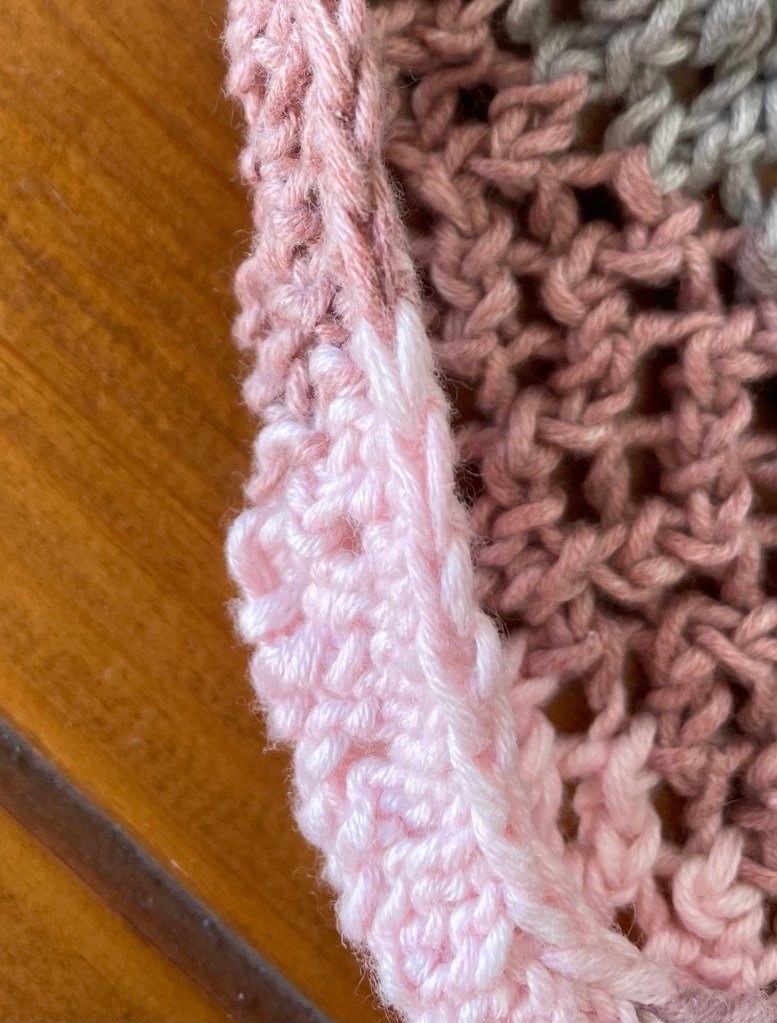
Since the tiger-knit is done, I’ve begun a project that I’ve had in mind for a few months and has already had a few trial runs. I’m amazed how well the yarn has stood up to being ‘frogged’ (knitting term that means to pull undone) four times up to now.

And even this time I was doubtful at first whether I’d keep this version as that bottom corner just will not unroll. I’ve tried a few things already, including pulling the first three rows apart. This merely caused the rolling effect to rise.

But I discovered it is probably an effect of the work being on the needles–which causes a certain tension along the sides–and which disappears when, for example, I knit half a line and the work hangs differently.

And let me tell you that the above are not the true colors! Though even the true colors, being what we used to call Vogue shades, are not my favorites. The yarn was on special, probably because no one likes them. I’m planning on throwing a bit of quinaquadrone gold at the finished work which usually fixes sickly hues such as these.

Third, as I hope you’ll have noticed by now, is the lack of a regular pattern. I wanted to see if I could knit a lacy organic-looking ‘shawlette’ to support an bunch of vines that I will crochet and/or embroider on it after the knitting.

A shawlette is a medium-sized shawl, I’m assuming. I learned the term from JS. The deepest part will about 40 cms or 17 inches. The length … not sure yet … whatever it ends up being when I’ve reached the required depth.

On the right side of the work, I’m increasing at the beginning of every line, then knitting eyelets either by (1) yarn over, slip one knit one and psso … which gives me a left-leaning stitch, and (2) yarn over and knit two together OR knit two together and yarn over … which give me right-leaning stitches. the main thing to remember is to do a yarn-over either before or after a pair of stitches knitted together. NOTE to self do not follow a yarn over directly after a yarn over.

The wrong side of the work is always purled.

By making these tiny decisions on each ‘knit’ line (on the right side of the work) for each wriggling vine wending its way up the knit, I’ll be able to pick out the strongest longest foundation vines to embellish. The rest will help build a foresty texture when I have fixed the colors.

That’s the plan, anyway.