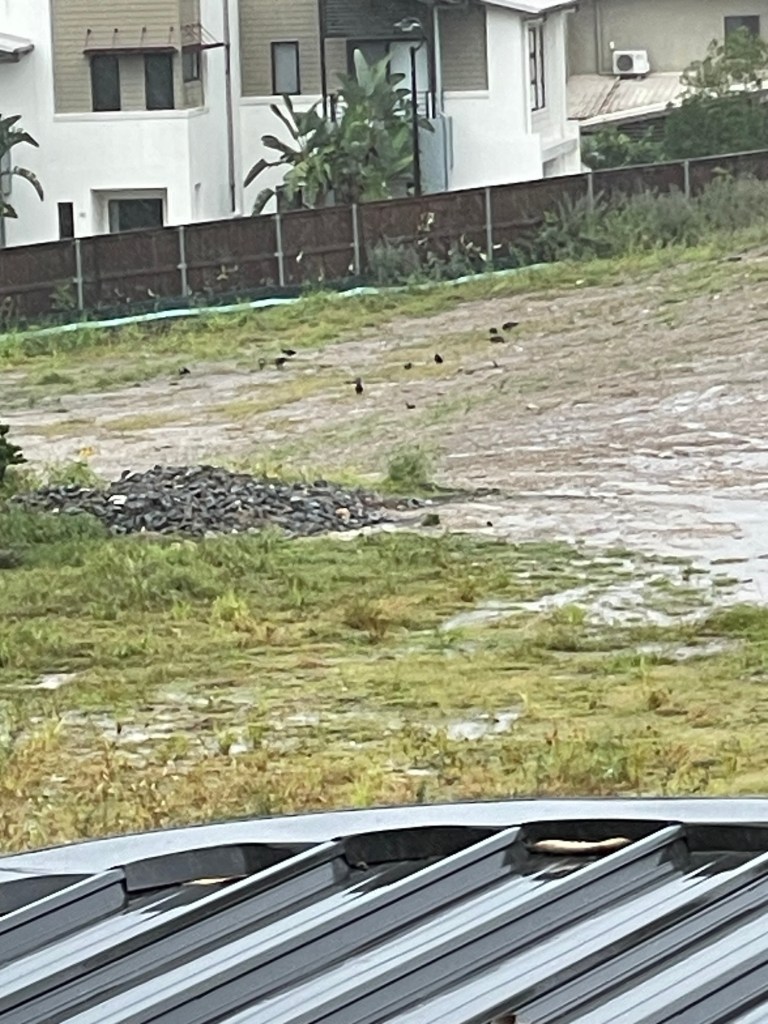
A mob of ibis, native to Australia and now more commonly known as ‘bin chickens’ hard at work on the little grassed area between the new access road and the still existing but now little used path. Little used because all it leads to is the paddock.
The little grass where the ibis are feeding is the lowest place at the base of a long slope. Water flows here both through the soil and over the grass, and from the diligent work of the birds, I gather that plenty of worms also live here.
I heard—haven’t fact-checked it yet—that ibis beaks are going through a speedy evolution turning from turned under tips to scoop food from mud, to straight tips that can pick up food from hard surfaces.
The whole time the emergency was raging outside, nobody did much. I’ve compared times with a few other people on this seems no one had any energy to do much else other than concentrate on the storm raging around us.
Six days ago I took this shot at night, storm clouds gathering
While the whole system moved sluggishly toward the coast it was like I was stultified, couldn’t concentrate on anything other thsn reading eternal weather reports. I did not knit, paint, write, read. Couldn’t settle to anything.
Watched the birds out on the so-called paddock. Crows, pigeons, lots of ducks, magpies, a stone curlew, ibis, plovers, and a couple of white cockatoos.
Pigeons work through the weeds in the foreground in the morning hours. A lot of birds sat companionably in the lee of that pile of rocks.
I watched a tree being pounded to the ground. This kurrajong held out until the second last day, in the constant and blustery east wind. It didn’t stand a chance, growing on the podium in what amounts to a planter, it’s roots wouldn’t have been deep enough for it to take the brunt of the wind.
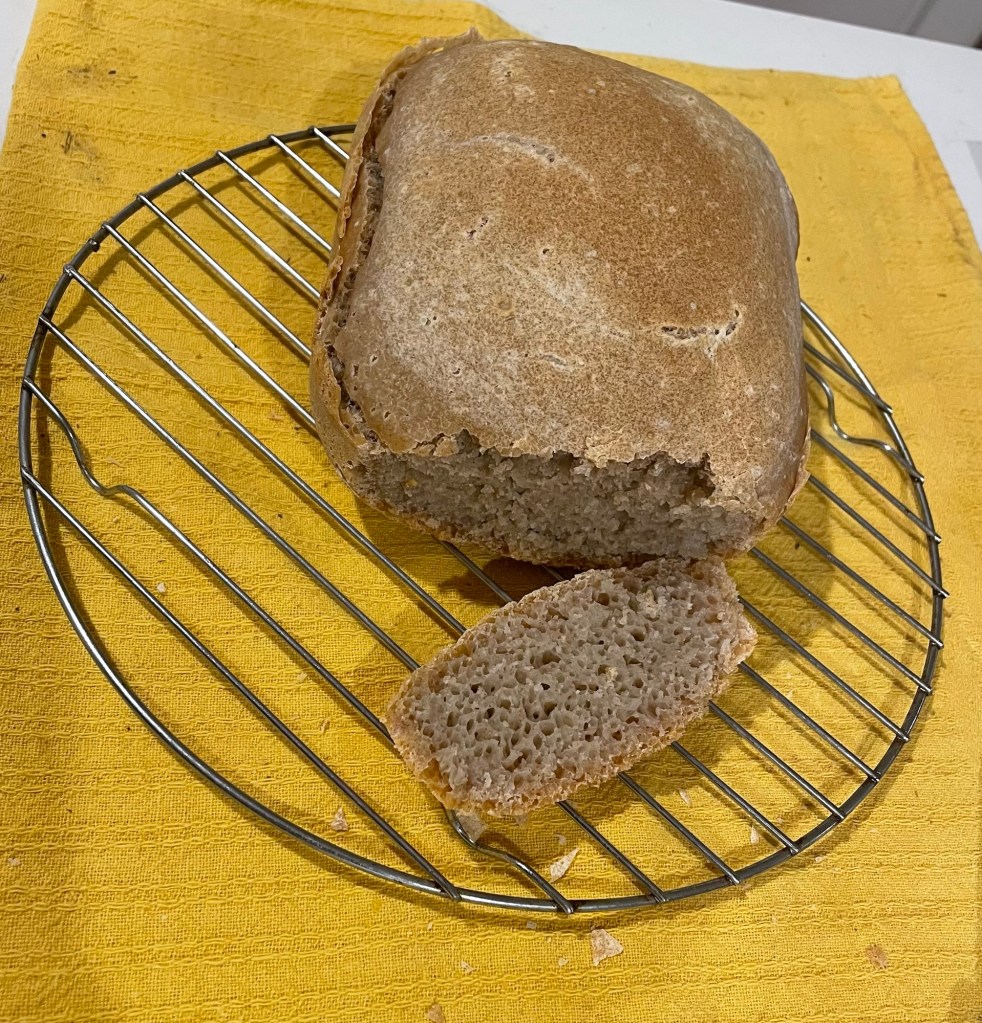
And I baked bread, having just got a bread machine. The retirement village where I live has a back-up generator which meant we had a power interruption for all of about three seconds until the generator kicked in. Very lucky.
My second loaf. The inside looks somewhat grey, though the bread is very tasty.
I remember a few years back when there was a small concern about the effect of drones on birds. That thinking seems to have gone away like it never existed. It seems like it’s full steam ahead everywhere with drones, no concern about the natural world at all.
Can you believe it? There’s even bird-watching with drones, as well as tree-planting! As a tree-planter with Landcare for twenty years, I have my doubts that a drone can successfully stick a plant or seed in the ground, cover it (its roots) with soil, water it in and come back regularly to check on it. As for birdwatching, by drone, I have yet to be convinced.
While I haven’t seen any deliveries by drones first-hand, and really have no desire for such, I hear that it is a real thrill to get a parcel delivered by a little robotic airplane.
I hear drones quite often, in parks generally, where people are practicing their new skills flying them. I saw a Youtube video just now of a person explaining all the ways he has to protect his drone from bird attack. His drone, he explained, is his livelihood. Which gives him a right to protect it from birds.
I suppose if termites took over the earth, they’d be just as uncaring of the rest of the natural world as humans are.
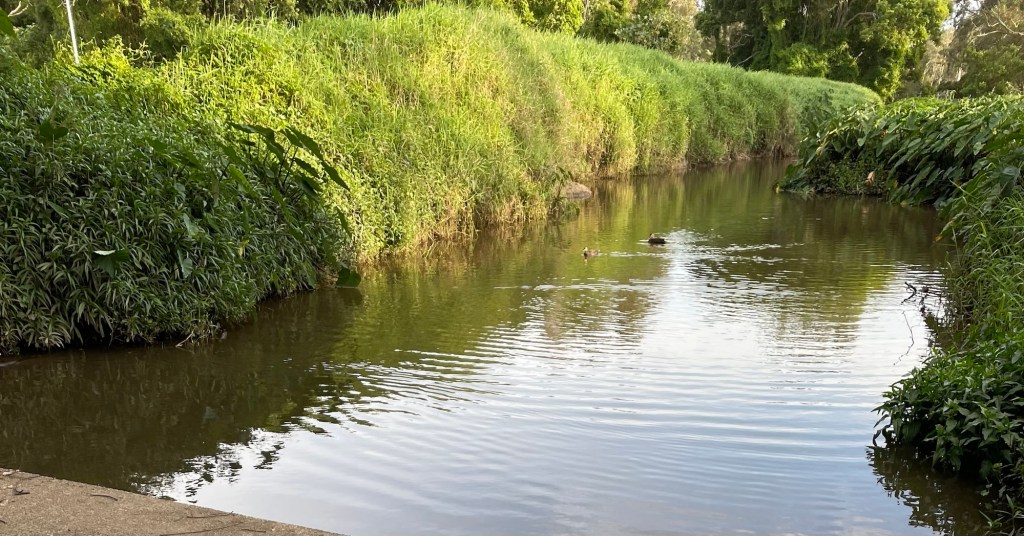
I was amazed to see one of these yesterday along Bulimba Creek, getting into the ripe native figs everywhere. Only seen them once before, in my previous stamping grounds.
Picture naturally not sharp, bird was too far away and the photo completely unplanned.
After I took ten photos, scoring an image just twice, the noisy miners took note of me and chased the big bad bird away.
Noisy miners are so aggressive—a channel billed cuckoo doesn’t impinge on them at all —it eats figs too large for them to tackle and lays its eggs in magpie, crow and currawong nests. But still the miners need to chase it away, it’s like they own this stretch of the creek.
A slightly better shot, the bird’s bright red eye put me wise to its identity.
These birds have the loudest most amazing trumpeting calls though this one just said kwark kwark kwark.
They migrate to North and Eastern Australia from New Guinea and Indonesia in spring and stay till autumn/fall.
Urban trees seem to be so confused that a lot of figs are bearing good crops of fruit.
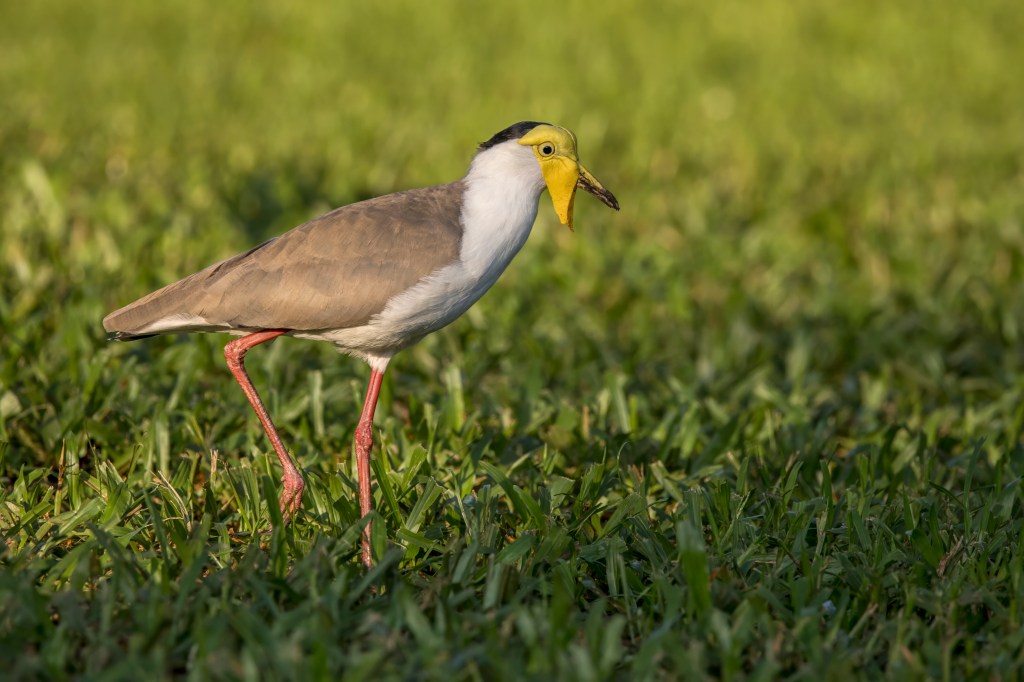
These last few day, whenever I walk into the bedroom for something, I stop and stare out through the windows at a little place on the grass beyond the podium at the plovers nesting there. Pronounced as ‘pluvvers’ according to a long-time Brisbanite.
My camera really does not do it justice so here’s where your imagination must come into play. [If you want to have a go at zooming in? The bird is sitting a little below the third panel of fencing from the right. All you will see is a little brown blob.]
In the last few days, I’ve only seen a couple of intrepid people take the concrete path from the podium across the grass to the old village. One of the dog-walkers had an angry, swooping bird follow them from one end of the path to the other. And, these birds are said to have a poisonous spur on their “wrists” … they have the spurs but they’re not poisonous.
“Breeding usually happens after the winter solstice (June 21), but sometimes before.” Quote from the Wikipedia article. Spot on. The birds began sitting seriously about four days ago. It’ll be interesting to see how long they take to hatch the eggs, as there is no info on that in my bird book or in the Wikipedia article. Today I was lucky enough to see the change over of parents a few minutes after dusk.
The chicks will be dependent on the parents for protection for about 5 months. I can’t see there being enough food (insects and worms) in that grassy area for that long, but if it does happen to suffice, I hope we residents can stay patient enough to see the chicks to maturity.
Talk about counting your chickens before they hatch! The Wildlife of Greater Brisbane tells me suburban birds rarely manage to hatch their eggs. Dogs, cats, foxes, humans … all of them disrupting and chasing and some of them predating. That’s being glum, of course. I did read that the Brisbane Snake Catchers as well as catching and relocating snakes, relocate plover nests. That has got to be a huge operation. Two large angry birds defending four eggs on a flattened bit of grass?
Just checked them and nope, they don’t. But they do give contact details to licensed plover catchers and a link to a neat “404 page IE a page not found”. [This latter will go into my collection of 404’s.]








 Rita de Heer