Felting … Felt … Feeling

This glorious riot of autumn colours is a piece of felt that I made in a wet-felting workshop about 21 years ago and then began to embellish by embroidering with Exotic Lights silk embroidery yarn hand-dyed by Robyn Alexander for her Colourstream label.

Back then I worked part-time in the original Colourstream studio, packaging up orders of hand-dyed silk embroidery yarns and ribbons amongst other things. I look back with nostalgia on that time, the only paying job I was able to hold onto for a few years while struggling with ongoing ME/CFS.

I thank you always, Robyn, when I use the silks and handle the things I have made using them. I still love the embroidery silks, and use them exclusively when I sew where stitches will show.

Unfortunately, though, fine needlework has gone by the way a bit in the last five years due to neuropathy. Especially frustrating when I look at photos of various elderly relatives still doing fine embroidery into their eighties.

But you read that right. Twenty one years, plus or minus. I tend to keep textiles I’m emotionally attached to, however unfinished and or decrepit they may be. Where the feeling in the title comes in.

This piece of felt is in no way decrepit and though it’s been packed away for years, looks as good as new. At the time, I sewed it onto a canvas backing thinking to make a fancy cushion cover. That obviously didn’t happen. It would’ve been a waste as any cushion in my house puts in the hard yards.

But you know, a 40×40 cm almost-square like this isn’t much use other than as a cushion cover. Every few years I get it out, I have it hanging around for a while, and even maybe think up a new possible idea for doing something with it. At one stage I planned to make it into a wallet-type bag. I don’t know what happened. I must’ve got frustrated with the idea and packed the piece away again.

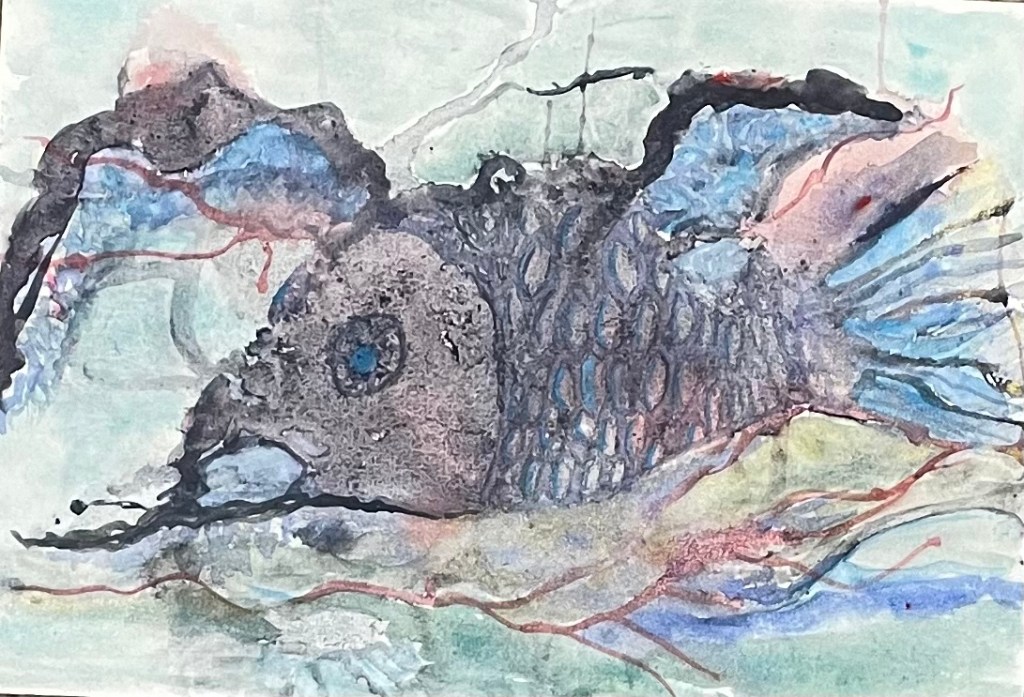
‘Spatter and Spray’

… is a way of painting with watercolors, I’ve discovered. And I’m in the throes of experimenting using the technique.

First came across it on Susan Cornelis’s blog. https://susancornelis.wordpress.com/wp-content/uploads/2025/03/googleeye.jpg

So I’ve fallen in love with granulating paints. My first effort was Miss Tabitha…

Ordered a couple more tubes of granulating paint and washed out a fine spray bottle originally used for a deodorant.

Second, this fish. I call it a bottom feeder, but may rename it … I’m having so much trouble getting this from my mobile … might have to do magic. Like, abracadabra … OK I’ve got it. Ended up saving it to the desktop … isn’t she beautiful? A spatter and spray painting barely touched up. Well, OK, I painted the scales. The rest is dabbed. Not yet sealed.

This is the top half of my third effort. I’ll tentatively call it The Aviatrix. The bottom half of this painting is still a problem. one thing is for sure, I’m learning a lot about gouache.

It’s hard to believe what you can get from spattering paint onto the paper then spraying it with water. But that’s only the first layer. You let it dry, then the next day, if the pattern you have doesn’t yet suggest anything to you, you do it again. Like I did with this one. The third day, this aviatrix lay there waiting for me. I painted some of the areas to increase that likeness and here she is.

The bottom half of her face needed work of a different sort. After my efforts first with gesso, then with gouache that’s still in the thought-pan, and another post.

As well as the spatter and spray technique, I’m experimenting with sealing my watercolor paintings with an acrylic varnish. I hate the look of paintings behind glass or the whole process of framing. Miss Tabitha has been varnished and the look is good.

And plus, I don’t have enough wall space to hang everything I paint. Nor will I foist amateurish experiments on my nearest and dearest. So, most must be stored. Varnishing them seems like a good option.

The varnish I’m using is water-based so easy to cut. A mixture of 25% acrylic varnish in 75% water seems to be working pretty well. Ideally this should be sprayed on but since I’m still only experimenting, I’m laying the varnish on the painting with a watercolor mop brush. A time-consuming procedure but the only one I can afford at the moment.

Knitting

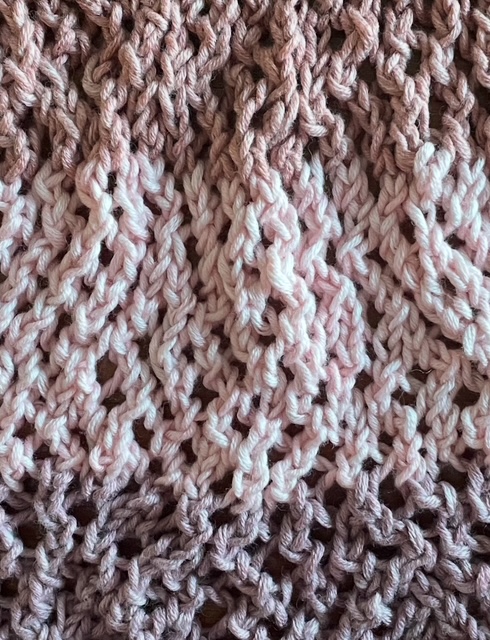
Since the tiger-knit is done, I’ve begun a project that I’ve had in mind for a few months and has already had a few trial runs. I’m amazed how well the yarn has stood up to being ‘frogged’ (knitting term that means to pull undone) four times up to now.

And even this time I was doubtful at first whether I’d keep this version as that bottom corner just will not unroll. I’ve tried a few things already, including pulling the first three rows apart. This merely caused the rolling effect to rise.

But I discovered it is probably an effect of the work being on the needles–which causes a certain tension along the sides–and which disappears when, for example, I knit half a line and the work hangs differently.

And let me tell you that the above are not the true colors! Though even the true colors, being what we used to call Vogue shades, are not my favorites. The yarn was on special, probably because no one likes them. I’m planning on throwing a bit of quinaquadrone gold at the finished work which usually fixes sickly hues such as these.

Third, as I hope you’ll have noticed by now, is the lack of a regular pattern. I wanted to see if I could knit a lacy organic-looking ‘shawlette’ to support an bunch of vines that I will crochet and/or embroider on it after the knitting.

A shawlette is a medium-sized shawl, I’m assuming. I learned the term from JS. The deepest part will about 40 cms or 17 inches. The length … not sure yet … whatever it ends up being when I’ve reached the required depth.

On the right side of the work, I’m increasing at the beginning of every line, then knitting eyelets either by (1) yarn over, slip one knit one and psso … which gives me a left-leaning stitch, and (2) yarn over and knit two together OR knit two together and yarn over … which give me right-leaning stitches. the main thing to remember is to do a yarn-over either before or after a pair of stitches knitted together. NOTE to self do not follow a yarn over directly after a yarn over.

The wrong side of the work is always purled.

By making these tiny decisions on each ‘knit’ line (on the right side of the work) for each wriggling vine wending its way up the knit, I’ll be able to pick out the strongest longest foundation vines to embellish. The rest will help build a foresty texture when I have fixed the colors.

That’s the plan, anyway.