
Been home since yesterday and today assessing what I’ve been reading since last time I talked about books.
And that seems weeks ago. A lot has happened.
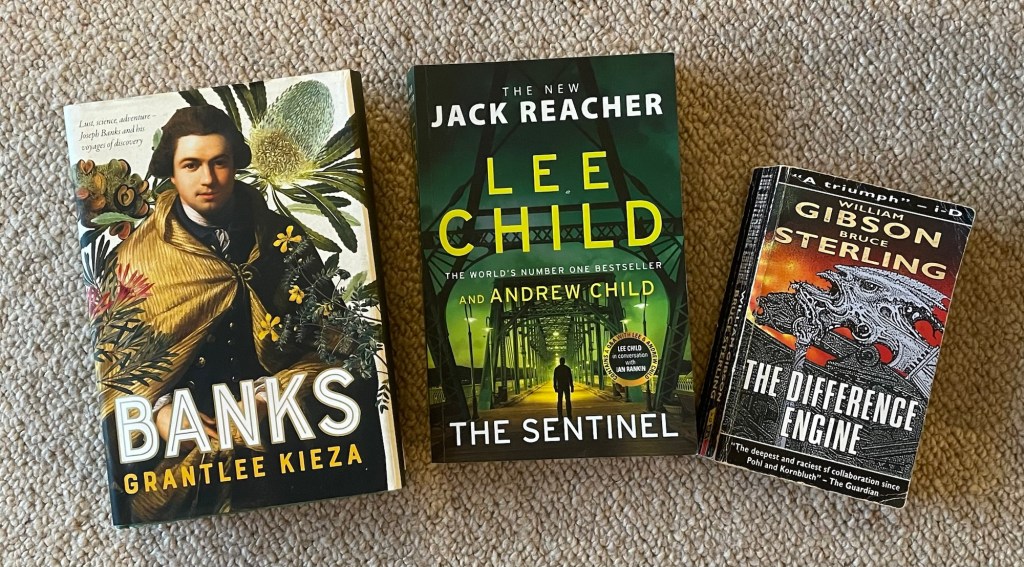
Book 15, Banks by Grantlee Kieza , published in 2020 by ABC Wave and HarperCollinsPublishers.
Though I’ve always been interested in Sir Joseph Banks and his plant discoveries in Australia, I had never read a biograpghy.
So was pleased to see this among the biographies in the Vista foyer. Started reading that night, full of vim and vigour.
My my! Did I get bogged down? I’ve seldom read a boggier book, such a disappointment. Kieza’s style is turgid, the first fifty pages are an unbroken list of namedroppings with numbers for endnotes. By page 50, there are 76 endnotes.
Normally, if a book doesn’t grab me by page 50, I give up. This time though, because it was about Banks I thought I should continue. After all, my thinking went, Banks himself is in the scene now. It isn’t just his friends and relatives tripping the stage.
On page 81 there is an interesting paragraph about the fitting out of the ship that was eventually to be named ‘Endeavour’. I must admit that here I appreciated the detail.
How a ship ninety eight feet long and twenty-nine feet and three inches wide could fit into it a crew of seventy, twenty scientists, dogs, cats, goats and poultry, is beyond belief.
The crew were alotted a space of fourteen inches wide for their hammocks. They’d have to swing top and tail, my reading buddy reminded me.
What I’m saying with these few facts … yes there are nuggets of gold in this book. They’re so far apart is the problem.
Book 16 The Difference Engine by William Gibson and Bruce Sterling. First published in 1990 by Victor Gollancz.
Started reading this when I hit another long slow chapter in Banks’ life.
The Difference Engine is a whole other kettle of fish. Fiction, of course, it’s said that with this story, Gibson and Sterling invented the cyberpunk genre.
Not a fast read either, but definitely interesting. The hold up here was the unusual terminology for what are normal concepts these days. So although you know you’re reading about a computer, it is called the difference engine.
The research done for this novel is astounding. Every kind of Victorianism is present and acounted for. Omnibuses, Hansom cabs, steam trains. Line-streamed aka stream-lined. China- hard platter of mud … many descriptions have been built using concepts right for the time.
The kind of story you want to read fast to see what happens next, but also slow to enjoy the richly described world. Quite a conundrum. I think probably in the goodness of time I will read it again.
After another couple of chapters of Banks, I picked up the so-called New Jack Reacher
Book 17, The Sentinel by Lee Child and Andrew Child. 2020 by The Bantam Press
I planned for this to be fast and thoughtless read. Pure relaxation. Didn’t turn out to be. The collaboration between these two gentlemen doesn’t work for me.
Lee Child’s normal style is spare and suspenseful. Andrew Child’s style slowed it down but not in a good way. Not by cranking up the suspense. Sentences are longer and sometimes there’s too much description.
I’m still supposedly reading Banks. Be hard to get back to it now. I might look for another biography about him
 Rita de Heer