
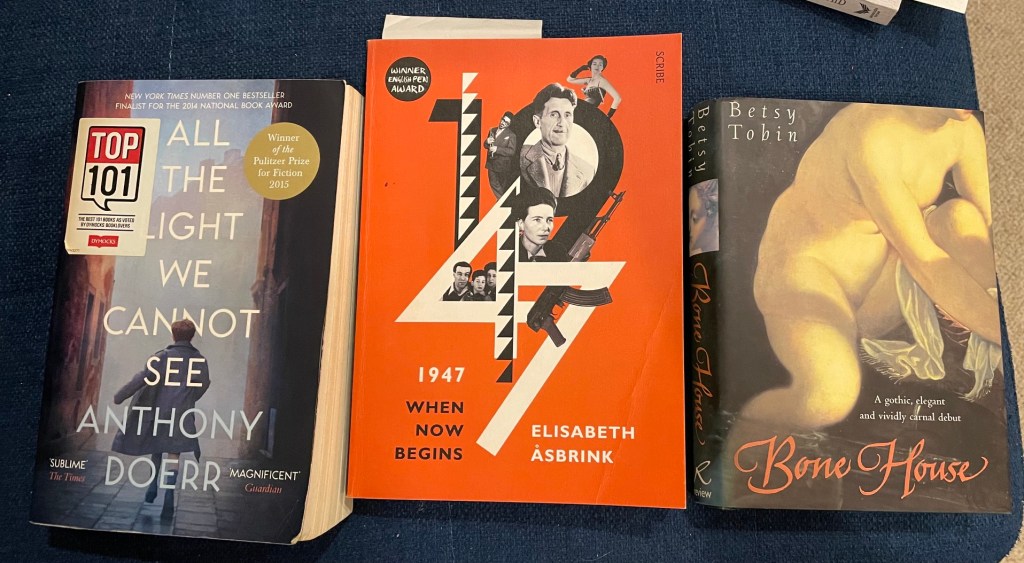
Book 29 … All the Light We Cannot See by Anthony Doerr, first published in 2014 by The Fourth Estate, an imprint of Harper Collins.
I read this a few months ago and to my shame could not recall a single thing about it when I picked it up to write this. But, when I turned to the back cover and read the synopsis, it all came rushing back.
Written in the first person present, a style I normally steer away from, it’s a gripping story. Set during World War Two, an abiding interest of mine. I was born three years after the end of that war to parents who didn’t talk all that much about their experiences. Only in my parents’ later years, did we, their children, get a few stories. A common experience from what I’ve read. But meaning that if you had any interest, you’d end up reading and researching widely.
The blind protagonist, Marie-Laure. The miniature maze her father made so she could learn the neighborhood. Their escape to ‘the walled city by the sea’ near the beginning of the Second World War. Doerr, the author uses a lyrical sensory style to portray Marie-Laure.
Werner, the German orphan and then Hitler Youth and radio operator, his story told in parallel, finally being ordered to that selfsame walled city. Where inevitably they meet.
No more spoilers for it’s a worthwhile read. The wikipedia article below will give you all the detail you might want about the reasons it was written, the style, the research, how long it took to write, etc etc.
https://en.wikipedia.org/wiki/All_the_Light_We_Cannot_See
Book 30 … 1947, When Now Begins by Elisabeth Asbrink, translated by Fiona Graham and published in 2017 by Scribe.
At the same time, but completely accidentally, I picked up this book which, while recounting the events of 1947, is really about the on-going fall-out of World War Two. Quoting from the back cover: “In 1947, Elisabeth Asbrink chronicles the creation of the modern world, as the forces that will go on to govern all our lives during the next 70 years make themselves known.”
1947 looks back as well as forward. And it tells the big story while all over Europe, people like my parents busied themselves setting up their new, very small lives and minding their own business, if and where they could.
One thing that made this read utterly topical is its description of the so-called Palestine question. Starting then! 79 years ago! The frightening partition of India into the smaller Hindu heartland flanked by the Muslim East and West Pakistans is also begun then.
I’m not sorry I read it and will probably keep it for a while. May want to read some of it again.
Book 31 … Bone House by Betsy Tobin, published in 2000 by REVIEW, an imprint of Headline Book Publishing.
This is another first novel and I have a soft spot for such, as you know. But it is also another book I forgot as soon as I read it. This time not even the back cover could help me. I do recall wondering why the “Bone House”? I mean, why call it that?
Learnt just now the two main meanings. The first as a charnel house where bones were kept—in small medieval times graveyards, graves had often to be reused before the previous occupants had melted into the ground—and second as a metaphor for the human body. Maybe that was what the title meant.
This is one of those novels where the illustrated book jacket with its voluptuous woman, Susannah Bathing, I believe, and suggestive byline gives completely the wrong idea about the book. Set in 1603, a town’s prostitute, beloved by all, is found dead. The daughter of the local midwife investigates the reason for the death.
Reading it, I had so many questions that were never answered. A weird little book.
Painting on book-jacket after Susannah Bathing, 1556, by Tinteretto
 Rita de Heer