3 realities. The everyday consensual. The Eleven Islands. The future.
Author: Rita de Heer
Writing is what I do. What I think about. What I meditate on. What I dream up. Listen to. Imagine. Sometimes I sleep. Sometimes I eat. And I walk. Pull out environmental weeds. There are a thousand more things I do, though writing comes into a fair few of those things too.
My modem is ‘on the blink’, which is a colloquial way of saying it has started to fail. Sometimes its little lights work well and my computer has an internet connection.
Sometimes they’re blinking and I know then there’s a gappy reception and goodbye to getting anything done online except by mobile. That means one-fingered typing for me.
I’m sitting on instalment 16 of Cat Tales, with no way that I have found of getting the photos from the computer onto my phone.
People will tell me the cloud and/or dropbox. Seems like neither of them like going in reverse. Mind you that could be a personal bugbear.
Surrounding the island where Bosley and Company have settled, lies a vast wetland of sandbanks, low islands and mostly shallow channels. The only river channel deep enough to take shipping fortunately runs past the west of the island.
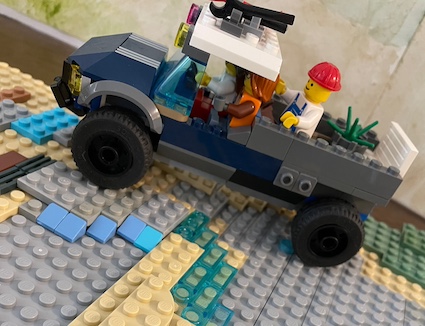
But today I’ll be starting part of the swampy landscape using this old road-plate. I realize this is a very old road plate, maybe even vintage. I got it in second hand lot. And base-plates have been hard to get secondhand.
NOTE that on this plate the height of the road surface and the plate surface between the studs is exactly the same. This is what will make it very easy to convert. I’ll be using a third version of my so far favorite technique … the MILS plate!
Surrounding the plate in the photo above are some of the bits and pieces I’ll be using to install a ‘skin’ over the whole plate. And I’ll be trying to save pieces (I never have enough) and time by laying down the bases of the various islands I’m planning as well as water channels as I’ve roughed up below. Scale is 4 studs per square. (I keep all my maps for this project in a Year 1 and 2 maths exercise book. )
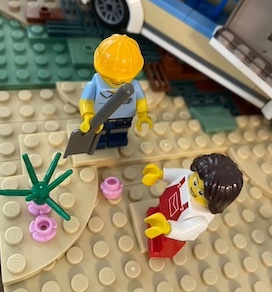
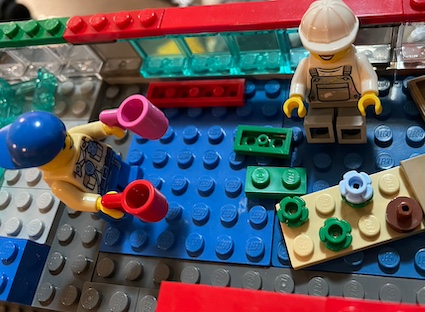
Here I’m about a third of the way. Light blue and grey will be water and mud. The tan places the islands. I’m using black and mid green plates to either fasten the larger plates to the studs or to support them on the flat roadway. To get everything to hang together it helps to connect the landscaping plates to each other with the underlay pieces.
This is my base layer. I’ve tested it by pressing down hard on all the plates and discovered two loose 3×3’s. They’ll need better foundations. The hole to the left? I didn’t have enough grey plates of the right sizes and shapes. I fixed it with two grey 1x2s on a black elbow. Pressed it in. It’s good to go.
Comparing this to the map, you’ve seen already that I had to let go of my ideas as to where to place the islands. It’s all right. I will solve that problem in the next installment.
My original plan was about four times larger than I have available … my tabletop is four baseplates wide (baseplates are 25 cm/10 inches a side.)
The first thing that told me I’d be biting off more than I could chew was realizing I’d need about 45 baseplates.
The sheer work involved in building them and the cost were the next considerations. I reminded myself of the premise.
“Bosley and Co are building their accommodation on an island that nobody wants, surrounded by wetlands.”
The cost of the wetlands alone would’ve been beyond the scope of the project. Transparent light blue 1×2 tiles are 22 cents each in my scene.
I decided to go back to my original idea. Instead of covering seven baseplates with swamp, I’ll make one, at most two, swamps and move them around as needed.
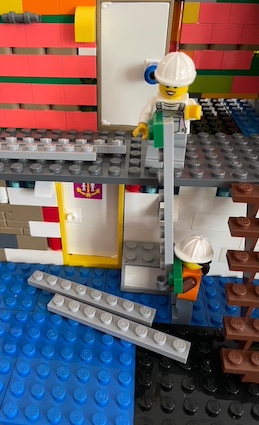
I’m not sure yet what I’ll do about the deep water river channel. Two baseplates already but including with the channel, places for large ships and small boats to dock. As seen below:
While the pernickety old woman pruned the rosebush in the front yard, a cheeky tom pranced along our back fence. I streaked over there, intending to see him off! I ran up the fence, made to dance along the top, thinking to tip the top crossbar every couple of paces with my right side foot and paw. For balance.
I was stuck! My rear claw too deep in the soft old timber! I wrenched and jerked to get free, tore my toe almost from my foot. Hurt! Hurt!
I miaowed and wailed and screamed for help. “Hurt! Tearing! My foot!”
My human came running. “What are you doing? What are you doing?”
“Oh no!” she said. “I’ll have to cut you loose and there’s blood already!”
“Hang on!” She pulled my leg back at the same time as snipping my claw through with the secateurs.
I screeched, would’ve jumped down and run, but she gripped me by the scruff of my neck. She moved me onto her shoulder and kneeled down to where she’d dropped her gardening apron. Moved me onto that and had me rolled up in it in a flash.
“Phew!” she said. Got to her feet. “I know I can’t trust you not to get free so you’ll have to come.” She took me into the garage. “We’re looking for the cat carrier. Give me a nudge when you see it.”
Me give her a nudge? I hate the cat carrier!
“Found it! Don’t move now!” She lay me on the work bench and slid the cat carrier out from under it. “It’s dusty! Where’s a rag?”
I wrenched and wriggled. Just about got myself free when she grabbed me and fed me into the cat carrier.
Yowling, I hung onto the doorway as usual but my heart wasn’t in the struggle. I smelled my blood. I wanted to be licking my foot. Let myself be pushed in.
She shut the little gate and barred it. “Well, let me think,” she said. “I doubt that I can carry you—carrier and all—all the way to the vet.”
I pressed into the back of the carrier. Really not interested. Found my wound and started licking.
The pernickety old woman went to the garden shed. Got out the wheelbarrow and lifted the carrier onto it. Trundled me down the drive, left turn into the street, across the road. Another left turn and a couple of blocks along. Right turn into the bad place.
I yowled. Felt sick. The turns and trundles dizzy-making. Give me peace and quiet. I don’t like it at the vet’s. They have pointy things they stick into me. They have rules. Dogs on their leashes, cats in their carriers. I wailed as the pernickety old woman carried me into the waiting room.
“Oh dear,” the secretary said while I took a breath. “Bleeding?”
“Yes, quite a bit of the red stuff,” the pernickety old woman said. She explained what she thought had happened.
“Come through,” one of the vet nurses said.
My human picked up the carrier and we went into the scary place. ———— Yes. They stuck me with something. I spent the night. Refused their food. In the morning, I was bandaged up. When we got home, the carrier and the wheelbarrow again, my human locked me in the shed. “Go to sleep,” she said. “They said you would want to. I’ll be back in a jiff.”
For the purposes of ordering book covers at the same time for all three parts of Lodestar, I’m continuing with this part of the saga. Viewpoint characters will be Ahni and Srese and the implant by way of both Srese’s and Kes’s life-suits.
(For those following Kestrel–you know who you are–don’t worry.)
Some of the materials I’m rewriting have been ‘on the back-burner’ and ‘under the bed’ for more than ten years and have dated somewhat. This is a definite risk where science fiction is concerned.
Lol ‘under the bed’ is where we writers kept our manuscripts in the pre-computer days, when everything had to be either hand-written or typed or both. We kept our first drafts in grocery boxes under the bed between edits, and we stored our non-viable manuscripts under there for when we’d need to mine them—pick and shovel style—for anything useful.
‘On the back-burner’ was a rotation strategy when we happened to be writing two or three novels at the same time. This was never recommended, but a rule often broken, from what I heard. We’d have a metaphoric stove going, with front and back burners. We’d keep one or two works stewing on the rear hot-plates while the one we were working on was being stirred on a front burner.
‘Burner’ will no doubt be remaindered when we all change over to 100 percent electricity.
My favorite metaphor for the writing process is the composting one. This refers to the idea that all the notes and scraps of paper living on a writer’s desk, her study floor, the front and back pages of printed books, her handbag, my pants pockets, gardening shirt and every other flat surface or container are collected.
The next step is to layer them, perhaps in proposed chapters, and arrange them in strategic places around my chair in the study nook for subsequent inputting. Overnight—because I’d always be called away to deal with this or that household crisis—things melded in a mysterious composting process such as happens on a forest floor, resulting ‘magically’ in meaning and order.
This time, however, I’ll be incorporating new ideas and updating old materials. I’ll be repairing bridges, writing stealthy byways, and designing new camel-ways. No magic other than sere insights.
I see I’ll have to adopt some kind of engineering metaphor to take care of all that road-building.
Despite the danger of the currawongs, I got used to doing my proper Hand-of-God work, and revelled in the thrill of seeing off intruders.
Small dogs, magpies and kookaburras all took flight when I ran at them. My large belly flubbered and wobbled as I ran, was one visitor’s unkind remark, after her little dog hid under her chair. My human glazed a stern glare over her face.
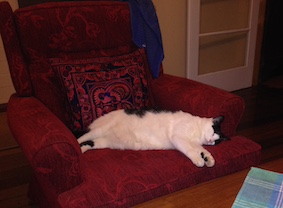
I am big, I accept it. Comes with being a daytime cat, apparently. My size helps me stay on top of the heap.
When even the pheasant-coucal stopped coming, probably because I chased him from the premises one too many times, I started to look for more excitement.
I had a go at climbing a tree. Got as far as the first branch, not more than a metre and a half from the ground.
The pernickety old woman, moving very fast for a human of her age, slapped an aluminium ladder against the trunk.
While she tied a denim apron round her waist I did not have the good sense to keep climbing. Always a sticky beak, I stopped to see what she was planning.
She climbed the ladder and lifted me from the tree. “Forget it,” she said. “You’re too heavy. Lucky for you I saw you before you got too high.”
“I’ll explain why one day,” she said through my complaints.
She continued wrapping me in the apron, tying the corners tightly round her waist. There’d be no getting free.
She climbed down and took me back to the deck. Where I lay about, sulking, and licking my wounded pride.