Reading Project, 9

Early in April, the old library in the part of our retirement village that is about to be rebuilt, was to shut down. Readers were encouraged to go there and ‘score’ any books they might like to take away. Don’t bother to bring them back was the second part of the instructions, and don’t return them to the new library the third.

Out I went with my walker, found about seventeen books that looked interesting enough to take away with me, and a cardboard box, thinking to pack them in that for an eventual delivery to Life Line, a charity that runs a massive annual book sale.

These books are now sitting on the floor in front of my bookshelves, no room for them on the shelves. Most will be one-read-wonders, so will be moved on, so no use making room for them yet.

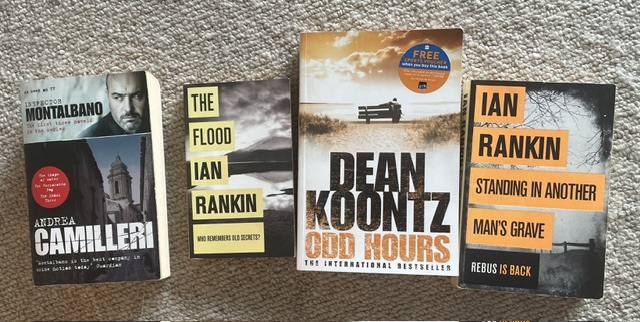
I started with the five detective fictions, one of them a compendium of three novels. Fast and easy to read, good for the weeks that I was prepping for the medical procedure everybody loves to hate, a nerve-wracking time when easy reads are the go.

As we are now well into May, even I can see that I’m getting behind with this project. And I’ve ordered a bunch of study books. Wonder how I’ll go with reporting on those.

Book 22 … The Flood by Ian Rankin, published 1986 by Polygon. Strictly speaking, The Flood is not a detective fiction. But as the first published novel of one of my favorite authors of detective fiction, Ian Rankin, I thought I might as well take it along.

Rankin’s own introduction informed me that his various skills began with this little book (I’m assuming that like many first novels it’s about 60 thousand words, it has that heft) so could be worth it to read. He himself tells us its a young man’s book ‘all about the perils and pitfalls of growing up’.

It was a patchy read. Sometimes you can learn too much about a book before reading it. Some parts I enjoyed. Others not so much. The first of the three parts to my mind the more interesting though of it is left hanging.

Book 23 … Standing in Another Man’s Grave by Ian Rankin, published 2012 by Orion. This book is advertised with ‘Rebus is Back’ as though Rebus has been away, missing. Rankin has written nineteen Rebus books as well as nine or ten that are unrelated to Rebus. This one is about a crusty old detective, resigned from the police force and working independently, as a private eye, I assume.

Co-incidentally, on TV (SBS on Demand) I’m following Harry Bosch in much the same scenario, in the Harry Bosch Legacy. What I enjoy about both these detectives is their personal lives. They tell the stories not just of their police work but also about their private lives, and their frail humanity.

Both also have been left behind by technology and isn’t that a relatable feature of modern life? Anybody over fifty will always be a migrant to the computer age and will, by the time they’re seventy, need a guide.

There’s enough detail in the average Rebus, and the story arc is usually familiar enough, that reading it was quite relaxing. There isn’t that need to hurtle along hurry hurry to find out the end, because the end is a foregone conclusion. Rebus will solve the mystery and the perpetrator will go to jail.

Book 24 … Odd Hours by Dean Koontz, published 2008 by HarperCollins. Once upon a time I studied Koontz’s written dialogue, to improve dialogue in my own writings, and enjoyed many of his novels. The cut and thrust of the dialogue, the spare but informative descriptions. The suspense.

Then he went into the Odd Thomas series, and barring maybe one of them, perhaps the first, these are not his best. In my opinion. I think I’ll be tossing this one into the recycling bin.

Book 25 … The Survivor by Sean Slater, published 2011 by Simon and Schuster. I’ve already passed this one on to my reading buddy. It was good. Added to which, Slater is the pen name for an actual police officer though I don’t really know if that makes a difference, most crime writers are very good researchers. But not having the book on hand does mean I’m limited to the Good Reading Magazine, if they even have it in their files.

They do. Their summary … “Columbine. Dunblane. Virginia Tech. Winnenden. But Saint Patrick’s High? In his first hour back from a six-month leave of absence, Detective Jacob Striker’s day quickly turns into a nightmare. He is barely on scene five minutes at his daughter’s high school when he encounters an Active Shooter situation.”

I was pleasantly surprised that there was another detective fiction author whose style I like that I’ve never yet read.

Books 26, 27 and 28 … Inspector Montalbano: The First Three Novels by Andrea Camilleri, translated into English by Stephen Sartarelli, published 2002 – 2004 by Picador.
The Italian publication dates were …1994, 1996, 1996 publishe by Sellerio editore … have I got a treat for you … the Sellerio publishing group is based in Palermo the capital city of Sicily, and they’ve adopted … ‘The program at the origin of the publishing house is a return to a culture that Sciascia defines as “pleasant,” that is, a culture in which so-called commitment is implicit and not explicit, therefore a culture of lightness, which does not renounce elegance, a culture of ideas, yes, but in the form of beautiful things.’ [My paraphrase.]

That’s brave in this day and age. I’ll be enjoying the publisher’s statement for a while … the link https://www-sellerio-it.translate.goog/it/casa-editrice/

And in addition, Inspector Montalbano, an Italian cop show set in Sicily, was a favorite TV series about twenty years ago, so how could I resist?

Starting to read The Shape of Water, the first of the three books—they don’t appear to be a trilogy—I realized I’ve read it before, or maybe started to read it before, because I did not recall the end.

The first thing to get used to in the book, compared to the TV show, is that it is not a version of Keystone Cops, the way that the TV version often resembled. A bunch of police constables and members of the Sicilian public perpetually running after Inspector Salvo Montalbano.

In the book all these people have their own personalities, and it’s good to get to know their differences. OK, yes, there does appear to be at least one Keystone Cop, and that is the officer most often left behind to man the radio, (I’ll find his name …ah, Cantarella) He does have all the hallmarks of a comic turn. Though I bet in Italian he’ll be funnier than he is in English.

The Terracotta Dog and The Snack Thief are the second and third novels. Both are also full of interesting geographic and historical detail and cultural ambience. These are extras, of course, for all non-Sicilian readers.

One thing I really enjoy is Inspector Montalbano’s relationship with his cook. She’s the mother of a pair of miscreants, one of whom Montelbano put in jail. The inspector is a total foodie and Aline leaves him with a stream of interesting dinners in his fridge.

Then there’s Livia, his girlfriend. The love of his life, she lives on the mainland. They enjoy their separate/together lives until they meet the snack thief in the third novel. Then they talk about getting married. But we only get Montalbano’s POV and he has doubts. There’s no resolution so far. I expect this conundrum to continue to be debated further on in the series.

Montalbano’s love-hate relationship with his second-in-command, Mimi Augello, is mercurial with a bit of ‘plain speaking’ involved. When Augello is well-meaning, Montalbano is savage and vice versa. Augello sounds ready to move into Montalbano’s chair, but Montalbano is nowhere near ready to move up.

Fazio and Tortorella are his sergeants, “or whatever the hell they were called nowadays,” he says. Then there are all the rest, constable I assume, hard to tell apart, except maybe for Catarella who usually mans the phone and mangles any message that needs to passed on and having to be re-interpreted when Catarella grasps the wrong end of the stick.

I can see from my confusion that I’ll be re-reading the series to get the chain of command, so I can read a run of Italian names and know who all they all represent.

The comedy often is in unexpected contrasts. Montalbano spend the morning scrubbing his house and then himself. He polishes his shoes, dons a formal suit with “his most serious” tie, and then sits waiting for a visitor, getting more and more nervous. He knocks back a glass and a half of whisky just before his visitor arrives, and who tells him, “I’m almost blind, I see very poorly.”

The comedy in The Terracotta Dog dances around a tragic plot. We get a glimpse of what life must’ve been like during World War Two in Sicily when the German Navy used its coastline and harbours to repair and resupply its ships.

Sometimes an old cultural practice is discussed. Could the fact that the corpse was found with a stone in its mouth mean something other than is commonly understood? Huh, I thought. I have no idea. Another reason I enjoy this series so much, this dialogue you need to have with yourself to ‘detect’ the full range of meaning. I recommend these.

The books I have here are the first three of a long career. I’m keen to read more now, see if they become formulaic which is always a danger. I hope they don’t, I hope Camilleri can keep his plots fresh. I’ll be hanging on to this one for a while. Pity that it is a tome. It’ll need quite a wide space on the shelves.
Reading Project, 8

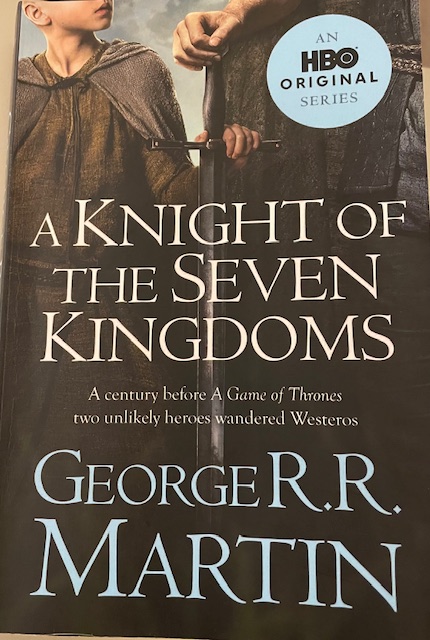
Book 21 … A Knight of the Seven Kingdoms by George R R Martin, with illustrations by Gary Gianni. This edition, being a collection of three novellas, has a complex publishing history but as a collection it was first published by Harper Collins in 2015.

After I saw the HBO TV version, I wanted to read the original, as print novels often are better at showing the complexity of characters. Which was a good move, for as well as the first story, The Hedge Knight, that the TV series is based on it, it gave me two more stories, that presumably will be televised in the goodness of time as installments 2 and 3.

A hedge knight is a knight not sworn to a lord or having land—such as Ser Duncan the Tall—and I guess would be equivalent to a ronin in the samurai tradition. Both are men who wander their countries and offer their swords in whatever battle that will give them food and shelter for a time.

Dunk (short for Duncan) is a young, tall, strong and inexperienced knight wandering the Seven Kingdoms with his squire, Egg. As soon as I read “Egg” I recalled Maester Aemon at the Wall in Westeros ( A Game of Thrones) talking about his younger brother Egg and spent quite a bit of time wondering how that worked. Forgetting that with the right question (ie prompt) Google’s AI would tell me in seconds.

Which it did. Aemon was two years older than Egg and Egg will rule as Aegon V. At the time of these stories Aemon is apprenticed at the Citadel learning to be a maester and he will serve at The Wall.

You have probably guessed by now that I am a Game-of-Thrones tragic. And you are right. I have the book series on my bookshelf. I was a member once of a huge fan club, forty thousand plus fellow tragics, industriously discussing all aspects. Though they worked out the Jon Snow is the son of Rhaegar Targaryen and Liana Stark puzzle and I still don’t know how. I confess I just took their word for it, never could find the proof in the books.

All this is getting side-tracked from the book I’m talking about, but have the excuse that the these stories brought it all back, because it is all connected. Reading it the first time round, it seems like a light read, though the battle at the tournament is quite complex. I had to read that a couple of times, nailing down who fought who and who bit the dust.

But wait, why am I saying it’s a light read? I’m changing that. Only the first story was a particularly light read and I suppose the fact that I already knew the story visually meant I just glossed the imagery in the words.

That’s the problem with visual media of all kinds and reading books after seeing related shows. By feeding viewers with media-ideas for what things look like, viewers who are also readers tend not to read stuff that will clash with pre-“recorded” visuals and as a result miss out on a lot of good metaphor.

Such as … “The spiked ball whirled round and round the sky and fell toward his head as fast as a shooting star. Dunk rolled.”

That didn’t happen in the tv series. Someone else wielded the spiked ball and not at Dunk. Why I can still appreciate it. The other thing to appreciate is a character’s thoughts. … I failed them. I am no champion. I’m not even a hedge knight. I am nothing…

I don’t mind those thoughts, they’re what anyone would think in the situation. But … He never saw dunk the lunk, though, did he?… the twenty-five times that Dunk thought that of himself … that grated on me after the fourth time. (Maybe not twenty-five, just felt like it.)

In the next story, The Sworn Sword, (p119) there’s less introspection as there is more interaction between Dunk and Egg. They are on the road, traveling to their next meal.

This story is book-ended by the two corpses hanging in a cage at the cross-roads where Dunk and Egg stop for a minute for a break and again on their way out. They’re to deliver a barrel of wine to a place called Standfast and happen to stay there, to help the inhabitants get out of a scrape they have with their neighbors about water rights, a complex quarrel. Dunc ends up fighting the opposition’s champion.

The third story is The Mystery Knight (p233). Coming away from Stoney Sept, Dunk and Egg are well supplied. As they near a town, they first see a traitor’s head on a spike on the town walls.

Two and a half pages of Dunk’s ruminations follow, about a law that allows septons to be decapitated for merely talking because … “words are wind” after all … he says. Egg puts his thoughts in where applicable and the whole is one of Martin’s stylistic manoevres to thicken up the story line with historical descriptions including the Targaeryan succession through Bloodraven.

Six days later they arrive at a ferry crossing. Here, again, as they ride toward the inn nearby, there are possibilities of informing the reader about money, as in how little they have, “twenty-two pennies, three stars, two stags, and an old chipped garnet, ser …” Egg informs us and Dunc.

All three stories give the feeling of meandering. The pace is slow while Dunc and Egg are traveling, they are on horseback, with the horses probably walking. Fights are fast blow by blow accounts of action.

Between the slow travel and fast battles unfold long sections of story needing close attention. There’s a lot of detail being slipped into every paragraph. Story-pearls are being seeded in at all times. Early in the story we learn about Bloodraven’s history. At the end we meet him, and learn that he is Egg’s cousin.

I found this book in the YA fiction section in the bookshop where I bought it. The book is probably classed as young adult fiction due to the single story line, the youth of the POV characters, and because it is illustrated.

The amount of detail in it, though, suggests an adult read. Words, phrases, clauses and sentences all contain seeds and reminders that these stories are part of the whole rest of the Westeros culture. It’s one of those books I read fast for the plot and again, slowly, for the complexity.

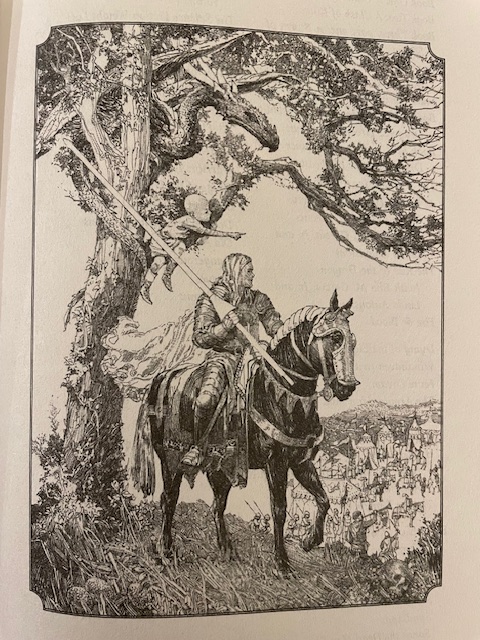
.Illustration by Gary Gianni.

Links, 1 …

That is, links between Mongrel, part 1 of the series and Meld, part 2. Ordinarily these might be called back-stories telling how various characters got to the point that they enter the story.

Though in this case, it’s the ongoing premise that needs more explanation than I can fit into the main tale. So I have recruited a group of supporting characters to tell their side of events, in the hope that they will then just slot you into the cycle.

This was a 500 word Flash Fiction try-out that describes Claire King’s secret project. If you’ve been reading long enough you’ll probably recognize the Dolphinate, who live in the Delta in Lodestar.

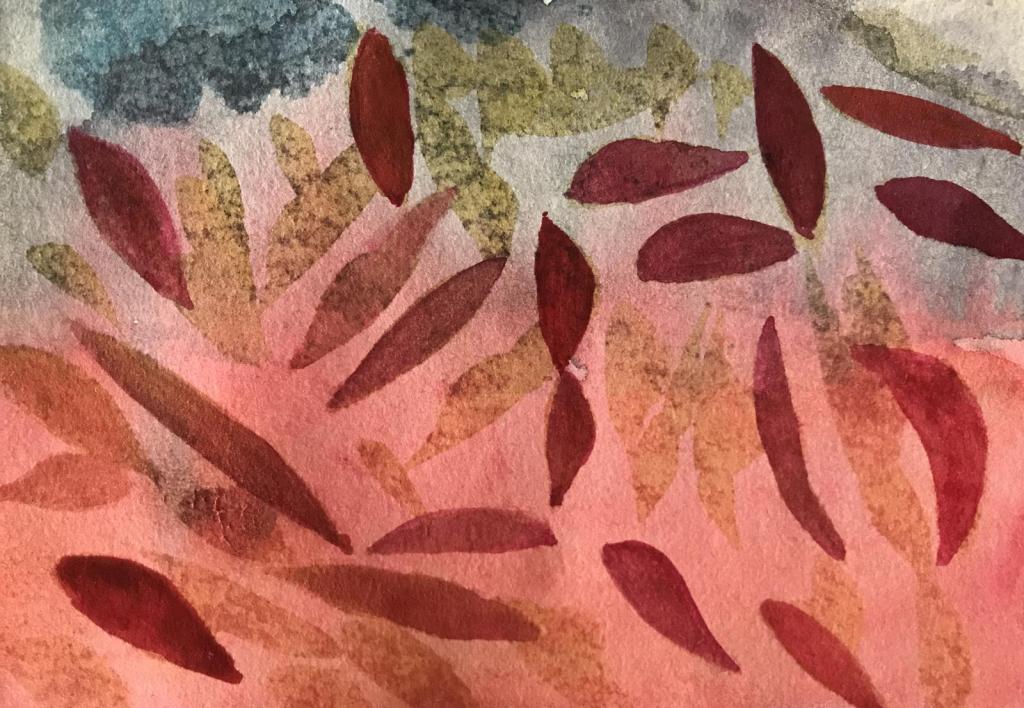
This little painting represents a bunch of new life in a petrie dish.

Mongrel: 46, 47 and 48

Last three chapters. But not really THE END.

It was hard to figure out the cut-off point between Mongrel and Meld. In a way, the whole of Mongrel is Tardi’s backstory and set-up for his role in Meld.

I felt that, with at least the main character a familiar person, we might all be able to better understand the new scenario. Experience it through his senses, as it were. It was hard to write and it’ll be hard to understand. But I hope you’ll find it intriguing.

— — — —

I’ve seen most snakes in the wild, but never a death adder. Like most bush-walking Australians I was always on the look out for them. Very scary. I’ve known several people who thought they killed one, only for the animal to turn out to be a blue-tongue skink.

Image from https://wildlifeqld.com.au/common-death-adder/ Check out this link for all the variety of colors of death adders.

Reading, 3

The third post of this series already though I haven’t settled into a routine yet. Today had the better idea of what to do about the illustration. Instead of letting just one book have all the glory, why not give them all a chance to attract readers? Will give that a go shortly.

The longer without a routine the better, I used to think before I was pole-axed by ME/CFS. Come Easter, I’ll have lived with this malady for 29 years. Somewhere along the line I learned that making decisions is a stressor that saps my strength.

The idea out there—in the public domain—is that the more non-important decisions we encapsulate in routines the more energy we’ll have to make important decisions. It’s not wrong … routines enable me. Interesting article on decision-making … https://en.wikipedia.org/wiki/Decision-making

Then I thought what about at the end of the year? Won’t I want to know how many books I actually read? That is the project after all. I saw myself counting through the posts. Got to be an easier way. Just number them already. So … started that today.

Book 5. The Light Pirate by Lily Brooks-Dalton, 2022. Published by Grand Central Publishing of New York.

This is the only book out of the five that I’ll recommend. I might’ve mentioned before on this blog that the climate change apocalypse, and its associated nightmare horsemen are my Sword of Damocles, and that the thread the sword is hanging by is wearing mighty thin and frayed.

The Light Pirate is set in the near-future and describes how the Florida coast is being engulfed the sea. It’s a blow-by-blow account of the way one family dies and adapts and is taken and finally evolves for a new existence. Ninety percent stark dark reality and ten percent luminous hope.

This is a book I would like to own. Read the good bits every now and then. This story speaks for everywhere there is low ground by the sea.

Book 6. Downward to the Earth by Robert Silverberg, 1969. First serialized in Galaxy Magazine it was published in 2015 by Gollancz in their SF Masterworks.

Although I’ve been reading science fiction since I was about 13, and Robert Silverberg has written hundreds of stories, I haven’t read all that many. Scanning through the titles in the front, I see only one that I own. Most don’t ring a bell. This little classic is said to … “blend mysticism, worldbuilding and literary references in an inventive mix …” from the backcover.

It’s probably about 60 thousand words, a common size in the 1970s, with a single storyline, the journey of the main character, Gundersen, returning to the planet after a ten year absence, out of guilt and needing to do penance for his mistreatment of the native species.

When I read old science fiction I’m forever fielding echoes. In this book I was reminded of some of Oscar Scott Card’s work. Comparing the dates of Silverberg’s and Card’s work, I think probably Card got his idea of the melding of the two species from Silverberg. Although, they could both have got the idea from Earth’s own panoply of creatures. Most insects, for example, have vastly different life-stages.

    Book 7. Iron in the Soul by Jean-Paul Satre, 1949. This edition translated by Gerald Hopkins and published by Penguin Classics, 2002.

    Despite that there was plenty of Jean-Paul Satre around when I was a young student, I was never tempted to read him then. Now I thought, browsing along the shelves at Carindale Library, why would Penguin choose to republish him as one of their classics if there wasn’t something to him?

    I read a few pages in the middle—that’s the way I test books for readability—and thought it might be interesting. A whole other viewpoint about the Second World War, this one from the POV of the rank and file of the French Army.
    Thousands were taken to Germany and, I read just now, more than ten thousand French soldiers fought alongside the Germans. I wonder if they were given a choice, fight for us or we shove you in a work camp? https://en.wikipedia.org/wiki/France_during_World_War_II

      Book 8. Wolf Girl: Into the Wild by Anh Do, 2019 with illustrations by Jeremy Ley, 2019. Published by Allen & Unwin.

      Seriously, was a bit of light relief, I zipped through this in about an hour. A story aimed at 8-10 year olds that my grandson lent me. I was interested to read how Anh Do, serious artist, translates into Anh Do, children’s author. His style reminds me of Enid Blyton’s.

      There are about a dozen installments. A money-spinner, if you ask me. And yet, Enid Blyton’s vast output was great for struggling readers, giving them lots and lots of practice of the plain vocabulary that they needed to become good readers. So perhaps this is the place for Anh Do’s output in Australia.

        Book 9. The Woods by Harlan Coben, 2007. Published by Orion Books.

        Returning a bunch of books to the in-house library in the community center, I picked up The Woods because Coben wrote it and I hadn’t read it yet. Pure indulgence. A fast forgettable read. Suspense? Of course. All the t’s crossed and the dots dotted? Yes. “The modern master of hook and twist,” says Dan Brown on the front cover. (Wonder what he got or did to get his name on someone else’s front cover?)

          Reading, 2

          The project continues.

          Next up was Chasm City by Alistair Reynolds, published in 2001. “A hardboiled pursuit/revenge thriller set in the RS universe,” from the author’s website. RS = Revelation Space, which I don’t know anything about other than what I’ve just read. Thriller? Nah.

          An eight-day read, worked at diligently. Dense and detail rich. According to my research after reading it, this is Reynolds’ second published novel. And also second in reading order, it’s a ‘stand-alone’ as the Reddit experts tell it, but which surprised me as there seemed quite a bit of bloat. Stuff, that for the sake of the pace, readers could’ve done without. Stuff that I wanted to skim, but ended up plodding through because of not knowing what was essential to the plot.
          There goes my theory that editors don’t look as closely at authors with a lot of books already published.

          At times I thought I was reading about Mars. I think it was a case of stories bleeding into one another due to proximity. In this case, me watching The Expanse Series by James S A Corey on television. I think probably due to the sheer size of the chasm. Very Martian. Though in this case, it’s a planet called Yellowstone and a large part of the chasm is domed over.

          Life in the chasm is very interesting, regional. As can be expected the upper classes live in the Canopy, the slums are in the Compost. Travel is by semi sentient vehicles that claw their way up and down and along hanging vegetation and cables. The slum dwellers are all about making a living. The rich play at turkey shoots, where they free a prisoner and force them to run for their lives.

          The two main characters, with at first separate stories, eventually seem to meld into one another. The POV character keeps changing identities, and is as slippery as an eel to keep hold of. I found that quite disconcerting as the story is complex and I found it easy to get lost in. I did a lot of re-reading.

          Why didn’t this turn into a DNF read? (Did Not Finish for those of us at war with acronyms). It could’ve, to be honest. But Reynolds also wrote the Revenger trilogy… Revenger, Shadow Captain, and Bone Silence. Three of my favorite modern science fiction reads.

          Fantastic worldbuilding, great characters, piracy and treasure hunting, a gripping plot, a steampunk flavor. Rave, rave, rave.

          Reading Chasm City I kept wanting to give Reynolds more time to come good, to tell the story with as much verve and vitality he’d shown in Revenger. I think now, knowing the Chasm City was only his second novel, that he was still learning.