3 realities. The everyday consensual. The Eleven Islands. The future.
Author: Rita de Heer
Writing is what I do. What I think about. What I meditate on. What I dream up. Listen to. Imagine. Sometimes I sleep. Sometimes I eat. And I walk. Pull out environmental weeds. There are a thousand more things I do, though writing comes into a fair few of those things too.
It’s useless to be thinking about the future when you are starting out, on anything. You start your working life putting up signs, you have no clue that one day you might be working on high rises installing in glass walls with the help of a robot.
People starting out as writers are the same. I started with writing poetry. I had no idea then that one day I’d take on an sf trilogy.
Nearly everybody here in the Discord’s Writing Cartel has a world/universe that they are either writing into or using as scene setting for any number of creative projects. Yesterday I watched a short film on Youtube, there are people developing games, writing novels, short stories, you name it, it’s being written.
Every one of these worlds/galaxies/universes are huge. Many of us have spent every spare moment of our boring work lives thinking up detail. There will always be areas in any of these worlds that will stay private to their creator, and other areas that will see heavy traffic of stories.
We’re all doing it for the love of it. World building is one of the most satisfying mind games we all engage in, relaxing and psychologically uplifting. Next comes the harder thing. Convincing other people to put their own worlds aside for an hour, and engage with us in ours. So we write stories, develop adventure games, produce visuals, film about our worlds.
The Discord Writing Cartel community is all about sticking our toes in the waters of our worlds, writing though the shallows, and finally committing ourselves to writing fully fledged stories to share first with each other, then with the world.
Only then, with that last word, can you start thinking about how much money you might make. Though, of course, these are just my own thoughts. Take them well salted.
This began as a piece of paper I used for practicing leaf shapes with a new brush, using indigo with a bit of yellow top and bottom.
Then, doing this project, I’m recycling paper as I go since everything I do is trial and error.
So, when trying phthalo blue over indigo and mopping out the centres of
shapes–another thing to practice–that fish became a thing when I
added its eye.
I realize that it is only through the corrugations formed by leaf shapes that I have a shaped mouth, and that I’ll probably never be able to reproduce it.
Bat out of Hell, Nov 17
This pic began with red. Bush-fires have burnt out large swathes of forest and hundreds of animals have died, four humans among them.
Red mixed with indigo and phthalo blue gave me the fire-ground. Indigo for the bat with a touch of orange for its eyes. The blue touches contrasted and made the clouds. Made it realistic, in fact.
After the Fire, Nov 19
After the fire when dead trees stand smoking and still aglow. The sun still shines, an angry ball. This little scene was to give me shades in indigo, but as usual I get carried away by the content.
Those of us in my region living in towns feel ourselves fairly safe in this emergency. So far. People from out of town have been evacuated and are staying with us. Others ask us to store their precious goods. I’m hosting four musical instruments and three large containers with photos and documents.
Recharging batteries is another thing we can do for people who no longer have electricity laid on. Whose power lines and generator sheds have been burned. In two cases I heard of today, the fire was stopped only a few meters from the main house.
The bushfire season began early this year. We’ve been burning since September, and the fires are getting worse, if that’s possible. Hotter, faster, and more destructive. In the past, diligent back-burning and fuel reduction in winter reduced your chances of being burnt out in summer. Now there’s hardly time. Winters are shorter and we’ve had less than half the rain we had last year when we already had a third less than in 2017.
It’s possible for a fire-ground to be burnt twice in two months. This despite the traditional view that rain-forest plantings, in contrast to Eucalyptus forest, will protect your property. No such thing now. Fires burn so hot that rainforests don’t stand a chance and they don’t grow back the way eucalyptus trees recover.
How will we live in a forever-blackened landscape?
Catherine Ingram’s article Facing Extinction, about the state of the world and humanity’s chances of surviving, is more a prescription for coping with the grief than a wake up call. It’s too late, she says, to try and save our Nature.
The way my countryside is burning, it certainly feels too late. I’m with Landcare. We plant trees. What if no trees survive either? It’s difficult to plan how to live now, when there’s said to be no future.
As well as tripping over imagery while researching online, I use photos and any images I may have produced in the past and present, as inspiration for my writing.
Though inspiration may not be the exact word.
Often I need to describe something so that it resembles reality. Landscapes are easy. Find a photo of a landscape and describe how your MC operates in it. Old calendars are great, although they do get cliched, almost always using the same Disney-esque castle in Bavaria, for example. Travel photos, my own and anyone else’s, are my next resource. But, of course, sometimes I’ll want a landscape not on Earth.
And this year I tripped over #huevember. “Make one painting every day of the week, using the appropriate color on the color wheel as the main color for that day.”
I could do that, I thought. If I was painting. [I hadn’t painted for over 6 months when I thought that.]
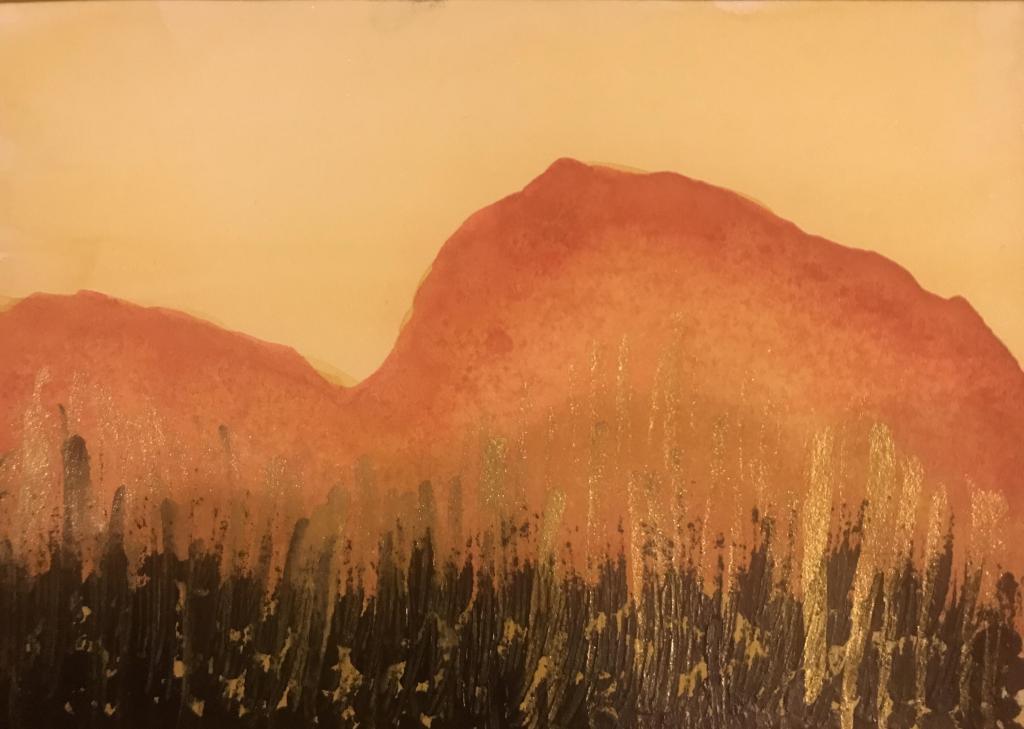
But, once you do start thinking that way, it’s hard not to get excited by something like #huevember. So. I fell for the dark orange dedicated to November 7, got my paints out and continued the journey of learning to paint with watercolors.
Main color is dark orange, November 7
Here I painted over the top of an uninteresting yellow scene. Turned out pretty impressive and got me over my initial will-I-won’t-I-commit doubts.
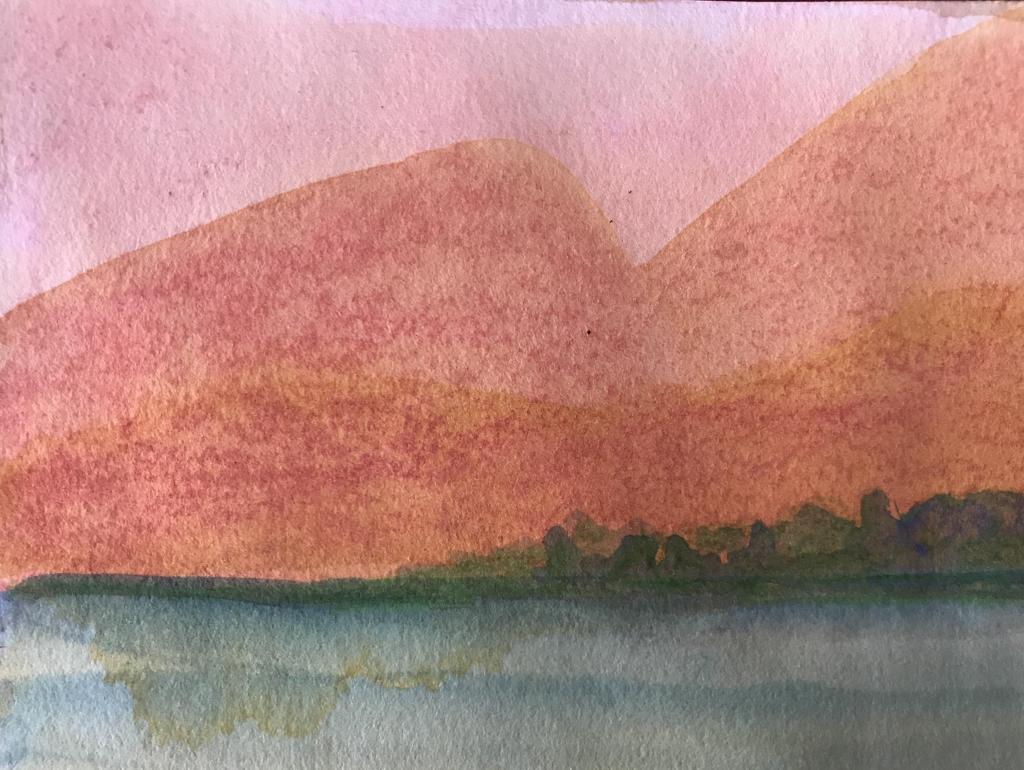
Burnt orange mediated by grainy paper, November 8
I painted this one over an uninteresting pink scene and didn’t get the desired burn-orange hue. May do it again sometime …
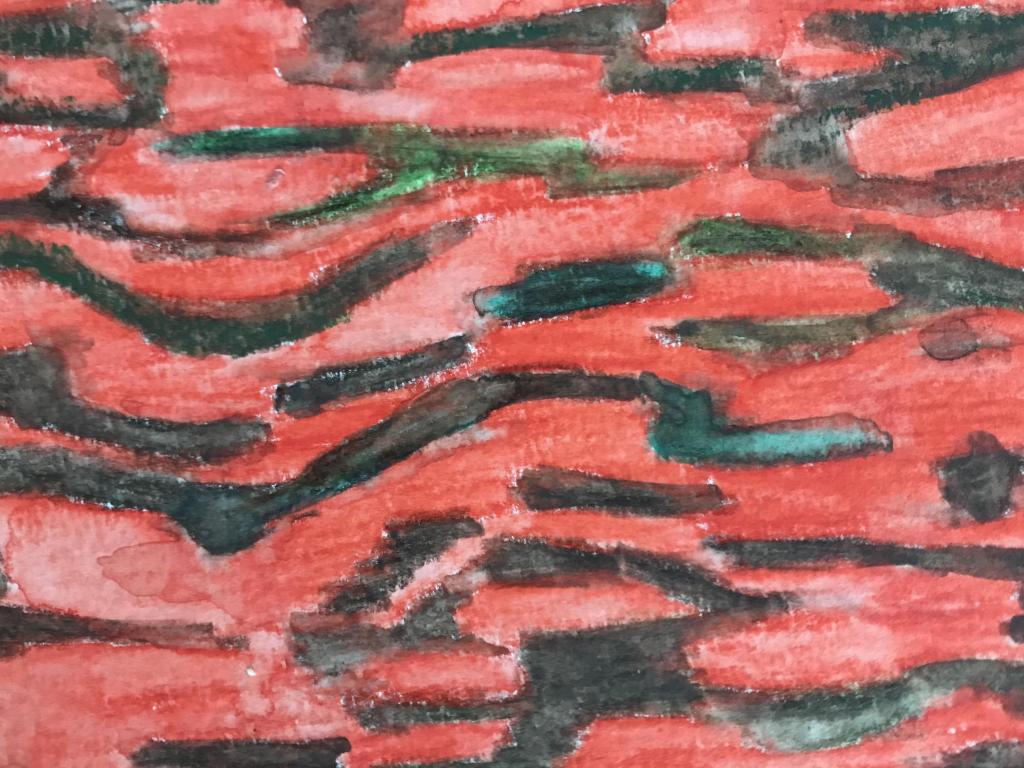
Scarlet for November 9
Scarlet … I don’t have a cool red tubepaint, or watercolor crayon. Had to dig out some old aquarelle pencils. This is an experimental animal-look pattern that might work for a shaman’s cloak.
A sad thing to report … Miss Maggy-bag was euthanased this morning due to tick paralysis. She was eleven years old and the most intrepid cat I’ve ever had the pleasure of guesting.
Intrepid because though she was too swaggy and inept to climb trees, she ran up walls after Asian House geckos, up fences to see off intruding felines and up the shade-cloth shed to sneer at the neighbor’s dogs.
She lost every collar with bells she was forced to wear as well as every flea collar. Under the house there will be a place where all these things lie, a testimony to a smart cat.
She was missing for sixteen hours. When I called her I only heard that squashed-frog sound, that frogs make when they are stuck in the drainpipes and it’s raining.
Finally found her at the bottom of the steps, cold, wet and unable to move. That noise was her, even her vocal chords were paralyzed.
I could’ve taken out a loan and gone through all the rigmarole of seeing if she’d make it with the antivenin, but she was 8x smaller than my dog who got a tick the same size and barely made it.
So I have her at home, swaddled in a towel, dead on my lap. It’s easy to imagine she is still alive because she is lying against me and I am breathing, she with me. It’s raining at the present, softening the ground. Later I’ll go out and dig a hole.
Maggy, wishful thinking. She tore off her toe on a fence and she could not go outside
Strings (2004) is a film acted by marionettes though it could be said that all the actors are puppeteer-marionette-pairs. This reading would help explain the only instance that a part of a marionette handler is seen.
A problem for me personally is the lack of subtitles in lieu of the absence of living lips to read. Hence, the intricacies of plot and story, for me are gappy. It’s a coming-of-age story.
A king kills himself and leaves a letter explaining–the letter is taken before his son can read it–and not knowing any better, the son goes out to avenge his father. There is a happy ending, but not before the scene (above) where the prince makes it home to witness his sister’s death.
It’s easy to become so engrossed in the Strings world that one would forget that marionettes are dependent on their human technicians and human voices for every move, every expression, and every placement in a scene.
In one scene a human foot is seen hastening up a stair out of a cellar after the puppeteer apparently drops their character to the ground with a definite and frightening crash.
I wondered about the editorial decision to leave that scene as-is. Is it that the foot can be seen as a reminder of who the agents are in this entertainment, or is it to remind viewers of the technical skills that have got the story so far? Either of those could then be seen as instances where the viewer trips and falls out of the story. A no-no in fiction in general that I didn’t want to suspect of the producers.
After some thought, it seems to me that there was no possibility other than a deux ex machina moment, literally a god-in-the-machine, to explain how that character came to be in that cellar, and that the puppet’s handler as portrayed by her foot represents that god.
While I knew that there is much more to world-building than concrete nuts-and-bolts world design, seeing in Strings how dialogue and character actions translate into very specific cultural metaphors, had me on the edge of my seat.
On the Plain of Death, for example, the soldiers’ strings snap-freeze and break. In a contrasting war scene portraying war with a desert people, death is signified by strings burning.
“We are all connected,” says the Prince’s desert princess. She glances at the string-filled heavens where all strings go, and where, above the clouds, it is believed that strings are connected. The pair making love is symbolized by their strings mixing and weaving together.
Writers of science fiction are warned away from metaphor. (Card, 1990) Yet in Strings, the outcome of many of the actions hinge on, or are influenced by marionette-specific metaphor. One of many such actions is the outgoing king committing suicide by cutting his own head-string. He isn’t buried, but god-like, is strung up on a wall.
The Prince’s sister tries to stop him leaving her by holding onto his hand-strings.
A pair of children quarreling get themselves tangled up in their strings.
The Prince’s uncle goes to receive a prophecy from a bunch of ancient puppets, bunches of slack stringless limbs, with only their head-strings still intact.
The gestation of a baby is signified by being carved from an appropriate wood. At the moment of its coming-to-life, light-filled strings descend from heaven that are reverently attached to the head, hands and feet.
There are dozens more of such moving moments.
If a story is to be more than a theatrical experience, it needs visual backdrops, props, and processes for the characters to interact with.
The Prince is of a people who have plenty of water in their land. Rain is common at times of great sadness. Raindrops on sad puppet faces in lieu of tears is a nice extrapolation.
Cells in a prison are delineated by overhead frames that contain prisoners’ strings and restrict their movement.
When all strings attached to the living rise up to an unseen heaven, it makes sense that hooked machetes, for instance, are a preferred war weapon. An enemy can hook in and cut an opponent’s head-string to kill them. Or an enemy will gather all their target’s strings and cut through the lot with one fell stroke to deliver an even worse fate.
Slave drivers use a weapon reminiscent of a carpet hook to in-gather the strings with which to control their captives.
The tents of the desert people are truncated into architecturally natural shapes to allow for the ascent of strings to the heavens.
Again, these are only a few of the instances. Watch the film, is what I’m saying.
There is a better quality version than the one below available on SBS, an Australian free-to-air television station.





 Rita de Heer