
Saw this from the side balcony …

Just seeing someone take advantage of the intermittent sun shining makes me feel good. Then I wonder why they are the only ones?
Saw this from the side balcony …
Just seeing someone take advantage of the intermittent sun shining makes me feel good. Then I wonder why they are the only ones?

Life has been challenging over this past week. Sometimes things happen that are difficult, if not impossible, to process. Such has been our …
Meditative Art
This post by Judith on https://artistcoveries.wordpress.com/ was a serendipitous find for me when I was casting about for a distraction from the on-going disaster that is the world out there. I had already weakened and thrown a train of the ongoing grief onto the page (previous post) when I recalled how soothing painting can be and thought that I should get back to it.
There’s nothing I can do about the ongoing train-wreck but keep myself sane and … I just don’t know what we as individuals can do.
Painting these miniatures my whole attention needs to go into every step of the process. They offer me three stages … I sketch, trace the important lines with black waterproof, and I paint. Six miniatures per A4 page, with two more to serve as a front door into the space and backdoor, or gate, out of the space.
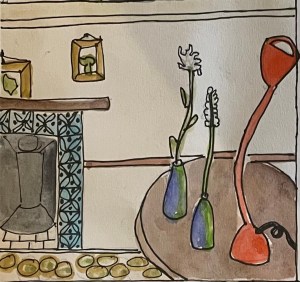
Unfinished sketch of a corner of a living room. A few more elements before I can call it done. the flowers need a touch of color, for example. And so do the bricks in the fireplace. 10 x 9.5 cm or 4 x 3.7 inches.
Before I put pen to paper I need to set the scheme out, and it’s easy to make a mistake. As I did with this series. To put the booklet together with the least number of cuts and gluing, the six inner elements need to be positioned facing upward, facing downward, facing upward. That didn’t happen here:

… and I will need to do more cutting and more gluing to get a successful outcome. My fingers are crossed.

One of my ongoing interests is how products are packaged. This began when I was about fifteen and my birth family hosted two Japanese engineers who were in Australia to install and test a huge new Japanese generator (or transformer) at the power plant where my father also was an engineer, and who brought us lots of presents.
During the week these men lived in a boarding house, and weekends Saturday or Sunday, they came to our place at Berowra, in the outer northern suburbs of Sydney in the 1960s.
At the time we had a garage which served as living and dining room and my parents bedroom, while kids had two bedrooms in the house built by my father on weekends, one room for three boys and one for three girls.
I don’t recall the power station. It could’ve been Lidell and that would’ve been a family shorthand nickname.
Lol, getting mired in backstory there!
Japanese packaging has always been superb! Classy! Stylish! Rave rave rave!
I saved all the wrappings of all the presents they gave us and kept them for years. And when I was in Japan, in 1976, I saved all packaging from vending machines and the like. I think at the end of my four months travel through Asia, Siberia, Russia and Scandinavia, a good bit of my luggage was souvenired packaging.
All to no avail, of course. My first night in London, the house where I was staying was robbed. All my precious collection was trampled through the mess left by two perpetrators breaking through the plasterboard ceiling, and getting away with all cameras, the family’s silver and jewellry. They even nicked my feather-down sleeping bag.
But. Getting back to the subject. Packaging. Enduring interest.

These cardboard ‘zippers’ fastened the lid of the box to the underside and nothing was torn taking them off. Bet they can be used again.

The laptop was covered with this simple envelope. The paper of similar weight to greaseproof paper. And similar to greaseproof paper, is coating-free, safe for recycling in the composting bin. (So called ‘baking paper’ is NOT safe!)
Several other bits of cardboard and paper wrapped the cord and power plug. All of it calm, plain, and functional.
People will say we pay for all that. True. And I’d rather pay for good design than bad. I’d rather pay for paper than more plastic bags. The bag handles in the first image are probably the only non degradable parts, but will be re-used as long as the bag lasts. And possibly after that if I can find a reuse for them.
Australia has 97 native mistletoes at last count. None grow in Tasmania, the author of the Wikipedia artice quotes that they died out in Tasmania during the last ice age.
Mistletoes don’t kill their hosts, though with a heavy infestation might shorten its host’s life. What I think will happen to this host.
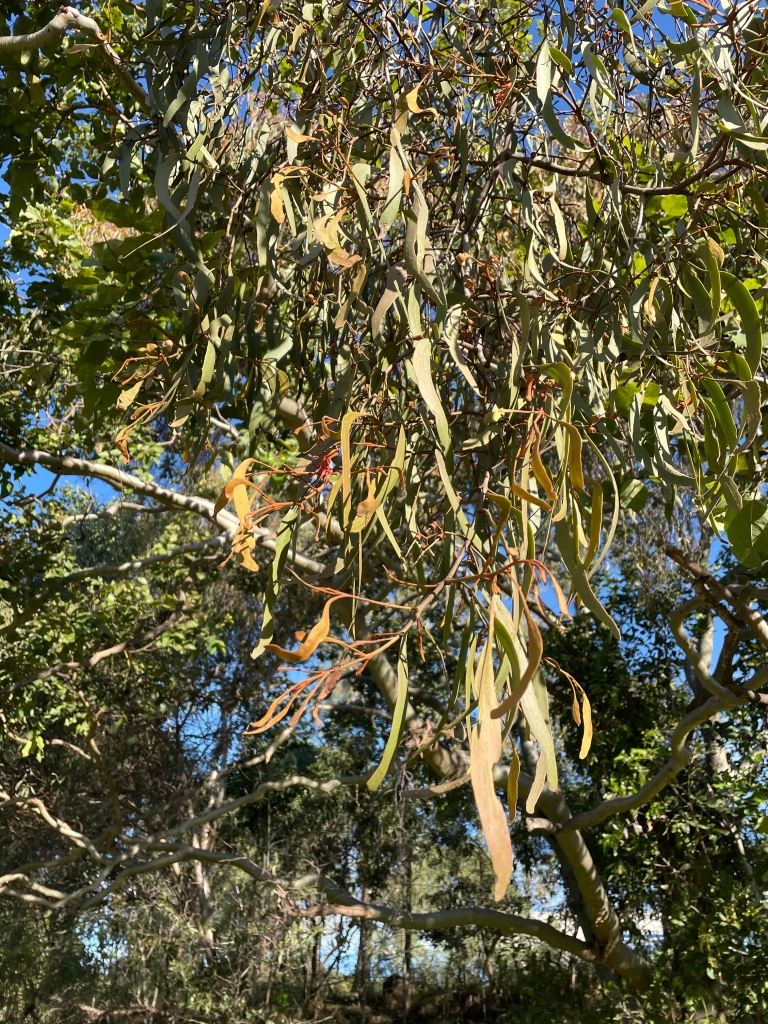
I have not yet found the species or genus name of this one infesting the ‘big’ tree in my patch. New growth on the mistletoe is rust brown while the long eucalyptus-style leaves are a cross between sage green and grey, despite what they look like on this photo.
Nor have I seen anything that looks like a bud, flowers might give me an indication of its genus. The only field guide I know about Australian mistletoes is for the temperate southern half of the continent.
Plantnet doesn’t know it. If Mangroves to Mountains (field guide for local plants) has an online presence I might find it there. We’ll see.
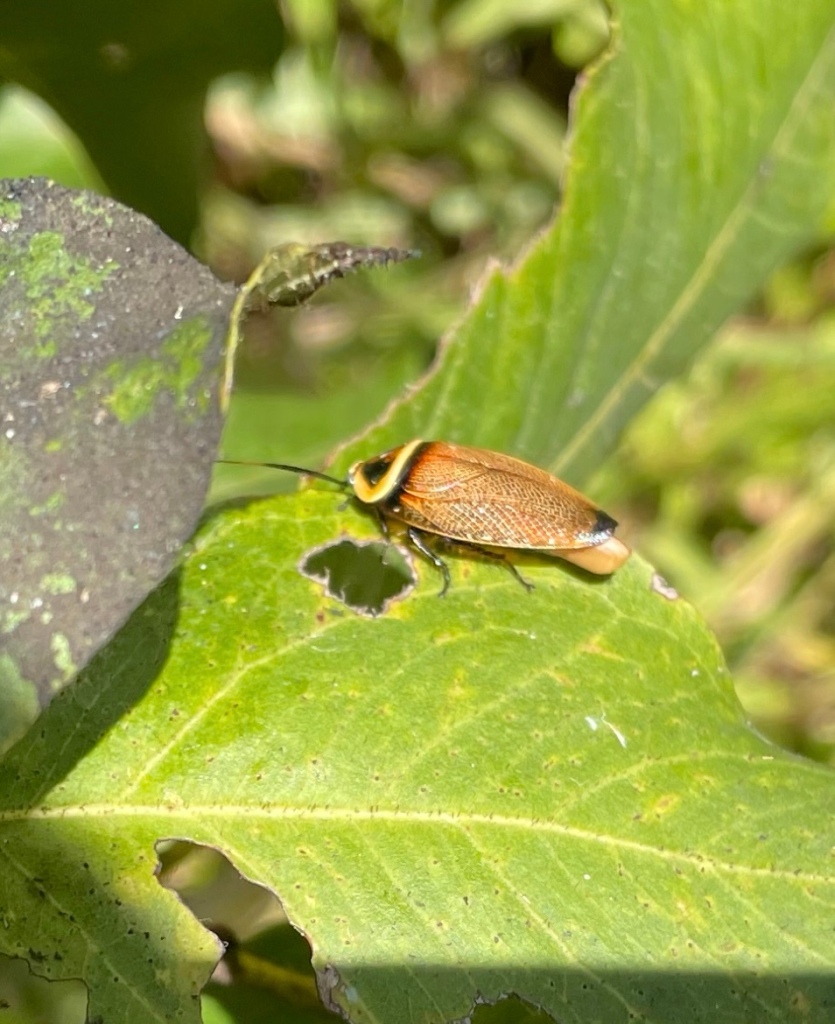
The jury is out on the bug’s ID. Just found a similar looking one in the Wildlife of Tropical North Queensland, a cockroach probably immigrating from Asia.
Or it could be a sap sucker related to the bronze stink bug. There is a sap sucking bug species, like this one on the Angophra sp, for all major tree species in Australia.
European honey bees very busy among the Tuckaroo flowers …
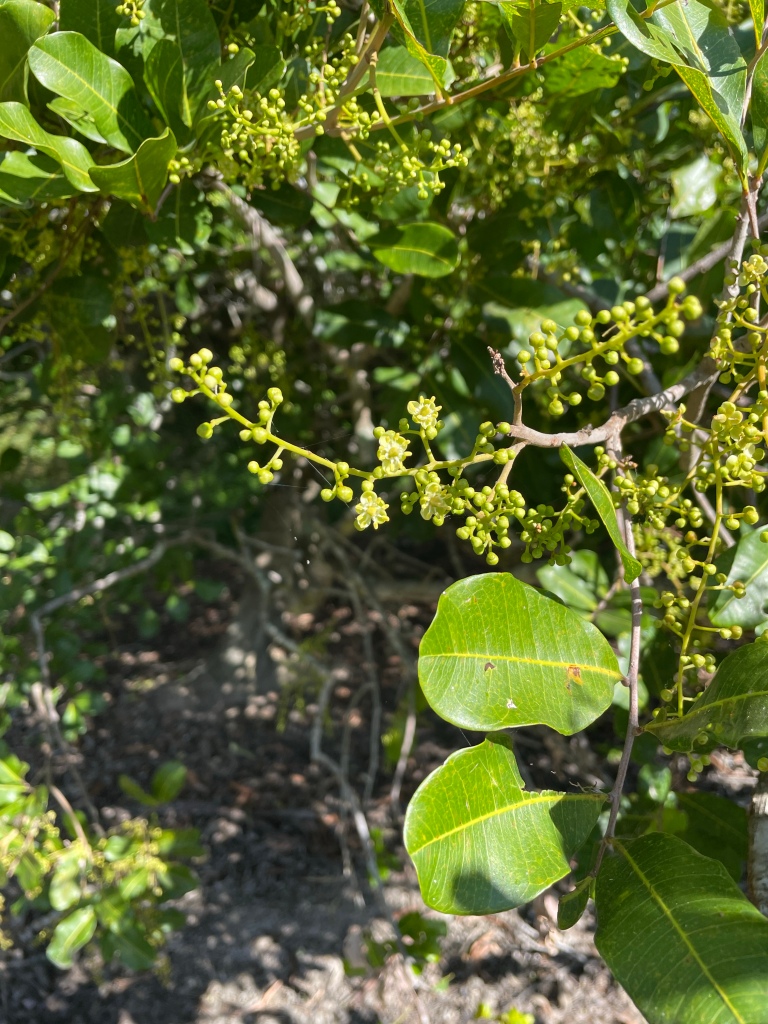
I had a little video clip here, but guess I need to negotiate with WP on that, and am on my mobile just now. Think of the above as a place holder.
A bunch of tiny blue butterflies skipped in amongst the grasses
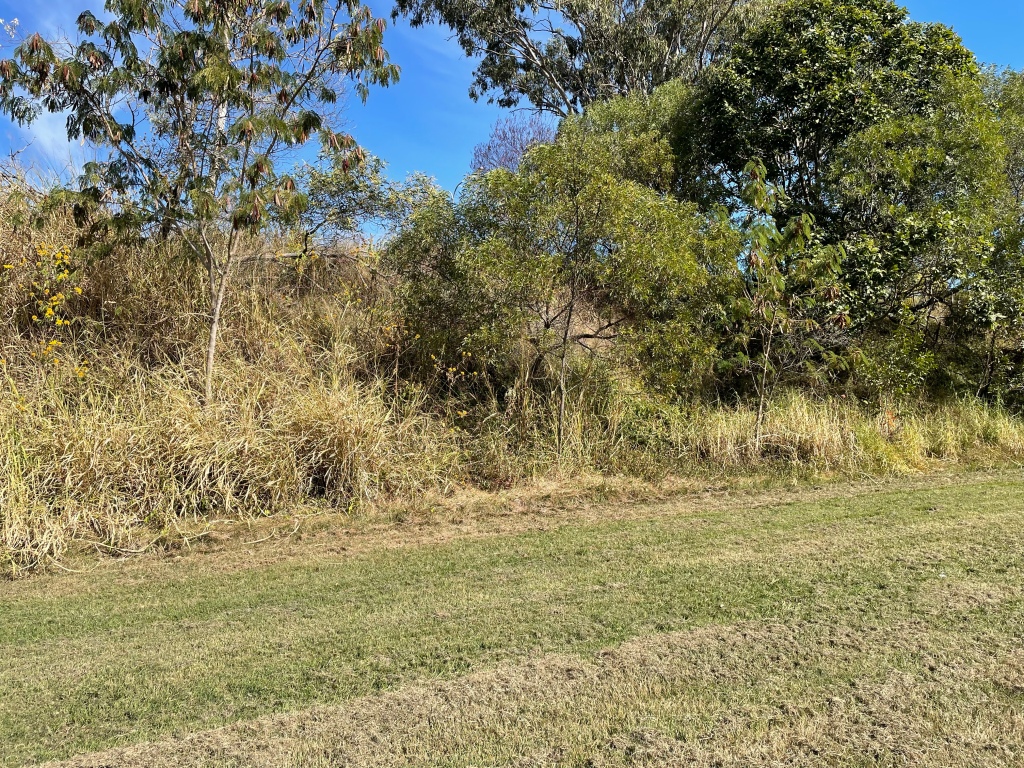
Fast fliers that never sit still they are one of approx 63 similar little blue butterfly species in the region, according to Helen Schwenke in her Create More Butterflies. I saw them among the above grasses.
If they were the Common Pencilled-Blue variety, they would’ve had plenty of food for their caterpillars for the Tuckaroo is a common host plant.
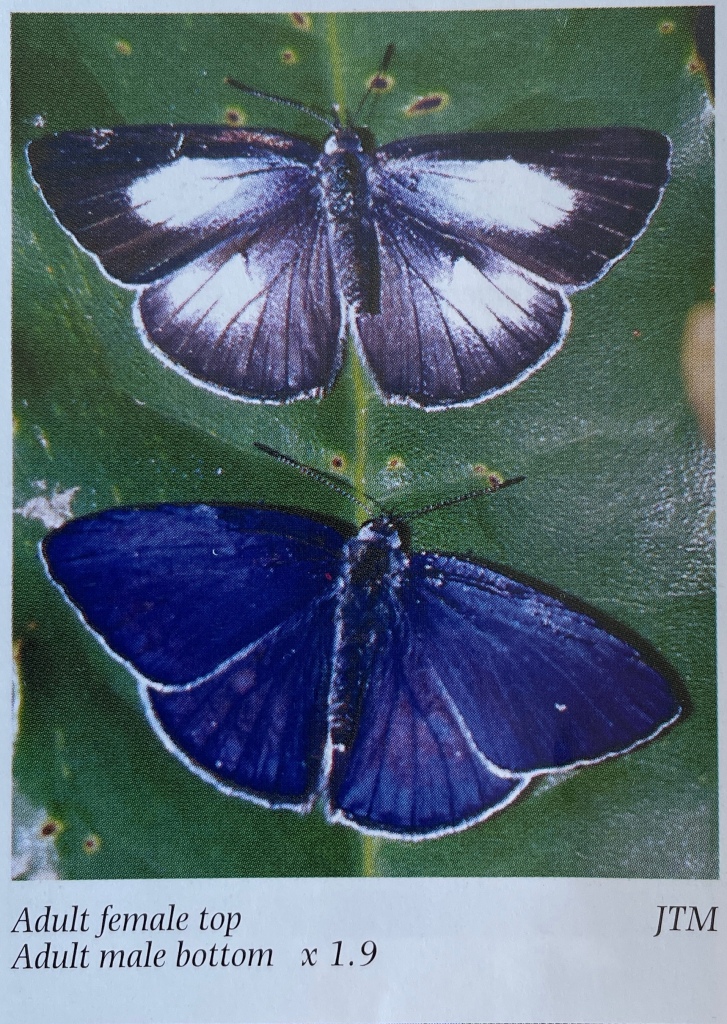
Is the steep rocky rise at the south end of Cadogen Park, a sports field surrounded by a narrow strip of vegetation.
Northfacing, the bank might as well be known as a commercial bank for its richness in biodiversity.
I suspect it was planted out purposely at one time, as the presence of human-spaced tuckaroo, acacia, and other native trees illustrates.
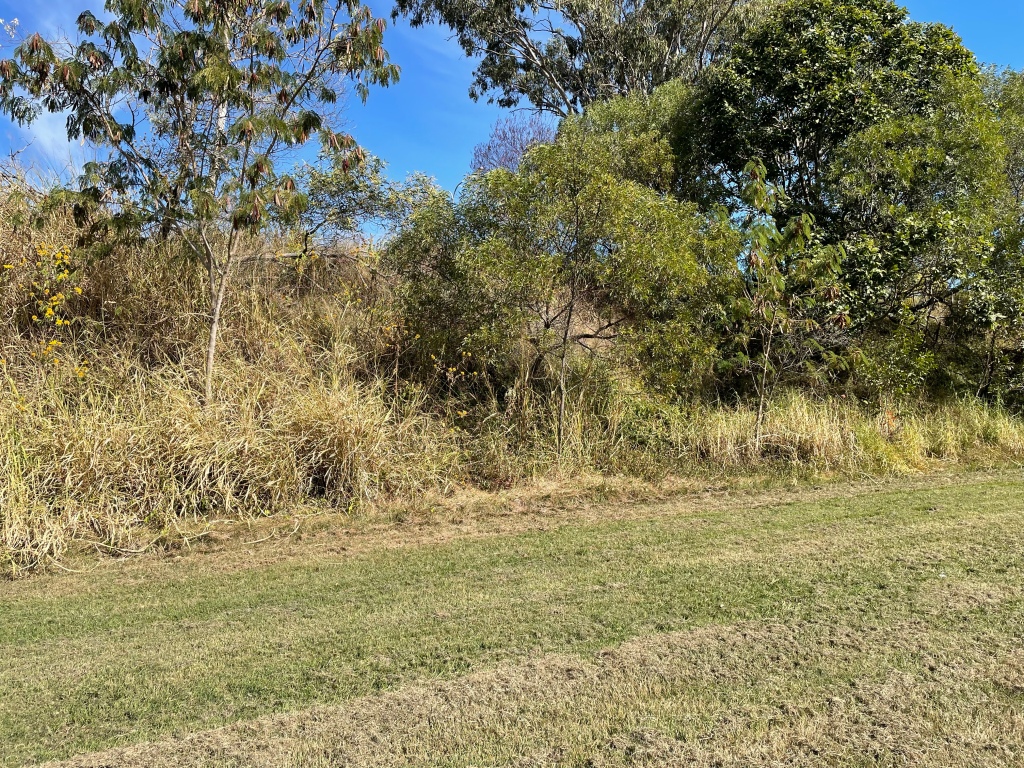
Just as many fast growing weedy non-natives have filled the spaces where originally, I suspect, slow-growing natives struggled to make a living.
The section above shows about a third of the total length. The east-bound arm of Bedivere Road encloses the western end of the bank, while at the eastern end—where I came in—a foot/bike path runs past.
In the foreground of the photo the newly mown cricket ground where two species of birds, two swallows and a willie wagtail, were busy picking up stunned insects. Though I don’t have good photos of either of them, or lol, shots I can post on the FB Crap Bird Photography group, I’v put both birds on my ‘bird species sighted’ list.

Most of the first third of the bank is influenced by this very large … still working out what it is … used to be called Angophra … a species that appears weedy in Brisbane … though this one may have been planted purposely.
This tree is on its way out. Almost every joint in the larger branches has a bunch of mistletoe hanging from it in various stages of life or death.
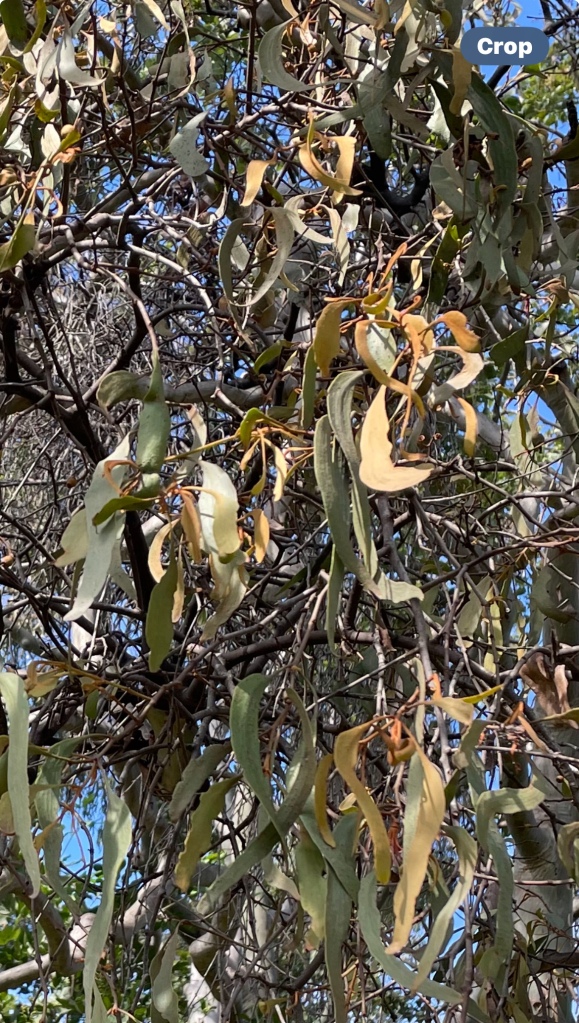
Mistletoe, the brown leaves are new growth, the grey green mature. The shape of its leaves resemble the generic Eucalyptus leaf-shape, so I wonder whether the very comfort of this mistletoe on this tree means it’s finding this … easier to eat?

Above, some of the many branches of the Angophra/Eucalypt with a bunch of its leaves in the left foreground. At my eye height all leaves were infected with black mould with every do often a sprig of tiny red new tree growth trying to push through.
This is not a tree you would happily sit under for its shade while watching the cricket, and, mindful of suddenly falling branches, I decided not to take a short cut back to the path by walking under it, either.
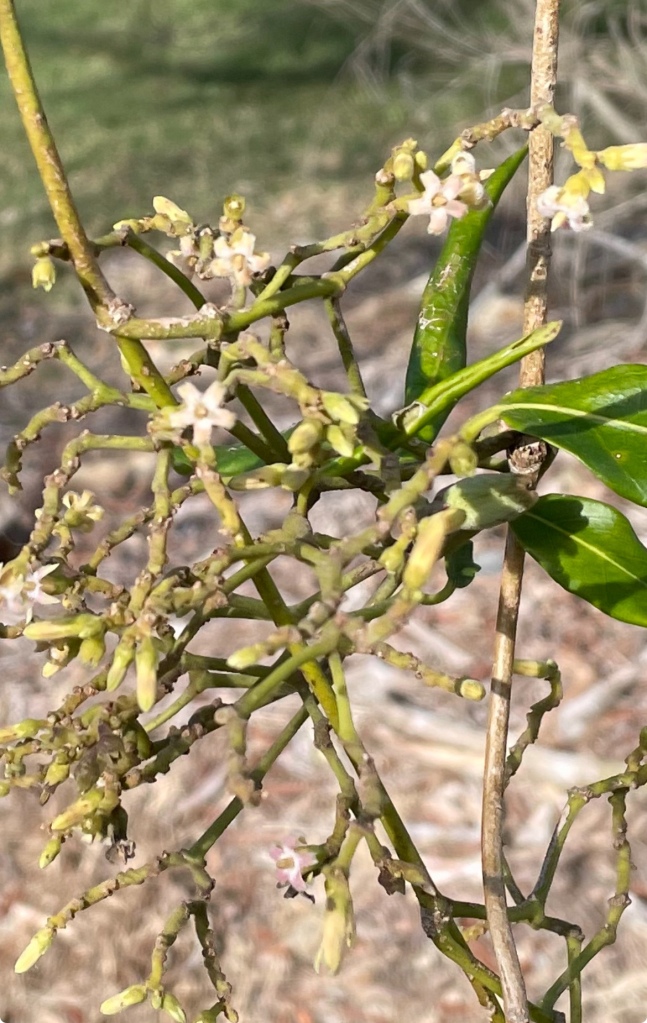
Saw a few small trees flowering … A little surprising since we haven’t even had the shortest day of the year.

The flowers above have already been fertilized, seeds are starting to develop.

I don’t know if it’s the same species as the one following, foliage on second one seemed greener.

This vine too is flowering. The tree it’s growing up is pretty well dead, just being held up be the vine, I think.
All these trees within a five hundred meters circle (1km diameter) surrounding the place where I live.
 Rita de Heer