Oh hail this magnificent hibiscus flower on this gloomy day …
Yesterday a friend staying at Carinya temporarily, walked me through the almost abandoned buildings and overgrown gardens.
This is one of the most vibrantly colored flowers I have seen. Without its flowers the shrub is insignificant, no more than a meter tall, with every millimetre of its bark covered with lichen.
I know people will tell me lichen doesn’t hurt tree bark. That may be so. But the lichen by creating little pockets, draws water to itself and that allows other, unfriendly, organisms a foothold. Rot is the next step.
When I see a shrub or tree bedizened with lichen, I see a tree in trouble, planted in the wrong place and or climate.
I’ve been waiting all day for this cloud to produce the rain that is its primary feature. Rain, that is, that falls as far as the ground.
Nimbostratus
All cloud names are derived from Latin. ‘Nimbus’ means rain cloud. ‘Stratus’ I think means spread out. This one blankets the southern sky and hangs out in the middle cloud levels, between five and ten kilometres above sealevel.
Nimbostratus rains and rains and rains, so we’ll see what tomorrow brings. Unlike cumulonimbus, the anvil in the sky thunderclouds, nimbostratus begins its weeping without fanfare. It just starts to rain.
Which has always felt wrong to me, since most of my life I’ve lived in places that attracted thunder and lightning, hail and rain bucketing down. Storms, you know? It’s only since I’ve lived in Brisbane that I’ve experienced nimbostratus rain events.
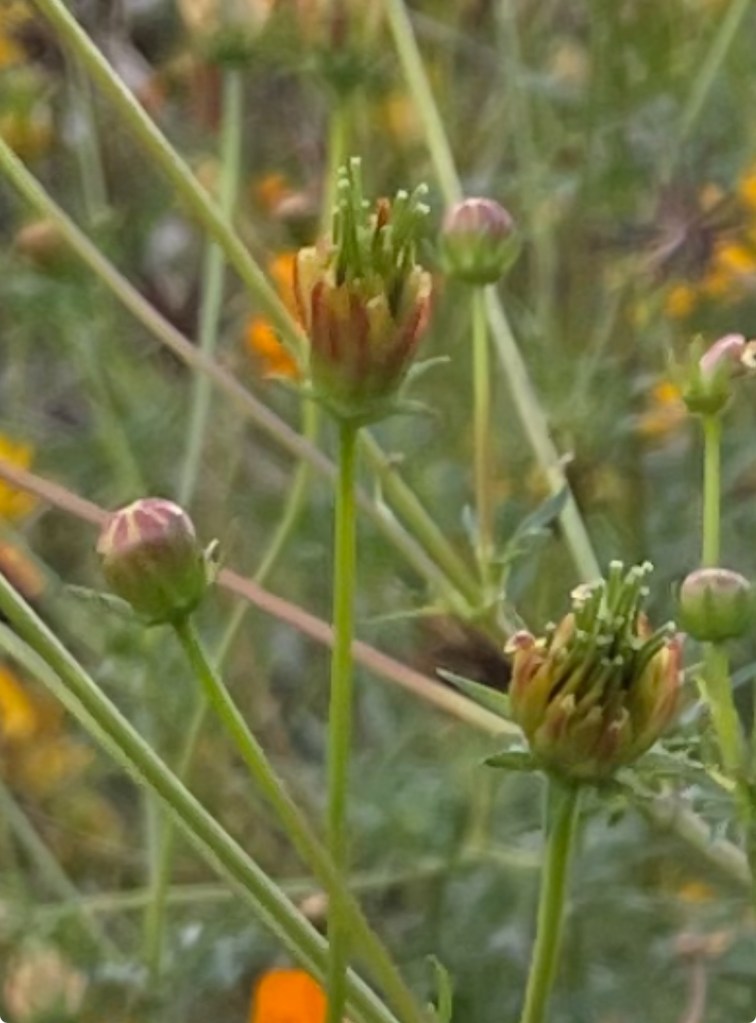
I’m pretty sure I have the name right this time. This cheery overgrowth of wild colour would’ve been a weed in most other places, but here and now in the wilderness of abandoned gardens, it’s a joy to see.
Interestingly, its seeding habit reminds me of the seed habit of the plant all bush-walkers and probably most farmers love to hate. I’m talking of the Australian weed, Farmers’ Friends.
It only needs one knee high plant to catch on your clothes, and you’re picking clingy seeds off for the next three weeks.
One old farmer I once knew, used to have to spend quite a bit of time picking seeds off his socks, since he nearly always forgot to wear his ‘shock absorbers’.
I’ve forgotten the punchline of the joke or pun this name referred to, but they are the little elasticized “skirts” people wear around their ankles, over their socks and tops of their boots. Let me know why they are called shock absorbers?
The old man, when he’d collected a 1 litre yoghurt container full of Farmers’ Friends seeds would throw them in the stove fire. The seeds hang together like velcro, so its easy to pick them up in one bunch.
However, these are Cosmos seeds heads. But if you know what Farmers Friends look like, you’ll see the likeness.
PS, that’s a shockingly bad photo, so out of focus it’s not funny. That’s one problem with composing a post on the mobile, with the photo merely being edited with the Apple editing software. I don’t like it. Probably I’ll go through the whole rigmarole of emailing the photo to myself, editing it using decent software and re-posting it.
My first butterfly at this place. The possibility of continuing to enjoy vists of butterflies is one of the reasons I wanted to live on the second floor, not the tenth.
I think an orchard butterfly, but not sure, investigating my bolly gum. I don’t have the Latin binomial at the end of my fingertips so will add in later.
In the foreground the butterfly rising from the plants, leaving disappointed, no doubt, not yet having found the citrus only a little distance toward the back of the plant array.
In the background a vast herd of Cumulus mediocris. Yes, that is what they are called. Thes are clouds of the lower altitudes, 2000 to 3000 feet above sealevel.
Cumulus mediocris appear as wide as they are tall, have proturbances and sproutings on top and do not usually cause rain, though can develop into angry and towering Cumulus congestus thunderclouds.
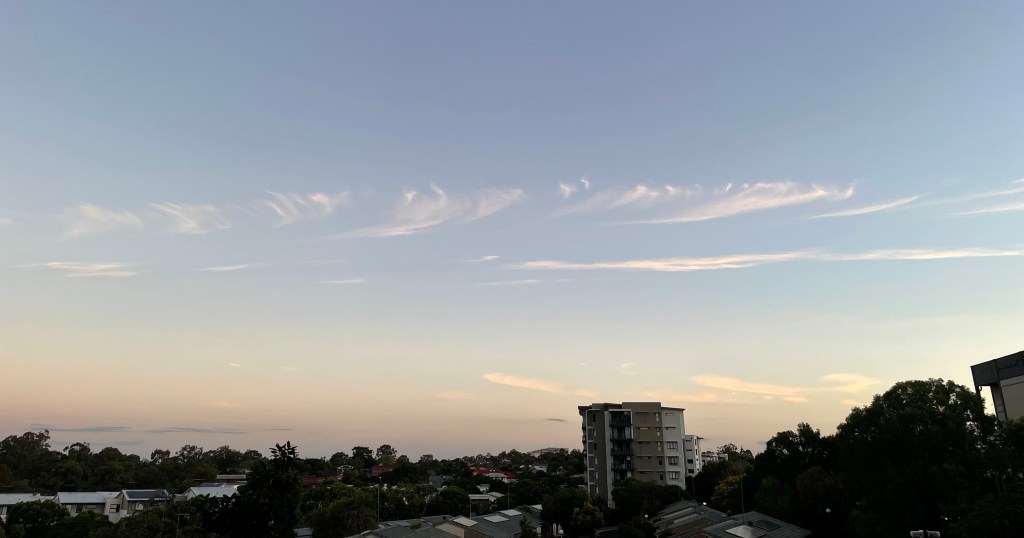
Or ‘mares tails’ elongated filaments, straight or slightly curved, without clumps or mounds on their upper sides … paraphrased from The Cloudspotter’s Guide by Gavin Pretor-Pinney.
Insert: What I forgot to say yesterday, is that mares’ tails are ‘higher level’ clouds that occur in the 5 to 14 kilometer (16k feet to 45k feet) outer layers of clouds.
They’re made up of ice spiccules that fall up there and evaporate well before they reach the ground. And, despite that these clouds look immovable, they’re speeding along at 160 kilometers or 100 miles per hour.
I was glad to see them, because up to now there have been days and weeks of the cumulous type clouds that are part of the rainy season.
Now, finally, it seems, we’ve progressed into autumn/fall. Cooler nights and days, ranging from 18C at night to about 28C in the daytime.
“The name spells it out. “Solar” signals optimism and a strong association with renewable energy, while “punk” reflects a DIY ethos and an anti-capitalist philosophy.”
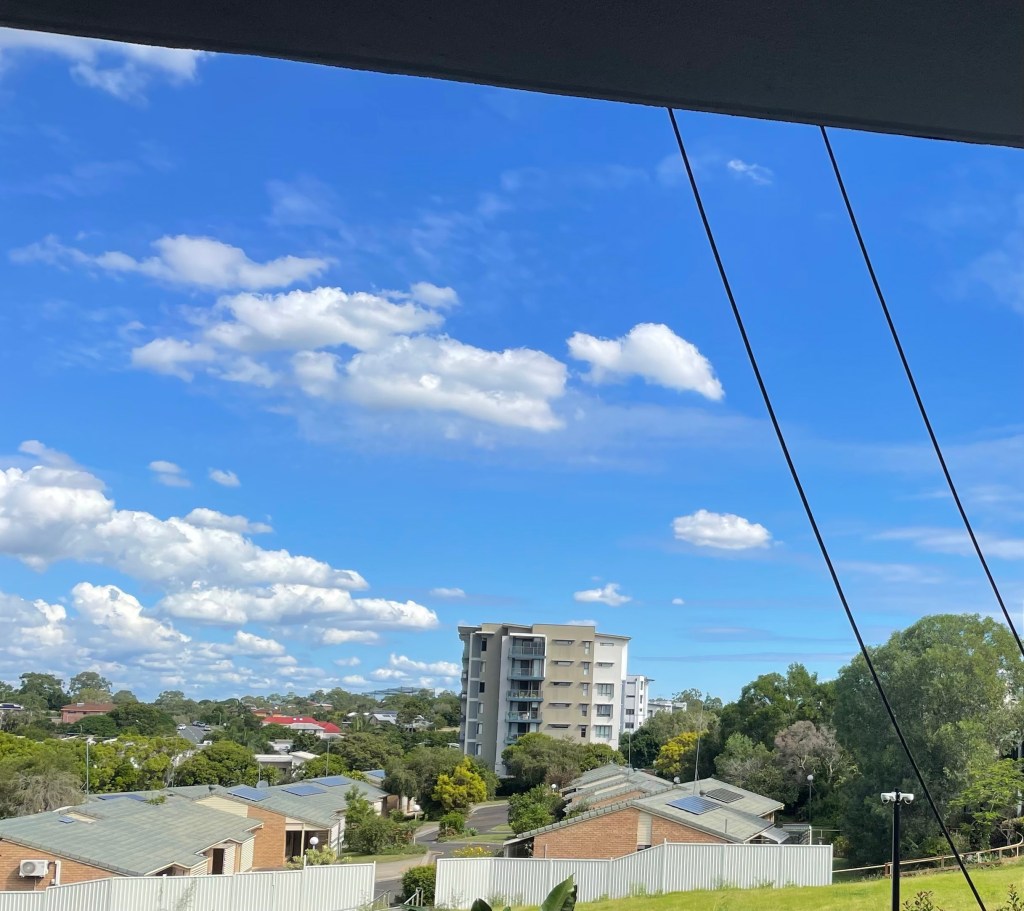
+ abseiling lines … the window washers are threaded over the building. They did a great job on my windows, which are clean for the first time in their lives. If you can talk about the lives of windows.
And my sky + a few Cumulus humilis according to my interpretation of a diagram in Gavin Pretor-Pinney’s The Cloudspotter’s Guide. Minimal vertical extent, he says. ‘They look flattened and appear wider than they are tall and do not cause rain.’
I’ve had that book for about fifteen years and this is the first time I’ve lived somewhere where I can see a decent bit of sky when I look out of the windows.
Isn’t it strange by the way, that we still say ‘look out the windows’ when actually, usually, we look through the windows? I often notice a paradoxical thing in relation with doors. We walk through the doors?
Have you tried that recently? I don’t recommend it.




 Rita de Heer