Lego: Remote Controlled Tower Crane

Part One

Model (MOC) by Tim Scheiter from Rebrickable.com

Bosley & Co’s Point of View …

So, with the river levels rising … the cabins need to be raised, the cattle paddock raised or the cattle relocated, and stores to be got in by boat or helicopter. Bosley decided they would acquire a tower crane and that it would be a permanent fixture in the village.

Jackie’s crane mounted on Jed’s truck, transferred onto a remaindered railway dolly, turned into be a good helper-crane. Great at helping to transport tower crane parts from the barges, and great at raising them to where the construction was happening.

The Build From My Point of View …

Getting the parts probably was not the hardest part but certainly seems so with postage becoming the real spoke in the wheel, after five parcels from five different far-flung places. This is the thing about living in Australia. Vast internal distances and even larger external distances which all equal to pricey postage.

And I still don’t have all the parts I need and though it’s only a short list at the moment, its length will increase as I start to modify the original design.

Modifying Before I’ve even build it? …

Yes, unfortunately. As always, space is constrained. Second, a few videos of real-life lone tower cranes swaying and breaking up in high winds, convinced me that even the stability of a Technic crane might need bolstering by being connected to its builds.

Beginning to make that happen, I found that I was using parts that will probably be needed elsewhere. The first really big problem I hit was a lack of two vital elements. Struts and panels. Just unable to get enough of either of them. I have only 5 of the panels, and 8 of the struts.
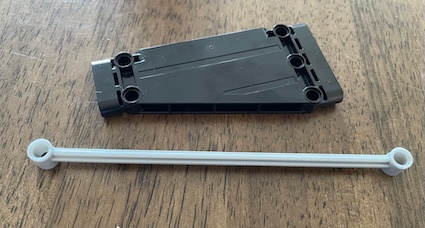

While I would’ve really enjoyed to build the whole thing without any hiccups, that was not to be. At this stage I thought I might be able to fix the tower on a base-plate with ordinary Lego pieces, support it that way.
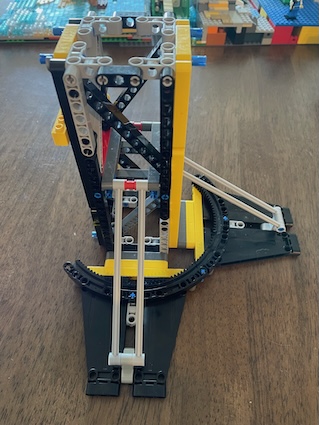

That idea turned into fixing the four-sided base of the tower to a Lego base-plate with the help of Technic bricks. Which worked very well on two opposite sides. These bricks lift the structure about 1 millimeter above the studs but because multiple pins on each side connect the two, there’s a strong and stable joint. Leaving me with the right number of strut-pieces for the jib/boom.

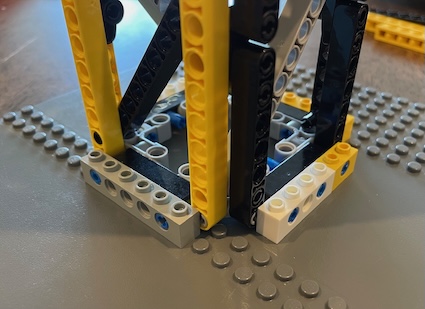
So what happened? While there are eleven studs between the first pair of two opposite sides—and there need to be—there are eleven-and-a-half studs between the second pair of opposite sides. I rebuilt the whole thing several times, tightened everything that could be tightened, but got the same result every time. By then quite frustrated.

After a while remembered the ancient roads base-plate in my collection. This is the result. I’ve done away with the need for the second pair of opposite sides to be fastened to the base-plate. They are wedged pretty tight. In the photo below you can just about see the problem, the white brick does not line up with the studs.
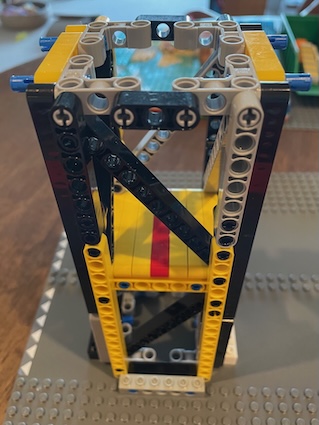
That left a final concern. Without the struts-and-panels stabilization system the tower structure was so rickety that I was afraid that with more weight on it from another section of tower, a boom and trolley, the machinery in the middle, and the power and battery system on the other end, the tower would just twist and collapse. I inserted two panels made of 7 x 7-beams midway the stage.

These are probably overkill, since I will be fastening this stage to two fire escape blocks, part of the new village build. I put them in for peace of mind.

Bosley’s Builders, 2

Lunch at the site, pizza again …

OMG, do you see what I see? Just noticed the smiley faces on the studs of the base plate … they’re not Lego, of course. But we knew that, right? It’s the Hardware Store Build and that base-plate is on notice.

This installment is now live here, on Story-ing Bricks couldn’t change a few things, like the file name, and there being no author name, as if the installment appeared out of the ether … these items are part of the set-in-concrete nature of MSWord. Hopefully those will be fixed from now on.

Didn’t change the upside down order of posts. They should be easier to find with the blog-post re-titling. That’s a WordPress thing.

So I’m wondering whether if I organize a ‘cloud’ that’ll help with find-ability. Can but try, as the saying goes.

Lego, Raft

Underside of hull …

This is the hull of Robbie Rafter’s new vessel. He will be meeting Boz … Boz in the rowboat in the shallow water, Robbie on the raft in the deep water … to discuss the forthcoming conditions.

This is the first time I’ve come to grips with Studs Not On Top (SNOT) bricks and angled plates in one of My Own Creations (moc). The problem here was the two hulls needing to be used upside down and connected to the deck plates which of course are set studs up.

Took me two and a half hours to produce the above and it is a fairly solid construction now. Although there are a couple of places where I may have used so-called illegal techniques, I was able to stabilize the area enough that elements aren’t falling off with handling.

The different colors on the underside speak of the same old same old. While I now have two IKEA Alexes and multiple little trays to store my whole parts collection in … I still don’t have enough of parts and colors to be able to construct even one color coordinated build. But never mind, the characters themselves are good at explaining away these little irregularities.

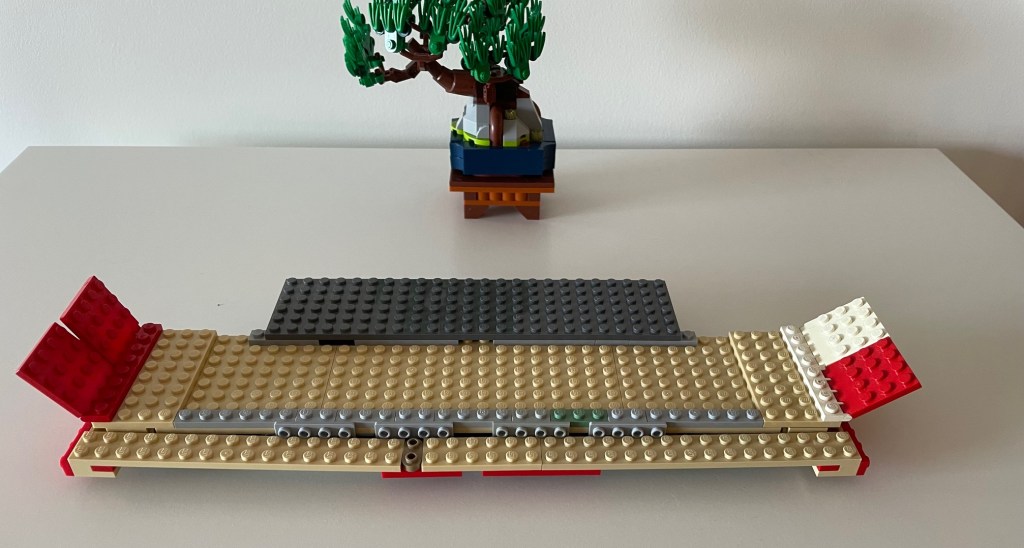
Top of as-yet-unbuilt-on hull … the dark grey platform will house the engine room, bridge, galley and the bunk room. The flaps at the ends are the gates/drive-on and off ramps. Similar to how a ferry works. The middle deck is for the cargo.

The walkway two studs wide on the near side, will allow Robby to save fuel and his propeller by ‘walking’ the boat through shallows … setting his pole in the mud and forcing the boat to move by walking in the opposite direction to where he’ll want to go.

Spoon Theory

In the ME/CFS arena it’s said that we have eight spoons of energy per day. And we do careful calculations so we don’t go over the eight because, woe betide me, going over means a week or more of resting and recovery.

Pacing is never going over your eight spoons per day.

Habits and routines are godsent, for they save me from having to make decisions. And decisions come at 12 and a quarter per spoon, if it’s true that we functionally have energy for only a hundred of the pesky blighters per day.

Habits and routines mean I am on automatic, doing stuff without consciously realizing it. Which can often work well. Though not today.

Today (Wednesday 10th) I sorted Lego in the morning. Used up eighty percent of decision making energy just deciding little things like which drawer, which container? More or less unconsciously.

This all, I am assuming now (Thursday 11th) so that I wouldn’t have any energy to do my usual wishy-washy, will I—won’t I, and just go … see Centrelink, and in the usual way fail to solve the problem due to not thinking it through before starting out.

Which is exactly what happened. I had about a quarter of the paperwork needed, and the operator organized me another appointment tomorrow (Friday 12) for an in-depth thing when they will put me through the wringer.

Own fault, though my good excuse is that I was, it turned out, half sick. Today, Thursday 11, whole sick.

Lego: On the Wall

After a lot of thinking and a couple of trials, decided that pieces of base plate would work better than a whole base plate. A pair of kitchen scissors did the trick.

Pieces had to be three by seven studs to fit the velcro fastener.

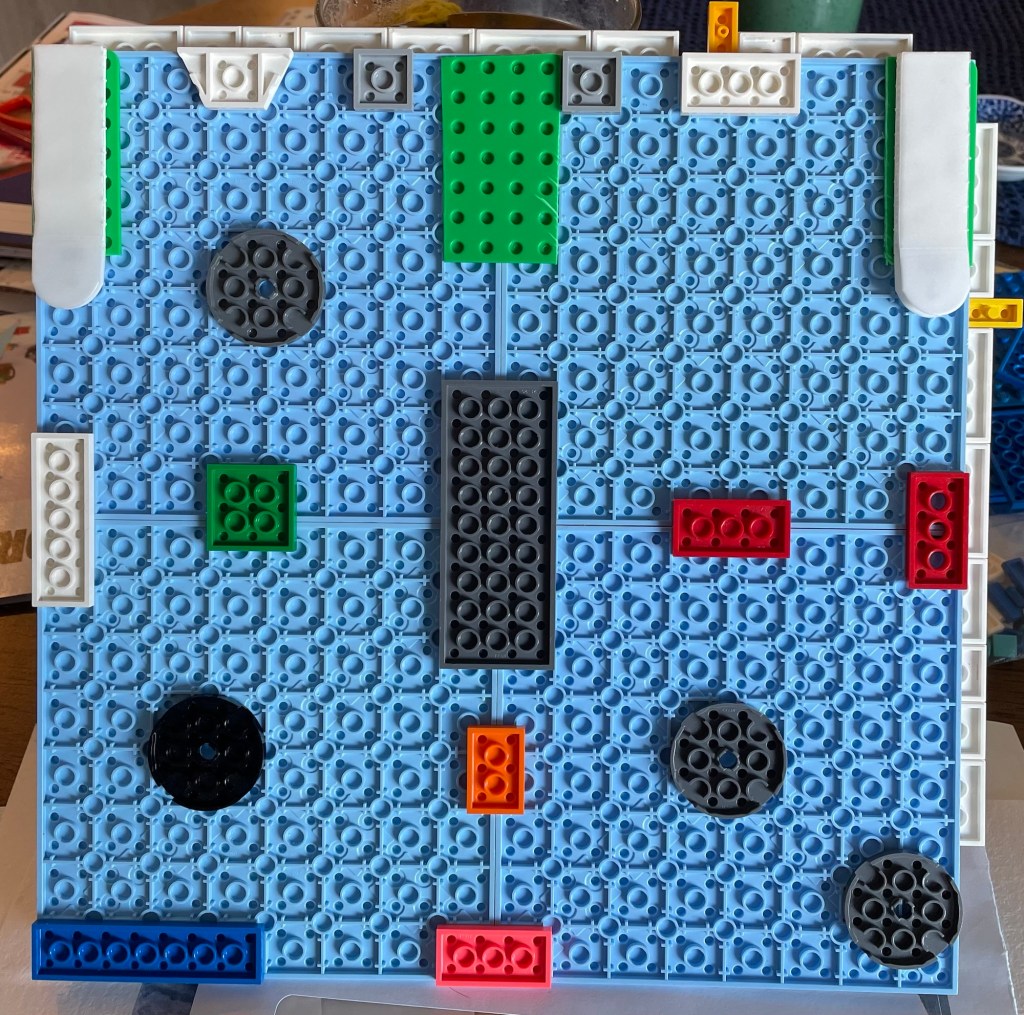
These four 16 x 16 plates connected by various other plates make up the base for the first part of the scene I’m intending to display outside my unit door.

Of the three bits of green base plate at the top, only the outside two have the wall mounts. The middle one is me testing its joining capabilities. Two wall mounts together will hold 4.5 kilograms the packet tells me. Plenty for the purpose.

What I discovered a minute after I glued the velcro fasteners to the wall … the two fasteners—one gripping the other and the thickness of a bit of base plate—are nearer to two plates thick than one.

Meaning I’ll probably need to add a two by one plate to the back of all the joiner plates, for the scene to hang straight against the wall. That’s my next thing to do.

He’s got the boat stuck on a sandbank, right?

Lego: The Supply Lama

Nothing to do with the new project, this set has been sitting around unopened for a couple of months.

I bought it originally because it looks like how I imagine the tiffanies in Earth Fall, thought i could maybe use it to illustrate various chapters.

Then opened the box and discovered the intricacy of the build. This will be one of those sets I’ll never take apart.

So last week had a surprise visit of the grandkids. The five year old went to the shelf and got down transparent bricks set she has been working her way through.

Leaving the almost eight year old a bit affronted, not being part of that far too easy a set for him. I said what about this one then? The supply lama that was.

He and his father built mightily and got to the end of bag three with the lama still just a forebody—very sturdy—and a box with open sides. Forgot to get that image.

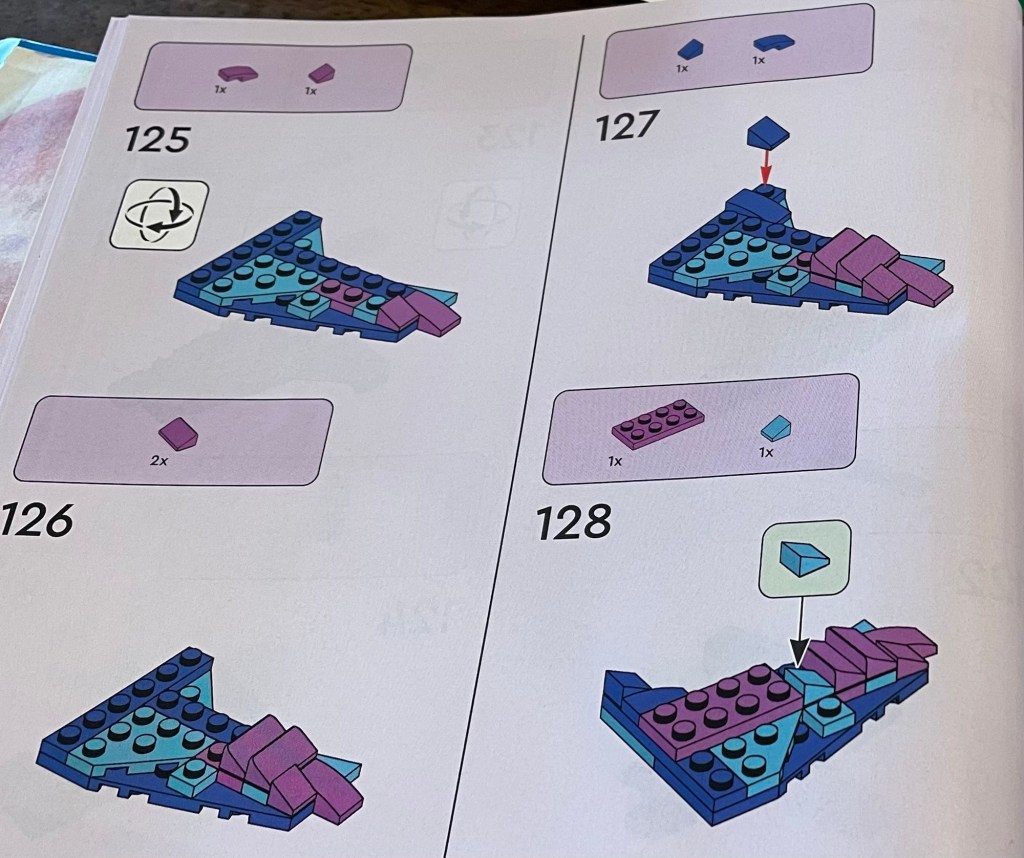
After about a week of it sitting around, I thought I better start on it. Most of Bags 4 and 5 were the cladding. Struck me that I really had to trust the instruction booklet because most of the time I had no idea what I was putting together.

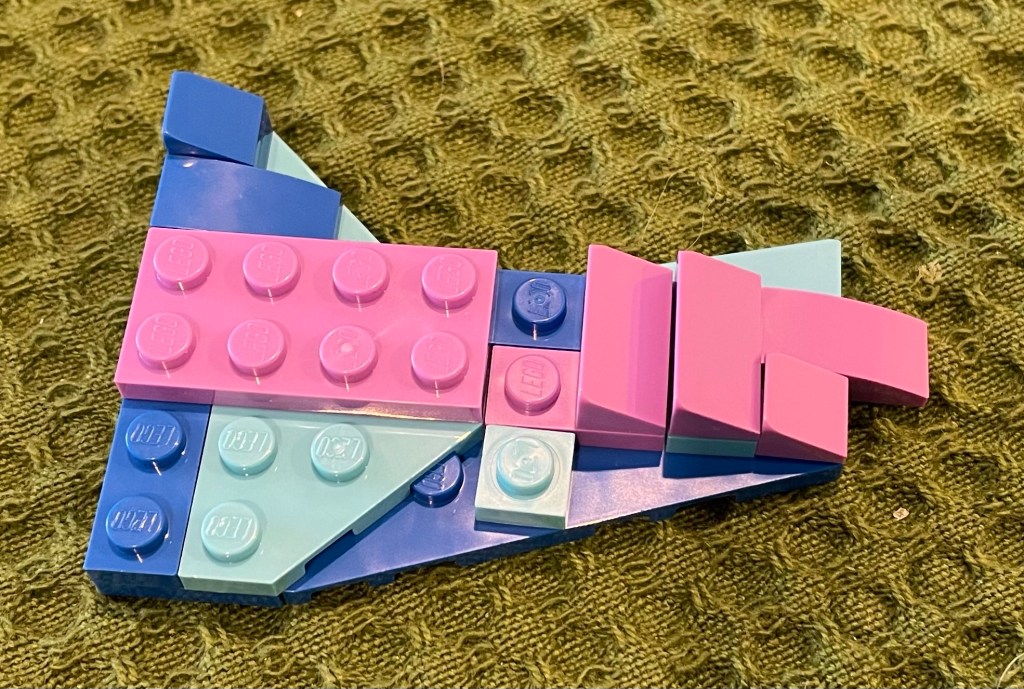
This for example …

Then the booklet gave me what the finished article should look like, and then where on the lama it should be installed.

A side neck piece, in case you’re wondering.

It wall be how to do the legs that I will be taking away with me, as they are quite elegant and I can see them on several other animals.

Constructing the head was fun, when you put the eyes on it suddenly has a character.

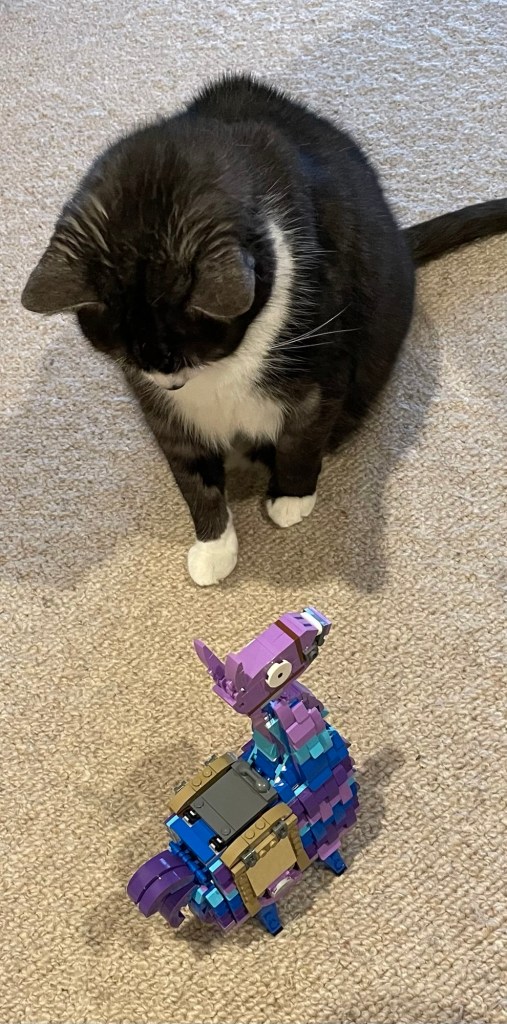
Moggy is a bit iffy about it. Like she’s saying, Do not come any nearer!

I haven’t put the Fortnite stickers on the hatches yet as I may still use the animal in a different story.