Indigo

Indigo by Daniel Smith is probably the watercolor I use most, and is also my favorite to experiment with … if that makes sense. This indigo is so finely milled it’s the smoothest paint I own and yet it’s capable of amazing gymnastics. Below a wet layer of indigo over a failed experiment (which is represented by the pink tones) with phthalo blue dropped into it.

The Indigo, being smooth and light (weight) allows granulars such as sodalite, and heavier colors such as phthalo blue, to react spectacularly.

Getting shades by dipping a brush into water after a stroke, indigo will last longer than any other color and make the most wonderful greys.

One of the newsletters I subscribe to is Books on Books curated by Robert Bolick (https://books-on-books.com/2025/03/23/books-on-books-collection-louis-luthi/)

This month’s letter took me to a link (https://sites.rutgers.edu/motley-emblem/indigo/) where I discovered some interesting facts about indigo. So far about 200 plants have been discovered that yield indigo, and it is nearly the only color-fast natural plant dye.

The two hundred plants is quite a surprise as the Japanese indigo cloths are quite expensive and said to be made from a rare plant. Several cultures in Africa also use indigo to dye cloths. I’m wondering now whether the original processes make these products expensive, there is bound to be a lot of processing necessary to make dyes from scratch.

My only experience extracting color from wild plant materials to dye wool, has been using lichens to make a dark red, and that was by boiling the lichen and the yarn in ammonia, then setting the pot in a sunny place for three weeks, stirring it daily. Reading how indigo was/is extracted, it seems a similar process.

Following the links, the Brooklyn Museum webpage presented me with Catherine McKinley’s article on indigo’s influence in women’s culture, where Indigo is spoke of as rare … as in “the rare, refulgent dye and the commodities spun from it.” from (https://www.brooklynmuseum.org/stories uncovering_a_womens_history_of_african_indigo) while Bloomsbury Press offered me one of McKinley’s resulting books https://www.bloomsbury.com/us/indigo-9781608195886/

In Asia, cultures such as Javanese batiks and ikats, and Japanese aizome also made indigo famous.

Nowadays ammonia is one of my no-no’s in that I’m allergic to everything with chlorine in it, though fabric dyeing has remained one of my interests. It was only a small hop to watercolor painting on cotton paper.

Wikipedia’s article on indigo, in particular growing the plant https://en.wikipedia.org/wiki/Indigofera_tinctoria

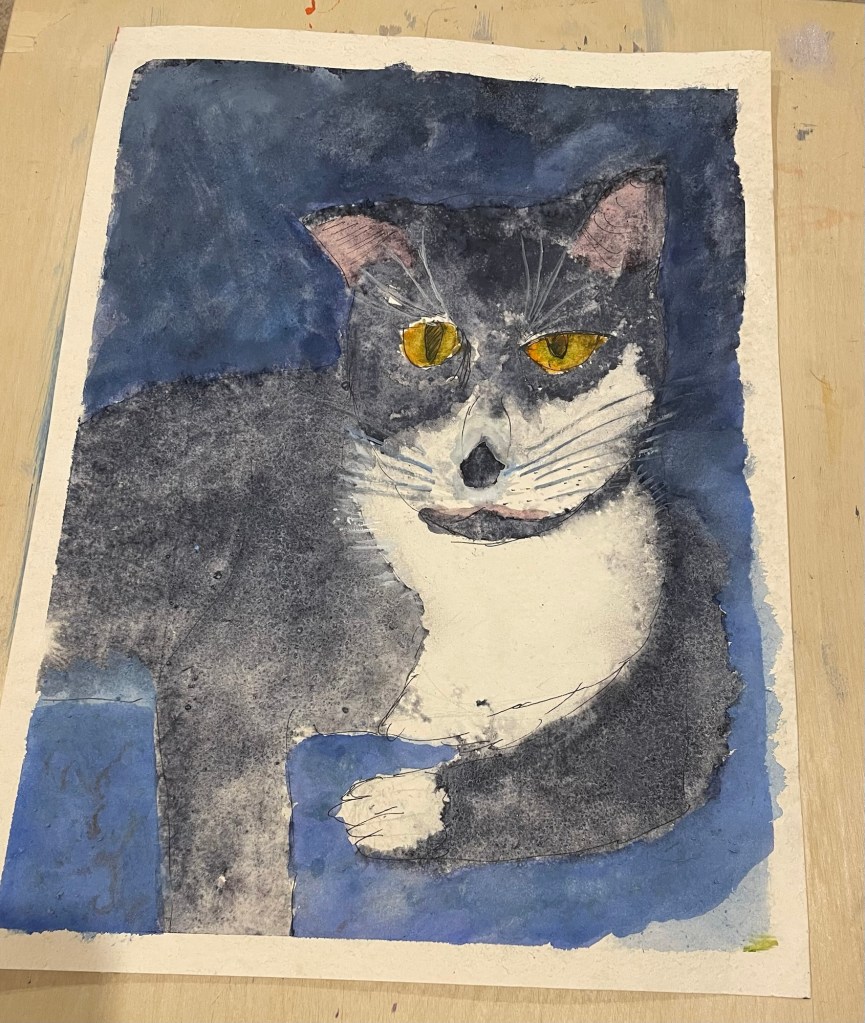
Been Painting…

All paintings are multiple experiments.

A3 size paper … could I sketch my cat and have it come out realistic? Her head is too long, has to be rounder next time

Could I use grainy paint and make that represent fur? sort of.

Could I make her eyes seem to look at the observer? Negative on that so far.

Could I tie the background together using a gesso glaze? Glaze too thick, blotted out the detail. Cat is sitting on a blue couch. Can’t really see that.

The original technique of spray and paint didn’t work all that well, need a better spray/misting bottle.

Other than those points I’m pretty happy with it.

Water color-painting .. practice

Learning a craft takes a lot of practice. When I was stil pretty new to watercolor painting, I used to try to paint on any type of paper and thin cardboard.

Not all of it worked. Art calendars featuring photographic art have a lot of marble dust in them. Paint sits on top until it dries. Made for some interesting experiments.

Then for a while I used mixed media papers, they worked better and I still have a few of those paintings.

Lately I’ve gone into 200 gsm paper specifically made for watercolor and since I have a problem throwing out good things that might be useful one day, I swear I’ve hung onto every bit of used 200gsm paper I’ve painted, it seems like.

Of course I laugh at myself but then don’t throw anything, I have a bag full of painted scraps for collaging.

Recently I’ve felt the need to practise painting a ‘wash’ or ten. Something I have a lot of difficulty with. So ended up with ten washes on four sides.

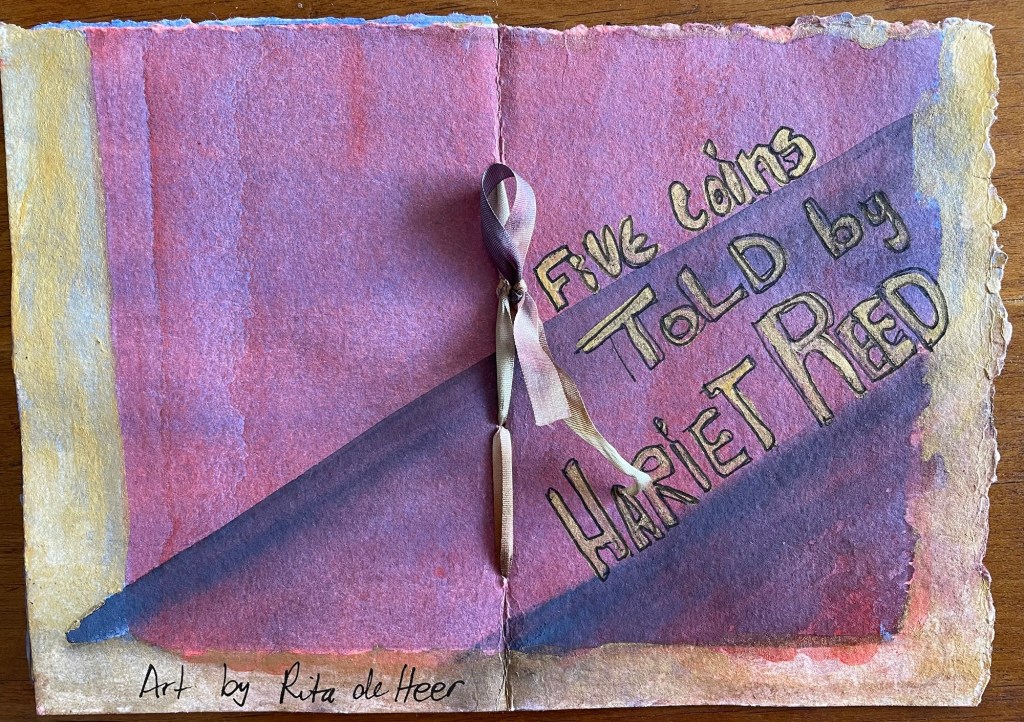
Made them into a little art zine … if I have that terminology right. Here the back and front covers (three washes)

The story was going to be about a red planet but the nickety nog said No!

Several aspects about this booklet please me quite a lot. The size, a quarter of an A4 page. It’s just enough for a short fairy story. I like the way the torn edges of the pages look edged with gold.

‘Hariet Reed’ is a pen name scrambled from my real name. Good for the witch telling this story. I don’t like the stickers much, will rethink that aspect. The random design of the pages (all those washes) worked well.

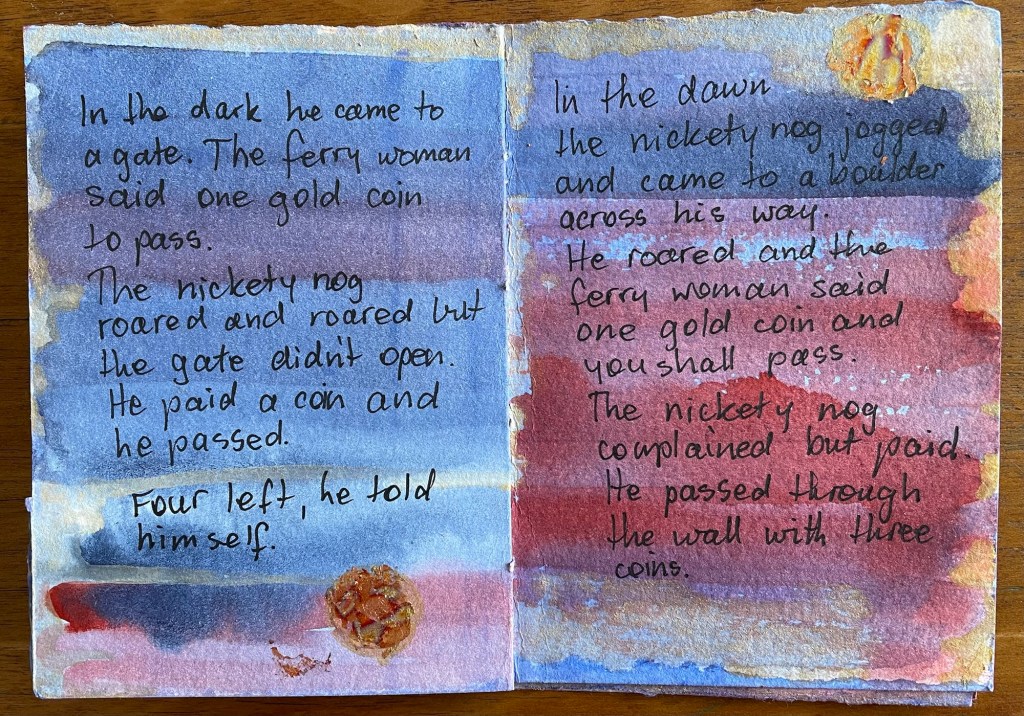
The story became a dark in color as wel as plot little tale about a nickety nog demanding a five and after being offered various juicy morsels and rejecting them, stealing five gold coins.

The story lacks cohesion, there are a couple of glitches, as well as other things I could’ve done better. The gold coins for example.

Some of the coins are gold-leaf on pva glue, none of them turned out round and some were rounded later with acrylic paint. And then towards the end I thought might as well paint the whole coin with acrylic gold. Worked the best of the lot.

All useful things to remember for when I make the next little story book. Only the last two pages were over-painted to help the tale end.

Watercolor Painting

For the last week or so I’ve been busy intermittently with my latest painting. A3 size, part of an ongoing learning curve. Can count the number of successful A3s I’ve done on one hand.

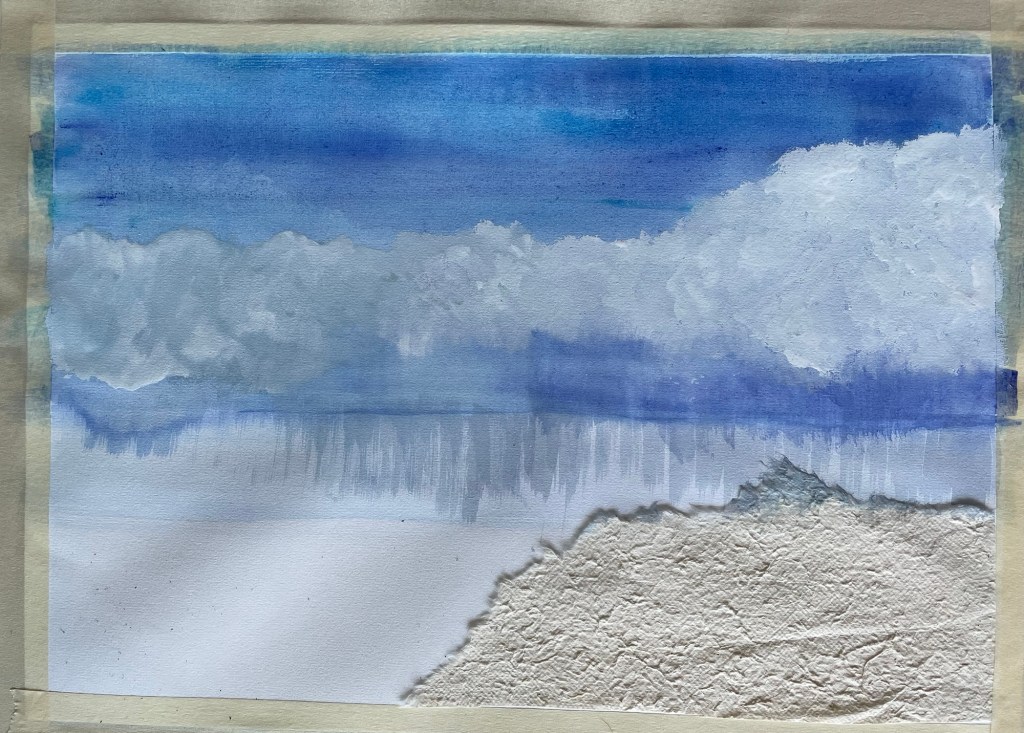
I wanted to use a collaged element, some textured paper that I’ve had for about 25 years.

A mix of French Ultramarine and Phthalo blue for the sky, clouded with gouache white going into grey. The headland unadorned in situ weirdly looks inset, rather than glued on top.

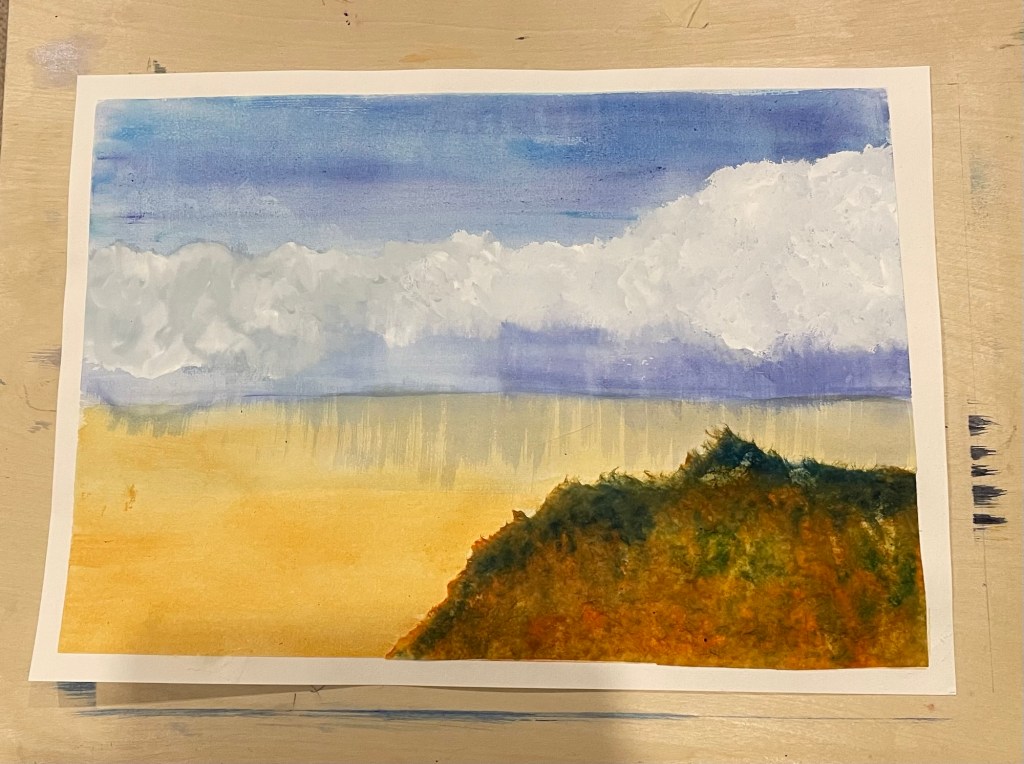
Headland and sand flats painted with Quinaquidrone Gold, headland in addition with Phthalo blue (green shade). Beautiful rich colors, but the sandflats too bright, too gold.

Left it a couple of days. Toyed with collaging an old building in the lower left. Read John Lovett’s website about ‘distressing’. Found a bristle brush. What he recommends for distressing.

Scary stuff to actually do it.

The big middle area painting every which way with grey made of the previous colours and a smidgen of Alazirin Red.

The dark diagonal area running down from the middle was the only problem. After trying to stare it gone for a couple of days, I wet it and mopped up excess paint. Repeated as required. At the same time disappeared the slumped bit of the horizon.

Then the gate. Something in the foreground is a way of getting depth. And that worked. it’s hard to get a good photo. For instance there’s no hill in the left of the picture. That line is much less obvious.

But, OK, I’m happy with if.

Colours/colors …

What do you see?

I see a warm red and a warm green watercolour reaching out for a 50/50 agreement.

I might be wrong though. The red is warm, I have no doubts on that score. But the green?

Apparently if a green leans to its yellow side on the colour wheel it’s classified as warm. And cool if it leans to the blue side.

Light yellowish green has always seemed greener to me, and so cooler. Blueish green on the other hand, felt richer and lush, and so warmer.

I’m about to do that exercise again using Alazarin Crimson, which leans towards its blue neighbour so is classified as cool, and Hooker’s Green wich also leans to the blue side.

And after that, a second trial with the so-called warm versions of red and green. I assume I’ll need to use a scarlet and green made with a warm blue and a warm yellow.

I expect neither of these exercises to resemble the above but we’ll see what we’ll see.