Old Safety Pins

Way way back when … when babies and toddlers wore cloth nappies (diapers to you in the north western hemisphere) safety pins were common.

The strong, well-made ones with the slide down safety caps ruled. Women regularly wore them pinned to their aprons while they bathed their babies.

Sometimes there was a cry through the house, where are the safety pins? For years and years, millions of nappies were safely safety-pinned around all the babies who wore nappies.
Yes, of course there were accidents, babies getting pricked. But not as often as disposable nappy manufacturers shouted about. There was a technique that you were taught in prenatal classes. You only stabbed your own fingers a few times until you learned.

Now we don’t have those particular accidents. But can you imagine the billions by now of disposable but not degradable diapers in landfills and oceans everywhere? And so there’ve been other, also frightening accidents.

Whales and other marine animals choking on soiled nappies thrown overboard a boat. Soiled nappies choking the gutters and causing floods.

Soiled nappies flushed down toilets, nappies dumped by the side of roads and wildlife trying to eat them. At least when my mother, who out of sheer frustration had to dump a full nappy in a train station’s rubbish bin, that nappy was made of biodegradable cotton.

I remember her mourning the necessity and the loss, sixty-eight years ago. The railway station in Genoa, Italy. The family, including the now four month old twins, were on their way back to Netherland after a year in Indonesia.

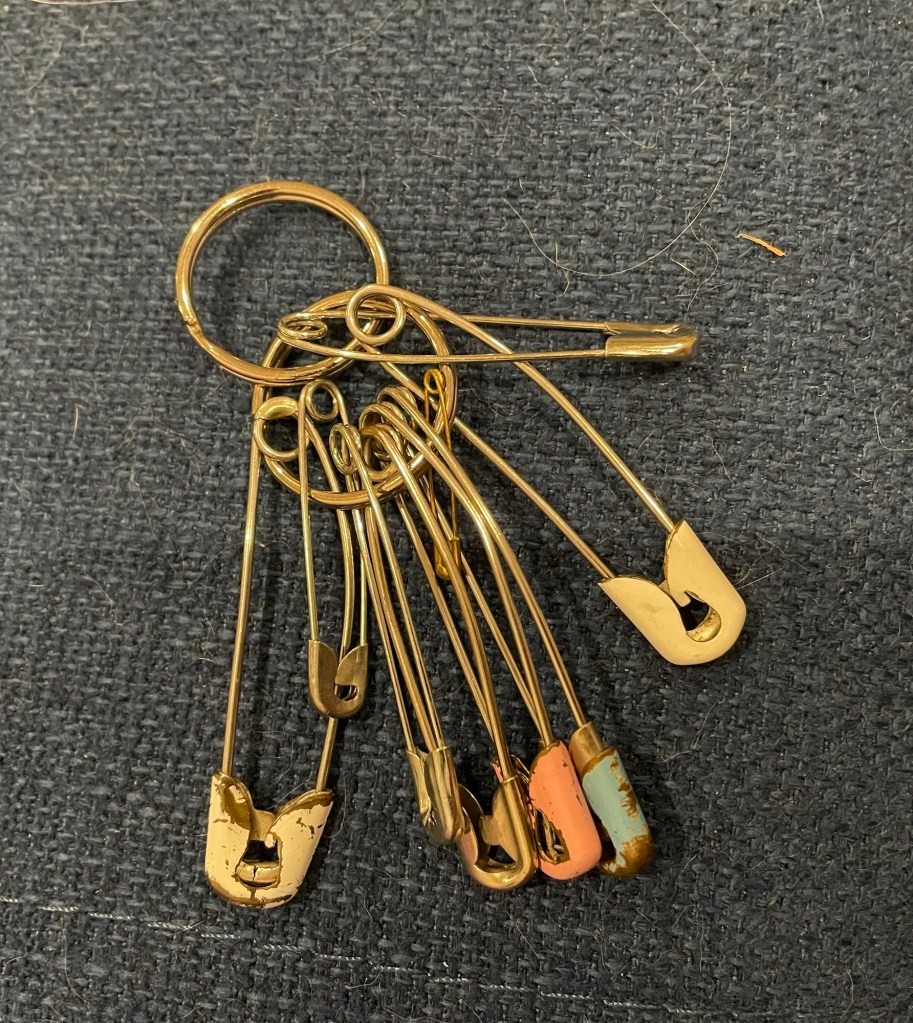
That up there is my collection of old safety pins. At least three are forty years old from the time when it was my turn to pin nappies on a baby. These pins still going strong. I wouldn’t like to be without them.
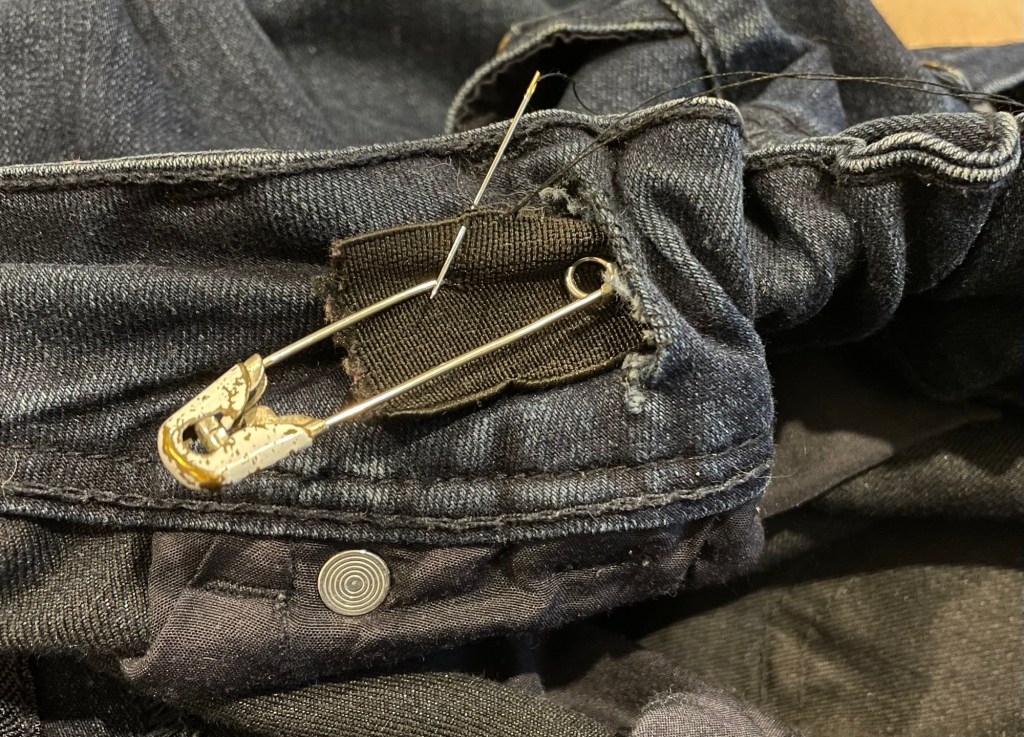
This little repair, for instance, does anybody ever replace tired elastic in jeans, pyjamas, etc? And how, if not with the help of safety pins?

Felting … Felt … Feeling

This glorious riot of autumn colours is a piece of felt that I made in a wet-felting workshop about 21 years ago and then began to embellish by embroidering with Exotic Lights silk embroidery yarn hand-dyed by Robyn Alexander for her Colourstream label.

Back then I worked part-time in the original Colourstream studio, packaging up orders of hand-dyed silk embroidery yarns and ribbons amongst other things. I look back with nostalgia on that time, the only paying job I was able to hold onto for a few years while struggling with ongoing ME/CFS.

I thank you always, Robyn, when I use the silks and handle the things I have made using them. I still love the embroidery silks, and use them exclusively when I sew where stitches will show.

Unfortunately, though, fine needlework has gone by the way a bit in the last five years due to neuropathy. Especially frustrating when I look at photos of various elderly relatives still doing fine embroidery into their eighties.

But you read that right. Twenty one years, plus or minus. I tend to keep textiles I’m emotionally attached to, however unfinished and or decrepit they may be. Where the feeling in the title comes in.

This piece of felt is in no way decrepit and though it’s been packed away for years, looks as good as new. At the time, I sewed it onto a canvas backing thinking to make a fancy cushion cover. That obviously didn’t happen. It would’ve been a waste as any cushion in my house puts in the hard yards.

But you know, a 40×40 cm almost-square like this isn’t much use other than as a cushion cover. Every few years I get it out, I have it hanging around for a while, and even maybe think up a new possible idea for doing something with it. At one stage I planned to make it into a wallet-type bag. I don’t know what happened. I must’ve got frustrated with the idea and packed the piece away again.

Brain/Mind

Getting my mind back after an anesthetic, even one of only 25 minutes duration was always going to be an interesting experience. One of my tests for regaining normal brain power is doing a crossword puzzle, and I have to confess that seven days after the fact, I’m still floundering in that respect. I successfully solved the Decoder Puzzle but am having a lot of trouble thinking up the required words for the Crossword Puzzle.

The eight letter US state had to be Arkansas in the end. Delaware just didn’t give me the right letters.

I remember my mother, Hendrika, complaining about a fuzzy brain after an operation in her eighties. It took her fully three weeks to remember, after knitting four or five false starts, how to knit socks. When she did finally remember the pattern, she never knitted anything else apart from 10 cm squares in the last three years of her life.

A few of Hendrika’s grandkids wearing her socks. She knitted about a thousand pairs in her later eighties, donating them to charitable groups after the family were supplied.

It has been suggested that as eldest daughter it would be fitting that I undertook that same project, but I’m afraid I might’ve built up a bit of steam and blown that suggestion out of the water. Seriously? I love knitting, but don’t have my mother’s fortitude to be knitting the same pattern over and over, and for years on end producing two or three pairs a week.

In fact, I like to invent patterns as I go. I started on a vest with the new yarn. Knitted a few experimental squares but decided in the end to go with diamonds. More on that project in a post.

Knitting

Treated myself to some new yarn …

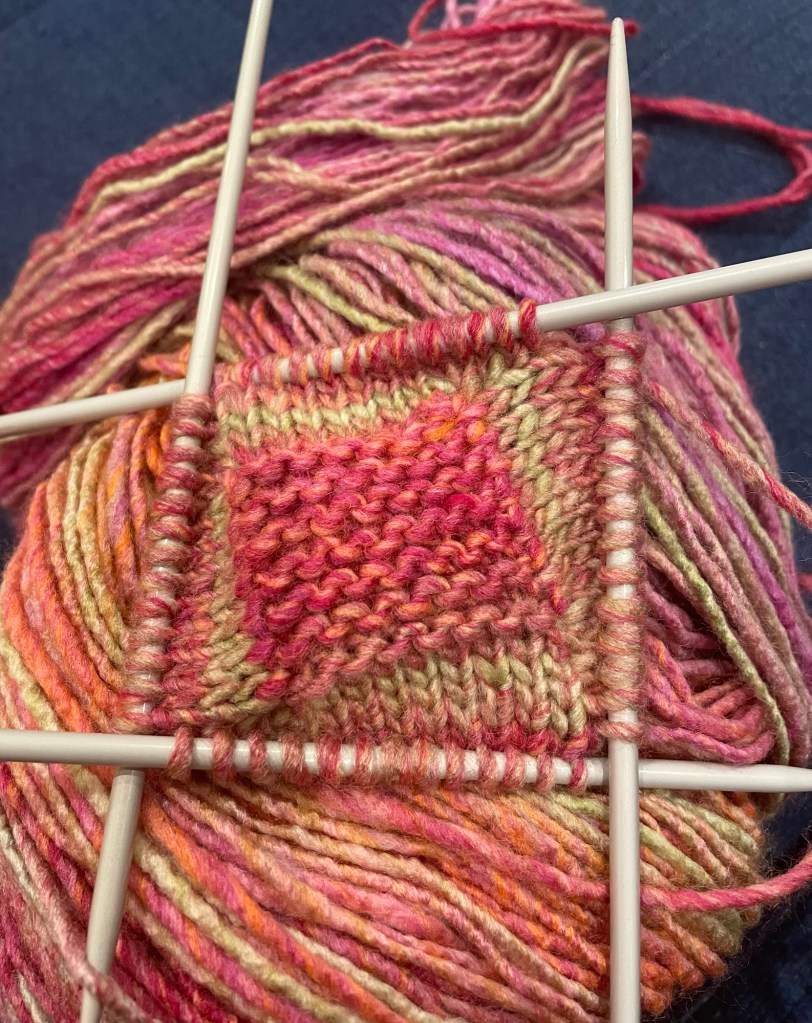
And the beginning of a new project. This little knit is a trial piece … can I knit a square by starting with a 4 cm centre and pick up stitches at each corner every round?

It’s working so far, though not yet looking particulrly tidy at the corners. I like how the patterning seems to be twisting. I haven’t worked out yet why it’s doing that.

When I imagined it the sides growing from the centre were straight. It’s possible that something totally different will eventuate if/when I knit a square all in purl. Wild times ahead.

Indigo

Indigo by Daniel Smith is probably the watercolor I use most, and is also my favorite to experiment with … if that makes sense. This indigo is so finely milled it’s the smoothest paint I own and yet it’s capable of amazing gymnastics. Below a wet layer of indigo over a failed experiment (which is represented by the pink tones) with phthalo blue dropped into it.

The Indigo, being smooth and light (weight) allows granulars such as sodalite, and heavier colors such as phthalo blue, to react spectacularly.

Getting shades by dipping a brush into water after a stroke, indigo will last longer than any other color and make the most wonderful greys.

One of the newsletters I subscribe to is Books on Books curated by Robert Bolick (https://books-on-books.com/2025/03/23/books-on-books-collection-louis-luthi/)

This month’s letter took me to a link (https://sites.rutgers.edu/motley-emblem/indigo/) where I discovered some interesting facts about indigo. So far about 200 plants have been discovered that yield indigo, and it is nearly the only color-fast natural plant dye.

The two hundred plants is quite a surprise as the Japanese indigo cloths are quite expensive and said to be made from a rare plant. Several cultures in Africa also use indigo to dye cloths. I’m wondering now whether the original processes make these products expensive, there is bound to be a lot of processing necessary to make dyes from scratch.

My only experience extracting color from wild plant materials to dye wool, has been using lichens to make a dark red, and that was by boiling the lichen and the yarn in ammonia, then setting the pot in a sunny place for three weeks, stirring it daily. Reading how indigo was/is extracted, it seems a similar process.

Following the links, the Brooklyn Museum webpage presented me with Catherine McKinley’s article on indigo’s influence in women’s culture, where Indigo is spoke of as rare … as in “the rare, refulgent dye and the commodities spun from it.” from (https://www.brooklynmuseum.org/stories uncovering_a_womens_history_of_african_indigo) while Bloomsbury Press offered me one of McKinley’s resulting books https://www.bloomsbury.com/us/indigo-9781608195886/

In Asia, cultures such as Javanese batiks and ikats, and Japanese aizome also made indigo famous.

Nowadays ammonia is one of my no-no’s in that I’m allergic to everything with chlorine in it, though fabric dyeing has remained one of my interests. It was only a small hop to watercolor painting on cotton paper.

Wikipedia’s article on indigo, in particular growing the plant https://en.wikipedia.org/wiki/Indigofera_tinctoria

Knitting: Mark 2

This time with a handful of rules …

… about half done. A zig zag shawlette based on two variations of the cellular stitch. (367, p67) I’ve so far found five ways of doing the eyelet stitch and all have different-looking fabric.

In this knit the two I’ve used result in a strong rib-like pattern on the front, and two brioche-style textures on the back. The book, see below, calls it the cellular stitch.

3 mm knitting needles or knitting pins if that’s what you’re used to.

Same yarn as before, equivalent in thickness to 4 ply, a 40% bamboo-derived viscose and 60% cotton, which is very comfortable to knit despite the problems identified in Mark 1.

— — — —

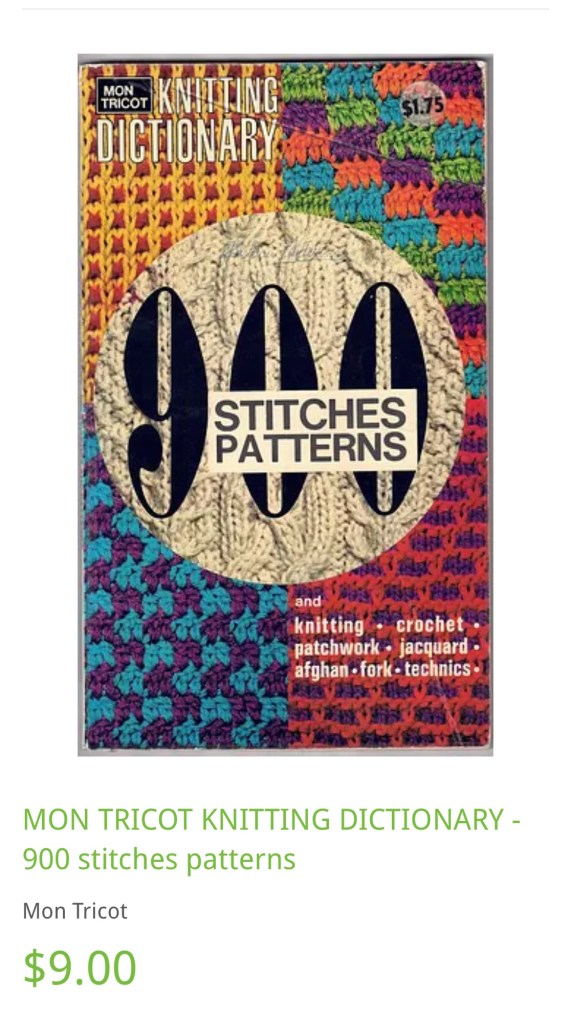
I’m still using Mon Tricot’s very elderly knitting dictionary with 900 stitches and patterns. English translation and adaption by Margaret Hamilton-Hunt, Published in France, 1971.

This for sale in the Oxfam shop in Adelaide … price hasn’t gone up much, whereas the copy on Etsy was $142.60!!! Guess that one was never used for its proper purpose.

Mine has the front cover being used as a bookmark.

But the first eyelet stitch I learned was well before 1972, probably round about 1962, knitting a little jumper for one of my sisters then aged about four …. “Wrap one to make one, purl two together” … Number 331 in the book on page 61.

— — — —

When my work (lol, in the present day) is sloping toward the right, all the action is on the back of the work. At the beginning of the row, knit two together purlwise, knit three plain, then wrap yarn to make one, and purl two together until the last four stitches, knit three plain and slip the last one purl-wise.

On the front of the work, make a stitch by purling first stitch and before pulling stitch from left needle, throw yarn back and finish with a plain stitch. There is probably a name for this process but I’ve never known it.

Though I discovered this way of increasing myself, I have no doubt that many other knitters also use it and that it has a name and set of instructions on how to achieve it.

Knit the rest of the line in plain, barring the last stitch which should be slipped purlwise.

Work as many rows as you have decided for your zig.

More to come on this as I haven’t even got you begun yet. Don’t despair.

— — — —

To begin, cast on three stitches. Knit eight rows always slipping the last stitch purl-wise, and doubling the stitch at the beginning of each row. You should have eleven stitches.

Now we start the pattern. Turn the first stitch into two using the same technique you’ve already been using, knit three stitches, *yarn over to make a stitch, knit two together purl-wise* repeat until last four stitches. Knit three, slip one purl-wise.

On the front side of the work, turn the first stitch into two, knit to the second last stitch and slip the last one purl-wise.

Proceed until you have a width that you like. From this point decide if you want a straight scarf or a zig zag.

If straight, continue increasing first stitch at front of work, and start decreasing at back of work—decrease by knitting first two stitches together purlwise which is easiest—every purl line.

I don’t like the yarn I’m using at the moment for a straight scarf. I like a more variegated colour-way. A straight scarf I’ll usually make longer than this zig zaggy one.

For the opposite of the zig—the zag— I need to knit to that place in my project before I can describe it.

And this is to come in Part Two. 😊

Knitting, Mark One

A while ago I started an experimental knit that I intended to serve as a base for a crochet design of leaves and vines.

What happened to that?

This. The rolling up just never resolved itself. The more I knitted the tighter and higher it rolled.

OK, so experienced knitters will be saying I’ve done something wrong and I accept that.

Too tight? Nope, as loose as possible with yarn no thicker than a regular two ply, knitted on 4mm knitting pins.

Weird yarn? Maybe. 60% cotton, 40% viscose. No spring in it. At all.

Wrong stitches? Very possible. Stitches in the body of the work are fine. Loose and drapy as desired.

Increasing at the beginning of each row? The problem has to be there! Ffor the purl, rear of the work, row I increased by sticking pin into back of first loop, knitting that plain, then bringing knitting needle forward to knit a purl and continuing with a purl line.

Did the opposite at the front of the work, making a stitch at the beginning of the row by knitting a purl, yarn to the back then knitting a plain and coninuing in plain.

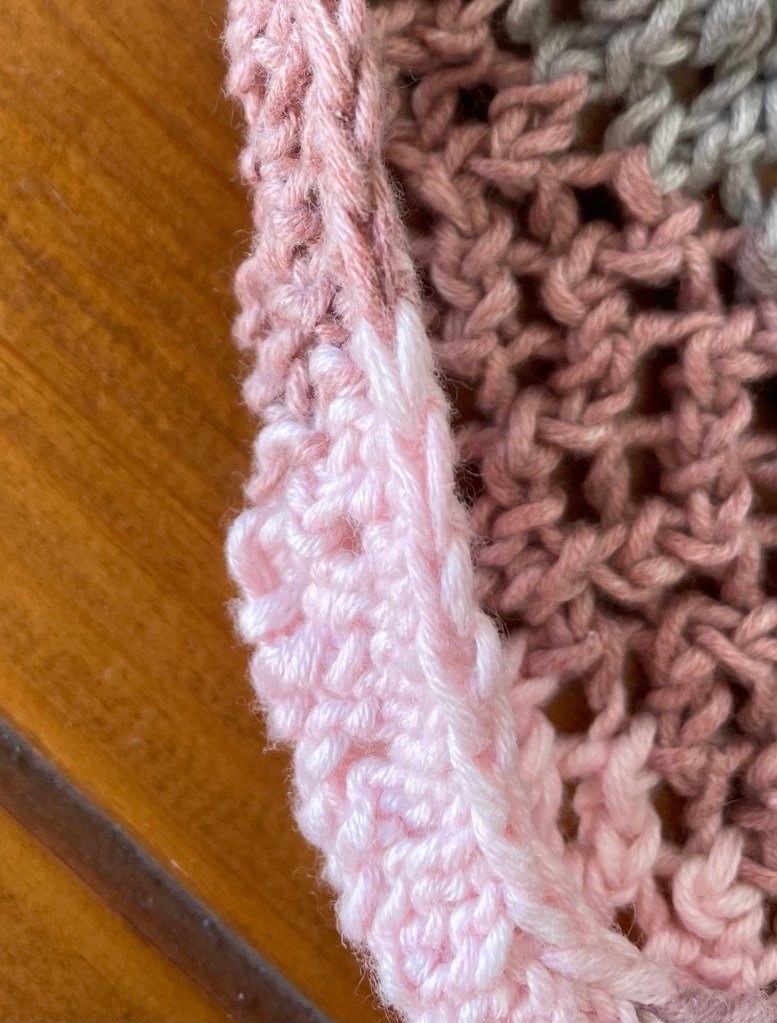
These made nice edges, one that I’d never seen before on the purl side of a work …

And yet, by the time I’d knitted twenty rows the first five had rolled up. After I unpicked those first five—with difficulty—the next five rolled up as I was doing it.

By sixty rows, the first fifteen had rolled up. No matter how I draped and folded the resulting cloth the bottom rolled up. By the time I’d knitted eighty rows I knew I had a twisted disaster and finished it off.

I may deconstruct it and use the yarn for another project, but this was already the second knit that that yarn featured in. Not sure how well it’ll stand up to the strain of pulling apart again.

Note that I said ‘twisted disaster’ …