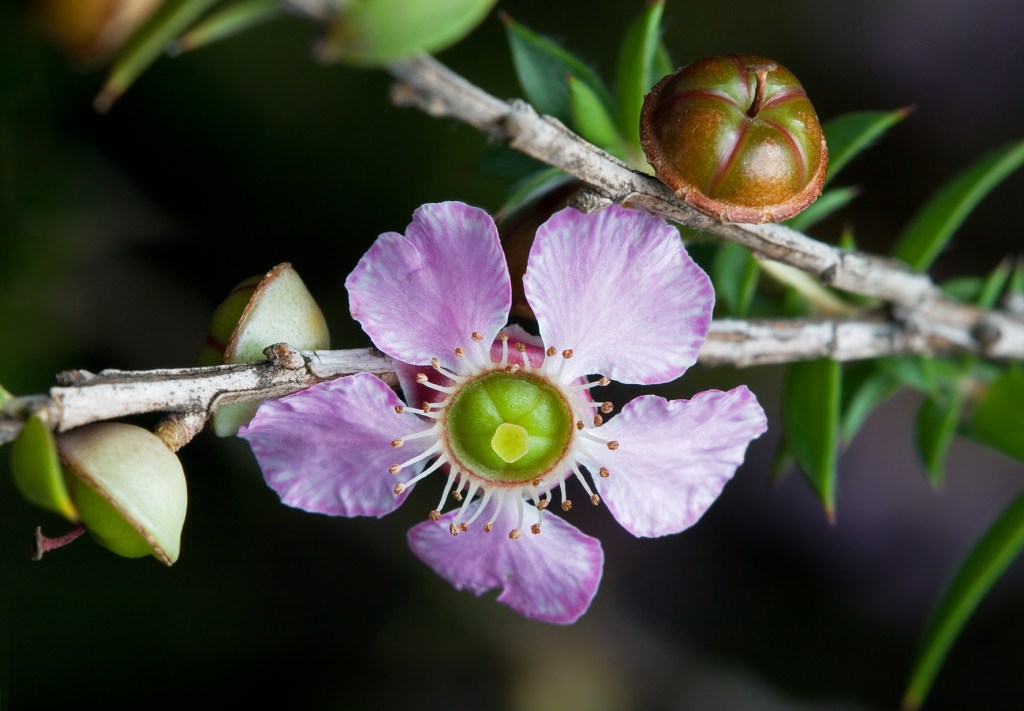
Various species of Leptospermum, or Teatree, an Australian native genus have been made into balms and other medicinal products for thousands of years. Here the flower and fruit of the Pink Teatree (Leptospermum squarrosum)
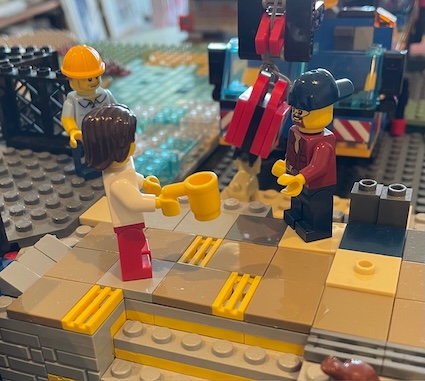
So, with the river levels rising … the cabins need to be raised, the cattle paddock raised or the cattle relocated, and stores to be got in by boat or helicopter. Bosley decided they would acquire a tower crane and that it would be a permanent fixture in the village.
Jackie’s crane mounted on Jed’s truck, transferred onto a remaindered railway dolly, turned into be a good helper-crane. Great at helping to transport tower crane parts from the barges, and great at raising them to where the construction was happening.
The Build From My Point of View …
Getting the parts probably was not the hardest part but certainly seems so with postage becoming the real spoke in the wheel, after five parcels from five different far-flung places. This is the thing about living in Australia. Vast internal distances and even larger external distances which all equal to pricey postage.
And I still don’t have all the parts I need and though it’s only a short list at the moment, its length will increase as I start to modify the original design.
Modifying Before I’ve even build it? …
Yes, unfortunately. As always, space is constrained. Second, a few videos of real-life lone tower cranes swaying and breaking up in high winds, convinced me that even the stability of a Technic crane might need bolstering by being connected to its builds.
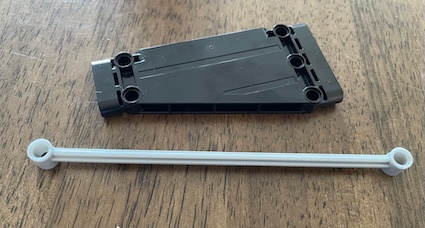
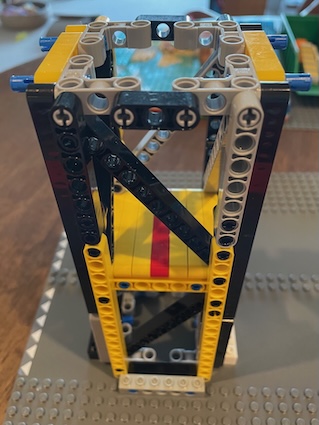
Beginning to make that happen, I found that I was using parts that will probably be needed elsewhere. The first really big problem I hit was a lack of two vital elements. Struts and panels. Just unable to get enough of either of them. I have only 5 of the panels, and 8 of the struts.
While I would’ve really enjoyed to build the whole thing without any hiccups, that was not to be. At this stage I thought I might be able to fix the tower on a base-plate with ordinary Lego pieces, support it that way.
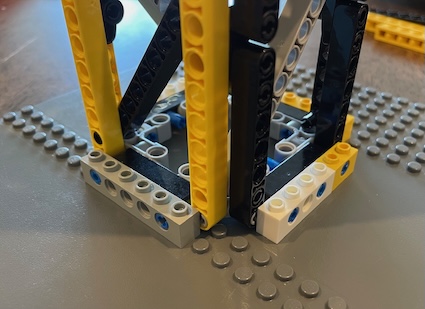
That idea turned into fixing the four-sided base of the tower to a Lego base-plate with the help of Technic bricks. Which worked very well on two opposite sides. These bricks lift the structure about 1 millimeter above the studs but because multiple pins on each side connect the two, there’s a strong and stable joint. Leaving me with the right number of strut-pieces for the jib/boom.
So what happened? While there are eleven studs between the first pair of two opposite sides—and there need to be—there are eleven-and-a-half studs between the second pair of opposite sides. I rebuilt the whole thing several times, tightened everything that could be tightened, but got the same result every time. By then quite frustrated.
After a while remembered the ancient roads base-plate in my collection. This is the result. I’ve done away with the need for the second pair of opposite sides to be fastened to the base-plate. They are wedged pretty tight. In the photo below you can just about see the problem, the white brick does not line up with the studs.
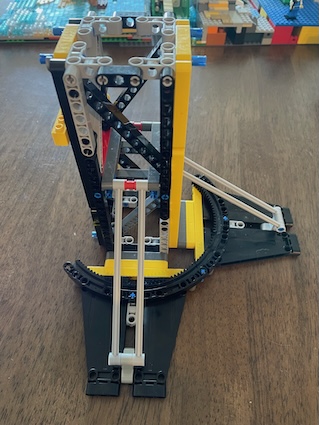
That left a final concern. Without the struts-and-panels stabilization system the tower structure was so rickety that I was afraid that with more weight on it from another section of tower, a boom and trolley, the machinery in the middle, and the power and battery system on the other end, the tower would just twist and collapse. I inserted two panels made of 7 x 7-beams midway the stage.
These are probably overkill, since I will be fastening this stage to two fire escape blocks, part of the new village build. I put them in for peace of mind.
Jed’s come with the crane. Still the same old Jed, like the world owes him and so far hasn’t come up with the goods. Read the next chapter in Storying Bricks in the menu bar, or here
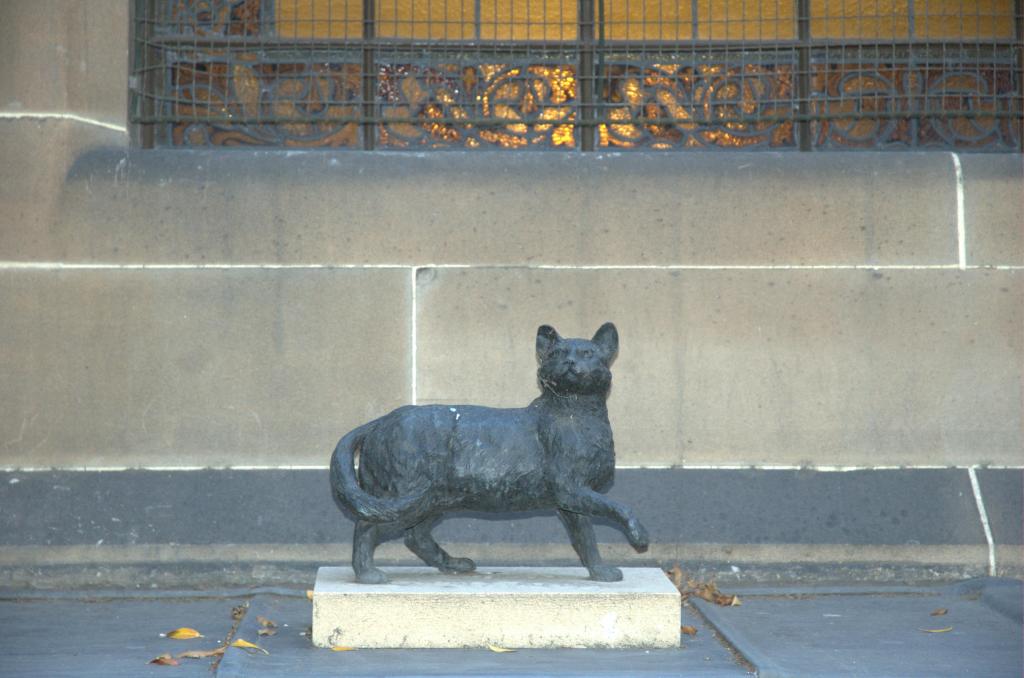
Next up is a book I’ve been wanting to read for about 20 years. When it was first published, the title grabbed me … Matthew Flinders’ Cat. I already knew that Flinders had a cat he’d named Trim, and had seen the bronze statue of Trim at the State Library of New South Wales.
I didn’t research the story beforehand as nowadays I usually do, just looked forward to reading a blow-by-blow account of Matthew Flinders’ voyage mapping the coastlines of what was then New Holland, accompanied by his cat.
Usually I wait until a book comes out in paperback before buying it, so when I didn’t see it appear in the local bookshop a year later, forgot about it. Since then I’ve seen it a few times in libraries without there ever being an opportunity to borrow it, and a couple of weeks ago saw it on one of the two bookshops I now frequent.
And so bought it. Because I needed a new, chewy read, and for the expectations I just described, but still not knowing anything about it apart from the fact that Trim might be one of the main characters.
Book 10. Matthew Flinders’ Cat by Bryce Courtenay, this edition published in 2006 by the Penguin group.
How did I miss that it was written by Bryce Courtenay? I’ve read a few of his but generally don’t like his style. To me they’re the kind of book I might read if there is nothing else available.
Such as when stuck in a camping ground by the roads being flooded and Bryce Courtenay book is the only thing to be found in the camp laundry. That’s where I found The Potato Factory and read that. But that’s by the by.
Reading the first paragraph of this book I knew it wasn’t going to come to my expectations but, I reminded myself, that was my own fault. And since I had given out good money for it, I would read it.
‘Billy O’Shannessy woke to the raucous laughter of two kookaburras seated on top of adjacent telegraph poles.’
There is Billy O’Shannessy … Courtenay does this thing that I was taught as a new fiction writer, make the first two words about the the main character. In that same first sentence there is also setting the scene, in this case the Australian scenario with the two kookaburras. And there is the modernity of telegraph poles, if a slightly old-fashioned term for them telling us the story is set in the present. Telegraph poles might’ve been normal for 2002, when the book was first published. I don’t remember. The rest of the paragraph tells of his hangover and that the birds served as his ‘regular alarm clock’.
In the next paragraph I learned he was lying on a park bench with a canopy of leaves over him. It’s only on the third page that Trim gets a mention and then only his life-sized bronze statue on a window ledge of the state library
The Wikipedia page about Trim is interesting. He’s got several more statues, one in Donington, UK and one in Port Lincoln, South Australia, as well as a glowing epitaph by Matthew Flinders himself.
Alas, this book is not primarily about Trim, or even Matthew Flinders.
Purporting to be a novel, it seems to me to be written as a tribute to the Salvation Army, the Twelve Step Program to recover from drugs and alcohol abuse and rehab, and the many services helping homeless people and troubled children in Kings Cross, Sydney. All very worthwhile people and services, I’m not denying that.
Published two years after Courtenay’s divorce, I did wonder whether he was writing a semi-autobiographical novel, that he was a recovering alcoholic. The fact that it is his twelfth novel might explain why an editor would do less editing, leaving unchanged the info dumps, for example, consisting of half or three-quarter pages describing people and places.
But I’ve often wondered how people go about writing a tribute novel so in that respect this was an interesting read. First, he had a professional researcher … the results of research are big in this novel. There are screeds of explanations. Over pages 333-334 there’s a paragraph of over 200 words. That’s almost a whole page. Commonly called a wall of text. It seems very 19th century-ish.
In places it feels like Courtenay inserted a whole paragraph straight from the source. That can’t be right, of course. Courtenay was a well-respected author. I like to think there would’ve been at least one rewrite to make the material his own.
In addition, most professional people wouldn’t hesitate when approached by a famous author to tell them about their world, any extra mention is going to help promote their concerns, right? That also shows in the detail about organizations such as the Salvation Army. I imagine there’s a fine line between wanting to do one’s sources justice and keeping the story from dragging the weight of excess information.
The bits about Trim were the story Billy O’Shannessy told Ryan, the ten-year-old other main character. Trim is imagined in the talking-animal style with a lot of agency. Which left me wondering whether the adventures described had any truth in them. They read like fantasy. Probably I’ll try to find something nearer to Matthew Flinders’ own account of his and Trim’s circumnavigation of Australia.
My favorite go-to for information … you name it, it provides … plus images not encumbered with watermarks and dollar chewing subscriptions. I do donate to help them keep going.
Wikipedia is 25 years old this year, three cheers …
I intended to reblog Hotchkiss’s blog but am on my mobile and don’t know where it went … in the ether somewhere
I’m pretty happy with this image, another cut from a ceramic puzzle I once made. The original 30 centimeter tile broke across during storage, a risk associated with green-ware. IE not yet kilned. I took the pieces home over the Christmas holidays to decide what I was going to do with it.
Ended up breaking them into 13 pieces to try a different experiment on each piece. In this photo are four of the pieces representing a creek. As well as incising them, and painting them with ceramic slips, I searched one of the local bottle dumps and found fragments of old blue and old white glass to crush. Kilning the glassy fragments made the foamy creek water featured on these pieces. Below them the pieces that were inscribed with creek bank vegetation and fungi.



 Rita de Heer
