

I can’t believe how well this watercolor sketch I did a few years ago illustrates an alien cloning bath. The warmth with steam rising in the left foreground, the bleak winter weather in the background.
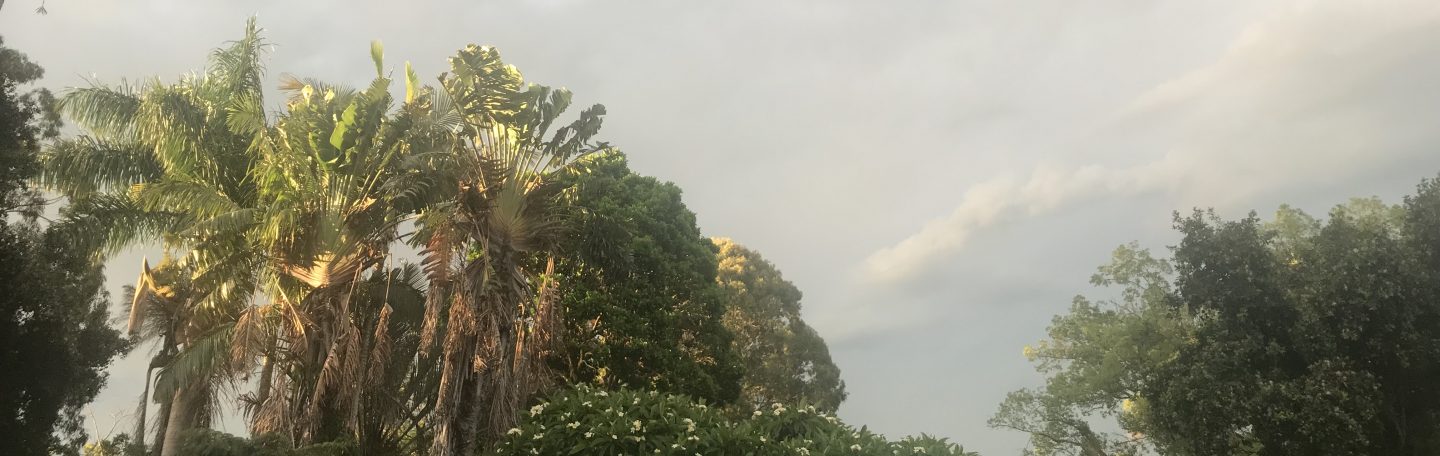
I can’t believe how well this watercolor sketch I did a few years ago illustrates an alien cloning bath. The warmth with steam rising in the left foreground, the bleak winter weather in the background.
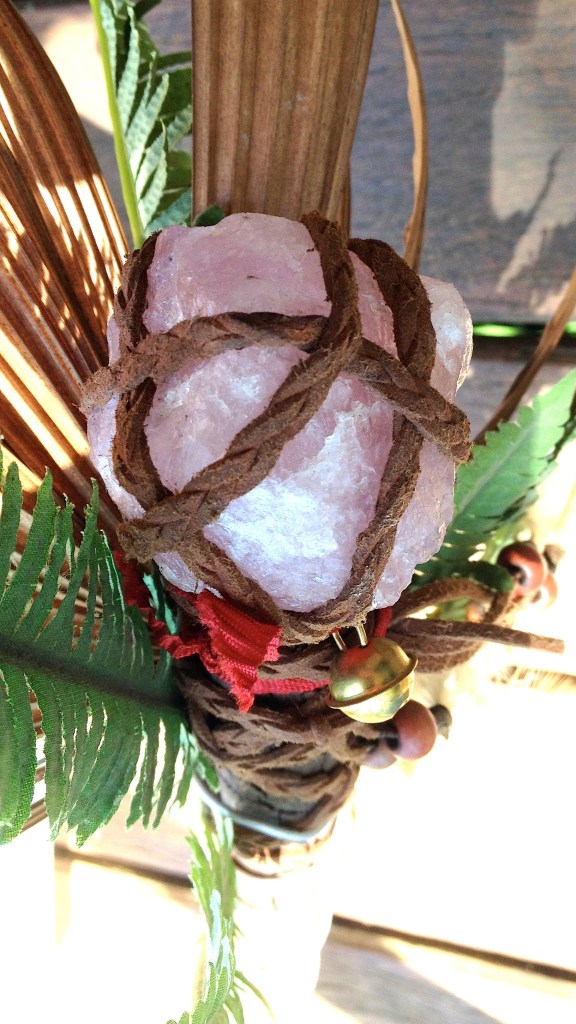
This crystal-topped staff hand-made by Alys Shilo (photo made in 2014) from various natural and machine-made objects, no plastic involved.
Caroline Ross’s post on Touch was a serendipitous discovery this morning, after a few weeks of thinking about my sense of Smell and Taste, worrying about them not coming back after the medical procedures I had last month. Both okay now, with my interest in how we use them enlivened by their possible loss.
Her list of five things to touch every day seems like a good start … Abbreviated to their headings by me … if you’re interested you can see the examples Ross gives in the article linked below.
https://carolineross.substack.com/p/ultra-processed-things
Although it’s still only noon here, I’ve already touched dozens of objects in category 5 (table, couch, laptop, etc etc)nand quite a lot fewer in the first four categories.
Quite a few things I touch every day need a bit of analysis. For example, the carpet in these units is said to be wool. It’s obviously machine-made. But does it have a plastic backing? Yes. So it’s another thing in category 5 and here I thought I was walking on a natural substance.
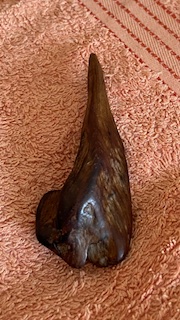
Definitely in category 1 is my bit of polished wood that I picked up from Raglan Beach, North Island NZ about 50 years ago, and keep in my pocket.
2. Unmade but modified. Hmmm. The examples are “ground coffee, stone paperweight, wooden walking stick, dried apple rings, raisins, a fallen log to sit on.” At breakfast I had currants on my cereal … and seeds, and various other unmade food-sources. Another easy one where food is concerned. Lol, a fallen log to sit on. Up here in my Level Two unit? Maybe not.
3. Handmade but unmade material source … that’s a hard one as I haven’t painted yet today and haven’t yet used ochre. or a handmade paint brush.
4. This one is easy for me. Machine made, but unmade material source. Wearing anything other than cotton, linen, silk, or viscose gives me hives and or eczema. Cotton, linen and silk are all unmade material sources.
That’s my five. How did you go?
Getting my mind back after an anesthetic, even one of only 25 minutes duration was always going to be an interesting experience. One of my tests for regaining normal brain power is doing a crossword puzzle, and I have to confess that seven days after the fact, I’m still floundering in that respect. I successfully solved the Decoder Puzzle but am having a lot of trouble thinking up the required words for the Crossword Puzzle.
The eight letter US state had to be Arkansas in the end. Delaware just didn’t give me the right letters.
I remember my mother, Hendrika, complaining about a fuzzy brain after an operation in her eighties. It took her fully three weeks to remember, after knitting four or five false starts, how to knit socks. When she did finally remember the pattern, she never knitted anything else apart from 10 cm squares in the last three years of her life.

A few of Hendrika’s grandkids wearing her socks. She knitted about a thousand pairs in her later eighties, donating them to charitable groups after the family were supplied.
It has been suggested that as eldest daughter it would be fitting that I undertook that same project, but I’m afraid I might’ve built up a bit of steam and blown that suggestion out of the water. Seriously? I love knitting, but don’t have my mother’s fortitude to be knitting the same pattern over and over, and for years on end producing two or three pairs a week.
In fact, I like to invent patterns as I go. I started on a vest with the new yarn. Knitted a few experimental squares but decided in the end to go with diamonds. More on that project in a post.

Treated myself to some new yarn …
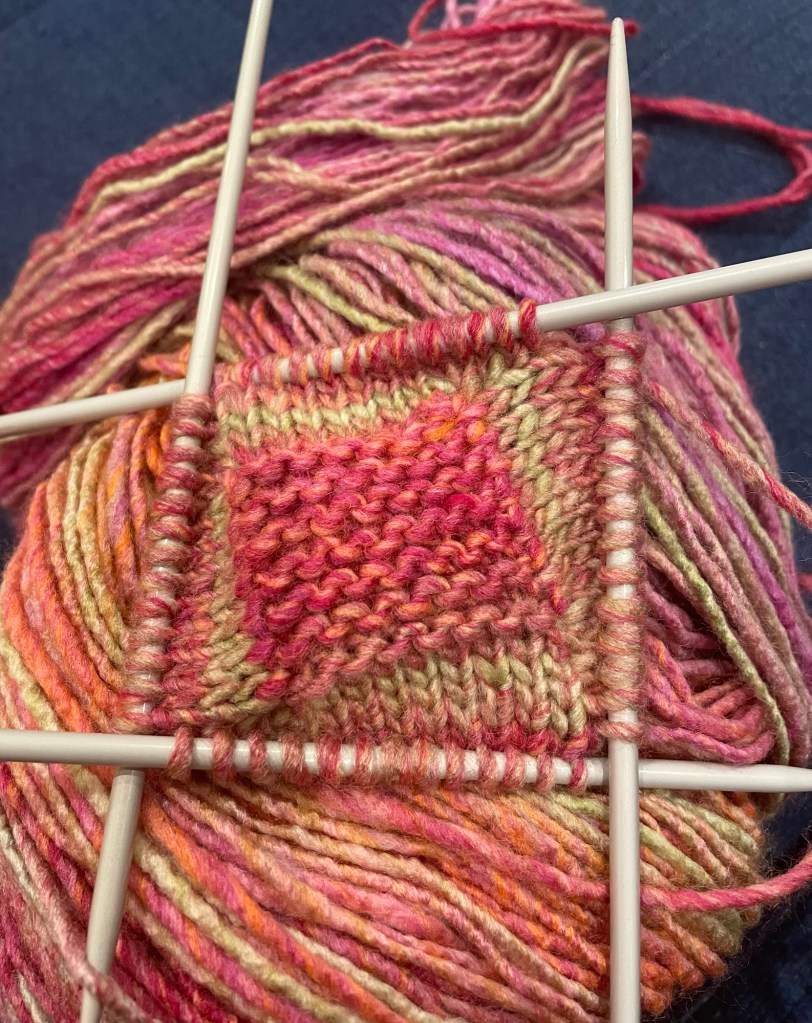
And the beginning of a new project. This little knit is a trial piece … can I knit a square by starting with a 4 cm centre and pick up stitches at each corner every round?
It’s working so far, though not yet looking particulrly tidy at the corners. I like how the patterning seems to be twisting. I haven’t worked out yet why it’s doing that.
When I imagined it the sides growing from the centre were straight. It’s possible that something totally different will eventuate if/when I knit a square all in purl. Wild times ahead.
Not a double exposure as such …

A reflection … I love the mystery of this kind of shot. Then a bit of framing and cutting and voila … a meaningful and metaphoric intersection.
I’ve been having to prep all week for a medical ‘procedure’ on Tuesday coming and it’s played havoc with my nerves. Meaning it’s played havoc with my routines, with writing, any reading except the sort of thing I can get engrossed in and forget that the consensual world exists.
To that end have thrown myself into the Broken Earth Trilogy by N K Jemisin. Have read Parts one and Two so far, and they are every bit as good as I’ve been told. Will be re-reading them as Number Three had to be ordered in. More on them in the goodness of time.
I had six weeks to prepare my mind for this thing, so did nothing until a week and a couple of days ago, then started with writing out the whole deal in long hand in my health diary and making lists. working of the lists now.
This morning the hospital called. Was I going to do an online pre admission form? Something I had completely forgotten. Not anywhere on my lists. So did that, now going shopping. Again.
It’s ridiculous how much stuff we need for this sort of thing.
The weird thing about the prep … for me … was that I couldn’t get started until I had my clothes sorted for travelling there and back. I’m not any kind of dress-up person, most of my clothes are old and worn.
So when a hospital says ‘loose and comfortable clothes’ they’re talking about the rags I wear at home. So it was only after I had one of my clothes try-outs with all my clothes endingin a pile on the bed, and finally deciding to wear my one and only rarely worn skirt, a tshirt and a longsleeved shirt and hanging them ready …
only then could I start to think about any dietary difficulties I might have with the prescribed diet, the fact I had to drop off my antihistamine a week ago and have my nose leaking and my skin allergies popping and so on.
Does anybody even sell plain gelatine these days? Haven’t found any.
A mob of ibis, native to Australia and now more commonly known as ‘bin chickens’ hard at work on the little grassed area between the new access road and the still existing but now little used path. Little used because all it leads to is the paddock.
The little grass where the ibis are feeding is the lowest place at the base of a long slope. Water flows here both through the soil and over the grass, and from the diligent work of the birds, I gather that plenty of worms also live here.
I heard—haven’t fact-checked it yet—that ibis beaks are going through a speedy evolution turning from turned under tips to scoop food from mud, to straight tips that can pick up food from hard surfaces.

 Rita de Heer