Touch …

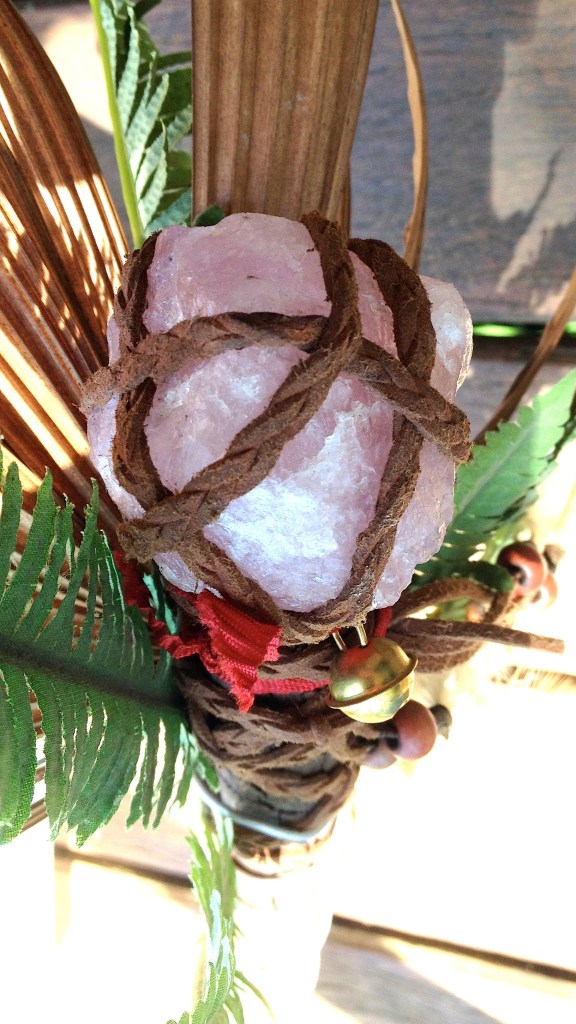
This crystal-topped staff hand-made by Alys Shilo (photo made in 2014) from various natural and machine-made objects, no plastic involved.

Caroline Ross’s post on Touch was a serendipitous discovery this morning, after a few weeks of thinking about my sense of Smell and Taste, worrying about them not coming back after the medical procedures I had last month. Both okay now, with my interest in how we use them enlivened by their possible loss.

Her list of five things to touch every day seems like a good start … Abbreviated to their headings by me … if you’re interested you can see the examples Ross gives in the article linked below.

  1. Entirely unmade
  2. Unmade but modified
  3. Handmade but unmade material source
  4. Machine made, unmade material source
  5. Machine made, artificial or mixed source materials

https://carolineross.substack.com/p/ultra-processed-things

Although it’s still only noon here, I’ve already touched dozens of objects in category 5 (table, couch, laptop, etc etc)nand quite a lot fewer in the first four categories.

Quite a few things I touch every day need a bit of analysis. For example, the carpet in these units is said to be wool. It’s obviously machine-made. But does it have a plastic backing? Yes. So it’s another thing in category 5 and here I thought I was walking on a natural substance.

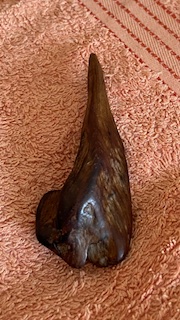
Definitely in category 1 is my bit of polished wood that I picked up from Raglan Beach, North Island NZ about 50 years ago, and keep in my pocket.

2. Unmade but modified. Hmmm. The examples are “ground coffee, stone paperweight, wooden walking stick, dried apple rings, raisins, a fallen log to sit on.” At breakfast I had currants on my cereal … and seeds, and various other unmade food-sources. Another easy one where food is concerned. Lol, a fallen log to sit on. Up here in my Level Two unit? Maybe not.

3. Handmade but unmade material source … that’s a hard one as I haven’t painted yet today and haven’t yet used ochre. or a handmade paint brush.

4. This one is easy for me. Machine made, but unmade material source. Wearing anything other than cotton, linen, silk, or viscose gives me hives and or eczema. Cotton, linen and silk are all unmade material sources.

That’s my five. How did you go?

‘Spatter and Spray’

… is a way of painting with watercolors, I’ve discovered. And I’m in the throes of experimenting using the technique.

First came across it on Susan Cornelis’s blog. https://susancornelis.wordpress.com/wp-content/uploads/2025/03/googleeye.jpg

So I’ve fallen in love with granulating paints. My first effort was Miss Tabitha…

Ordered a couple more tubes of granulating paint and washed out a fine spray bottle originally used for a deodorant.

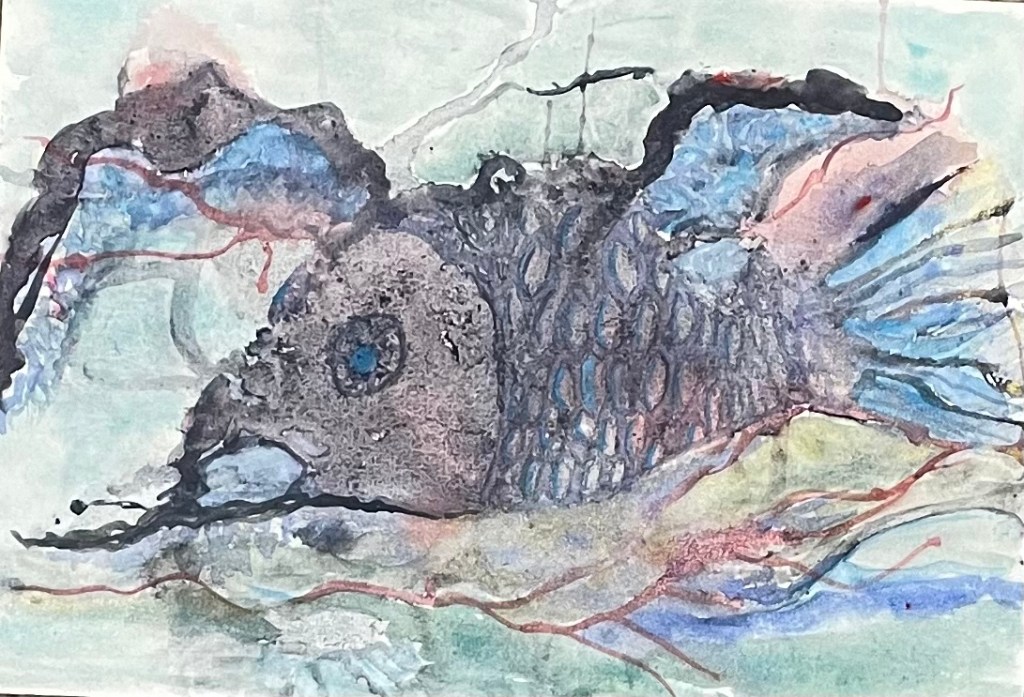
Second, this fish. I call it a bottom feeder, but may rename it … I’m having so much trouble getting this from my mobile … might have to do magic. Like, abracadabra … OK I’ve got it. Ended up saving it to the desktop … isn’t she beautiful? A spatter and spray painting barely touched up. Well, OK, I painted the scales. The rest is dabbed. Not yet sealed.

This is the top half of my third effort. I’ll tentatively call it The Aviatrix. The bottom half of this painting is still a problem. one thing is for sure, I’m learning a lot about gouache.

It’s hard to believe what you can get from spattering paint onto the paper then spraying it with water. But that’s only the first layer. You let it dry, then the next day, if the pattern you have doesn’t yet suggest anything to you, you do it again. Like I did with this one. The third day, this aviatrix lay there waiting for me. I painted some of the areas to increase that likeness and here she is.

The bottom half of her face needed work of a different sort. After my efforts first with gesso, then with gouache that’s still in the thought-pan, and another post.

As well as the spatter and spray technique, I’m experimenting with sealing my watercolor paintings with an acrylic varnish. I hate the look of paintings behind glass or the whole process of framing. Miss Tabitha has been varnished and the look is good.

And plus, I don’t have enough wall space to hang everything I paint. Nor will I foist amateurish experiments on my nearest and dearest. So, most must be stored. Varnishing them seems like a good option.

The varnish I’m using is water-based so easy to cut. A mixture of 25% acrylic varnish in 75% water seems to be working pretty well. Ideally this should be sprayed on but since I’m still only experimenting, I’m laying the varnish on the painting with a watercolor mop brush. A time-consuming procedure but the only one I can afford at the moment.

Indigo

Indigo by Daniel Smith is probably the watercolor I use most, and is also my favorite to experiment with … if that makes sense. This indigo is so finely milled it’s the smoothest paint I own and yet it’s capable of amazing gymnastics. Below a wet layer of indigo over a failed experiment (which is represented by the pink tones) with phthalo blue dropped into it.

The Indigo, being smooth and light (weight) allows granulars such as sodalite, and heavier colors such as phthalo blue, to react spectacularly.

Getting shades by dipping a brush into water after a stroke, indigo will last longer than any other color and make the most wonderful greys.

One of the newsletters I subscribe to is Books on Books curated by Robert Bolick (https://books-on-books.com/2025/03/23/books-on-books-collection-louis-luthi/)

This month’s letter took me to a link (https://sites.rutgers.edu/motley-emblem/indigo/) where I discovered some interesting facts about indigo. So far about 200 plants have been discovered that yield indigo, and it is nearly the only color-fast natural plant dye.

The two hundred plants is quite a surprise as the Japanese indigo cloths are quite expensive and said to be made from a rare plant. Several cultures in Africa also use indigo to dye cloths. I’m wondering now whether the original processes make these products expensive, there is bound to be a lot of processing necessary to make dyes from scratch.

My only experience extracting color from wild plant materials to dye wool, has been using lichens to make a dark red, and that was by boiling the lichen and the yarn in ammonia, then setting the pot in a sunny place for three weeks, stirring it daily. Reading how indigo was/is extracted, it seems a similar process.

Following the links, the Brooklyn Museum webpage presented me with Catherine McKinley’s article on indigo’s influence in women’s culture, where Indigo is spoke of as rare … as in “the rare, refulgent dye and the commodities spun from it.” from (https://www.brooklynmuseum.org/stories uncovering_a_womens_history_of_african_indigo) while Bloomsbury Press offered me one of McKinley’s resulting books https://www.bloomsbury.com/us/indigo-9781608195886/

In Asia, cultures such as Javanese batiks and ikats, and Japanese aizome also made indigo famous.

Nowadays ammonia is one of my no-no’s in that I’m allergic to everything with chlorine in it, though fabric dyeing has remained one of my interests. It was only a small hop to watercolor painting on cotton paper.

Wikipedia’s article on indigo, in particular growing the plant https://en.wikipedia.org/wiki/Indigofera_tinctoria

Food: GF Bread

‘Falling off the Wagon’, is a phrase that originated in the Temperance Movement, according to Wikipedia.

Meaning falling of the water wagon back into alcoholism. Getting back onto the wagon means getting sober again. I’m sure I’m not telling you anything new.

Every so often I fall off my gluten free, dairy free, lowFODMAP and sugar free penny-farthing-bicycle and then I am in pain and discomfort.

Getting back onto my penny-farthing bicycle is a matter of figuring out where the bad stuff has crept in. While one teaspoon of gluten-containing flour in a loaf of bread is not going to cause any problems, a cup of 100% wheat flour will. And I’ve been mixing spelt flour in my baked goods to encourage yeast action.

And having that bread daily. Having anything you’re sensitive to daily, is another no-no for people with a lot of allergies, intolerances and sensitivities.

Having a particular food once every three days usually prevents a build up of the bad chemicals in the body. But sometimes all I want is to be able to eat something without worrying what it will do to my chemistry.

That’s when my penny-farthing slams to the ground and I fall by the wayside.

Which is why I’ve started experimenting with baking my own bread. Commercial gluten free breads tend to have a ‘stampede of ingredients’, and the breads that are any good aren’t always available. The phrase ‘stampede of ingredients’ … so appropriate to food intolrances … comes from the MooGoo people, who make natural skin care products.

Cutting gluten-containing flour from my diet only half-fixed my problem. I came to the conclusion yesterday it has to be a capsule filler causing me grief. I’m now taking 0.9 mg LDN daily, either a (3 x 0.2 + 3 x 0.1) dose equaling 6 capsules, or (4 x 0.2 + 1 x 0.1) equaling 5 capsules.

Meaning, I’m taking a lot of Avicel cellulose filler. And I’ve been reading in a pertinent group that this stuff gives a lot of people grief. They either have their capsules compounded with a different filler and that’s a minefield I don’t want to go into right now, or they throw the contents of their capsules in water. The LDN dissolves and the Avicel is the residue at the bottom of the glass, and then drinking the water.

That’s what I’ll be doing. I still have about one hundred and fifty capsules to work through before I can ask for a different filler. It’s a real “Good Grief, Charley Brown!” situation.

Lunch … couldn’t wait any longer. Wilted greens, avocado, a few olives and the equivalent of approx 2 slices of newly-baked bread. A third of an apple. A jug of hot salted water.

After stopping the bread machine for a minute, I hauled out the bucket and scooped out the equivalent of two slices of bread. Bucket back in to finish the cycle, 28 minutes to go. Going on the texture of the bread, it looks like it will be my most successful loaf yet.

Tagging My Fish aka Content

in this, part two of yesterday’s topic, I’ve been Tagged … I’ll be discussing the Questions to do with blog content.

On a totally different topic for a minute, Moggy and I have had a rough beginning to our morning, along with every other resident on Levels Two and Three of our building. No power from 7 a/m to 9.15 a/m. Though we were told beforehand and had prepared–with a thermos of hot water for example–nobody knew that the alarm units in every apartment would be telling us that … “mains supply is interrupted” … every ninety seconds for the duration. This to happen again on Friday. Not much of an imposition, I know. Especially when we were forewarned.

Moggy was so weirded out by this strange un-embodied voice spouting its refrain that she retired to the far corner under the bed and re-appeared only when the lights went back on and the voice was silenced.

What surprised me about this event was how ‘in the moment’ I had to be just because I couldn’t engage some of my early morning routines. At one point I realized that the ‘net’ metaphor I used in the previous post can definitely be applied to routines. Making in this case the routines the net, and the-new-and-interesting-things-to-do the fish. Something like that.

I’m chortling at this point. After last night’s success at ‘prompting’ (explaining to the resident AI to what pic I needed) I wanted to see what the AI (I’ll need to find out its name) made of this … “Smoky furred cat with white underside and white paws, black nose and black lower jaw.” Nothing is the answer. The message was the image could not be found due to network problems. Ri-i-ight. The AI is stumped?

Q2 If your blog was a person, fictional or real, who would it be? I’d have to say my blog would be a fictional person because she’s a digital entity, existing only in bits and bytes and only online. She’s a ghost in the works. One of millions. It’s as crowded in her world as it is in the consensual ‘real’ world.

It does actually surprise me sometimes that we–me and my digital identity–can connect pretty reliably. Part of the reason is probably that WordPress keeps her safe. She doesn’t have to wheel and deal out in the hot hard world of the world wide web.

Although, not too many entities are out there on their own anymore. I’ve certainly noticed a change in my online experiences from when I first got online in approx 1998, in that nearly everybody I want to talk to, is now in some kind of gated community. It’s difficult now to ‘surf the web’ in the free-wheeling and easy way we used to. All the gated communities still provide that for their members but anybody else first has to sign up and often pay down real money.

Q3 What helps you create new content when you need inspiration? This question follows naturally from the previous one. ‘Creating new content’ is writing or photographing, painting, sketching etc about new ideas I happen to trip over. New ideas provide the ‘inspirations’.

Having to pay everywhere makes it harder to find and produce new content. It’s not only $$$ that stop me finding good stuff. Substack, for example, has this full page thing that they flash at me every time I go to read some of my favorite commentators, where I’m supposed to mark three things that I like to read about, and they’ll be able to steer more of the same my way. I’ve been skipping out every time I see it. It’s such a creativity killer to be shunted into the same byways every time I get online.

WordPress, in contrast, has introduced a ‘discovery’ application that I’m happy with, as I’m able to range further into the domain, and have already got a few topics of interest in my stash. Eg, last week I stumbled across an article on ‘hypovolemia’ which is now sitting there brewing. When I find more info about it, I’ll copy and paste that in there too. With four or five points I’ll have plenty to write about.

My Drafts is where I keep my stash of topics I might post about some day. Usually I’ll copy a link and open a new post, and save it in there. I usually have five or six drafts on the go–waiting for more info, energy, and or time. Any that get too old and stale, I’ll delete. Recently, an Apple mobile phone update provided me with a ‘Journal’ app where I’ve also been noting interesting topics.

In my actual life I keep a bunch of journals. Health diary. Art Journal. Dream School. Bosley and Co’s stories. They also all provide me with grist for the inspiration mill. The picture following is from my art journal, it’s a sketch for a larger painting. A sketch is where I try out techniques, perspectives, colors, even the framing is an experiment. Washi tape. I’m showing it unedited.

Lodestar 56b: Scrim continued

Part Two of Chapter 56: Scrim Learning his Ropes

In the night, a number strong with drink clambered up to Scrim’s hide to talk about his fate and how he wanted to forget it with sex. “What about it, partner?” he said.

Scrim rolled to his feet. Pushed the number to the window hole, then fought him through it.
The number screamed getting pronged on an upstanding old iron below. He screamed and screamed until the transies came first for laughing at him and chiacking, and then killing him some more with their knives.

Scrim hugged himself tight all night breathing Min-breathing.

When the hooter called, the transies left quick-smart. Then crows came. So crows clean up the dead in the city as well as in the rubble. Soon after, Mapmaker squeaked by on his wheels.
Scrim stayed hid to see what was what.

Mapmaker stopped at an alley across the street. Put his trike into the alley. He set out his things in the mouth of the alley. Both sides of him were the dead houses of the wall strung together with lectrics on their outside.

Further in, behind the trike, stood a steel egg as tall as a Scrim, an egg that Scrim could only see iffen he did a trick with his eyes where he stared through the wall behind the egg and suddenly the egg was there.

Scrim’s side of the street—what he saw of it yesterday—was a cobble of lanes and high-ups, all of them near to half-broke. Not one window had glass. Entries were black holes like the black hole into the home cave in the rubble. He saw another egg when he leaned a little out his window hole. That one at the west end of the street, where the sun sank.

Both sides of the street now had people setting up tables and tents. They filled the tables with all kinds of green plant foods, and roots, and flats of bread what made him hungry. Some had bottles of drinks. Making him thirsty. In the rubble the littlies got theirs first. The long-legs last. Here, he didn’t know and wouldn’t find out if he didn’t go down.

He tried to not see the crows. Made himself a mouse and crossed the street to Mapmaker.
“A man left me these,” Mapmaker said. “Smoked rabbits. I don’t need them. Maybe you can trade the ones you don’t eat.”

Scrim took them, two sixes of naked animals with no fur strung on a pair of strings. Hard-smoked. With short ears and like rabbits only by their same-size.  

A number who came to do business with Mapmaker pushed Scrim so he had to step into the street.

“You, boy! With your rabbits.” A man across the street beckoned him. “You look so lost you’ll get found quick-smart. You trading those rabbits?”

That word again, trading. Scrim had no meaning for it. He shrugged.

“Like, are you swapping?” the man said.

Scrim shrugged again.

“Come here. Stand with us. We’re all getting nervous for you.”

Scrim glanced around. No danger he could see.

“That’s Tom,” Mapmaker said at Scrim past the man sitting opposite him. “He’s a friend of mine.”

Scrim nodded, then crossed the street to where Tom and another man had built a table with poles and an old flat-wood.

Tom shook Scrim’s hand, “Any friend of Mapmaker’s is my friend too. Come behind the table with us. Look at how Wobby trades. I’m the watch-out for danger. Stray whistlers, uncouth transies, crazed numbers and, of course, the customers and their guards. See our scars? Courtesy of Mapmaker. We’ve never got picked yet. Mostly people prefer trading at their houses, at night. Wobby will show you.”

Music started up from a speaker hanging above the place.

“Wrap it up, Tom. Here they come” Wobby said. “Don’t look anyone in the eye, kid. But watch all of them like you are a hawk.”

The customers came tootle-cardling like magpies, the way they chattered and called to each other, making a party in the street. Their clothes were new and all the colors of old oil in a puddle of rain. Their own true wrinkles could hardly be seen under their thin masks, white-painted with friendly smiles, but staring with their own stony eyes at everyone and everything around them.

The numbers buying food and drink were kept moving by a squad of transy guards, the sort what must have got their smarts back. Each customer also had a transy dancing attendance. Sometimes such a customer-and-guardian pair followed a particular number around the market discussing them, be they man or woman, as though the number couldn’t hear what customer said about them.

Scrim burned for the numbers.

After the market, Tom and Wobby took Scrim home with them. They lived a couple of streets west with a handful more people, in a ground-hole hid under a row-house with its walls still standing, roof gone, and hollow inside. A green garden grew inside the walls.

Hundreds of flyers, that Wobby called pigeons, went out in the daytime getting their food and came back at night for sleeping and roosting on every perch Tom and his group put up. Tom’s lot made tallows with pigeon-fat that they wanted Scrim to trade.

“Why not from your stall?” Scrim said.

“Because we don’t want it known we have this good a place and good family.”

“How come you let me know?”

“Mapmaker signed at us that you are his friend so we help him help you be a trader,” Wobby said.

“Did you see the nubies today? Three of them,” Tom said. “The robots,” he explained to Scrim’s puzzling face. “One in the alley behind our friend Mapmaker. One opposite us and one at the end of the street.”

“You telling me and me not seeing them, gives me the heebies worse than any customer-and-guardian tandem,” Wobby said.

“With a trick of my eyes I saw a steel egg in the alley,” Scrim said.

“That’s them,” Tom said. “They’re nubies folded up. Most people don’t have the knack of seeing them. Like Wobby.”

“Why we always bring Tom,” Wobby said.

All week, every night, Wobby showed Scrim the overhead routes through the ruins, what the flyers had showed Wobby, though in some places they had to run along an alley or a street. But that was alright for they were two, one for watching the other-his-back.

At every place Wobby said, “Next week you’re gonna have to be especial careful here on your lonesome.”

The first time Scrim laughed to hear Wobby using Min’s favorite words, “especial” and “careful”.

“Transies is always a gang, never alone,” Wobby said, still teaching Scrim his ropes. “If one sees you, they’ll all chase. But they’re frighted to climb, maybe scared of falling and wrecking their new bodies.”

At the end of every route was a place with people hiding who had use for tallows and smoked rabbits. They gave Wobby and Scrim whatever they grew, whatever they made, whatever they could find. Even sunshine yellow flowers sometimes that Wobby took for Sal, his girl.

At one place Wobby said for Scrim to give a whole tallow for one sheet of thin grey paper that Mapmaker had a use for.

When Wobby gave a tallow and two smoked rabbits at the next place for a pot with a hole like a fist punched through, Scrim despaired his learnings. “What good? That huge hole!”

Wobby laughed. “I love pots with holes. Good for growing things in. It’s great, you getting into trading. I can spend more days in the sun.”
 

— — — —


The first next dusk of Scrim on-his-own, when the meats were all traded away and the new tallows resting after they were made, Scrim searched out a high ruin for his new hide. The nubies had gone home and he wouldn’t meet any transies iffen he stayed off the streets. 

Halfway between the market and Mapmaker’s place were two tall narrow walls once making the corner of a high house. With the rusted bar-ends sticking out inside some-places, it was easy to climb, and all that climbing done out of sight of the street. At the top, to the left of the shaft, swayed a little room on its lonesome, like a tree-house.

Scrim remembered trees. Long time away when he was a bub. Before he was a kinnie. Sleeping that night was good and warm too because he traded two coats that day. His windows were spy-holes in the walls of his hide. In the dawn he spied out his new scene.

Through the middle hole he saw way out east. The rubble with the cliffs at the end of the world. If he had a telescope he might even see Min walking her walk, teaching the new lot their ropes. A wave of home-sick overflowed his eyes. He sniffed it up. I can’t be looking out that hole too much.

At another injury to the wall, in the most east-wise corner, he saw Mapmaker on his roof feeding his pigeons and petting them. After that Mapmaker stood up a thing with a yellow round with yellow stripes spurting from it. Numbers and transies in the street wouldn’t see it, or even Min with her telescope, because of where the thing was between the stair-house and the front wall. Who was Mapmaker signing to?

In his stair-house Mapmaker waved like he knew Scrim’s hide. Then Mapmaker pointed to the round yellow thing like he told Scrim it telling him I want to see you, Scrim.