Early in April, the old library in the part of our retirement village that is about to be rebuilt, was to shut down. Readers were encouraged to go there and ‘score’ any books they might like to take away. Don’t bother to bring them back was the second part of the instructions, and don’t return them to the new library the third.
Out I went with my walker, found about seventeen books that looked interesting enough to take away with me, and a cardboard box, thinking to pack them in that for an eventual delivery to Life Line, a charity that runs a massive annual book sale.
These books are now sitting on the floor in front of my bookshelves, no room for them on the shelves. Most will be one-read-wonders, so will be moved on, so no use making room for them yet.
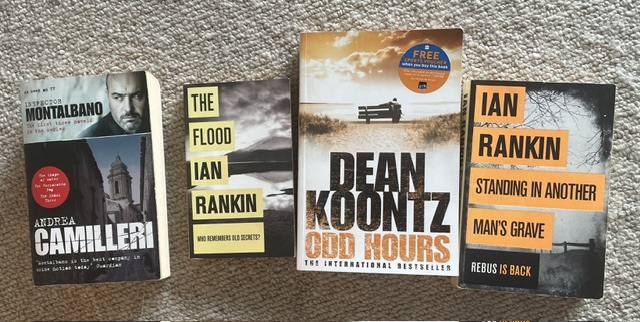
I started with the five detective fictions, one of them a compendium of three novels. Fast and easy to read, good for the weeks that I was prepping for the medical procedure everybody loves to hate, a nerve-wracking time when easy reads are the go.
As we are now well into May, even I can see that I’m getting behind with this project. And I’ve ordered a bunch of study books. Wonder how I’ll go with reporting on those.
Book 22 … The Flood by Ian Rankin, published 1986 by Polygon. Strictly speaking, The Flood is not a detective fiction. But as the first published novel of one of my favorite authors of detective fiction, Ian Rankin, I thought I might as well take it along.
Rankin’s own introduction informed me that his various skills began with this little book (I’m assuming that like many first novels it’s about 60 thousand words, it has that heft) so could be worth it to read. He himself tells us its a young man’s book ‘all about the perils and pitfalls of growing up’.
It was a patchy read. Sometimes you can learn too much about a book before reading it. Some parts I enjoyed. Others not so much. The first of the three parts to my mind the more interesting though of it is left hanging.
Book 23 … Standing in Another Man’s Grave by Ian Rankin, published 2012 by Orion. This book is advertised with ‘Rebus is Back’ as though Rebus has been away, missing. Rankin has written nineteen Rebus books as well as nine or ten that are unrelated to Rebus. This one is about a crusty old detective, resigned from the police force and working independently, as a private eye, I assume.
Co-incidentally, on TV (SBS on Demand) I’m following Harry Bosch in much the same scenario, in the Harry Bosch Legacy. What I enjoy about both these detectives is their personal lives. They tell the stories not just of their police work but also about their private lives, and their frail humanity.
Both also have been left behind by technology and isn’t that a relatable feature of modern life? Anybody over fifty will always be a migrant to the computer age and will, by the time they’re seventy, need a guide.
There’s enough detail in the average Rebus, and the story arc is usually familiar enough, that reading it was quite relaxing. There isn’t that need to hurtle along hurry hurry to find out the end, because the end is a foregone conclusion. Rebus will solve the mystery and the perpetrator will go to jail.
Book 24 … Odd Hours by Dean Koontz, published 2008 by HarperCollins. Once upon a time I studied Koontz’s written dialogue, to improve dialogue in my own writings, and enjoyed many of his novels. The cut and thrust of the dialogue, the spare but informative descriptions. The suspense.
Then he went into the Odd Thomas series, and barring maybe one of them, perhaps the first, these are not his best. In my opinion. I think I’ll be tossing this one into the recycling bin.
Book 25 … The Survivor by Sean Slater, published 2011 by Simon and Schuster. I’ve already passed this one on to my reading buddy. It was good. Added to which, Slater is the pen name for an actual police officer though I don’t really know if that makes a difference, most crime writers are very good researchers. But not having the book on hand does mean I’m limited to the Good Reading Magazine, if they even have it in their files.
They do. Their summary … “Columbine. Dunblane. Virginia Tech. Winnenden. But Saint Patrick’s High? In his first hour back from a six-month leave of absence, Detective Jacob Striker’s day quickly turns into a nightmare. He is barely on scene five minutes at his daughter’s high school when he encounters an Active Shooter situation.”
I was pleasantly surprised that there was another detective fiction author whose style I like that I’ve never yet read.
Books 26, 27 and 28 … Inspector Montalbano: The First Three Novels by Andrea Camilleri, translated into English by Stephen Sartarelli, published 2002 – 2004 by Picador.
The Italian publication dates were …1994, 1996, 1996 publishe by Sellerio editore … have I got a treat for you … the Sellerio publishing group is based in Palermo the capital city of Sicily, and they’ve adopted … ‘The program at the origin of the publishing house is a return to a culture that Sciascia defines as “pleasant,” that is, a culture in which so-called commitment is implicit and not explicit, therefore a culture of lightness, which does not renounce elegance, a culture of ideas, yes, but in the form of beautiful things.’ [My paraphrase.]
That’s brave in this day and age. I’ll be enjoying the publisher’s statement for a while … the link https://www-sellerio-it.translate.goog/it/casa-editrice/
And in addition, Inspector Montalbano, an Italian cop show set in Sicily, was a favorite TV series about twenty years ago, so how could I resist?
Starting to read The Shape of Water, the first of the three books—they don’t appear to be a trilogy—I realized I’ve read it before, or maybe started to read it before, because I did not recall the end.
The first thing to get used to in the book, compared to the TV show, is that it is not a version of Keystone Cops, the way that the TV version often resembled. A bunch of police constables and members of the Sicilian public perpetually running after Inspector Salvo Montalbano.
In the book all these people have their own personalities, and it’s good to get to know their differences. OK, yes, there does appear to be at least one Keystone Cop, and that is the officer most often left behind to man the radio, (I’ll find his name …ah, Cantarella) He does have all the hallmarks of a comic turn. Though I bet in Italian he’ll be funnier than he is in English.
The Terracotta Dog and The Snack Thief are the second and third novels. Both are also full of interesting geographic and historical detail and cultural ambience. These are extras, of course, for all non-Sicilian readers.
One thing I really enjoy is Inspector Montalbano’s relationship with his cook. She’s the mother of a pair of miscreants, one of whom Montelbano put in jail. The inspector is a total foodie and Aline leaves him with a stream of interesting dinners in his fridge.
Then there’s Livia, his girlfriend. The love of his life, she lives on the mainland. They enjoy their separate/together lives until they meet the snack thief in the third novel. Then they talk about getting married. But we only get Montalbano’s POV and he has doubts. There’s no resolution so far. I expect this conundrum to continue to be debated further on in the series.
Montalbano’s love-hate relationship with his second-in-command, Mimi Augello, is mercurial with a bit of ‘plain speaking’ involved. When Augello is well-meaning, Montalbano is savage and vice versa. Augello sounds ready to move into Montalbano’s chair, but Montalbano is nowhere near ready to move up.
Fazio and Tortorella are his sergeants, “or whatever the hell they were called nowadays,” he says. Then there are all the rest, constable I assume, hard to tell apart, except maybe for Catarella who usually mans the phone and mangles any message that needs to passed on and having to be re-interpreted when Catarella grasps the wrong end of the stick.
I can see from my confusion that I’ll be re-reading the series to get the chain of command, so I can read a run of Italian names and know who all they all represent.
The comedy often is in unexpected contrasts. Montalbano spend the morning scrubbing his house and then himself. He polishes his shoes, dons a formal suit with “his most serious” tie, and then sits waiting for a visitor, getting more and more nervous. He knocks back a glass and a half of whisky just before his visitor arrives, and who tells him, “I’m almost blind, I see very poorly.”
The comedy in The Terracotta Dog dances around a tragic plot. We get a glimpse of what life must’ve been like during World War Two in Sicily when the German Navy used its coastline and harbours to repair and resupply its ships.
Sometimes an old cultural practice is discussed. Could the fact that the corpse was found with a stone in its mouth mean something other than is commonly understood? Huh, I thought. I have no idea. Another reason I enjoy this series so much, this dialogue you need to have with yourself to ‘detect’ the full range of meaning. I recommend these.
The books I have here are the first three of a long career. I’m keen to read more now, see if they become formulaic which is always a danger. I hope they don’t, I hope Camilleri can keep his plots fresh. I’ll be hanging on to this one for a while. Pity that it is a tome. It’ll need quite a wide space on the shelves.