Reading Project, 11

I’ve been in two minds whether to include study and text books in this project.

In October 2023 I signed up with Dream School run by the This Jungian Life group.

For a year, I read course studies and completed online assignments, to start to learn how to interpret dreams. This followed on from months of nightmares and a short stint with a Jungian psychoanalyst.

After the end of the course, I continued with the analyst for another year. Which brought me to late last year. Since then I’ve been reading rather voraciously and, at the beginning of the year, beginning this project.

After I read Book 31 … Bone House by Betsy Tobin I was at a loss. Though I have plenty of other books lying around, a dozen un read and many many that could do with a second or third reading, I was feeling jaded. Like it was the end of a holiday.

I felt like I needed some chewier fare, a project with a bit of heft. Picked up MDR by Carl Jung, having had it on my shelves for about a year.

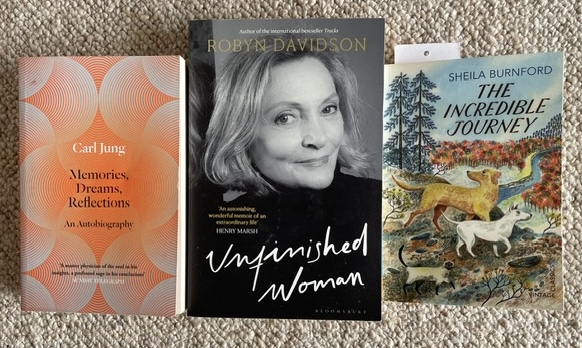
Book 32 … Memories, Dreams and Reflections: An Autobiography by Carl Jung translated from the German by Richard and Clara Winston, published by William Collins, a paperback edition in 2019.

This is not a book you can just read in one sitting, or even a week. It took me well over a month, the whole of May, I might as well say, there being plenty in it for me to think about.

When I started having nightmares back in 2023, I had already thought that I needed a way to think about what was happening in my mind. I wasn’t happy with the physical world of neuroplasticity, MRIs of people’s brains firing, the whole kit and caboodle of studying flesh-and-blood brains and what looks like is happening in them, and thinking that that is the be-all-and-end-all of how minds work.

So when I fell over Jungian dream interpretation by way of the This Jungian Life podcasts, I was stoked. Seemed to me that this was the lyric metaphoric way of thinking about what happens in minds that I could relate to. Been in that mode ever since.

(Stoked is an informal adjective meaning to be highly excited, enthusiastic, or exhilarated about something. Originating in surfing and skateboarding slang, it shares the same root as feeding or fueling a fire—meaning your energy and enthusiasm are burning brightly, Google)

Memories Dreams and Reflections, MDR for short, is both Jung’s autobiography and an account of his studies and discoveries. Despite what many people think, he went about his project of exploring what happens in our minds in a scientific way. He describes his experiments and the empirical results.

He named the personal unconscious that we all have, and discovered the deeper, archetypal unconscious we all have.

(Archetype is a Jungian psychology concept of an inherited unconscious predisposition, behavioral trait or tendency (“instinct”) shared among the members of the species …Wikipedia)

And then spent the rest of his life exploring how the unconscious works with the ego—your conscious mind. But he was writing in the early third to half of the 20th century and his turn of phrase, if anything, is quite esoteric, readable by only a small number of people, and somewhat turgid for the likes of me. I knew I would have to search out those interpreting him for more modern readers. And plus, I knew also that I’d be reading some light relief.

Book 33 … Unfinished Woman by Robyn Davison, published by Bloomsbury Publishing in 2023.

Picked this up from down in the Vista foyer where there’s a long shelf under the parcel bench, dedicated to memoirs, autobiographies and some histories.

Lol, love all these prepositions one after the other “up from down in” … makes sense, I hope?

The same Robyn Davison who lived Tracks and then wrote it. From the back cover, “In 1977, 27 year old Robyn Davison set off with a dog and four camels to cross 1700 miles of Australian desert to the sea.” I had that book for years. Don’t recall where I picked it up, second hand while traveling that same desert probably. Camp laundries are the best places to pick up good books.

I already had a soft spot for camels and loved the desert. I read that book more times than I can remember.

Davison was born on a cattle station, is quintessentially Australian, and the first modern woman explorer I read about. My heroine the minute I read about her. This memoir, about the forces that set her up to wander, to travel, to always be on the move, is a gripping read.

A poor childhood, her mother suicides, and Robyn thereafter is raised by her father and older sister in an outer Brisbane suburb. She was in London for the first time roundabout the same time I was in London.

After that she goes on to do all the romantic-sounding things that women in those days usually only could read about. Marrying an Indian prince. Living in London and writing. But, you know, there are always costs.

Book 34 … The Incredible Journey by Sheila Burnford, first published by Hodder and Stoughton in 1961. This copy by Vintage Books in 2013.

Bought this for a ninth birthday present and read it hoping to discover whether it could still rip my heart out. So many books written in the past lose their numinosity when set against more modern texts. Realizing this is a function not only of the language they are written in, but also the culture that nowadays washes through our minds.

It has this in the front as a prologue…  

The Beasts by Walt Whitman (1855)
I think I could turn and live with animals, they are so placid and self-contain’d,
I stand and look at them long and long.
They do not sweat and whine about their condition,
They do not lie awake in the dark and weep for their sins,
They do not make me sick discussing their duty to God,
Not one is dissatisfied, not one is demented with the mania of owning things,
Not one kneels to another, nor to his kind that lived thousands of years ago,
Not one is respectable or unhappy over the whole earth

Sounds modern, doesn’t it?

— — — —

The first three pages are a description of the setting, which I suspect may largely be skipped when reading them aloud. But still, the setting hasn’t suffered from the encroachment of modernity. I suspect only if you live right there will you know of the depredations of industries such as milling, mining and road-making.

The three animals are introduced in the next chapter. Two dogs and a cat. They’re being cared for by a friend of their human family and his housekeeper, Mrs Oakes, while their own family is overseas. A couple of weeks before the family is due back, the animals take off for home.

A distance of about two hundred and fifty miles separated the animals from their home, with plenty of dangers along the way. Bears, porcupine, floods, cold, snow, irascible farmers with shotguns. As well as just enough kindly humans to help the animals along.

I thoroughly enjoyed it. It hasn’t lost anything in the years since I read it to my nine year old. It’s a famous story. Disney made two movies of it, but to me it’ll always be a favorite read. And by that I mean a text I take in with my eyes.

Reading Project, 9

Early in April, the old library in the part of our retirement village that is about to be rebuilt, was to shut down. Readers were encouraged to go there and ‘score’ any books they might like to take away. Don’t bother to bring them back was the second part of the instructions, and don’t return them to the new library the third.

Out I went with my walker, found about seventeen books that looked interesting enough to take away with me, and a cardboard box, thinking to pack them in that for an eventual delivery to Life Line, a charity that runs a massive annual book sale.

These books are now sitting on the floor in front of my bookshelves, no room for them on the shelves. Most will be one-read-wonders, so will be moved on, so no use making room for them yet.

I started with the five detective fictions, one of them a compendium of three novels. Fast and easy to read, good for the weeks that I was prepping for the medical procedure everybody loves to hate, a nerve-wracking time when easy reads are the go.

As we are now well into May, even I can see that I’m getting behind with this project. And I’ve ordered a bunch of study books. Wonder how I’ll go with reporting on those.

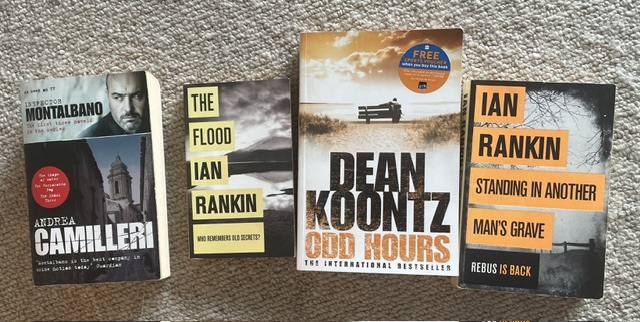
Book 22 … The Flood by Ian Rankin, published 1986 by Polygon. Strictly speaking, The Flood is not a detective fiction. But as the first published novel of one of my favorite authors of detective fiction, Ian Rankin, I thought I might as well take it along.

Rankin’s own introduction informed me that his various skills began with this little book (I’m assuming that like many first novels it’s about 60 thousand words, it has that heft) so could be worth it to read. He himself tells us its a young man’s book ‘all about the perils and pitfalls of growing up’.

It was a patchy read. Sometimes you can learn too much about a book before reading it. Some parts I enjoyed. Others not so much. The first of the three parts to my mind the more interesting though of it is left hanging.

Book 23 … Standing in Another Man’s Grave by Ian Rankin, published 2012 by Orion. This book is advertised with ‘Rebus is Back’ as though Rebus has been away, missing. Rankin has written nineteen Rebus books as well as nine or ten that are unrelated to Rebus. This one is about a crusty old detective, resigned from the police force and working independently, as a private eye, I assume.

Co-incidentally, on TV (SBS on Demand) I’m following Harry Bosch in much the same scenario, in the Harry Bosch Legacy. What I enjoy about both these detectives is their personal lives. They tell the stories not just of their police work but also about their private lives, and their frail humanity.

Both also have been left behind by technology and isn’t that a relatable feature of modern life? Anybody over fifty will always be a migrant to the computer age and will, by the time they’re seventy, need a guide.

There’s enough detail in the average Rebus, and the story arc is usually familiar enough, that reading it was quite relaxing. There isn’t that need to hurtle along hurry hurry to find out the end, because the end is a foregone conclusion. Rebus will solve the mystery and the perpetrator will go to jail.

Book 24 … Odd Hours by Dean Koontz, published 2008 by HarperCollins. Once upon a time I studied Koontz’s written dialogue, to improve dialogue in my own writings, and enjoyed many of his novels. The cut and thrust of the dialogue, the spare but informative descriptions. The suspense.

Then he went into the Odd Thomas series, and barring maybe one of them, perhaps the first, these are not his best. In my opinion. I think I’ll be tossing this one into the recycling bin.

Book 25 … The Survivor by Sean Slater, published 2011 by Simon and Schuster. I’ve already passed this one on to my reading buddy. It was good. Added to which, Slater is the pen name for an actual police officer though I don’t really know if that makes a difference, most crime writers are very good researchers. But not having the book on hand does mean I’m limited to the Good Reading Magazine, if they even have it in their files.

They do. Their summary … “Columbine. Dunblane. Virginia Tech. Winnenden. But Saint Patrick’s High? In his first hour back from a six-month leave of absence, Detective Jacob Striker’s day quickly turns into a nightmare. He is barely on scene five minutes at his daughter’s high school when he encounters an Active Shooter situation.”

I was pleasantly surprised that there was another detective fiction author whose style I like that I’ve never yet read.

Books 26, 27 and 28 … Inspector Montalbano: The First Three Novels by Andrea Camilleri, translated into English by Stephen Sartarelli, published 2002 – 2004 by Picador.
The Italian publication dates were …1994, 1996, 1996 publishe by Sellerio editore … have I got a treat for you … the Sellerio publishing group is based in Palermo the capital city of Sicily, and they’ve adopted … ‘The program at the origin of the publishing house is a return to a culture that Sciascia defines as “pleasant,” that is, a culture in which so-called commitment is implicit and not explicit, therefore a culture of lightness, which does not renounce elegance, a culture of ideas, yes, but in the form of beautiful things.’ [My paraphrase.]

That’s brave in this day and age. I’ll be enjoying the publisher’s statement for a while … the link https://www-sellerio-it.translate.goog/it/casa-editrice/

And in addition, Inspector Montalbano, an Italian cop show set in Sicily, was a favorite TV series about twenty years ago, so how could I resist?

Starting to read The Shape of Water, the first of the three books—they don’t appear to be a trilogy—I realized I’ve read it before, or maybe started to read it before, because I did not recall the end.

The first thing to get used to in the book, compared to the TV show, is that it is not a version of Keystone Cops, the way that the TV version often resembled. A bunch of police constables and members of the Sicilian public perpetually running after Inspector Salvo Montalbano.

In the book all these people have their own personalities, and it’s good to get to know their differences. OK, yes, there does appear to be at least one Keystone Cop, and that is the officer most often left behind to man the radio, (I’ll find his name …ah, Cantarella) He does have all the hallmarks of a comic turn. Though I bet in Italian he’ll be funnier than he is in English.

The Terracotta Dog and The Snack Thief are the second and third novels. Both are also full of interesting geographic and historical detail and cultural ambience. These are extras, of course, for all non-Sicilian readers.

One thing I really enjoy is Inspector Montalbano’s relationship with his cook. She’s the mother of a pair of miscreants, one of whom Montelbano put in jail. The inspector is a total foodie and Aline leaves him with a stream of interesting dinners in his fridge.

Then there’s Livia, his girlfriend. The love of his life, she lives on the mainland. They enjoy their separate/together lives until they meet the snack thief in the third novel. Then they talk about getting married. But we only get Montalbano’s POV and he has doubts. There’s no resolution so far. I expect this conundrum to continue to be debated further on in the series.

Montalbano’s love-hate relationship with his second-in-command, Mimi Augello, is mercurial with a bit of ‘plain speaking’ involved. When Augello is well-meaning, Montalbano is savage and vice versa. Augello sounds ready to move into Montalbano’s chair, but Montalbano is nowhere near ready to move up.

Fazio and Tortorella are his sergeants, “or whatever the hell they were called nowadays,” he says. Then there are all the rest, constable I assume, hard to tell apart, except maybe for Catarella who usually mans the phone and mangles any message that needs to passed on and having to be re-interpreted when Catarella grasps the wrong end of the stick.

I can see from my confusion that I’ll be re-reading the series to get the chain of command, so I can read a run of Italian names and know who all they all represent.

The comedy often is in unexpected contrasts. Montalbano spend the morning scrubbing his house and then himself. He polishes his shoes, dons a formal suit with “his most serious” tie, and then sits waiting for a visitor, getting more and more nervous. He knocks back a glass and a half of whisky just before his visitor arrives, and who tells him, “I’m almost blind, I see very poorly.”

The comedy in The Terracotta Dog dances around a tragic plot. We get a glimpse of what life must’ve been like during World War Two in Sicily when the German Navy used its coastline and harbours to repair and resupply its ships.

Sometimes an old cultural practice is discussed. Could the fact that the corpse was found with a stone in its mouth mean something other than is commonly understood? Huh, I thought. I have no idea. Another reason I enjoy this series so much, this dialogue you need to have with yourself to ‘detect’ the full range of meaning. I recommend these.

The books I have here are the first three of a long career. I’m keen to read more now, see if they become formulaic which is always a danger. I hope they don’t, I hope Camilleri can keep his plots fresh. I’ll be hanging on to this one for a while. Pity that it is a tome. It’ll need quite a wide space on the shelves.
Reading, 7

This session started while I was in hospital. Trying for easy reading matter. Easy to put down when necessary, for example to have a blood test done, or connect me to the IV.

My reading buddy brought me a book that he had trouble with and that I put aside after only one chapter, no way was I going to be able to read that in a scene where I needed to interact with maybe fifty people a day.

By day three I was hungering for anything at all to read. I’d forgotten to bring my tablet, and I’d been down to the kiosk in the downstairs lobby twice, and that had only magazines and newspapers available. Over two days, I bought two dailies of a right-wing newspaper, read them from cover to cover and felt like a foreigner.

Then, during one of my afternoon perambulations on the ward, I saw and remembered the existence of a lounge or two in each ward in that hospital, where visitors could withdraw to wait out procedures on their loved ones, and that there often were a couple of books.

Day three I sallied out and found a book that I normally wouldn’t read in a pink fit but needs must, as the saying is. A Readers’ Digest Condensed Book, in the new century renamed Readers Digest Select Editions. Still ongoing, I was amazed.

These are collections of “Popular, bestselling novels condensed to remove subplots or descriptions without altering the author’s style or story,” according to Reddit users and eBay sellers, quoted by Google’s AI. Hence me not reading them in a pink fit. However, by the 2020s I’m suspecting, the novellas could be being written purposely for the series. The four stories I read certainly seemed so.

According to Wikipedia https://en.wikipedia.org/wiki/Reader%27s_Digest_Select_Editions
I probably read

Book 18 … Volume 395 – #6 – September 2023 with • The Hunter – Jennifer Herrer • Hello Stranger – Katherine Center • Play the Fool – Lina Chern and • The Last Lifeboat – Hazel Gaynor

And because I was reading to pass the time, I have no clear memory of what all four stories were about except that one of them was about a bunch of newly-outed characters making the Titanic trip. By ‘newly outed’ I mean these people have not before featured in any of the Titanic fiction. And that they are probably completely fictional fictions. “IE did not appear in the passenger lists.” (Authorial note)

The other one I have some memory of is Hello Stranger, a thriller about a woman who has lost her memory. As this was the last story I read, I recall it best and it was good enough, in my opinion, not to give out any spoilers.

The remaining two stories? Can’t recall a word.

— — — —

After four nights, the days between, the two half-days fore and aft, and bells bells bells every minute of the night, I returned home. Blessed relief, with no bells clamoring all night I slept like a young thing.

Returned home with a prescription for another five days of antibiotics that had now to be taken by mouth, of course. And don’t bother with the probiotics yet was the word. The first couple of days I was quite well, getting stuck into the clean-up, and even managing to attend the weekly art class on Thursday morning.

By the Friday nausea began to rule. All the jobs I had begun slid into the background. There’s a pile of washed Duplo in front of me, another pile drying on the balcony. The grandkids have outgrown it, but some will still be useful to me for mountain-building. All of it needing sorting and I haven’t washed the plastic tubs yet.

Then there’s the laundry, one load ready to be folded, one load still in the washing machine, and another pile growing in a corner of the bathroom. Then there are the three days worth of dishes to be washed. Then … then …

I looked at my bookshelves, found something I hadn’t read yet, and promised myself time would pass. Five doses to go.

Book 19 … My Sister Rosa by Justine Larbalestier, published in 2016 by Allen and Unwin.

I picked this book up in the library in the village community center some time ago. The back cover promised me edge-of-my-seat reading and it was not wrong. I read it in one gulp, which took me till 1.30 A/M, and some time ago I’d sworn off that kind of read. Sleeping only about five hours does not agree with me these days. It’s like I’m hungover the whole next day.

Spending a bit of time at https://goodreadingmagazine.com.au/ about this one, reading reviews, I discovered that people either loved or hated the book. Also, that it’s classed as young adult fiction, which I just don’t see. Just because the POV character is a teenager does not necessarily make it a YA fiction.

Some readers thought the novel well researched, others thought it badly researched. I’m neutral about that. Just so long as the research doesn’t intrude into the reading experience I don’t mind what lengths writers go to get a readerly reality. I’ve paddled that sea myself, researching the ins and outs of surfing for my novel, Mongrel, for example. Body-surfing was the only kind of surfing I ever did and then only casually.

Some readers loved the supporting character, the ten-year-old psychopath, thinking her very realistic. Others thought her tricks were mere childishness. On that point I really don’t believe the average ten-year-old will try to talk a so-called friend into killing her twin for entertainment. People who thought that, I stopped respecting the minute I read their opinion.

Che, the older brother who told the story, was trying to be a normal teenager and not succeeding. Neither of the parents were ‘at home’, so to say, and his little sister became his responsibility. Of course in the past, it was normal for an eldest sibling to have the care of the younger brood. In my past it certainly was, and I often had three young kids trailing me. Nowadays, with families of only one or two kids it is much less common.

Book 20 … The Alchemist by Paulo Coelho. Translated by Alan R Clarke. Originally published in 1988. The first English language edition in 1993. This copy is a 25th anniversay edition published in 2014, by Harper One an imprint of HarperCollins.

Its publishing history is complex. In 1993 my son was eight years old and I was a keen library reader and thrift store customer. That would be one of the reasons this book completely passed me by. That library was struggling a bit, new books few and far between, and thrift stores feature the old and remaindered. Nor was I in any reading clubs where people raved about it. Small country town. Not even a bookshop in those days.

Nor would I have been psychologically mature enough in that time to read it. I hadn’t yet started my writing studies, and the only hero’s journey I knew about, was me eking out a living. Thirty three years later–now–I read The Alchemist with joy. I recognized so much. The hero’s journey, yes. There’s been so much said about the hero’s journey in film, literature, how-to books and descriptive critiques, most people will be familiar with its concepts.

But also some of the Jungian concepts I’ve been studying for the past couple of years. The Personal Legend, for example. Do you know yours? I’m not yet so familiar with mine that I can talk about it in detail, though I’ve received a few clues from dreams. If you don’t yet journal your dreams, start now. I recommend it.

Then there’s The Soul of the World. I know that as the collective unconscious, but described much more poetically. There’s more. The plot of the recurrent dream of treasure in a far off place that returns you to your original place? A plot that I’ve read in a couple of recently published novels. It was an aha moment and me thinking, So this is where they got that!

Even the title. The Alchemist. The alchemist is a wise man. The last thing he said to the boy? “No matter what he does, every person on earth plays a central role in the history of the world. And normally he doesn’t know it.”

This seemingly simple little book gave me a lot to think about.

Mongrel: 46, 47 and 48

Last three chapters. But not really THE END.

It was hard to figure out the cut-off point between Mongrel and Meld. In a way, the whole of Mongrel is Tardi’s backstory and set-up for his role in Meld.

I felt that, with at least the main character a familiar person, we might all be able to better understand the new scenario. Experience it through his senses, as it were. It was hard to write and it’ll be hard to understand. But I hope you’ll find it intriguing.

— — — —

I’ve seen most snakes in the wild, but never a death adder. Like most bush-walking Australians I was always on the look out for them. Very scary. I’ve known several people who thought they killed one, only for the animal to turn out to be a blue-tongue skink.

Image from https://wildlifeqld.com.au/common-death-adder/ Check out this link for all the variety of colors of death adders.