
Just posted Part 16 on the Brick Stories page. I realized this morning I’m seriously behind and not even sure whether I’ve even posted it already, though could not find it.
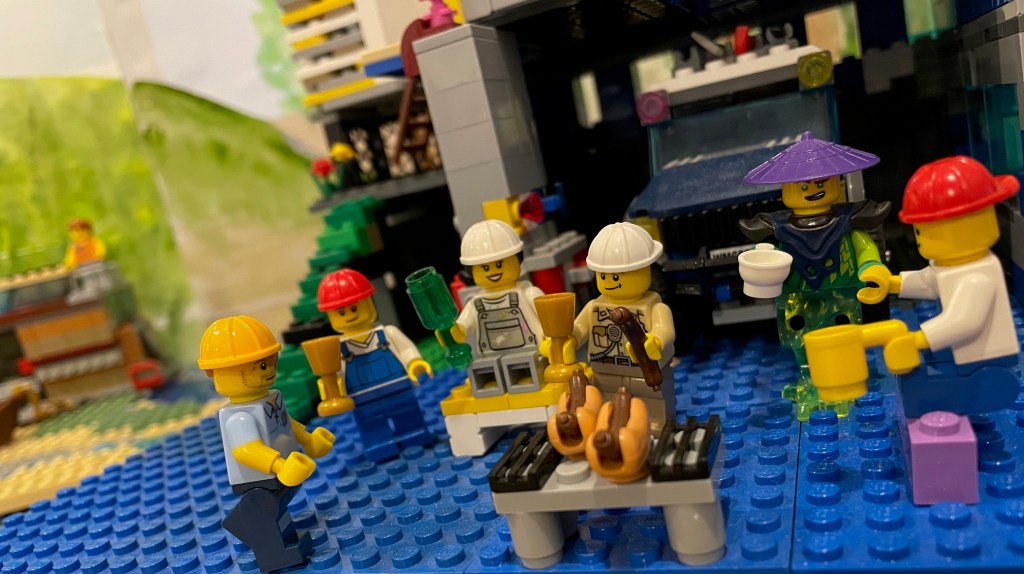
The crew having their Saturday barbecue … read the chapter in Brick Stories
Just posted Part 16 on the Brick Stories page. I realized this morning I’m seriously behind and not even sure whether I’ve even posted it already, though could not find it.
The crew having their Saturday barbecue … read the chapter in Brick Stories
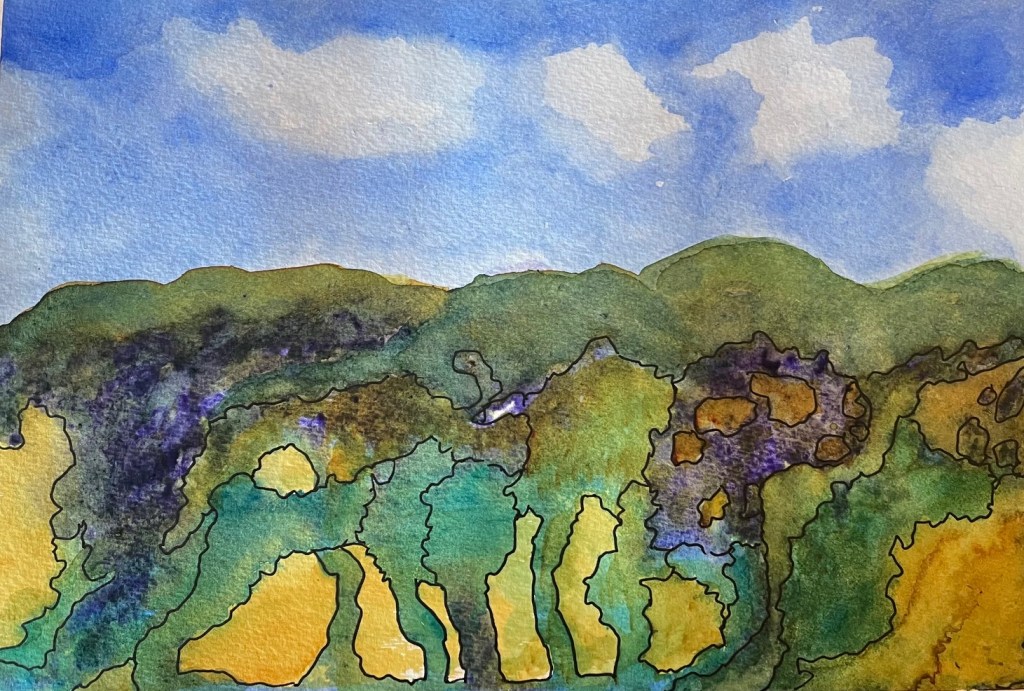
In the Biesboschen
Four hundred begettings ago,
Hunting, fishing and gathering
We people followed the narrow under-tree paths
of deer and swine.
Otter-Wijf might then have been my name.
Hung with bones, herbs and a wisert’s skin
I walked and walked and walked the cool under-tree paths
Of our home range.
— — — —
With this painting and poem I’ve tried to manifest a dream in which I had the clearest sensation that I walked through sand–making those little squeaks–in an ancient Dutch setting. Otter-wijf was my name and I wore a leather shoulder bag with dried herbs in it, and a leather wrap about my shoulders.
It was the uncanniest thing when I woke, no longer wearing the wrap or the bag when only seconds before they felt as real, as the bed-sheets a few seconds later.
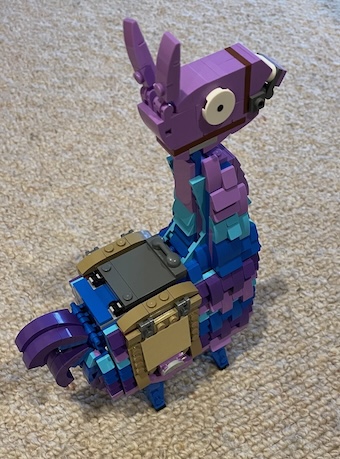
This Lego model is something how I imagined a tiffany would look like.
What follows is a long chapter tying off most of the ends, a short final chapter will follow in the goodness of time.
Connecting A to B
Connecting Earth Fall to Meld is not happening. The amount of time between them is out of wack. I think now that the events in Earth Fall took place before anything in Mongrel happened.
Lol, does it seem like I’m talking as though these events are coming into being without a writer’s input? Put like that? Yes, it does. A broad band of muscular storying is growing between Earth Fall and events in Mongrel and it’s not like I planned anything much.
Mongrel was to be part one of a trilogy that in my mind I’ve already scaled back to a twosome. Time will tell. Mongrel resides in the long long tail of indie published novels marketed by Draft to Digital.com.
I had a quick read of Mongrel’s Chapter 26 the other day and thought I wouldn’t mind running my eagle editing eye over it once more. And maybe turn it into an audio file by reading it chapter by chapter into some software and publishing that chapter by chapter.
Which will necessitate taking it off Amazon if I don’t want to get a shirty email, saying I’ve been cancelled, as the biggie doesn’t allow any part of a production it’s selling to exist outside the virtual covers of the item being sold.
Making some friends over on Substack, I got a bunch of links on how to find my voice. Thank you, Aurelian Ashmore. So yeah, I’m looking into it.

Can you believe it? I wrote this same post (that I just posted) back in December 2024 and did not follow through with it! A better post, too.
This is it….
“I love it when I check the time and see that it is 12.12 on the 21st. Always gave me a little tweak of emotional satisfaction to see the patterning. For a long time, for years, I thought that that was synchronicity at play.
A palindrome-like date is good too. The most recent one we had was 24 November 24, or 24/11/24
Mentioning that to a friend, he said it was just co incidence. “And it’s not even that,” he said. “I bet that kind of number confluence”— that is what he called it, I probably should google that for veracity—“happens so often you can’t call it co incidence.”
Of course, I set out to see what’s what and prove either me or him wrong.
I use a twelve hour clock.
12 x 60 = 720 minutes
Set them out in a table, 12 columns across the top left to right; 60 rows top to bottom. 720 cells.
Write in only the numerals where there was a definite pattern.”
Lol, from here on re read my latest on this topic.
Like many people, I enjoy the number play possible for example with such tools as digital clock times. What I’m realy talking about of course, is play with the numerals 0 1 2 3 4 5 6 7 8 9. Usually I add or divide them.

Look at all these nines! If you add them all together you get 27, add those two and you get 9 again. If you add only two nines, you get 18 and if you then add 1 and 8 you get another 9. Nothing magic about it, just a pattern inherent in 9 and its processes.
A couple of years ago I went to the trouble of spreadsheeting every minute in twelve hour. 720 minutes, if you are interested. I found that a full third of these minutes have two numerals that are the same.
The above numeral combination is hardly chance, in other words. But even knowing that hasn’t changed my inclination to get excited over these tiny bits of co-incidence.
One of these days, I’ll record every single time I look at the time and see what I get. It feels like it’ll be 50%.
Do you have a relationship with co-incidences?
Ushen at Ten

Basalt boulder, possibly coughed out by Wollumbin, 23 million years ago.
 Rita de Heer