
Author: Rita de Heer
Writing is what I do. What I think about. What I meditate on. What I dream up. Listen to. Imagine. Sometimes I sleep. Sometimes I eat. And I walk. Pull out environmental weeds. There are a thousand more things I do, though writing comes into a fair few of those things too.
The Gisnep Puzzle

Unfolds like origami in reverse
— — — —
Ironic Sans continues to shine. Every time I solve the daily Gisnep puzzle, I learn of another interesting person by way of a link to Wikipedia, this time the brother of the man who invented the concept–and word–of ROBOT, more than a hundred years ago now. Though the brother himself is the subject …. Lol, just trying not to drop too many clues.
Avatar Remaindered, 3
The Gesso Project …
Finally able to do a bit more work on my big painting project. Out on the balcony it’s been either too hot 36 degree Celsius, or too wet, or both.
Today an early thunderstorm and short period of rain cleared the air. Painted the sky, a plain blue. Half of the mountainous mid-ground, a variegated green and brown.
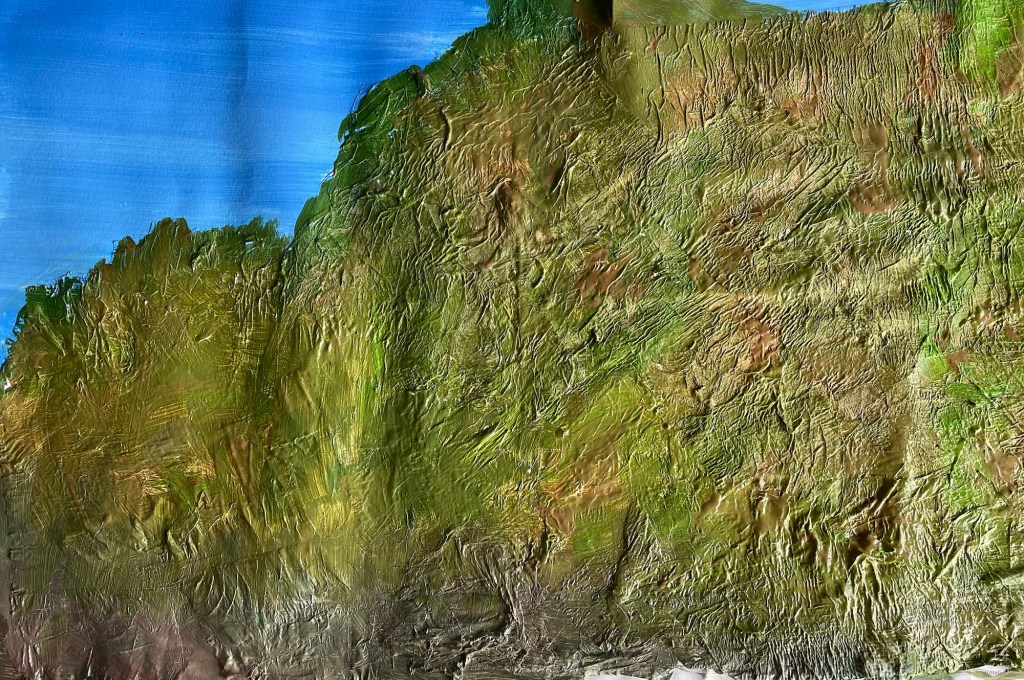
As it’s drying, I notice hundreds of places where the paint hasn’t touched, or the paint is shrinking back. It will need a third coat.
It’s meant to be a backdrop for my brick stories.

Next time …
Avatar Remaindered, 2
Decided to revise everything and repost.
Avatar Remaindered, 1
Back about three or four years ago, when I began this project … this paying out of my story debt, I must’ve begun with Chapter 2 of Avatar Remaindered. As–lol–I have not found Chapter 1 anywhere in the archives. Diligent searching, I tell you.
I thought I might link to it when I post up Chapter 23 as the avatar needs to be in the district round about now, and Avatar Remaindered was always going to be ‘published’ before the end of Lodestar.
Since a lot of readers have joined in the meantime, I decided instead to enable you all to read … if you’re interested … Sard Yon Kerr’s adventures from start to finish. I’ve gone back to the original and revised it. May follow it up with the chapters in between. Be easier to find consecutive chapters then.
Umbrellas … the physical objects
[I see I’ve been resting on my laurels a bit, with my last post five days ago.]
Wikipedia’s definition: “An umbrella or parasol is a folding canopy supported by wooden or metal ribs that is mounted on a wooden, metal, or plastic pole.” And a little further in the article: “Generally speaking, parasols and umbrellas are small, handheld, personal use items.”
I first became interested in umbrellas when as a ten or eleven-year-old when as a special treat I was allowed to use the family’s Indonesian bamboo and oil-paper umbrella, called a ‘pajong’ to walk to a friend’s house through the rain.
We lived in Sumatra at the time (1958), in a small village called Indarung. [I looked it up on Google Earth and it still exists, but now as an outer suburb of Padang. In the 1950s it was a clearing in the forest.] And tropical downpours were a daily feature in the wet season.
The most fascinating part about the pajong was the way the spokes were joined to the center and the ribs.
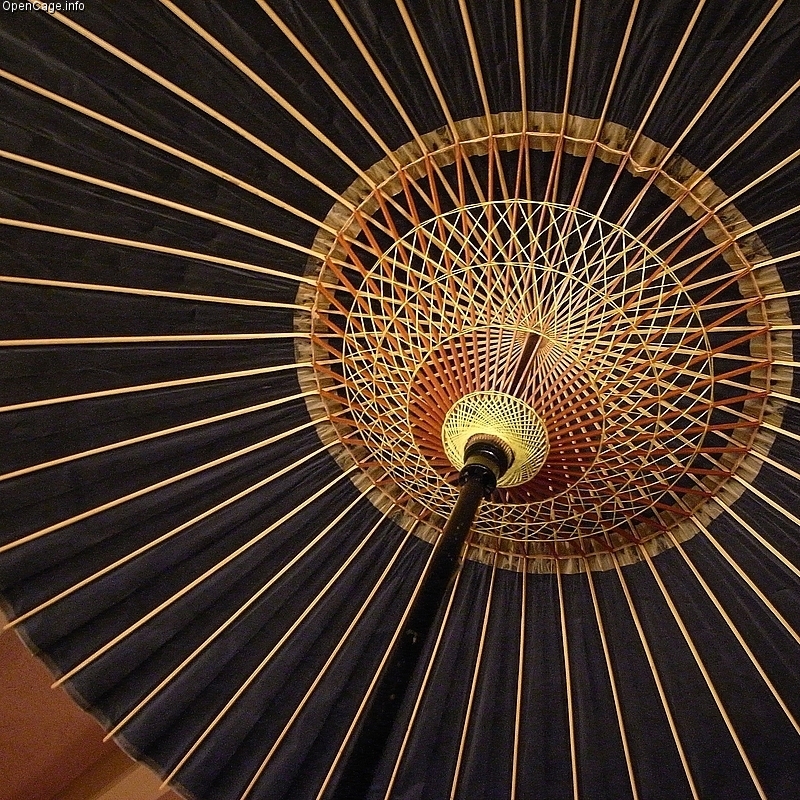
The above Japanese umbrella is way more complex than a simple ‘pajong’ made in a Sumatran village. Our umbrella had a greenish interior bamboo frame, oiled paper canopy, with a gold painted trim and point, with none of the extra basket-weaving in the above example. I remember the smell above all, of the oil applied to the paper to make it waterproof.
Both my present umbrellas have seen better days. The sun umbrella that I’m not calling a parasol as it isn’t dainty enough, has been all but unusable for years already, with one of the spokes bent and another broken. I’m hanging on to it as I aim to repair it.
My fold-up rain umbrella was blown inside-out last summer and was a mess of bent spokes and torn-away fabric. Most people throw such wrecks straight into the bin but I can’t bear it. Fold-up umbrellas are amazing technological marvels. If you have one, have a good look, it’s fascinating.
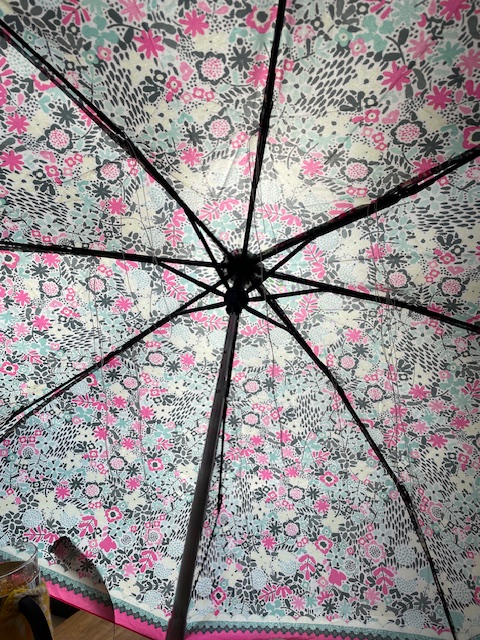
This is mine, photo by me. It’s a fairly ordinary design, I could’ve maybe gone for something a bit snazzier but this one was the only pattern on hand when I needed shelter. The threads hanging down are me having a go at fixing it. So far, I’ve reconnected all the innermost hinges to the fabric. When I’ve done all the hinges I’ll dot the repaired places with glue, maybe super glue. Then cut off the excess thread.
The long threads make it very easier to knot the threads after passing them twice through the holes in the spokes and twice through the fabric, then once around the sub-spoke. I’ve bypassed the really finicky job of sewing the spokes to the inner seam and instead have sewn the spoke to the fabric by drawing the thread to the outside and back in again. Similar to sewing on a button.
This all made me wonder how much assembly there had to have been by nimble young fingers? While I can see the frame being produced by machines, sewing the canopy to the frame … a machine? Not a chance.
Another form of intricate but boring labor by the modern enslaved workforce … I imagine each person in an assembly line having to sew an unending line of spokes to canopies … have you ever seen/been in an umbrella factory?
 Rita de Heer