3 realities. The everyday consensual. The Eleven Islands. The future.
Author: Rita de Heer
Writing is what I do. What I think about. What I meditate on. What I dream up. Listen to. Imagine. Sometimes I sleep. Sometimes I eat. And I walk. Pull out environmental weeds. There are a thousand more things I do, though writing comes into a fair few of those things too.
The jury is out on the bug’s ID. Just found a similar looking one in the Wildlife of Tropical North Queensland, a cockroach probably immigrating from Asia.
Or it could be a sap sucker related to the bronze stink bug. There is a sap sucking bug species, like this one on the Angophra sp, for all major tree species in Australia.
European honey bees very busy among the Tuckaroo flowers …
I had a little video clip here, but guess I need to negotiate with WP on that, and am on my mobile just now. Think of the above as a place holder.
A bunch of tiny blue butterflies skipped in amongst the grasses
Fast fliers that never sit still they are one of approx 63 similar little blue butterfly species in the region, according to Helen Schwenke in her Create More Butterflies. I saw them among the above grasses.
If they were the Common Pencilled-Blue variety, they would’ve had plenty of food for their caterpillars for the Tuckaroo is a common host plant.
Is the steep rocky rise at the south end of Cadogen Park, a sports field surrounded by a narrow strip of vegetation.
Northfacing, the bank might as well be known as a commercial bank for its richness in biodiversity.
I suspect it was planted out purposely at one time, as the presence of human-spaced tuckaroo, acacia, and other native trees illustrates.
Just as many fast growing weedy non-natives have filled the spaces where originally, I suspect, slow-growing natives struggled to make a living.
The section above shows about a third of the total length. The east-bound arm of Bedivere Road encloses the western end of the bank, while at the eastern end—where I came in—a foot/bike path runs past.
In the foreground of the photo the newly mown cricket ground where two species of birds, two swallows and a willie wagtail, were busy picking up stunned insects. Though I don’t have good photos of either of them, or lol, shots I can post on the FB Crap Bird Photography group, I’v put both birds on my ‘bird species sighted’ list.
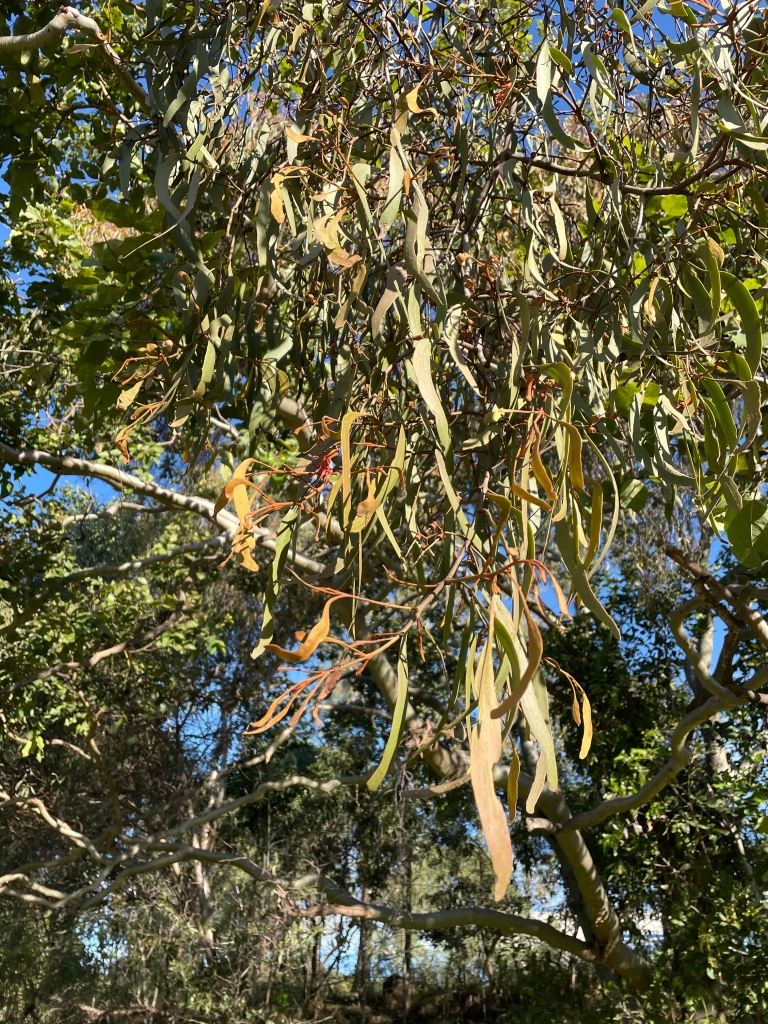
Most of the first third of the bank is influenced by this very large … still working out what it is … used to be called Angophra … a species that appears weedy in Brisbane … though this one may have been planted purposely.
This tree is on its way out. Almost every joint in the larger branches has a bunch of mistletoe hanging from it in various stages of life or death.
Mistletoe, also an unknown species
Mistletoe, the brown leaves are new growth, the grey green mature. The shape of its leaves resemble the generic Eucalyptus leaf-shape, so I wonder whether the very comfort of this mistletoe on this tree means it’s finding this … easier to eat?
Above, some of the many branches of the Angophra/Eucalypt with a bunch of its leaves in the left foreground. At my eye height all leaves were infected with black mould with every do often a sprig of tiny red new tree growth trying to push through.
This is not a tree you would happily sit under for its shade while watching the cricket, and, mindful of suddenly falling branches, I decided not to take a short cut back to the path by walking under it, either.
As you can see when you zoom in, most of the duckweed is white and dead.
I’ve been keeping fish and frog ponds for about fifteen years and I’ve never had such a wholesale dieback that even the duckweed carked it.
The feathery green plant seems okay so far. Fingers crossed that they make it. And, I hope that both the Azolla waterfern and the duckweed have left spores and seeds behind, that hopefully will sprout when we leave winter behind.
While you are zoomed in you may be able to spot the two remaing fish. Though they look like leprosy warmed up in the photo, in their analogue state they‘re stockier than they were, but at least still alive.
I moved their habitat back under the outdoor light, in the hope that that gives the plants enough light to survive until I get my grow lights. An added bonus is that I can sometimes see the fish flitting about from inside my living room.
There are more tracks/songs on this post-rock album. Steede Bonnet, my favorite in this album, is a kind of western, soundtrack sounding …?
Can you believe it, we have not yet found a good substitute for track/song and these purely instrumental compilations are called songs.
I’ve had a problem with that since I began with post-rock in 2017. At least the word ‘album’ has stood the test of advancing technologies.
The exact month and day now escape me but some time in 2017 I got home from a funeral and typed ‘big music’ into the google search box, because it felt like suddenly half my conscious mind had nothing to do.
I took up watercolour painting at the same time, as well as a third project to round things out…but what?
For the life of me I cannot remember what I decided on. Or even how I changed my life to fit it in. Still worrying at it at times like my tongue worries at a hole in my teeth.
Google came up with post-rock, and I’m still listening. Voiced lyrics don’t do it for me, I spend all my time trying to hear what they are saying. That’s not to say I don’t have a few favorite classical albums among my play lists. Plus quite a few film scores.
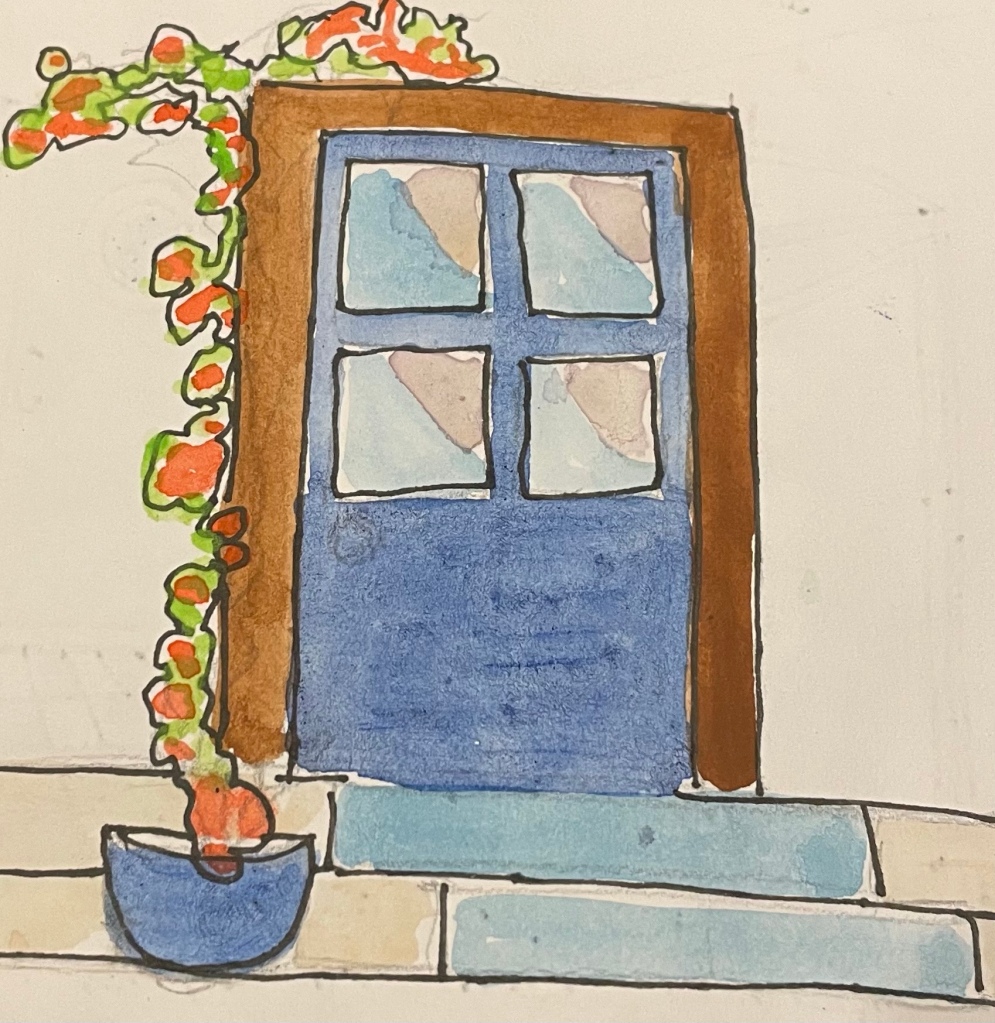
It’s been a while. Here a sketch that looks unfinished. If I lay a couple of fingers over the light green and house, it looks like something. I’m letting it sit for a while before I decide.
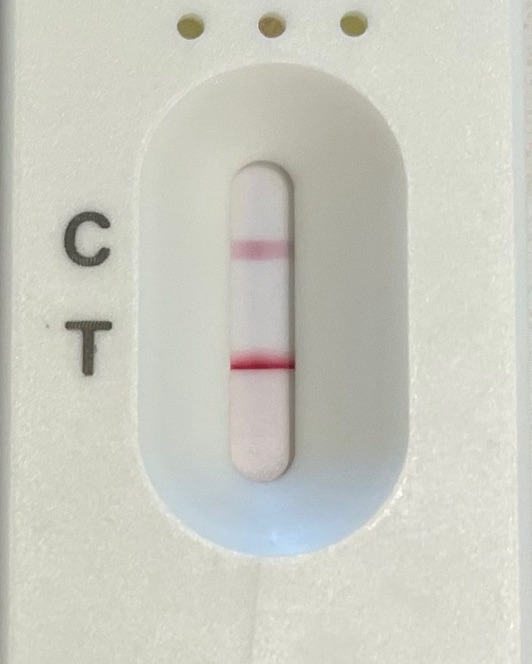
Good news today, for me anyway! Still in remission! Yay! Three years and four months. My type of cancer has an 11% survival rate.
This year alone we’ll all spend the equivalent of 500 million years scrolling on social media. (Collectively, the world spends 720 billion minutes a day using social media platforms. Over a full year, that adds up to more than 260 trillion minutes, or 500 million years of collective human time, according to a report from GWI, a consumer research company.)
Beggars belief, the numbers he quotes. see the whole article below.
Hi Rita,
There were two weeks in July 2012 that completely changed your life forever.
However, at the time you were blissfully unaware of what was going on.
(We all were.)
What happened?
Well, it all began when Facebook listed on the Stock Exchange, which was a total and utter disaster. Within a few months its shares had crashed by more than 54%.
Why?
At the time of its IPO (initial public offering), Facebook stated it had “no material revenue from mobile”. (Yes, in 2012 we were all checking our Facebook friend requests on our web browsers.)
Zuckerberg could see the writing on the wall. They were dead meat unless they got on mobile. And so, as legend has it, he pivoted the entire company to building a killer app – fast. He famously refused to have a meeting with anyone until they had presented him with what he wanted.
And in those few weeks the smartest behavioural psychologists and programmers in Silicon Valley created the very first social media app, something so powerful that it changed the course of history.
Seriously.
Let’s flip forward.
This year alone we’ll all spend the equivalent of 500 million years scrolling on social media.
(Collectively, the world spends 720 billion minutes a day using social media platforms. Over a full year, that adds up to more than 260 trillion minutes, or 500 million years of collective human time, according to a report from GWI, a consumer research company.)
In short, you’re spending way too much time on your phone, right?
Everyone is.
The Digital Australia 2024 Report by consumer intelligence company Meltwater shows that the average time users spend on TikTok is 42 hours and 13 minutes per month. Second place is YouTube, with the average user spending 21 hours and 36 minutes per month. And Aussies are some of the biggest users of Snapchat, with 17 hours across 619 individual sessions (!) per month. Facebook users spend an average of 20 hours and 15 minutes per month, and for Instagram it’s 11 hours and 45 minutes per month (which I thought would be higher, to be honest).
Is this a good use of your most precious asset?
Well, if you ask Mark Zuckerberg the answer is “Hell, yeah!”. Facebook’s profits were $US32 million in 2012 … and last year they were $US39,000 million.
Yet what about for the rest of us?
Well, Facebook interviewed eMarketer’s Ezra Palmer about the dramatically increased use of mobile, which is up 627% in the last four years alone. She glowingly described it as our “connected consciousness” and brushed aside the naysayers:
“If it were not a valuable way of interacting and being, we wouldn’t be doing it. Mobile is an extension of us … it’s a fundamental shift in our psychology … it’s one thing to look at the [daily usage] numbers, it’s another to think about the amazing ramifications of that”, she gushed.
Uh-huh.
Just like all those people at the casino wouldn’t be there if it weren’t a valuable way of being.
And let’s look at those amazing ramifications.
The rise of social media has coincided with an accelerating decline in teen mental health, and hospitalisations for self-harm have exploded, especially for young girls.
Not only are today’s kids more anxious, depressed and suicidal than in previous generations, they’re also getting dumber. Australian students are among the world’s biggest users of digital devices at school, yet academic results released in December showed teens have fallen a full academic year behind those who went to school in 2000s, according to the Programme for International Students Assessment (PISA).
This all makes sense.
Social media (which has done another ‘pivot’, this time to 45-second viral videos) is the equivalent of junk food.
You wouldn’t spend upwards of 10 hours a day continuously gorging on highly processed junk food and expect to be healthy.
It’s the same for our mental health. You are what you eat … and what you scroll (and Zuckerberg is your personal chef serving us up dopamine-soaked donuts all day long).
Yet waving our fists at the tech giants is about as useful as blaming Macca’s for your kid eating Big Macs for breakfast.
We’re the parents, and we’re in charge.
And many of us have trained our children to see that a phone is the most important thing on earth. I’m ashamed to admit that at every milestone of my kids’ life – the day they were born, the day they took their first steps, the day they pedalled their first bike, and every birthday – they looked up and didn’t see my eyes … they saw the back of my phone as I yelled “Smile!”.
They also see Mum and Dad mindlessly scrolling on our phones while the world passes us by.
Again, what message do you think that sends them?
So I’ve come to a couple of conclusions.
First, if I want my kids to have a healthy relationship with technology, I need to model it myself. That means keeping my phone in a dish with my car keys and wallet at the front door – and leaving it there – so I can engage with my family without constant distraction.
Second, it’s my job to give our kids experiences they can’t get from screens.
Like what?
Like encouraging them to have friends over to hang out IRL (which is what kids actually want most). Or going on a family hike, to the beach, or to a sporting event. Or encouraging them to start their own little Barefoot Business (perhaps with a mate).
Now this sounds very aspirational, but how would you force yourself to actually do it?
Well, the fastest way would be to implement Screen Free Sundays. And that’s what my wife and I havedecided to trial with our family – starting this week.
Yes, we’re trying to put the internet back in the box, and live like it’s 2012!
Tread Your Own Path!
Much better than I could’ve said.
Plus, I overworked my shoulders today, can’t type.