Page 1 …

This is page 1 of Mongrel Part 1 of the Doomed? series. If you like what you read, hasten to your favorite ebook distributor, the 99c sale ends on 14 July.

1: Tardi

Tardi Malko dived down the water column to where the wrecked trawler lay on its side six meters below, the water as cool and smooth as satin bed-sheets. He stopped a meter above the wreck, sculling with his hands. He’d break the perfection of the display if he touched down, but now that he’d seen the silver coral, he definitely wanted to use it in the video clip he intended to submit for the Virtual Surfing job.

He smiled closed-mouthed to not let any water in. Oh yes! This little addition is going to swing the vote my way, he thought. He swam up for a breath, aiming for the dark torpedo shape of his surfboard floating above.

Out of habit, he checked for triangular fins when his head broke through the surface of the water. Not that he expected any of the really wild wildlife that passed through; not the season for it.

In the east it was still too bright to see much, with the rising sun seeming to hang only a couple of hand-widths above the horizon. He turned, scooping at the water with his hands and kicking with his feet. The Byron Shire coast was dark blue and rumpled with hills. The surface of the sea had the bronze tints of a Roman mirror, no wind and still no swell. His surfboard only moved because he’d troubled the water near it.

Deep breath.

He dived, squeezing his eyebrows together to adjust the goggles for magnification. On the way down, he flicked the side of the goggles near his left temple to switch to the cam function. With the goggles videoing, he swept his gaze back and forth over the silvery clumps for a background sequence of the squared pattern. There were ten rows of the clumps on the near-horizontal side of the wreck. To create a pattern like this the coral must have been seeded.


Up for a breath, and down again.

The early sunlight trembled through the turquoise water and reflected off what looked like barbs, the coral’s hair-like structures. The sun’s rays glancing over the hairs must cause the shimmering effect people had told him about. Good score, Tar-boy. All my problems solved.

Art by Dan van Oss of Covermint

MONGREL by Rita de Heer (2019) books2read.com
UBL: https://books2read.com/u/bW9Pgq
Universal Book Links Help You Find Books at Your Favorite Store!
Read Doomed? 1: Mongrel

Mongrel … the fellow in the banner … is available for just 99 cents from 30 June to July 14 … click on Universal Book Link: https://books2read.com/u/bW9Pgq for your favorite ebookshop

The first installment of a series set in The Eleven Islands, Mongrel tells the beginning of the story of Tardi Malko, a 22nd century surfer and trucker.

He needs a second job. While videoing his application to work at Virtual Surfing, he’s thrown against some alien coral. The Moogerah Monster, an alien entity, instantly invades Tardi’s mind and starts to force Tardi to help it break out of its prison.

Tardi begins his resistance by intending to stay himself. His ex-girlfriend signs him up for a job with her, and his drowned brother wants to stay dead next time his CPU freezes. Then the Stormies, a mysterious underclass, claim him as their own. Tamer, they call him. They expect him to control the alien monster, to use it for the good of all Stormy kind.

How will he stay human?

Wordsmithing

The excerpt below is written in a fictional, grammar-based dialect. It has one word I made up … skanzy … and some that are used in different ways than you might be accustomed to.

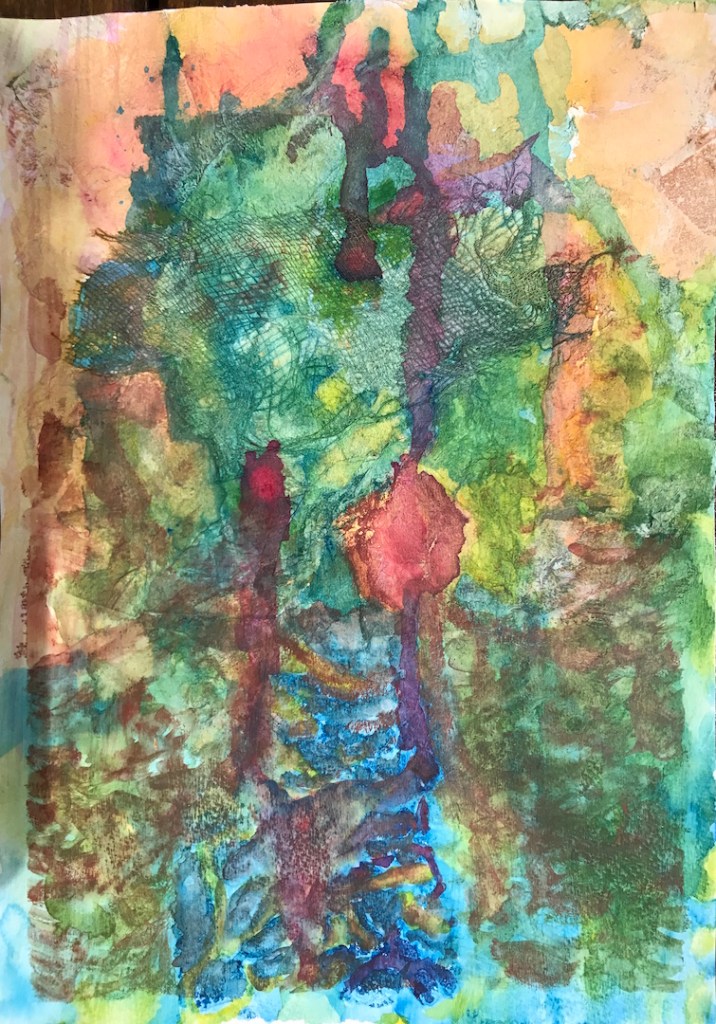
Watercolor painting of what one of the characters described might look like.
A typical skanzy is hard to see when you’re
trying too hard.

“A skanzy by kind and a skanzy with aptitude is what I am, though I’m quite long-winded as well. The bottom falling out of the bio-engineering market left a lot of us product scrabbling for a living. Cities wouldn’t have us, or anywhere you live. You who are not mis-made.

“Down to the rivers is where we drifted, and where we now live in permanent river-camps, despite floods and melting floes. The some of us what hold down jobs support us all. The jobs never notice there’s an unending succession of us—seen one, you say, seen us all—so when one of us is too sick to get out of bed, injured, or arthritic of a morning—someone else will turn up.

“We can’t afford to lose any of the jobs so we have a rota and a job school in every camp where we all learn all the jobs.

I’d love it if you leave a comment on how well you can understand it, and would maybe like to read more by this character?

Writing is Gardening

Mullumyard in the Rain

Gardening is like a hands-in-the-dirt kind of writing. That’s the thought I had about them both while I pulled out weeds this morning.

What I was doing there–with that thinking–was trying to construct a metaphor. You will have noticed, though, that I had doubts and inserted a ‘like’. The two things that I was trying to relate to each other at that moment felt like they are too different from each other and I settled for making a simile.

But what is there about gardening and writing that I thought I could bring them together in a metaphor? Thinking thinking thinking. I guess it is more about the ways that I engage in each process.

Gardening, you pull your garden gloves on, walk into the backyard and start weeding. For example. When you’ve picked all the dandelion flowers due to set seed and put them in the organic refuse bin, you’ll see that the newly planted pansy plants are looking a bit limp. Without having to wonder what you’ll do next, you’ll get a watering can, fill it and give the pansies a drink. Next, you’ll notice that the excess thyme plants you ripped out last week, are looking nicely dried. You’ll give them a good shake above the vegetable patch to release all those little dry leaves, where they’ll add to the mulch. Every little bit helps. And so on.

Writing, you’ll open the software you’re using, open the files you’re working on, and start adding into or subtracting from the section you last worked on. Soon you’ll discover that if you add this action to a character’s arc here, you’ll need to seed that character earlier in the piece, and you work on that for a while. While you are getting your lunch, you think of a nice metaphor with which to explain one of your most recalcitrant plot points, and so when you get back into it, you shift your attention to that part of the arena. And so on.

See the similarities?

Gardening is a hands-in-the-dirt kind of writing and writing is gardening with words.

‘Pantsing’ versus Planning

One of my typical ‘pantsed’ embroideries. Even the frame surrounding it was unplanned. Proof is in the areas where it touches or goes over the inner design.

This week I started to rewrite my work-in-progress before I have even written the last two chapters. Since I already know how they must proceed, it didn’t seem as important to finish the work as fix the holes I was finding while re-reading.

Some of these holes are places where I need to ‘seed’ facts to familiarize readers with concepts that will later be used as part of the plot. About five of them, so far.

For example, in Meld, the novel I’m working on, I’ll be writing a time-jump scene. There’s a space shuttle involved that I can’t just have appearing out of the blue … I’d be accused of using a plot device known as a deux ex machine ‘whereby a seemingly unsolvable problem in a story is suddenly and abruptly resolved by an unexpected and seemingly unlikely occurrence …’ (Wikipedia)

I’ll need to ‘seed’ the shuttle earlier in the story to show that it belongs.

A second problem are the areas of credibility stretched thin by an over-use of descriptive detail, or an over-use of dramatic elements. The former is easy to fix. I just need to decide which bits of description the story can’t do without, and delete the rest.

The latter, the dramatic elements, are more difficult. In several cases these consist of personal characteristics of one or other of the characters and as such have been used to influence outcomes of behavior throughout the novel.

First I had to plot all main characteristics of each of the 6 most important characters … I hear you asking … why wouldn’t you do that before you start writing? And I would say to you … there speaks a planner. Which I am not. I’ll always will be doing this kind of thing half or three-quarters of the way through a project because I am a pantser.

I get an idea for a story in the form of a piece of dialogue between two characters. Or a thought. And I start writing. Dialogue and narrative are the first of my output. I plot and plan down the track. Insert and rewrite. Often.

Pantsing is a lot like sketching. I write and rewrite until a distinct story/image forms among the crowded words/pencil marks. How do you get your story out?

Blog Post Titles

Every so often we all need to revisit lessons from the past. I’ve been blogging for over nine years now, and have learned a thing of two about the tagging system as used by Google and now WordPress.

Titles are more important than tags!

I’ve often thought that a blog post, to be read or even just glanced at, hardly needs any other tags than a really good, snappy, catchy title.

Five days ago I posted a blurb with the sort of milk-coffee title that has much more milk in it than coffee. We all forget ourselves sometimes. And as can be expected that post gained no hits whatsoever.

Google and or WordPress just weren’t interested. The phrasing was wrong. It started with a pronoun. Had no keywords in it. I could go on and on with the parsing.

Usually I prove my point by posting up a great title with either no tags, or just a couple of seriously general ones. No problem getting hits.

As this is an experiment about titling, I won’t even include an almost obligatory interesting image. We’ll see how I go.

You’ll Have Noticed…

…a dearth of anything. Am dealing with a bout of influenza. The doc said, go home two weeks in bed. This after I already spent eight days ailing, including an overnight stay in the local hospital.

All else is the fluttering of leaves in the wind.

Twin ink caps (fungi) that dried on the windowsill while I had my attention on other things