Transport

This one, yes, this one I would really like … it’s an EV of course … built in 1918 by I think it was Millard

My car is yet again incapacitated. I didn’t drive it enough through my illness and the battery is flat once more. The poor NRMA guys have been to my place at least three times already this year and I’m wondering why I still have a car with an internal combustion engine.

If I had an electric car I could just plug in the power cord and charge it up. Problem solved. It isn’t as though I don’t have enough electricity.

I started to research that today. New EV cars cost an arm and a leg. I’ve never spent more than 20k on a car even when I was still working. Second hand EV cars are as scarce as hens’ teeth in Australia. New Zealand has enough sense to import them from Japan, but Australia is a Johnny-come-lately, still wanting to run the world on coal, oil and gas fracking.

Then I plugged ‘lightweight EV vehicles’ into Google. It came up with the goods, of a sort, but I can’t imagine riding 10 kilometers along a narrow secondary road–two lanes only with a shoulder meant for single file bicycle riders–up a steep hill and down it again on the other side to Brunswick Heads, for example, on something that looks like an electric wheel chair.

I’m not old enough. I’m not a daredevil. I’m not stupid, we get rain here sometimes. and the new bike path is still a long time off. Maybe another ten years, when I have gone into my feisty years.

Tropes: Time Travel

Watercolour: we spent summers travelling to the beach.

My interest in time travel began when my birth-family arrived in Australia as immigrants from the Netherlands. The first place where we lived was a migrant hostel outside Sydney. We children mostly noticed differences. The English language of course. The food. What the hell is this orange stuff? Pumpkin? But that’s cattle food. And what is vegemite? it’s horrible. Nothing like apple butter.

And the bush. Walking along the dirt road to our house block at midday, there was no shade. The thin vegetation let the sunlight burnish right through it. The only living creature we saw that day was a snake sunning itself on a sandstone slab protruding above the road’s surface. A venomous brown, in suburbia. My father said to stamp on the ground to scare it away. The landscape seemed very alien.

Adults noticed the seeming backwardness of the new country. There was not a decent cup of coffee to be had, for instance. Schooling was 30 years behind European education, many parents thought when they took their kids to the migrant hostel’s school. Most of the breadwinners, having their European qualifications downgraded, could only get laboring work.

A common complaint was that we had traveled back in time.

But the primitive building code enabled a lot of families to live on a house block and build their own accommodation. Many children saved shoe leather by going to school on bare feet. And if you lived in the outer suburbs, it was cheaper to buy a week’s supply of fruit and vegetables at Paddy’s Produce Markets in central Sydney and carry them home in a hessian sack, than getting stuff piecemeal at the local shops.

The existence of tropes as a category of themes tells you there’s nothing new in fiction. But I’m cruisy about using a conventional theme, if I can do something new with it, time travel as an immigrant having prepped me.

Though I’ll tell you right now that I won’t be sitting through the 700+ movies that apparently use time travel as their theme. Wikipedia has a nice page on Time Travel in Fiction listing the main sub-tropes of time travel generating a manageable list of things to read/watch.

From all the above, and without having to watch anything, I gather that what I’ve been writing into is the time-slip sub-trope.

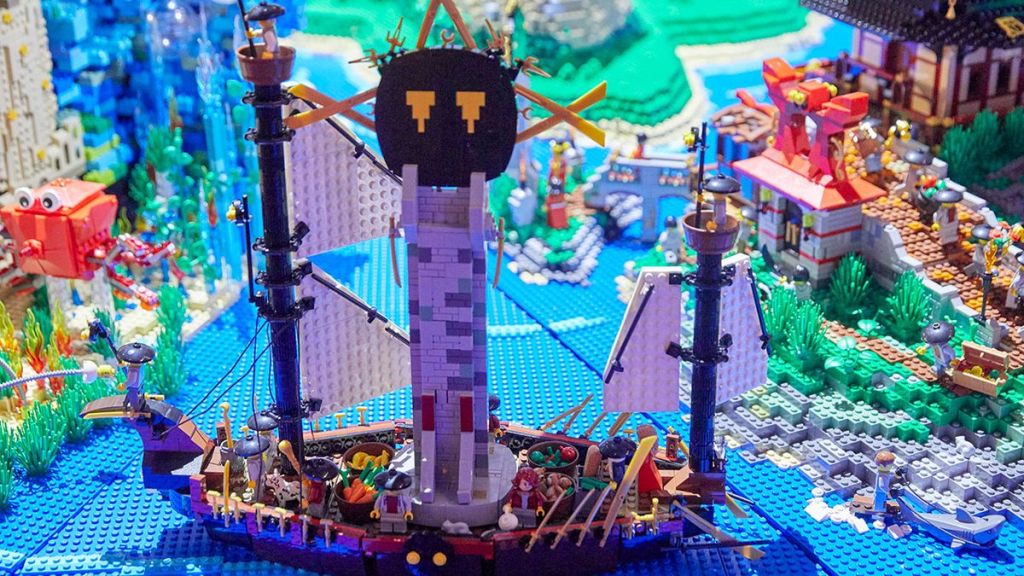
LEGO Masters’ Australia 2020

One of Damian’s and Andrew’s builds from LEGO Master’s Australia 2020

For something completely different, helped along considerably by losing my internet link and having only ordinary television, I started watching LEGO Masters. Much less depressing than everything else on offer.

My interest in Lego began when I received a box of red components, the approximate size of a pack of cards, way back in my childhood. Both my brothers and I were given a set each as presents before our family left on the first of of its sea voyages.

I think my set probably represented the build of a little red house. I recall a red framed window-piece, bits of red roofing-tile and some red eight stud bricks for the walls.

It’s an off-the-planet experience for me to see a bunch of eight adult teams race each other and the clock to produce amazing masterpieces using all the colors available, pressing thousands of small pieces together and coming up with astounding themes. The builds tonight required the interpretation of a fairy story.

Apart from the sheer inventiveness of the projects, the thing that grabs me most is the complexity of the meta-world that surrounds the Lego phenomenon. There’s Lego-specific jargon to describe, for example, each Lego piece. SNOT pieces? Only users will know what they mean. And as for acronyms? There may be a dozen that probably even the Urban Dictionary doesn’t know.

And there’s a language for critiquing the builds. How else would the best be chosen, you might ask? But seriously, this language rivals the language invented to describe post-rock music that I studied last year. One of my interests is how specialist terminology can help or hinder enjoyment of the art they describe. In the case of Lego-critiquing, the Lego specific terminology definitely helped me to see and appreciate the different projects’ intricate complexities.

Real Life: Bush Fire Emergency

Hugh and Nan Nicholson’s rainforest burning

Those of us in my region living in towns feel ourselves fairly safe in this emergency. So far. People from out of town have been evacuated and are staying with us. Others ask us to store their precious goods. I’m hosting four musical instruments and three large containers with photos and documents.

Recharging batteries is another thing we can do for people who no longer have electricity laid on. Whose power lines and generator sheds have been burned. In two cases I heard of today, the fire was stopped only a few meters from the main house.

The bushfire season began early this year. We’ve been burning since September, and the fires are getting worse, if that’s possible. Hotter, faster, and more destructive. In the past, diligent back-burning and fuel reduction in winter reduced your chances of being burnt out in summer. Now there’s hardly time. Winters are shorter and we’ve had less than half the rain we had last year when we already had a third less than in 2017.

It’s possible for a fire-ground to be burnt twice in two months. This despite the traditional view that rain-forest plantings, in contrast to Eucalyptus forest, will protect your property. No such thing now. Fires burn so hot that rainforests don’t stand a chance and they don’t grow back the way eucalyptus trees recover.

How will we live in a forever-blackened landscape?

Catherine Ingram’s article Facing Extinction, about the state of the world and humanity’s chances of surviving, is more a prescription for coping with the grief than a wake up call. It’s too late, she says, to try and save our Nature.

The way my countryside is burning, it certainly feels too late. I’m with Landcare. We plant trees. What if no trees survive either? It’s difficult to plan how to live now, when there’s said to be no future.

A Cat’s Story Ends

Miss Maggy-bag

A sad thing to report … Miss Maggy-bag was euthanased this morning due to tick paralysis. She was eleven years old and the most intrepid cat I’ve ever had the pleasure of guesting.

Intrepid because though she was too swaggy and inept to climb trees, she ran up walls after Asian House geckos, up fences to see off intruding felines and up the shade-cloth shed to sneer at the neighbor’s dogs.

She lost every collar with bells she was forced to wear as well as every flea collar. Under the house there will be a place where all these things lie, a testimony to a smart cat.

She was missing for sixteen hours. When I called her I only heard that squashed-frog sound, that frogs make when they are stuck in the drainpipes and it’s raining.

Finally found her at the bottom of the steps, cold, wet and unable to move. That noise was her, even her vocal chords were paralyzed.

I could’ve taken out a loan and gone through all the rigmarole of seeing if she’d make it with the antivenin, but she was 8x smaller than my dog who got a tick the same size and barely made it.

So I have her at home, swaddled in a towel, dead on my lap. It’s easy to imagine she is still alive because she is lying against me and I am breathing, she with me. It’s raining at the present, softening the ground. Later I’ll go out and dig a hole.

Maggy, wishful thinking. She tore off her toe on a fence and she could not go outside

Writing is Gardening

Mullumyard in the Rain

Gardening is like a hands-in-the-dirt kind of writing. That’s the thought I had about them both while I pulled out weeds this morning.

What I was doing there–with that thinking–was trying to construct a metaphor. You will have noticed, though, that I had doubts and inserted a ‘like’. The two things that I was trying to relate to each other at that moment felt like they are too different from each other and I settled for making a simile.

But what is there about gardening and writing that I thought I could bring them together in a metaphor? Thinking thinking thinking. I guess it is more about the ways that I engage in each process.

Gardening, you pull your garden gloves on, walk into the backyard and start weeding. For example. When you’ve picked all the dandelion flowers due to set seed and put them in the organic refuse bin, you’ll see that the newly planted pansy plants are looking a bit limp. Without having to wonder what you’ll do next, you’ll get a watering can, fill it and give the pansies a drink. Next, you’ll notice that the excess thyme plants you ripped out last week, are looking nicely dried. You’ll give them a good shake above the vegetable patch to release all those little dry leaves, where they’ll add to the mulch. Every little bit helps. And so on.

Writing, you’ll open the software you’re using, open the files you’re working on, and start adding into or subtracting from the section you last worked on. Soon you’ll discover that if you add this action to a character’s arc here, you’ll need to seed that character earlier in the piece, and you work on that for a while. While you are getting your lunch, you think of a nice metaphor with which to explain one of your most recalcitrant plot points, and so when you get back into it, you shift your attention to that part of the arena. And so on.

See the similarities?

Gardening is a hands-in-the-dirt kind of writing and writing is gardening with words.

‘Pantsing’ versus Planning

One of my typical ‘pantsed’ embroideries. Even the frame surrounding it was unplanned. Proof is in the areas where it touches or goes over the inner design.

This week I started to rewrite my work-in-progress before I have even written the last two chapters. Since I already know how they must proceed, it didn’t seem as important to finish the work as fix the holes I was finding while re-reading.

Some of these holes are places where I need to ‘seed’ facts to familiarize readers with concepts that will later be used as part of the plot. About five of them, so far.

For example, in Meld, the novel I’m working on, I’ll be writing a time-jump scene. There’s a space shuttle involved that I can’t just have appearing out of the blue … I’d be accused of using a plot device known as a deux ex machine ‘whereby a seemingly unsolvable problem in a story is suddenly and abruptly resolved by an unexpected and seemingly unlikely occurrence …’ (Wikipedia)

I’ll need to ‘seed’ the shuttle earlier in the story to show that it belongs.

A second problem are the areas of credibility stretched thin by an over-use of descriptive detail, or an over-use of dramatic elements. The former is easy to fix. I just need to decide which bits of description the story can’t do without, and delete the rest.

The latter, the dramatic elements, are more difficult. In several cases these consist of personal characteristics of one or other of the characters and as such have been used to influence outcomes of behavior throughout the novel.

First I had to plot all main characteristics of each of the 6 most important characters … I hear you asking … why wouldn’t you do that before you start writing? And I would say to you … there speaks a planner. Which I am not. I’ll always will be doing this kind of thing half or three-quarters of the way through a project because I am a pantser.

I get an idea for a story in the form of a piece of dialogue between two characters. Or a thought. And I start writing. Dialogue and narrative are the first of my output. I plot and plan down the track. Insert and rewrite. Often.

Pantsing is a lot like sketching. I write and rewrite until a distinct story/image forms among the crowded words/pencil marks. How do you get your story out?