‘Seared in My Memory’ …Part One

Was thinking this morning about the four countries where I’ve lived. I’m not counting England/London because it was more like a long but intermittent stay of about a year.

It struck me that I have a series of images and sensations that come up for each country every time I think of anything to do with that place. And it’s like I must acknowledge those moments before any other thinking can get going.

Next I winnowed through each series to find the single most important moment to me. Came up with four moments that are seared in my memory.

I was born in North Holland, in the Netherlands. When I was about six years old, my father took me ice skating. A local farmer would’ve flooded a field for a hard winter freeze to turn into a skating rink.

The only thing I remember was how I fell over and between my hands on the ice saw a bright yellow dandelion flower set among a three of sap green dandelion leaves in the ice. Lifting my gaze a little, I understood there this ice skating rink was.

That little flower encased and covered by ice is my primary memory of my childhood. When I think of my early years up to age ten, that little flowers is always the first thing that comes to mind.

In Indonesia, where we lived next, for a ‘big’ year as my mother used to call it (about fourteen months) the moment that stands out for me was a moment of the half hour I spent utterly alone sitting on a large rock in a nearby creek (kali).

Rainforest lined both sides of the little river with no paths that I could see. And anyway, the way back was rock-hopping over the stones till I came to the place where the village (kampong) women washed their clothes.

The hot blue sky above pressed me down on the rock and I sat with my feet in the water. I don’t recall wearing shoes. A couple of rocks furter upstream, a log seemed to come alive. A large lizard, probably of the goanna tribe, dipped its fore half down into the water. To drink I thought.

But no, it slid all the way in and went I don’t know where. I’d risen as it slid down. I hovered waiting to see where it would come up.

All I recall next is the rock hopping way back, and that I was wearing a white drill cloth dress with embroidery round the hem. For heaven’s sake, I think now, why a white, embroidered dress to muck about in?

Fast forwarding now to Australia, where we arrived in late 1959. It’s difficult to extract just the one outstanding moment here. I grew up north of Sydney and then spent six years in New Zealand.

Since I returned until now I’ve lived a variety of different kinds of life. So I think I’ll honour them all, all those different lives in a separate post.

New Zealand is the first country where my soul felt at home. I haven’t worked out yet why that is. Many of my fictions are set in an amalgam of New Zealand/Aoteoroa that I called Leaf Island.

Which is a fictional island rising from the edge of the actual submerged continent Zealandia, about halfway between present day New Zealand and Australia.

My adventures in New Zealand in the early 1970s took me to a small dairying community at the base of the Urewera Range. The whole two years I lived there, I wanted to go up into the Ureweras and explore the wilderness. But I would need a guide. Someone who was native to the place.

Hard to meet for a shy new pakeha (White resident of NZ) woman when most of the Ureweras were owned by Maori.

I met a man who might’ve taken me on his last day in Murupara before he immigrated to Parramatta in Australia where he had a job. On my last day in the valley, I drove to the foot of the mountain.

The plain was flat. The Urewera Range rises steeply out of it without foothills. I parked my car in a newish gravelled carpark. Walked to the mountain. Afternoon light burnished the low heather/montane vegetation.

I put my hands on the earth and soil in front of me as if I would climb up. The slope was between 45 and 70 degrees from the horizontal I remember thinking.

I didn’t climb. Stood there with just my hands spread pressing into the thin soil backed with the stone of ages. A shield wall at the edge of the Mt Ruapehu volcano’s caldera. When I think mountain, that’s it, the Ureweras. An ongoing mystery.

When I woke I lifted my hands from the almost vertical ground taking care not to dislodge the little shrubs and miniature grasses. The sun was well down in the west, a glowing ball on the western horizon.

No other mountains have owned me the way the Ureweras own me. They are the most numinous landscape in my mind.

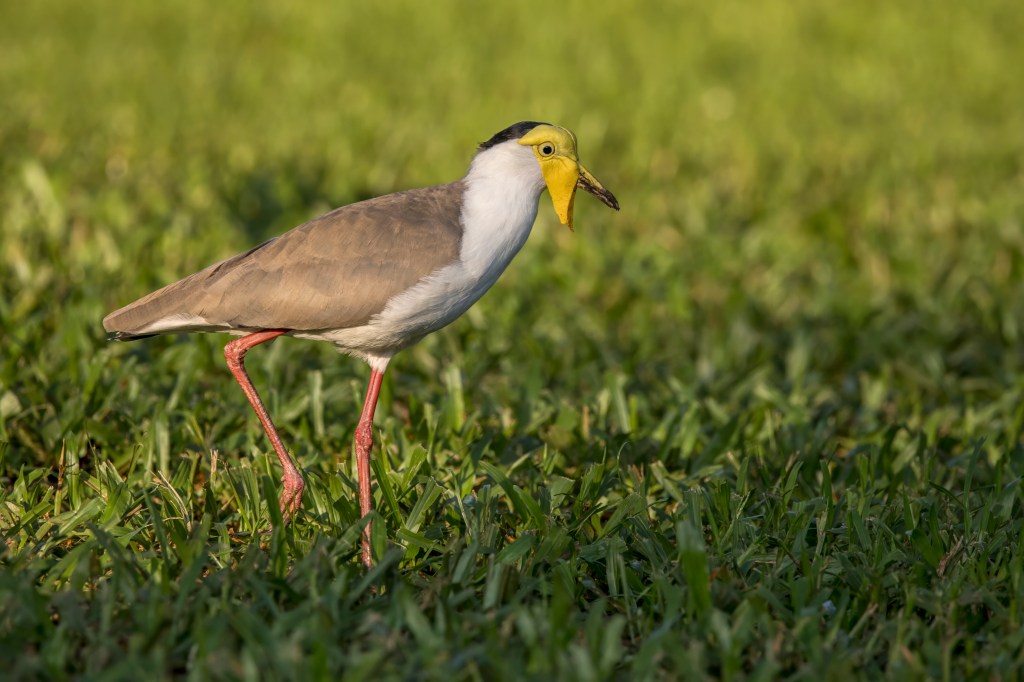
Plover aka ‘Masked Lapwing’

By Charles J. Sharp – Own work, from Sharp Photography, sharpphotography.co.uk, CC BY-SA 4.0, https://commons.wikimedia.org/w/index.php?curid=145114385

These last few day, whenever I walk into the bedroom for something, I stop and stare out through the windows at a little place on the grass beyond the podium at the plovers nesting there. Pronounced as ‘pluvvers’ according to a long-time Brisbanite.

My camera really does not do it justice so here’s where your imagination must come into play. [If you want to have a go at zooming in? The bird is sitting a little below the third panel of fencing from the right. All you will see is a little brown blob.]

In the last few days, I’ve only seen a couple of intrepid people take the concrete path from the podium across the grass to the old village. One of the dog-walkers had an angry, swooping bird follow them from one end of the path to the other. And, these birds are said to have a poisonous spur on their “wrists” … they have the spurs but they’re not poisonous.

“Breeding usually happens after the winter solstice (June 21), but sometimes before.” Quote from the Wikipedia article. Spot on. The birds began sitting seriously about four days ago. It’ll be interesting to see how long they take to hatch the eggs, as there is no info on that in my bird book or in the Wikipedia article. Today I was lucky enough to see the change over of parents a few minutes after dusk.

The chicks will be dependent on the parents for protection for about 5 months. I can’t see there being enough food (insects and worms) in that grassy area for that long, but if it does happen to suffice, I hope we residents can stay patient enough to see the chicks to maturity.

Talk about counting your chickens before they hatch! The Wildlife of Greater Brisbane tells me suburban birds rarely manage to hatch their eggs. Dogs, cats, foxes, humans … all of them disrupting and chasing and some of them predating. That’s being glum, of course. I did read that the Brisbane Snake Catchers as well as catching and relocating snakes, relocate plover nests. That has got to be a huge operation. Two large angry birds defending four eggs on a flattened bit of grass?

https://snakecatcherbrisbane.net.au/plover-management/

Just checked them and nope, they don’t. But they do give contact details to licensed plover catchers and a link to a neat “404 page IE a page not found”. [This latter will go into my collection of 404’s.]

Meditative Art

Life has been challenging over this past week. Sometimes things happen that are difficult, if not impossible, to process. Such has been our …

Meditative Art

This post by Judith on https://artistcoveries.wordpress.com/ was a serendipitous find for me when I was casting about for a distraction from the on-going disaster that is the world out there. I had already weakened and thrown a train of the ongoing grief onto the page (previous post) when I recalled how soothing painting can be and thought that I should get back to it.

There’s nothing I can do about the ongoing train-wreck but keep myself sane and … I just don’t know what we as individuals can do.

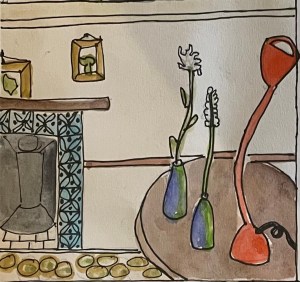
Painting these miniatures my whole attention needs to go into every step of the process. They offer me three stages … I sketch, trace the important lines with black waterproof, and I paint. Six miniatures per A4 page, with two more to serve as a front door into the space and backdoor, or gate, out of the space.

Unfinished sketch of a corner of a living room. A few more elements before I can call it done. the flowers need a touch of color, for example. And so do the bricks in the fireplace. 10 x 9.5 cm or 4 x 3.7 inches.

Before I put pen to paper I need to set the scheme out, and it’s easy to make a mistake. As I did with this series. To put the booklet together with the least number of cuts and gluing, the six inner elements need to be positioned facing upward, facing downward, facing upward. That didn’t happen here:

… and I will need to do more cutting and more gluing to get a successful outcome. My fingers are crossed.

Product Presentation

Carry Bag Handles

One of my ongoing interests is how products are packaged. This began when I was about fifteen and my birth family hosted two Japanese engineers who were in Australia to install and test a huge new Japanese generator (or transformer) at the power plant where my father also was an engineer, and who brought us lots of presents.

During the week these men lived in a boarding house, and weekends Saturday or Sunday, they came to our place at Berowra, in the outer northern suburbs of Sydney in the 1960s.

At the time we had a garage which served as living and dining room and my parents bedroom, while kids had two bedrooms in the house built by my father on weekends, one room for three boys and one for three girls.

I don’t recall the power station. It could’ve been Lidell and that would’ve been a family shorthand nickname.

Lol, getting mired in backstory there!

Japanese packaging has always been superb! Classy! Stylish! Rave rave rave!

I saved all the wrappings of all the presents they gave us and kept them for years. And when I was in Japan, in 1976, I saved all packaging from vending machines and the like. I think at the end of my four months travel through Asia, Siberia, Russia and Scandinavia, a good bit of my luggage was souvenired packaging.

All to no avail, of course. My first night in London, the house where I was staying was robbed. All my precious collection was trampled through the mess left by two perpetrators breaking through the plasterboard ceiling, and getting away with all cameras, the family’s silver and jewellry. They even nicked my feather-down sleeping bag.

But. Getting back to the subject. Packaging. Enduring interest.

These cardboard ‘zippers’ fastened the lid of the box to the underside and nothing was torn taking them off. Bet they can be used again.

The laptop was covered with this simple envelope. The paper of similar weight to greaseproof paper. And similar to greaseproof paper, is coating-free, safe for recycling in the composting bin. (So called ‘baking paper’ is NOT safe!)

Several other bits of cardboard and paper wrapped the cord and power plug. All of it calm, plain, and functional.

People will say we pay for all that. True. And I’d rather pay for good design than bad. I’d rather pay for paper than more plastic bags. The bag handles in the first image are probably the only non degradable parts, but will be re-used as long as the bag lasts. And possibly after that if I can find a reuse for them.

Mistletoe

Australia has 97 native mistletoes at last count. None grow in Tasmania, the author of the Wikipedia artice quotes that they died out in Tasmania during the last ice age.

Mistletoes don’t kill their hosts, though with a heavy infestation might shorten its host’s life. What I think will happen to this host.

I have not yet found the species or genus name of this one infesting the ‘big’ tree in my patch. New growth on the mistletoe is rust brown while the long eucalyptus-style leaves are a cross between sage green and grey, despite what they look like on this photo.

Nor have I seen anything that looks like a bud, flowers might give me an indication of its genus. The only field guide I know about Australian mistletoes is for the temperate southern half of the continent.

Plantnet doesn’t know it. If Mangroves to Mountains (field guide for local plants) has an online presence I might find it there. We’ll see.

Insects at the ‘Patch’

Australian Cockroach/ unknown stinkbug

The jury is out on the bug’s ID. Just found a similar looking one in the Wildlife of Tropical North Queensland, a cockroach probably immigrating from Asia.

Or it could be a sap sucker related to the bronze stink bug. There is a sap sucking bug species, like this one on the Angophra sp, for all major tree species in Australia.

European honey bees very busy among the Tuckaroo flowers …

I had a little video clip here, but guess I need to negotiate with WP on that, and am on my mobile just now. Think of the above as a place holder.

A bunch of tiny blue butterflies skipped in amongst the grasses

Fast fliers that never sit still they are one of approx 63 similar little blue butterfly species in the region, according to Helen Schwenke in her Create More Butterflies. I saw them among the above grasses.

If they were the Common Pencilled-Blue variety, they would’ve had plenty of food for their caterpillars for the Tuckaroo is a common host plant.

Image nearly twice the size!