As you can see when you zoom in, most of the duckweed is white and dead.
I’ve been keeping fish and frog ponds for about fifteen years and I’ve never had such a wholesale dieback that even the duckweed carked it.
The feathery green plant seems okay so far. Fingers crossed that they make it. And, I hope that both the Azolla waterfern and the duckweed have left spores and seeds behind, that hopefully will sprout when we leave winter behind.
While you are zoomed in you may be able to spot the two remaing fish. Though they look like leprosy warmed up in the photo, in their analogue state they‘re stockier than they were, but at least still alive.
I moved their habitat back under the outdoor light, in the hope that that gives the plants enough light to survive until I get my grow lights. An added bonus is that I can sometimes see the fish flitting about from inside my living room.
This year alone we’ll all spend the equivalent of 500 million years scrolling on social media. (Collectively, the world spends 720 billion minutes a day using social media platforms. Over a full year, that adds up to more than 260 trillion minutes, or 500 million years of collective human time, according to a report from GWI, a consumer research company.)
Beggars belief, the numbers he quotes. see the whole article below.
Hi Rita,
There were two weeks in July 2012 that completely changed your life forever.
However, at the time you were blissfully unaware of what was going on.
(We all were.)
What happened?
Well, it all began when Facebook listed on the Stock Exchange, which was a total and utter disaster. Within a few months its shares had crashed by more than 54%.
Why?
At the time of its IPO (initial public offering), Facebook stated it had “no material revenue from mobile”. (Yes, in 2012 we were all checking our Facebook friend requests on our web browsers.)
Zuckerberg could see the writing on the wall. They were dead meat unless they got on mobile. And so, as legend has it, he pivoted the entire company to building a killer app – fast. He famously refused to have a meeting with anyone until they had presented him with what he wanted.
And in those few weeks the smartest behavioural psychologists and programmers in Silicon Valley created the very first social media app, something so powerful that it changed the course of history.
Seriously.
Let’s flip forward.
This year alone we’ll all spend the equivalent of 500 million years scrolling on social media.
(Collectively, the world spends 720 billion minutes a day using social media platforms. Over a full year, that adds up to more than 260 trillion minutes, or 500 million years of collective human time, according to a report from GWI, a consumer research company.)
In short, you’re spending way too much time on your phone, right?
Everyone is.
The Digital Australia 2024 Report by consumer intelligence company Meltwater shows that the average time users spend on TikTok is 42 hours and 13 minutes per month. Second place is YouTube, with the average user spending 21 hours and 36 minutes per month. And Aussies are some of the biggest users of Snapchat, with 17 hours across 619 individual sessions (!) per month. Facebook users spend an average of 20 hours and 15 minutes per month, and for Instagram it’s 11 hours and 45 minutes per month (which I thought would be higher, to be honest).
Is this a good use of your most precious asset?
Well, if you ask Mark Zuckerberg the answer is “Hell, yeah!”. Facebook’s profits were $US32 million in 2012 … and last year they were $US39,000 million.
Yet what about for the rest of us?
Well, Facebook interviewed eMarketer’s Ezra Palmer about the dramatically increased use of mobile, which is up 627% in the last four years alone. She glowingly described it as our “connected consciousness” and brushed aside the naysayers:
“If it were not a valuable way of interacting and being, we wouldn’t be doing it. Mobile is an extension of us … it’s a fundamental shift in our psychology … it’s one thing to look at the [daily usage] numbers, it’s another to think about the amazing ramifications of that”, she gushed.
Uh-huh.
Just like all those people at the casino wouldn’t be there if it weren’t a valuable way of being.
And let’s look at those amazing ramifications.
The rise of social media has coincided with an accelerating decline in teen mental health, and hospitalisations for self-harm have exploded, especially for young girls.
Not only are today’s kids more anxious, depressed and suicidal than in previous generations, they’re also getting dumber. Australian students are among the world’s biggest users of digital devices at school, yet academic results released in December showed teens have fallen a full academic year behind those who went to school in 2000s, according to the Programme for International Students Assessment (PISA).
This all makes sense.
Social media (which has done another ‘pivot’, this time to 45-second viral videos) is the equivalent of junk food.
You wouldn’t spend upwards of 10 hours a day continuously gorging on highly processed junk food and expect to be healthy.
It’s the same for our mental health. You are what you eat … and what you scroll (and Zuckerberg is your personal chef serving us up dopamine-soaked donuts all day long).
Yet waving our fists at the tech giants is about as useful as blaming Macca’s for your kid eating Big Macs for breakfast.
We’re the parents, and we’re in charge.
And many of us have trained our children to see that a phone is the most important thing on earth. I’m ashamed to admit that at every milestone of my kids’ life – the day they were born, the day they took their first steps, the day they pedalled their first bike, and every birthday – they looked up and didn’t see my eyes … they saw the back of my phone as I yelled “Smile!”.
They also see Mum and Dad mindlessly scrolling on our phones while the world passes us by.
Again, what message do you think that sends them?
So I’ve come to a couple of conclusions.
First, if I want my kids to have a healthy relationship with technology, I need to model it myself. That means keeping my phone in a dish with my car keys and wallet at the front door – and leaving it there – so I can engage with my family without constant distraction.
Second, it’s my job to give our kids experiences they can’t get from screens.
Like what?
Like encouraging them to have friends over to hang out IRL (which is what kids actually want most). Or going on a family hike, to the beach, or to a sporting event. Or encouraging them to start their own little Barefoot Business (perhaps with a mate).
Now this sounds very aspirational, but how would you force yourself to actually do it?
Well, the fastest way would be to implement Screen Free Sundays. And that’s what my wife and I havedecided to trial with our family – starting this week.
Yes, we’re trying to put the internet back in the box, and live like it’s 2012!
Tread Your Own Path!
Much better than I could’ve said.
Plus, I overworked my shoulders today, can’t type.
I was glad to see this tiny patch of native moss among the giant south American exotics. Even better the clue to another species of birds to discover …
A scribbled sculptural form …
One a a pair of twins …
Its mate. They guard a pebbled through-way
In Brazil, or wherever they originate, there would’ve been a froglet living in the little pool in the heart of the floret. More on them after I re-read Wings by Terry Pratchett (1990).
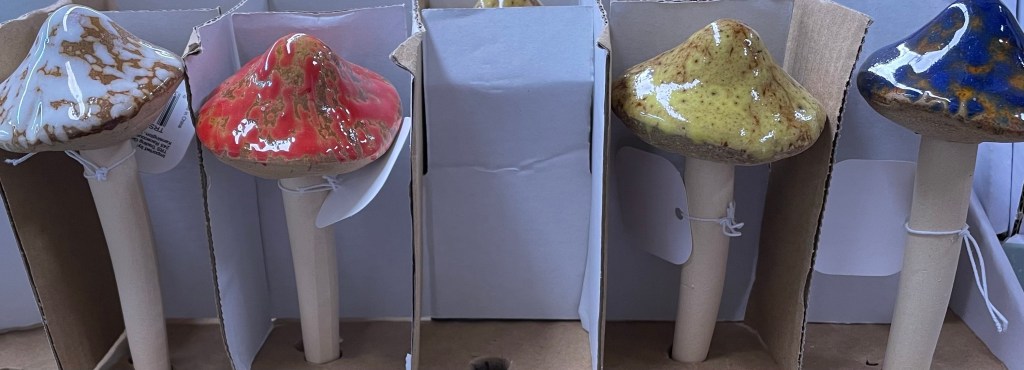
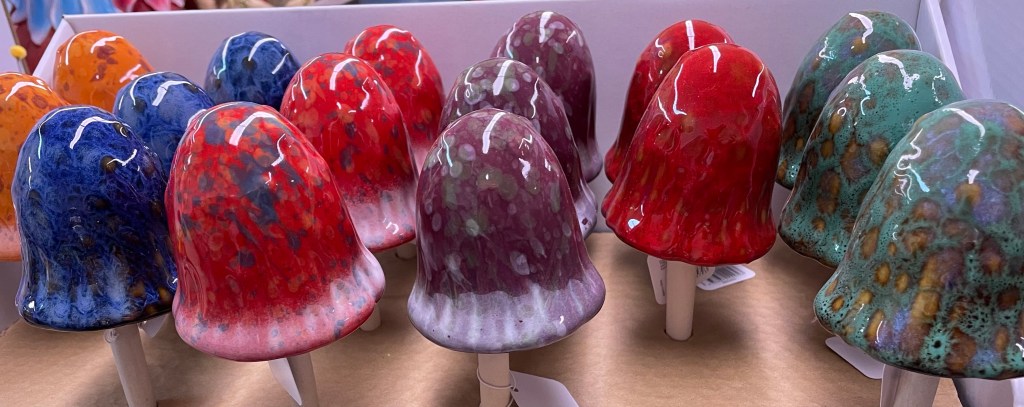
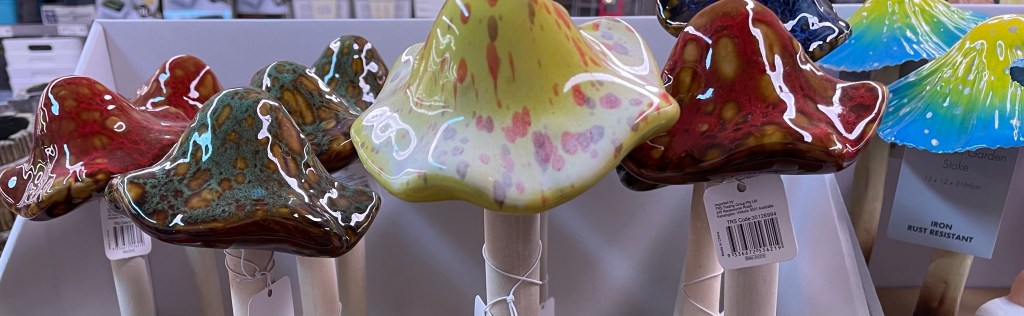
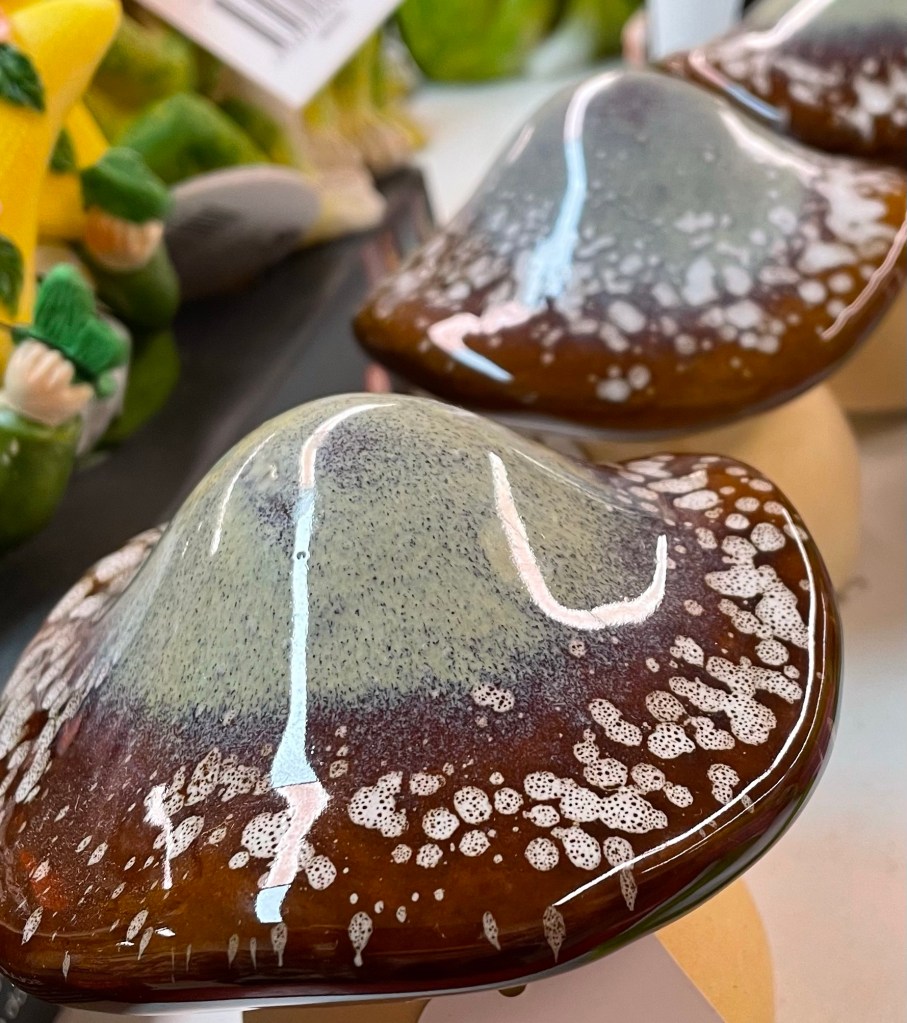
I was out for my groceries. Hit a Reject Shop for some kids stickers, a birthday coming up. Saw these … lol the only fungi I’ve seen other than photos for over a month.
Surprising, that there were different sorts … Not that there was much relationship to real fungi
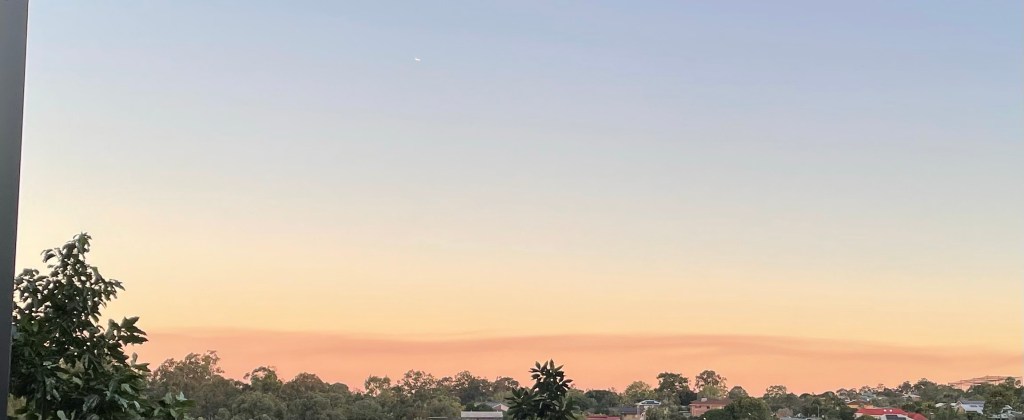
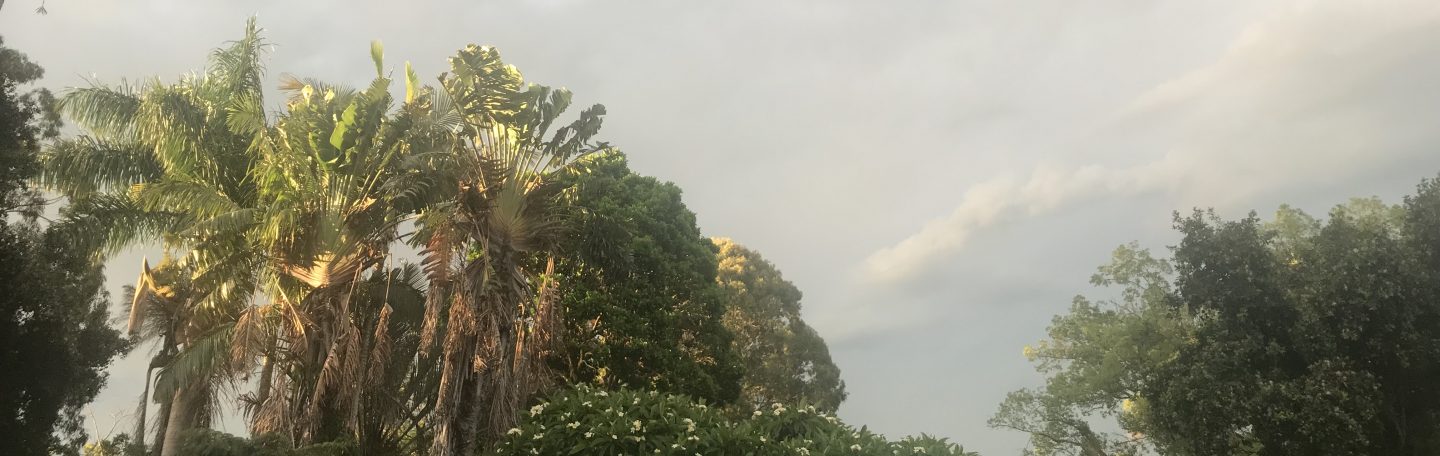
Good to see evidence in the sky of winter back-burning, where town councils pay teams of volunteer fireys (slang for volunteer fire fighters) to go out and burn undergrowth in an attempt to limit the fuel load ahead of bush-fire season.
Cold weather is the time to do that, much less chance the fire gets away.
That burning off had to have been done where the wind wasn’t so fierce, locally we had gusts of over 35 kph.
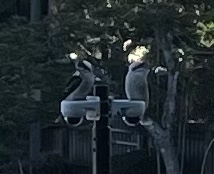
This morning opened the curtains to see two kookaburras on the lightpole out front of my unit.
Bit of a crummy photo, it having to have been cropped severely. I was inside, behind glass, the birds were probably about seven metres (23ft) distant, and the camera just is not interested in middle distance detail.
The kookies don’t look like they’re watching for insects in the grass at the foot of the podium, but they are canny hunters.
The lawns at Carinya are being mown, and grasshoppers will jump up to get away from the blades.
There goes one of the birds.
He glides a long slow flight to the whirring insect, snaps it up with his beak and turning his aileron-feathers slightly, changes course for a perch on a fence down there.
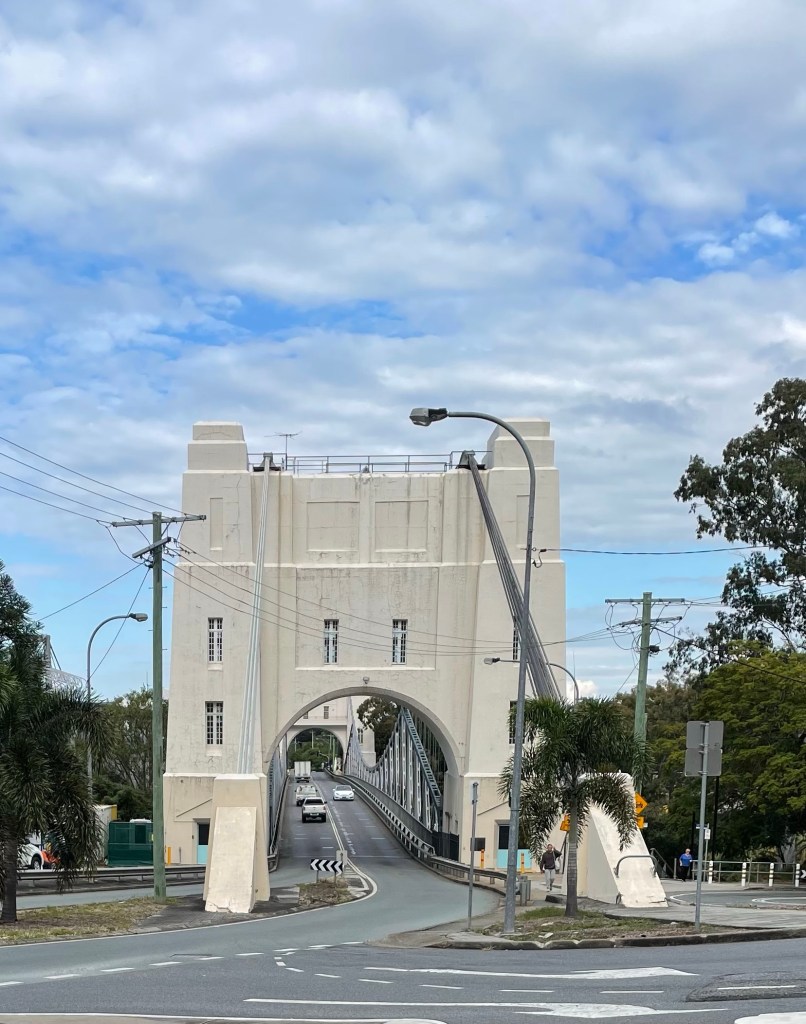
Walter Taylor Bridge, one of the many bridges across the Brisbane River. This one joining Chelmer on the southwest side to Indooroopilly on the northwest side.
I travelled 18 kilometres to Indooroopilly to finally have my hearing aid fixed. Eighteen kilometres that costs $55 and about forty minutes in a cab.
18 kilometres back again for an unknown amount on my senior’s Go-Card, but not more than about ten dollars, and two and a half to three hours by train, shank’s pony and bus.
I paid the cab fare on the way out there because I wanted to see how far along the roadworks had got. These the works relating to the new underground railway station and new railway tunnel under the river. It’s astounding how much of that work has to be done top-side. Made up for the cab fare by not spending anything on lunch.
On the way home, walked to the railway station—saw that nice piece of vintage infrastructure above—and waited at the station. Twenty minutes gone.
Roma Street Station still—by now it’s probably been five years of mess—at sixes and sevens due to the changes being made. But managed to find a human ticketing dispenser and was able to exchange my blue Go-Card for a brown seniors’ card. Forty five minutes at Roma Street.
Roma Street so frustrating in the end, I thought I might as well shank’s pony again (ie walk) to King George Bus Station and catch my ride home from there.
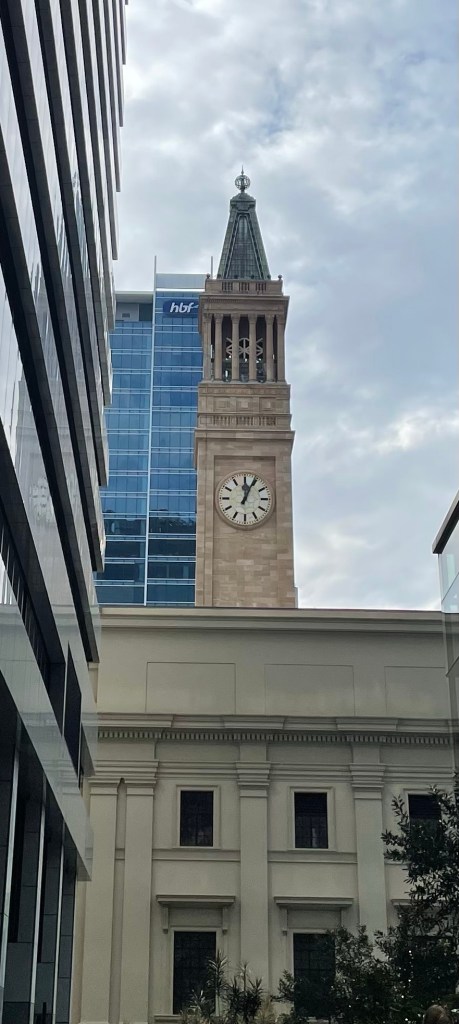
Sat down for a lunch snack and drink at 12 noon, just in time for this …
Post Office tower and how tiny it now looks! A short carrilion in keeping with the hour.
The bus 222 home to Carindale, a total of 4005 steps as well as all the other mileages. Left home at 10.00 am, got back at 1.30ish pm. Worth it?
Oh yeah! I can hear again. Missed listening to music, hearing phonecalls properly, not being surprised by squealing laughter, and birds … I can hear birds again!


 Hi Rita,