Mystery Rock …

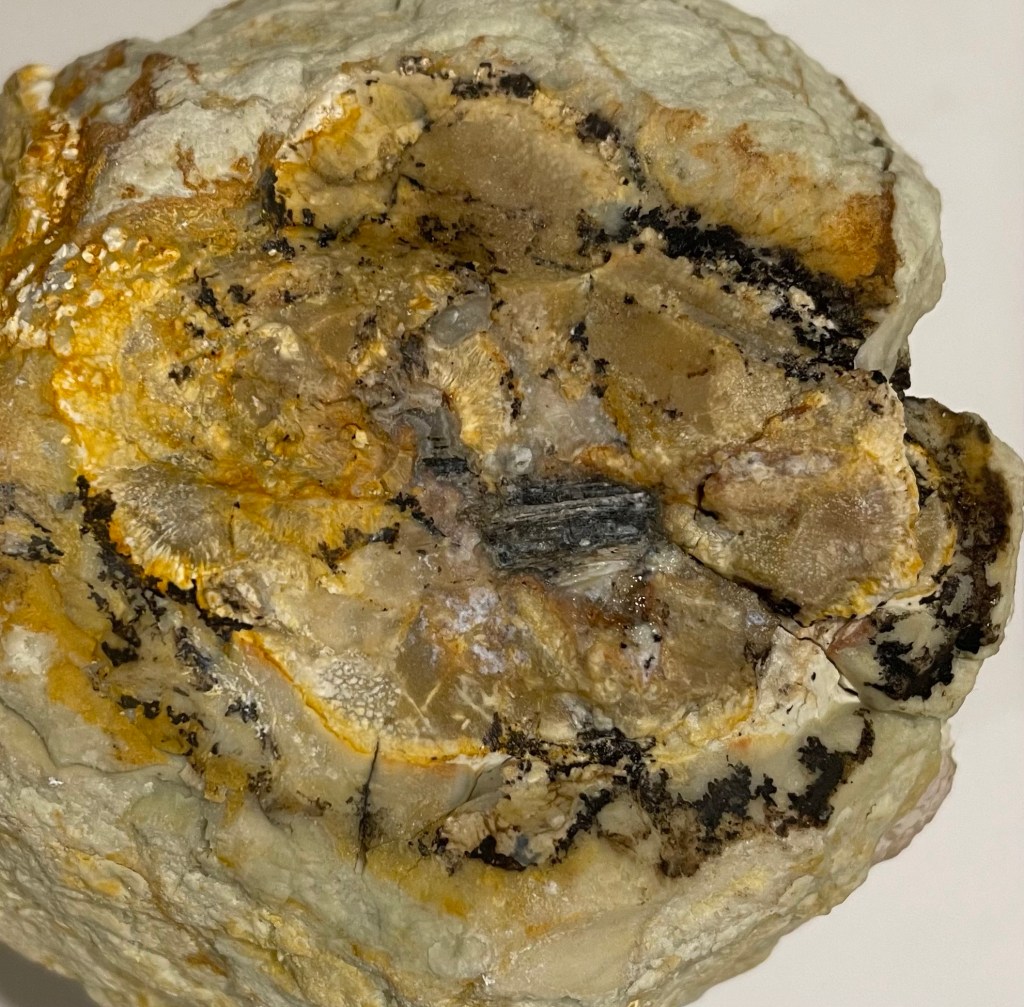
This rock, which is about the size of a large orange and weighs about a kilo, (2.2 pounds) was collected for me while the family were out looking for ‘thunder eggs’. A common activity in Northern NSW and southern Queensland.

While this one hasn’t got the simple perfection of the much covetted ‘real’ thunder eggs, I like it because it is so complex inside the nodule.

In places there look to be more than a dozen layers. Thicker and also leaf-thin. There are a couple of crystals according to the errant glitter, and areas that look like spongy bone marrow.

The outside appears to be covered with a layer of fossilised clay. There does look to be some soil encrusted in the inside but I could be wrong. I will wash it and see.

‘Testament of Youth’ …

By Vera Brittain, first published in 1933, and with a long publishing history thereafter, has kept me reading for over a week.

This is not a book review in the formal sense as I’m sure thousands of those have been written over the ninety-one years of existence of this … what we nowadays might call a memoir. (If I understand correctly that such a thing is an autobiographical account of a period of time)

Vera Brittain was of the same generation as my grandparents, who all four were also born in the 1880s to 1890s. Brittain was born in the provincial middle class hinterland of what is now the UK, my grandparents were born and raised in the provincial middleclass hinterland in the Netherlands.

There the comparison ends, for neither of my grandmothers were rebels, and due to their nation’s neutrality, they did not experience the 1914-1918 years in the same way as most other people in Europe.

According to the histories I’ve read, it suited the powers surrounding the Netherlands to allow that nation’s neutrality to continue through the whole of the war, for their convenience.

While German troops crossed and recrossed Dutch territories at will, millions of Belgian refugees made their homes in the Netherlands through the war. Coal and other minerals from the Dutch colonies warmed British homes and kept factories going.

But there was no historical, personal detail from the four families, how they were affected by the fighting on their very doorsteps, they surely would’ve been close enough to hear the guns in Belgium?

And while I’ve read a few historical novels about the Great War, I’d never read an account written from a woman’s point of view. So ‘seized’ the opportunity.

The first most noticeable thing reading a book written in the 1920s is the brand of tortured English. Well, I’m calling it that.

There are always ten words where we, nowadays, can make ourselves understood with a mere five or six. All ten, or however many there are, of the English language’s verb tenses get a good work-out.

It’s noticeable in Brittain’s account when a noun is unadorned by one or two adjectives or a verb with at least one adverb. It feels bare then. Most sentences have more than thirty words. It’s exceedingly verbose and towards the end I skipped many half page paragraphs.

Why did I even keep going, you’ll be wondering? Brittain’s experiences during the war and her incredible, through thick and thin, correspondences with her lover, her brother and two friends of theirs until they died, either in action or after being wounded is the real story here.

How the Army kept the postal service going to all areas of the front would make an amazing read. The logistics to keep that going boggles my mind.

It’s astounding, the numbers of letters written by soldiers at war, sent, and received by relatives if Vera Brittain’s experiences are anything to go by. At one point she mentions that there were daily letters or postcards or even brief notes from men stuck in the trenches.

Brittain’s own experiences as a war nurse, working in hospitals right next to various battle fronts, where they triaged men with horrific wounds make you thankful to live now. I learned more about mustard gas than I knew. More about infection when there were no antibiotics. About gangrene. About … Medicine has come a long way in a hundred years.

I understand there have been a film and TV series made. If I’d seen the film first, I’d probably not bother to read the book. It is quite heavy going. But then I wouldn’t have read the rain of little diamonds sprinkled throughout the text. The words and images that I will treasure.

Such as when Vera visits first Roland’s grave and a few years later her brother’s grave. On the way there so many broken tree-trunks lay along the road bearing witness, that only the Omniscient Mmathmatician could count them.

There was a great deal to enjoy.

But have you noticed how unconsciously influenced I was by the wordy turgidity of Miss Brittain’s style? That passive voice will haunt me.

Typed one-fingered on my mobile, this will have to go out un checked and un-proofed. I’ll do that tomorrow.

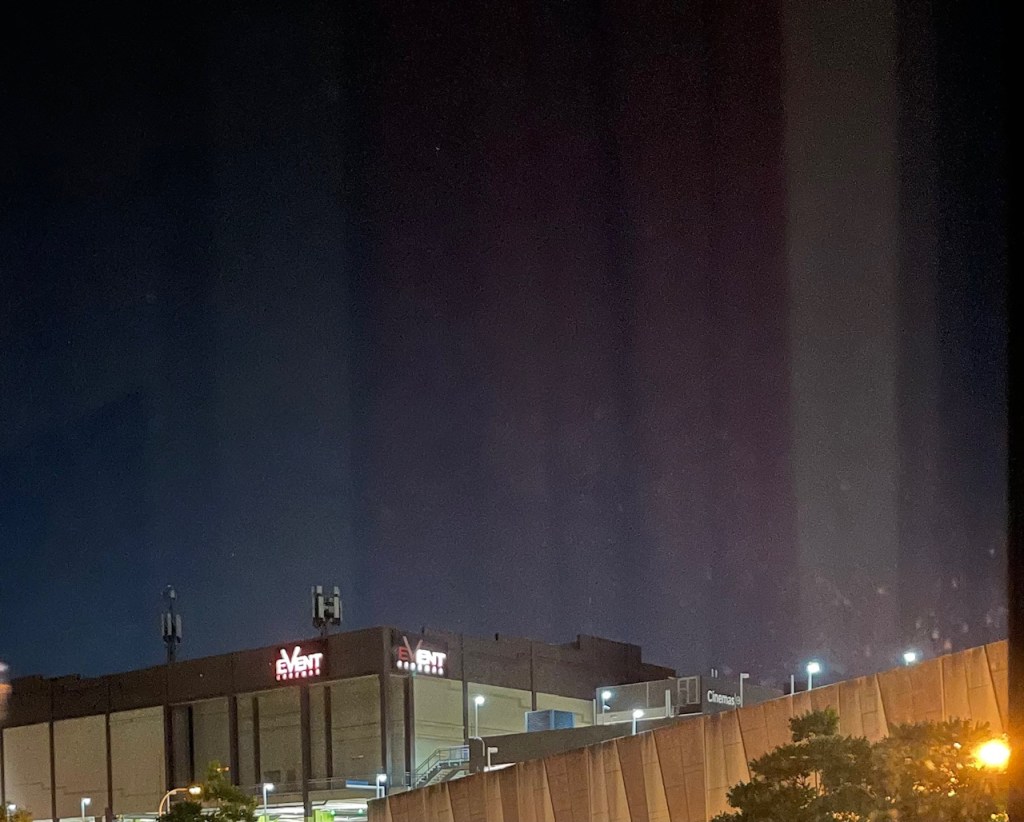
Night Sky

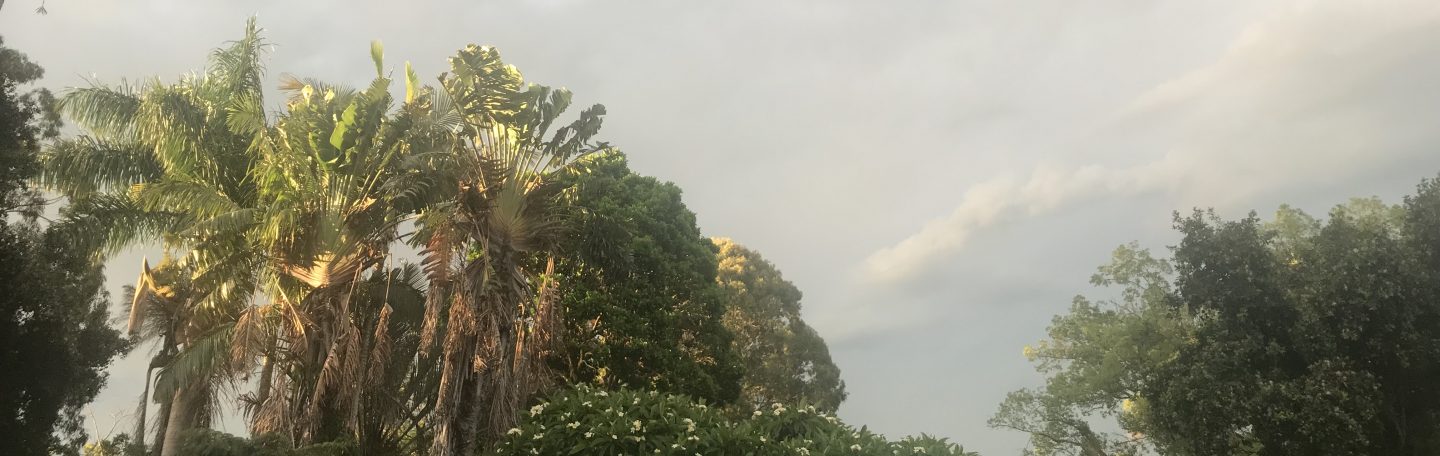
Surprised myself, taking this shot, and look at the festive lights.

The dark had a few bands of dark grey and I wondered how they’d show up.

Who knew that all that cloud-life, invisible to human eyes, despite them being augmented with new lenses, could be shown by a hand-sized piece of technology?

Its eyes immediately changed the program it usually follows and went into slow motion. Gathering light to itself and noting wavelengths, it transcribed them into colors and festive textures. All before the end of the few seconds it took to record the scene. Magic!

The Other Walk

When I was out the other day, after I had sat down in the civilized new-ness of the one year old addition to the village and found it too structured for my mood, I walked into the old section.

This village started in the the 1980s with a field of little villas surrounding a community facility. About half the villas remain along with the old communal areas.

So I crossed the vacant block along the concrete path. Weed central but with more flowers than the sculptural resort style gardens in the newer sections …

There’s even a lone fungal fruiting body. Further on, as I come into the streets, the vacancies and their bewildered gardens become obvious. (A pun there)

Can barely see the villas for the overgrown gardens. A riot of flowers though. More varieties of hibiscus that I’ve seen in one small area.

There are some beautiful trees and shrubs, five to ten metres tall. I can’t imagine they’ll be kept when the building program continues.

Finally, in a derelict corner I see a clump of fungi. I had been wondering whether these gardens were maintained by the establishment or cultivated by the residents themselves. The fungi speak for the latter.

Three, possibly four species I make that. What do you think, mycophiles?

Fish Pond is Leaking!

Hoping to stop a flood

This morning early, everything OK, fed the fish and they loved their new food. Probably hungry.

Little time later, an hour, noticed water level descending quite fast from yesterday when I replaced about 3 litres.

Checked around. Oh no!

A lot of water creeping over the tiles to the balcony drop off.

Seepage not only from underneath … but also from the side! Ceramic side! Meant to be water-proof!

Every time I dried it off, couple of minutes later it’s wet again. Condensation? I don’t know how that works.

But started bailing into hopefully still waterproof plastic crate.

Transferred two fish so far …