Indigo

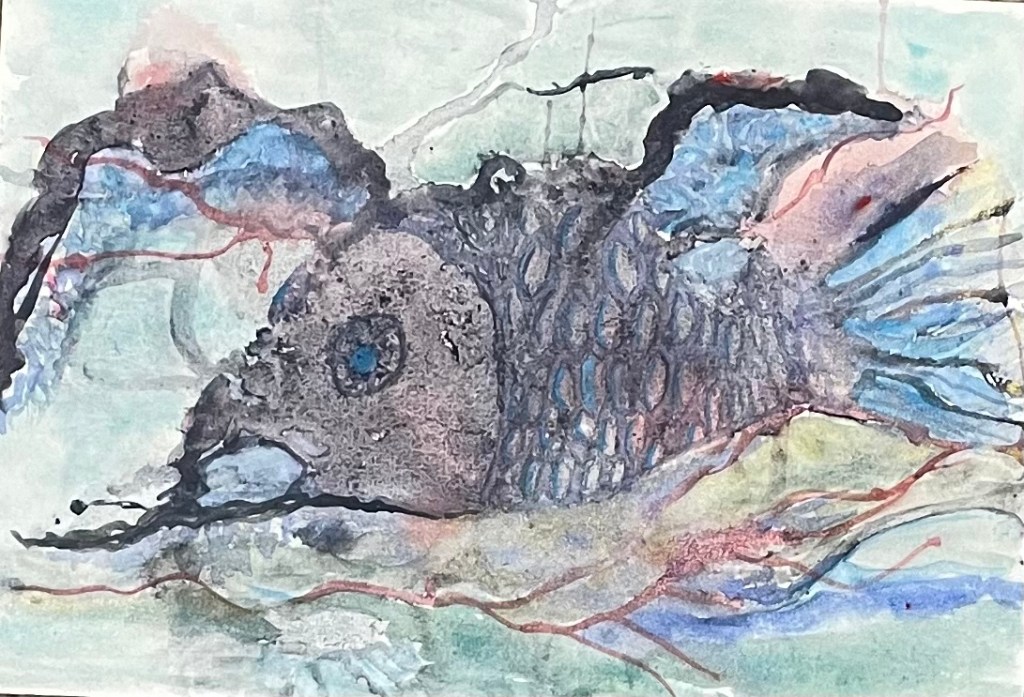
Indigo by Daniel Smith is probably the watercolor I use most, and is also my favorite to experiment with … if that makes sense. This indigo is so finely milled it’s the smoothest paint I own and yet it’s capable of amazing gymnastics. Below a wet layer of indigo over a failed experiment (which is represented by the pink tones) with phthalo blue dropped into it.

The Indigo, being smooth and light (weight) allows granulars such as sodalite, and heavier colors such as phthalo blue, to react spectacularly.

Getting shades by dipping a brush into water after a stroke, indigo will last longer than any other color and make the most wonderful greys.

One of the newsletters I subscribe to is Books on Books curated by Robert Bolick (https://books-on-books.com/2025/03/23/books-on-books-collection-louis-luthi/)

This month’s letter took me to a link (https://sites.rutgers.edu/motley-emblem/indigo/) where I discovered some interesting facts about indigo. So far about 200 plants have been discovered that yield indigo, and it is nearly the only color-fast natural plant dye.

The two hundred plants is quite a surprise as the Japanese indigo cloths are quite expensive and said to be made from a rare plant. Several cultures in Africa also use indigo to dye cloths. I’m wondering now whether the original processes make these products expensive, there is bound to be a lot of processing necessary to make dyes from scratch.

My only experience extracting color from wild plant materials to dye wool, has been using lichens to make a dark red, and that was by boiling the lichen and the yarn in ammonia, then setting the pot in a sunny place for three weeks, stirring it daily. Reading how indigo was/is extracted, it seems a similar process.

Following the links, the Brooklyn Museum webpage presented me with Catherine McKinley’s article on indigo’s influence in women’s culture, where Indigo is spoke of as rare … as in “the rare, refulgent dye and the commodities spun from it.” from (https://www.brooklynmuseum.org/stories uncovering_a_womens_history_of_african_indigo) while Bloomsbury Press offered me one of McKinley’s resulting books https://www.bloomsbury.com/us/indigo-9781608195886/

In Asia, cultures such as Javanese batiks and ikats, and Japanese aizome also made indigo famous.

Nowadays ammonia is one of my no-no’s in that I’m allergic to everything with chlorine in it, though fabric dyeing has remained one of my interests. It was only a small hop to watercolor painting on cotton paper.

Wikipedia’s article on indigo, in particular growing the plant https://en.wikipedia.org/wiki/Indigofera_tinctoria

Been Painting…

All paintings are multiple experiments.

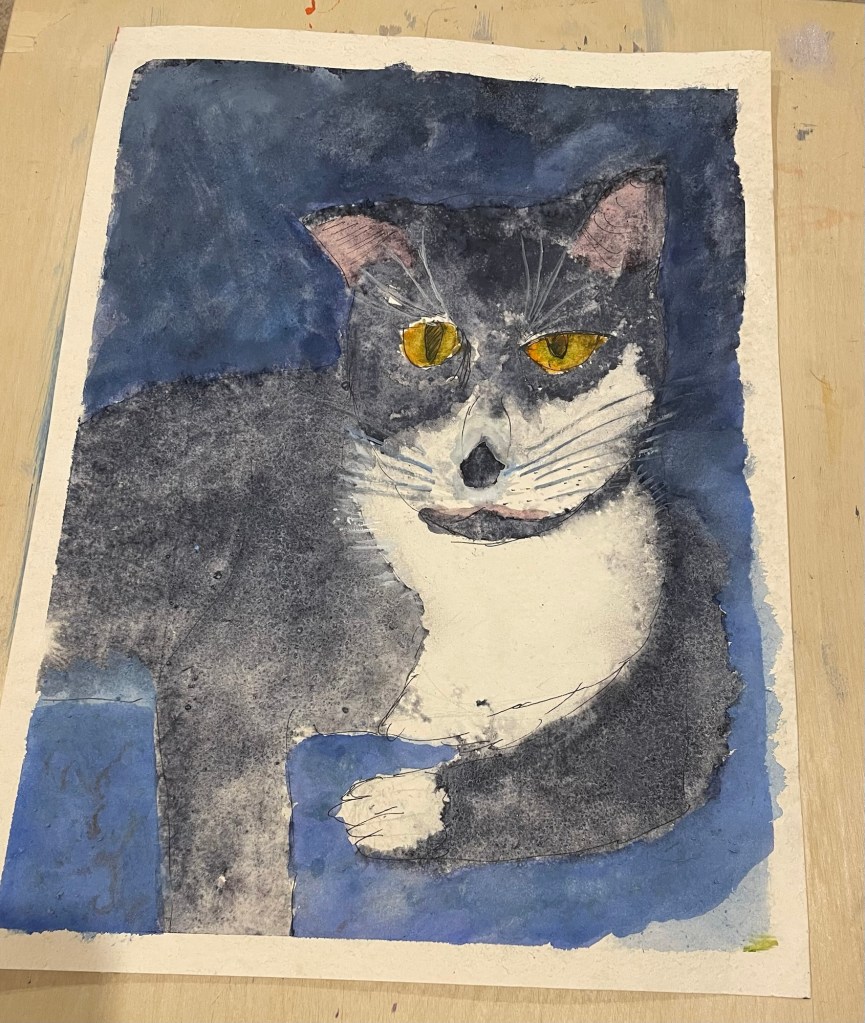
A3 size paper … could I sketch my cat and have it come out realistic? Her head is too long, has to be rounder next time

Could I use grainy paint and make that represent fur? sort of.

Could I make her eyes seem to look at the observer? Negative on that so far.

Could I tie the background together using a gesso glaze? Glaze too thick, blotted out the detail. Cat is sitting on a blue couch. Can’t really see that.

The original technique of spray and paint didn’t work all that well, need a better spray/misting bottle.

Other than those points I’m pretty happy with it.

Water color-painting .. practice

Learning a craft takes a lot of practice. When I was stil pretty new to watercolor painting, I used to try to paint on any type of paper and thin cardboard.

Not all of it worked. Art calendars featuring photographic art have a lot of marble dust in them. Paint sits on top until it dries. Made for some interesting experiments.

Then for a while I used mixed media papers, they worked better and I still have a few of those paintings.

Lately I’ve gone into 200 gsm paper specifically made for watercolor and since I have a problem throwing out good things that might be useful one day, I swear I’ve hung onto every bit of used 200gsm paper I’ve painted, it seems like.

Of course I laugh at myself but then don’t throw anything, I have a bag full of painted scraps for collaging.

Recently I’ve felt the need to practise painting a ‘wash’ or ten. Something I have a lot of difficulty with. So ended up with ten washes on four sides.

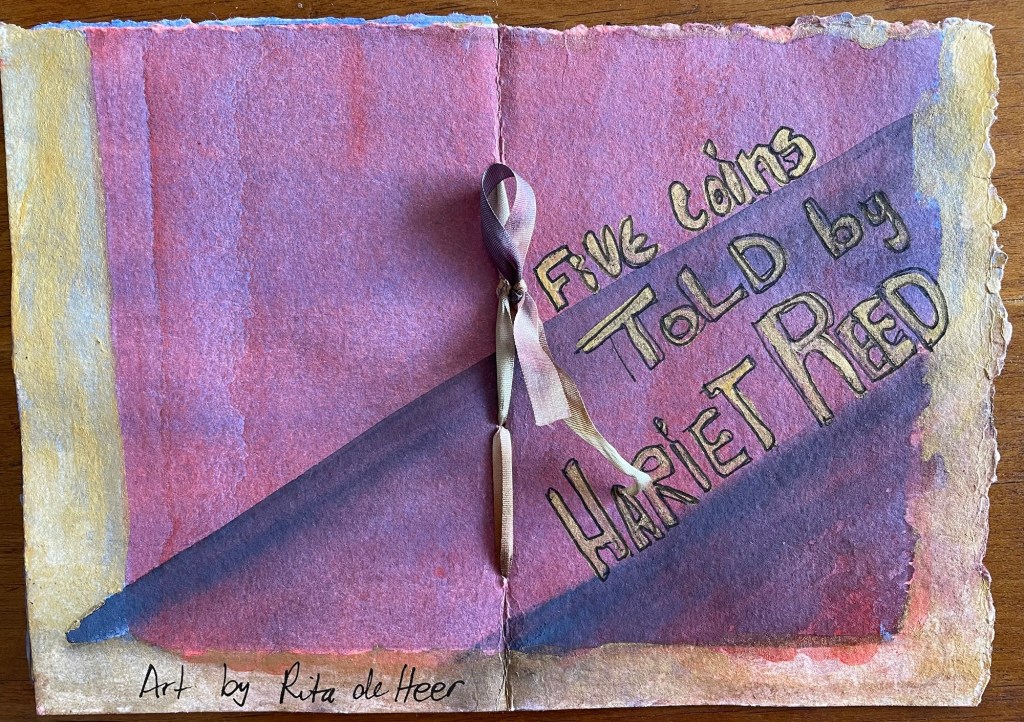
Made them into a little art zine … if I have that terminology right. Here the back and front covers (three washes)

The story was going to be about a red planet but the nickety nog said No!

Several aspects about this booklet please me quite a lot. The size, a quarter of an A4 page. It’s just enough for a short fairy story. I like the way the torn edges of the pages look edged with gold.

‘Hariet Reed’ is a pen name scrambled from my real name. Good for the witch telling this story. I don’t like the stickers much, will rethink that aspect. The random design of the pages (all those washes) worked well.

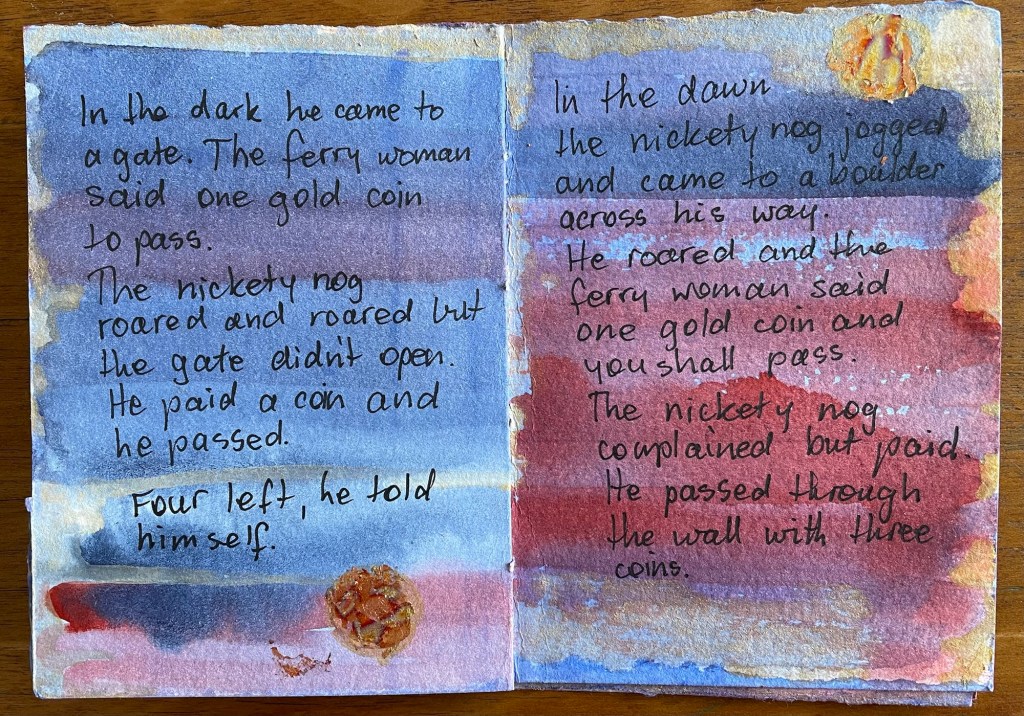
The story became a dark in color as wel as plot little tale about a nickety nog demanding a five and after being offered various juicy morsels and rejecting them, stealing five gold coins.

The story lacks cohesion, there are a couple of glitches, as well as other things I could’ve done better. The gold coins for example.

Some of the coins are gold-leaf on pva glue, none of them turned out round and some were rounded later with acrylic paint. And then towards the end I thought might as well paint the whole coin with acrylic gold. Worked the best of the lot.

All useful things to remember for when I make the next little story book. Only the last two pages were over-painted to help the tale end.

The ‘Case for Re-reading’…

Reading this article has gifted me with a fantastic reading list. I’ve read maybe four books on the list, a couple that are also on my shelves and that are also on my re-reading list.

I came across this website only recently and haven’t explored the whole of it yet. The links in the article below are giving me a lot of food for thought.

https://aworkinglibrary.com/writing/case-for-rereading

When Mandy Brown mentioned the novel I had just started to re-read–The Peripheral by William Gibson–I felt I was finally in the right reading group.

Though maybe only a parallel group to the one being written about, I still feel like this writer is reading stuff I’m reading, and thinking along the similar lines I’m thinking. I feel relationship for the first time in a long while.

Reading isn’t an escape—it’s a reckoning.

Rereading is training, practice for remaking and unmaking—and, yes, razing—the world. Rereading draws your best thoughts close, keeps them at the ready, prepares you to think thoughts with them, prepares you to act with them at hand. Your favorite reads are your armor and your weapons and your shelter all in one. What have you gathered about you? What has taken root in your mind? What thoughts are you thinking with?

from the Case for Re-reading by Mandy Brown

Knitting: Mark 2

This time with a handful of rules …

… about half done. A zig zag shawlette based on two variations of the cellular stitch. (367, p67) I’ve so far found five ways of doing the eyelet stitch and all have different-looking fabric.

In this knit the two I’ve used result in a strong rib-like pattern on the front, and two brioche-style textures on the back. The book, see below, calls it the cellular stitch.

3 mm knitting needles or knitting pins if that’s what you’re used to.

Same yarn as before, equivalent in thickness to 4 ply, a 40% bamboo-derived viscose and 60% cotton, which is very comfortable to knit despite the problems identified in Mark 1.

— — — —

I’m still using Mon Tricot’s very elderly knitting dictionary with 900 stitches and patterns. English translation and adaption by Margaret Hamilton-Hunt, Published in France, 1971.

This for sale in the Oxfam shop in Adelaide … price hasn’t gone up much, whereas the copy on Etsy was $142.60!!! Guess that one was never used for its proper purpose.

Mine has the front cover being used as a bookmark.

But the first eyelet stitch I learned was well before 1972, probably round about 1962, knitting a little jumper for one of my sisters then aged about four …. “Wrap one to make one, purl two together” … Number 331 in the book on page 61.

— — — —

When my work (lol, in the present day) is sloping toward the right, all the action is on the back of the work. At the beginning of the row, knit two together purlwise, knit three plain, then wrap yarn to make one, and purl two together until the last four stitches, knit three plain and slip the last one purl-wise.

On the front of the work, make a stitch by purling first stitch and before pulling stitch from left needle, throw yarn back and finish with a plain stitch. There is probably a name for this process but I’ve never known it.

Though I discovered this way of increasing myself, I have no doubt that many other knitters also use it and that it has a name and set of instructions on how to achieve it.

Knit the rest of the line in plain, barring the last stitch which should be slipped purlwise.

Work as many rows as you have decided for your zig.

More to come on this as I haven’t even got you begun yet. Don’t despair.

— — — —

To begin, cast on three stitches. Knit eight rows always slipping the last stitch purl-wise, and doubling the stitch at the beginning of each row. You should have eleven stitches.

Now we start the pattern. Turn the first stitch into two using the same technique you’ve already been using, knit three stitches, *yarn over to make a stitch, knit two together purl-wise* repeat until last four stitches. Knit three, slip one purl-wise.

On the front side of the work, turn the first stitch into two, knit to the second last stitch and slip the last one purl-wise.

Proceed until you have a width that you like. From this point decide if you want a straight scarf or a zig zag.

If straight, continue increasing first stitch at front of work, and start decreasing at back of work—decrease by knitting first two stitches together purlwise which is easiest—every purl line.

I don’t like the yarn I’m using at the moment for a straight scarf. I like a more variegated colour-way. A straight scarf I’ll usually make longer than this zig zaggy one.

For the opposite of the zig—the zag— I need to knit to that place in my project before I can describe it.

And this is to come in Part Two. 😊