Knitting: Mark 2

This time with a handful of rules …

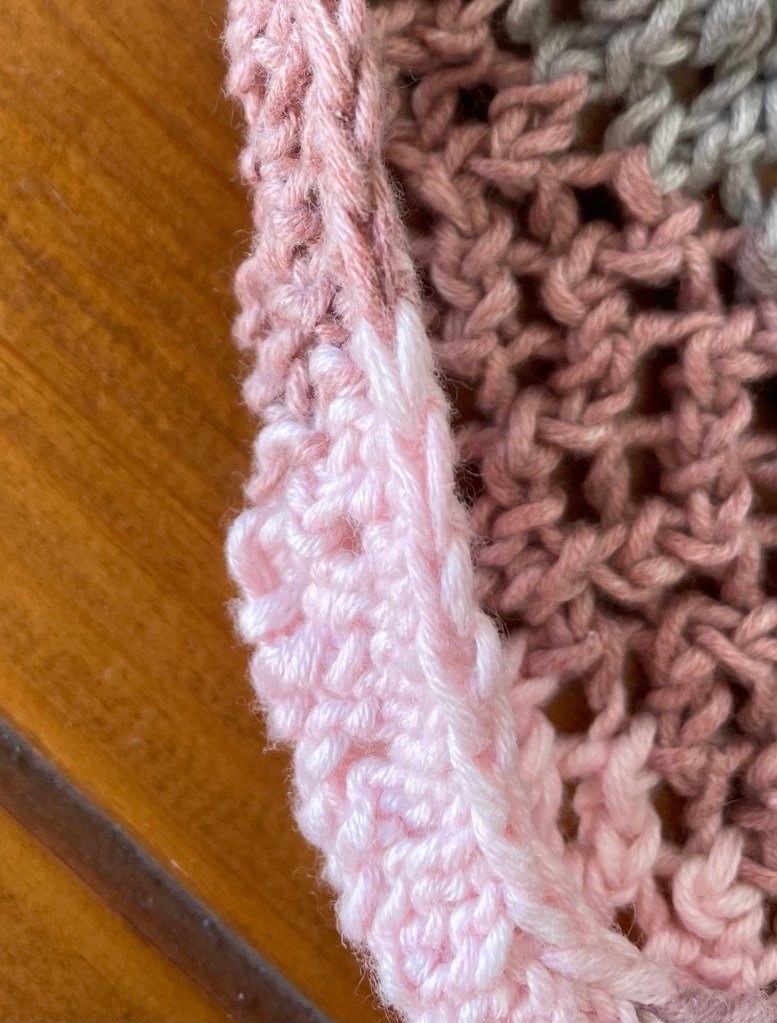
… about half done. A zig zag shawlette based on two variations of the cellular stitch. (367, p67) I’ve so far found five ways of doing the eyelet stitch and all have different-looking fabric.

In this knit the two I’ve used result in a strong rib-like pattern on the front, and two brioche-style textures on the back. The book, see below, calls it the cellular stitch.

3 mm knitting needles or knitting pins if that’s what you’re used to.

Same yarn as before, equivalent in thickness to 4 ply, a 40% bamboo-derived viscose and 60% cotton, which is very comfortable to knit despite the problems identified in Mark 1.

— — — —

I’m still using Mon Tricot’s very elderly knitting dictionary with 900 stitches and patterns. English translation and adaption by Margaret Hamilton-Hunt, Published in France, 1971.
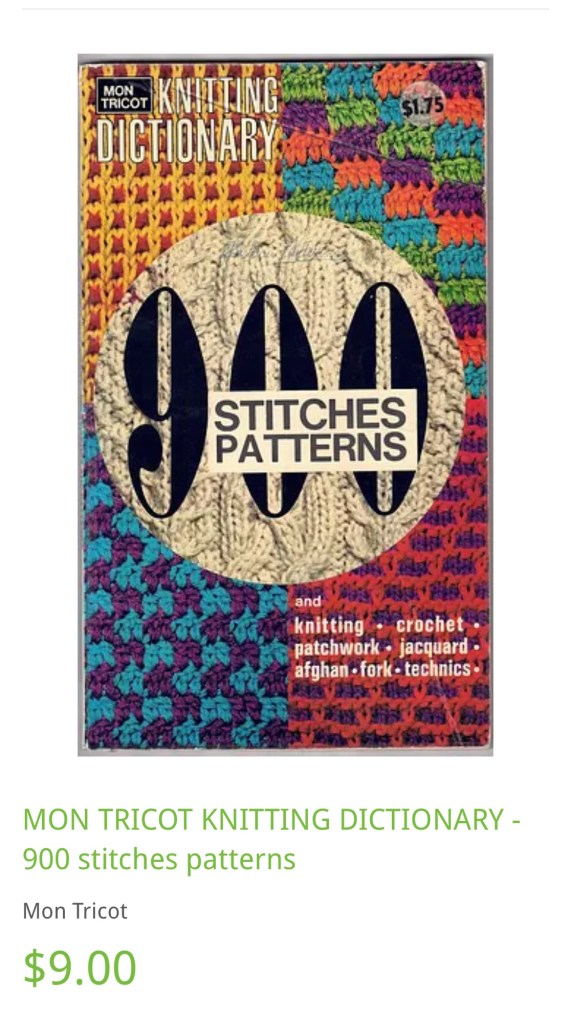
This for sale in the Oxfam shop in Adelaide … price hasn’t gone up much, whereas the copy on Etsy was $142.60!!! Guess that one was never used for its proper purpose.

Mine has the front cover being used as a bookmark.

But the first eyelet stitch I learned was well before 1972, probably round about 1962, knitting a little jumper for one of my sisters then aged about four …. “Wrap one to make one, purl two together” … Number 331 in the book on page 61.

— — — —

When my work (lol, in the present day) is sloping toward the right, all the action is on the back of the work. At the beginning of the row, knit two together purlwise, knit three plain, then wrap yarn to make one, and purl two together until the last four stitches, knit three plain and slip the last one purl-wise.

On the front of the work, make a stitch by purling first stitch and before pulling stitch from left needle, throw yarn back and finish with a plain stitch. There is probably a name for this process but I’ve never known it.

Though I discovered this way of increasing myself, I have no doubt that many other knitters also use it and that it has a name and set of instructions on how to achieve it.

Knit the rest of the line in plain, barring the last stitch which should be slipped purlwise.

Work as many rows as you have decided for your zig.

More to come on this as I haven’t even got you begun yet. Don’t despair.

— — — —

To begin, cast on three stitches. Knit eight rows always slipping the last stitch purl-wise, and doubling the stitch at the beginning of each row. You should have eleven stitches.

Now we start the pattern. Turn the first stitch into two using the same technique you’ve already been using, knit three stitches, *yarn over to make a stitch, knit two together purl-wise* repeat until last four stitches. Knit three, slip one purl-wise.

On the front side of the work, turn the first stitch into two, knit to the second last stitch and slip the last one purl-wise.

Proceed until you have a width that you like. From this point decide if you want a straight scarf or a zig zag.

If straight, continue increasing first stitch at front of work, and start decreasing at back of work—decrease by knitting first two stitches together purlwise which is easiest—every purl line.

I don’t like the yarn I’m using at the moment for a straight scarf. I like a more variegated colour-way. A straight scarf I’ll usually make longer than this zig zaggy one.

For the opposite of the zig—the zag— I need to knit to that place in my project before I can describe it.

And this is to come in Part Two. 😊

The News and Where to Get It …

Out of My Gord’s thoughts on news and where to get it chime pretty well with mine, though I’m still looking for a dependable Australian news outlet that doesn’t cost too much for a subscription. I’ve been making do with COSMOS Science magazine and The Fifth Estate Magazine for topics I’m interested in, but haven’t yet found a nutritional news feed.

I want chewy, not pre-masticated news.

Bosley & Co

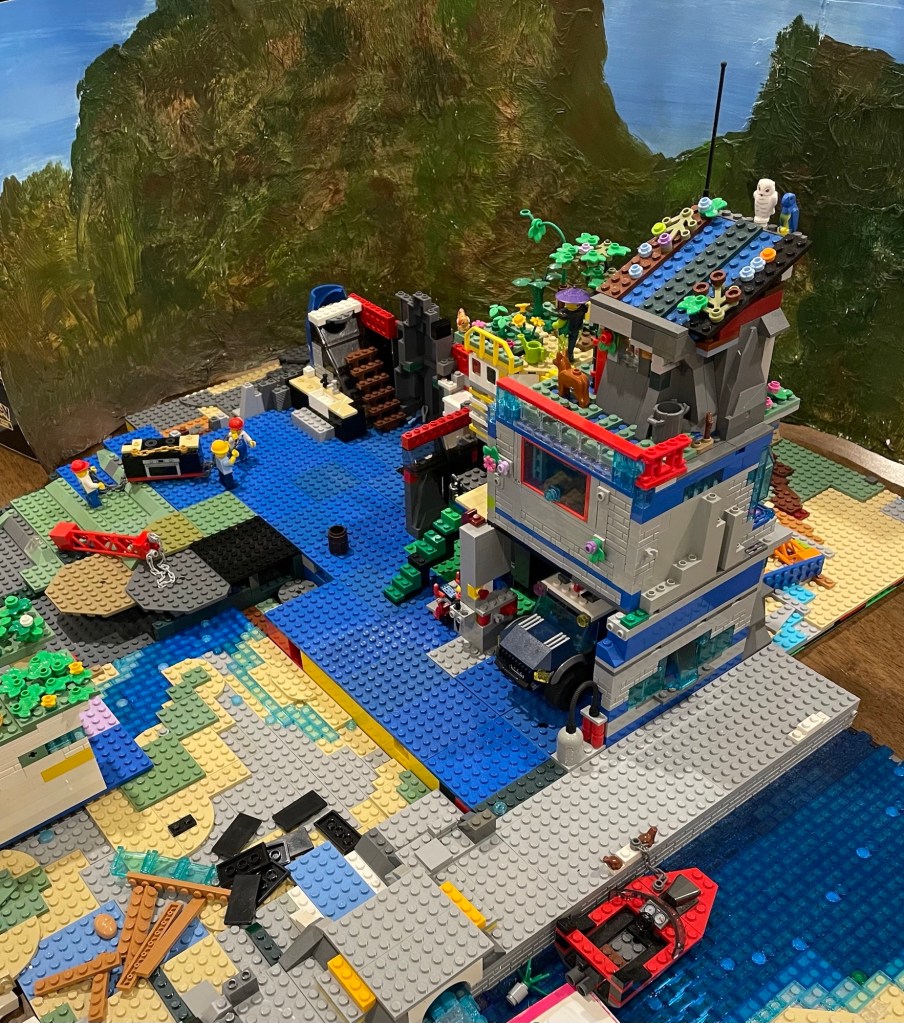
The site as it stands. Work has begun on the canteen. Naturally there are some quibbles and quarrels.

Trish wants her cabin up asap.

Boz asks her where with his most irritating logic.

Tim wants to get on with it already.

Dan wants to go salvaging.

Drew stalks around looking inscrutable.

Nin Wizard is agitated and hops here and there with his teacup.

Nin’s younger brother and his crew have almost finished the Stone Dragon Teahouse with just the five of them … a fact Jed points out at least three times a day.

Watercolor Painting

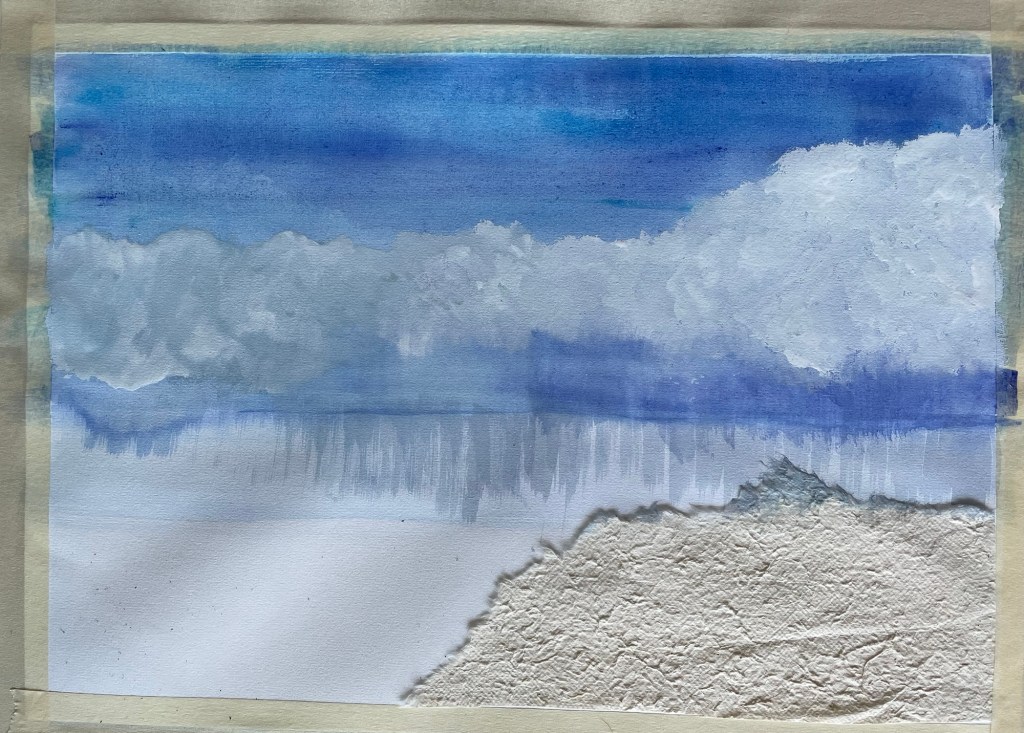
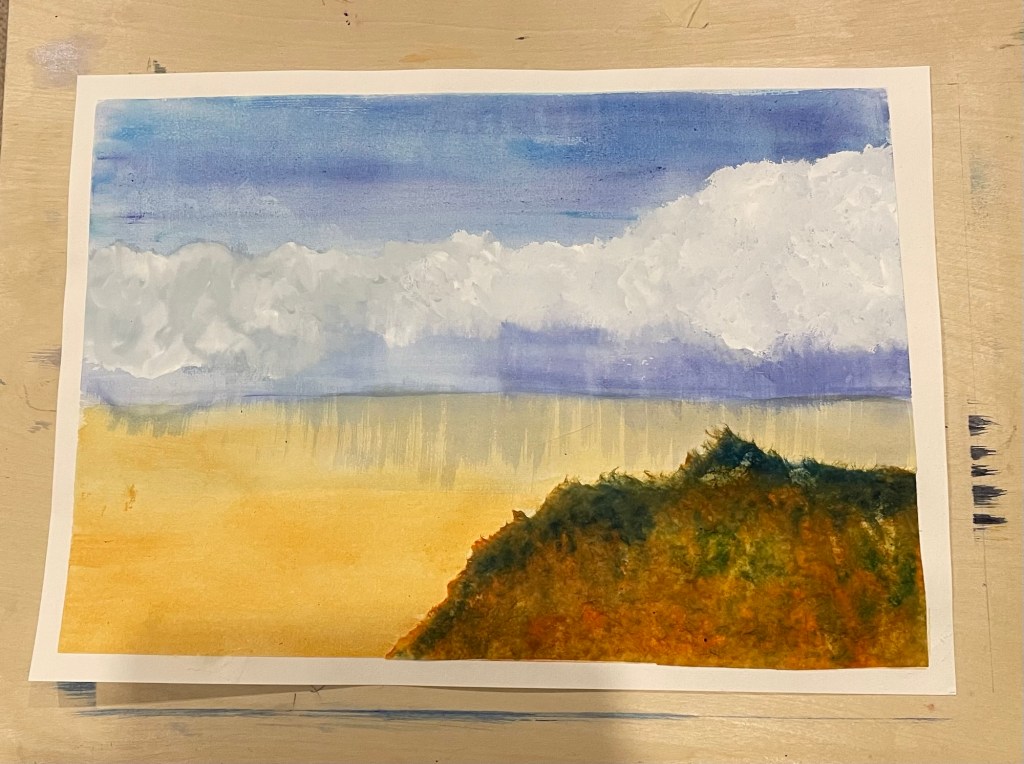
For the last week or so I’ve been busy intermittently with my latest painting. A3 size, part of an ongoing learning curve. Can count the number of successful A3s I’ve done on one hand.

I wanted to use a collaged element, some textured paper that I’ve had for about 25 years.

A mix of French Ultramarine and Phthalo blue for the sky, clouded with gouache white going into grey. The headland unadorned in situ weirdly looks inset, rather than glued on top.

Headland and sand flats painted with Quinaquidrone Gold, headland in addition with Phthalo blue (green shade). Beautiful rich colors, but the sandflats too bright, too gold.

Left it a couple of days. Toyed with collaging an old building in the lower left. Read John Lovett’s website about ‘distressing’. Found a bristle brush. What he recommends for distressing.

Scary stuff to actually do it.

The big middle area painting every which way with grey made of the previous colours and a smidgen of Alazirin Red.

The dark diagonal area running down from the middle was the only problem. After trying to stare it gone for a couple of days, I wet it and mopped up excess paint. Repeated as required. At the same time disappeared the slumped bit of the horizon.

Then the gate. Something in the foreground is a way of getting depth. And that worked. it’s hard to get a good photo. For instance there’s no hill in the left of the picture. That line is much less obvious.

But, OK, I’m happy with if.

Knitting, Mark One

A while ago I started an experimental knit that I intended to serve as a base for a crochet design of leaves and vines.

What happened to that?

This. The rolling up just never resolved itself. The more I knitted the tighter and higher it rolled.

OK, so experienced knitters will be saying I’ve done something wrong and I accept that.

Too tight? Nope, as loose as possible with yarn no thicker than a regular two ply, knitted on 4mm knitting pins.

Weird yarn? Maybe. 60% cotton, 40% viscose. No spring in it. At all.

Wrong stitches? Very possible. Stitches in the body of the work are fine. Loose and drapy as desired.

Increasing at the beginning of each row? The problem has to be there! Ffor the purl, rear of the work, row I increased by sticking pin into back of first loop, knitting that plain, then bringing knitting needle forward to knit a purl and continuing with a purl line.

Did the opposite at the front of the work, making a stitch at the beginning of the row by knitting a purl, yarn to the back then knitting a plain and coninuing in plain.

These made nice edges, one that I’d never seen before on the purl side of a work …

And yet, by the time I’d knitted twenty rows the first five had rolled up. After I unpicked those first five—with difficulty—the next five rolled up as I was doing it.

By sixty rows, the first fifteen had rolled up. No matter how I draped and folded the resulting cloth the bottom rolled up. By the time I’d knitted eighty rows I knew I had a twisted disaster and finished it off.

I may deconstruct it and use the yarn for another project, but this was already the second knit that that yarn featured in. Not sure how well it’ll stand up to the strain of pulling apart again.

Note that I said ‘twisted disaster’ …

Colours/colors …

What do you see?

I see a warm red and a warm green watercolour reaching out for a 50/50 agreement.

I might be wrong though. The red is warm, I have no doubts on that score. But the green?

Apparently if a green leans to its yellow side on the colour wheel it’s classified as warm. And cool if it leans to the blue side.

Light yellowish green has always seemed greener to me, and so cooler. Blueish green on the other hand, felt richer and lush, and so warmer.

I’m about to do that exercise again using Alazarin Crimson, which leans towards its blue neighbour so is classified as cool, and Hooker’s Green wich also leans to the blue side.

And after that, a second trial with the so-called warm versions of red and green. I assume I’ll need to use a scarlet and green made with a warm blue and a warm yellow.

I expect neither of these exercises to resemble the above but we’ll see what we’ll see.