
Decided to revise everything and repost.
Category: Uncategorized
Avatar Remaindered, 1
Back about three or four years ago, when I began this project … this paying out of my story debt, I must’ve begun with Chapter 2 of Avatar Remaindered. As–lol–I have not found Chapter 1 anywhere in the archives. Diligent searching, I tell you.
I thought I might link to it when I post up Chapter 23 as the avatar needs to be in the district round about now, and Avatar Remaindered was always going to be ‘published’ before the end of Lodestar.
Since a lot of readers have joined in the meantime, I decided instead to enable you all to read … if you’re interested … Sard Yon Kerr’s adventures from start to finish. I’ve gone back to the original and revised it. May follow it up with the chapters in between. Be easier to find consecutive chapters then.
Umbrellas … the physical objects
[I see I’ve been resting on my laurels a bit, with my last post five days ago.]
Wikipedia’s definition: “An umbrella or parasol is a folding canopy supported by wooden or metal ribs that is mounted on a wooden, metal, or plastic pole.” And a little further in the article: “Generally speaking, parasols and umbrellas are small, handheld, personal use items.”
I first became interested in umbrellas when as a ten or eleven-year-old when as a special treat I was allowed to use the family’s Indonesian bamboo and oil-paper umbrella, called a ‘pajong’ to walk to a friend’s house through the rain.
We lived in Sumatra at the time (1958), in a small village called Indarung. [I looked it up on Google Earth and it still exists, but now as an outer suburb of Padang. In the 1950s it was a clearing in the forest.] And tropical downpours were a daily feature in the wet season.
The most fascinating part about the pajong was the way the spokes were joined to the center and the ribs.
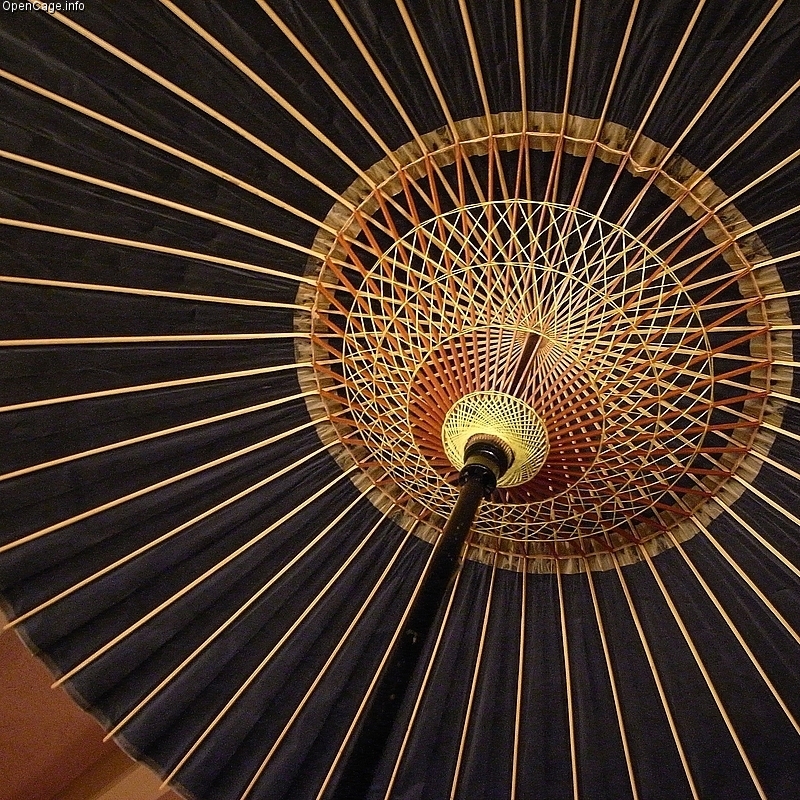
The above Japanese umbrella is way more complex than a simple ‘pajong’ made in a Sumatran village. Our umbrella had a greenish interior bamboo frame, oiled paper canopy, with a gold painted trim and point, with none of the extra basket-weaving in the above example. I remember the smell above all, of the oil applied to the paper to make it waterproof.
Both my present umbrellas have seen better days. The sun umbrella that I’m not calling a parasol as it isn’t dainty enough, has been all but unusable for years already, with one of the spokes bent and another broken. I’m hanging on to it as I aim to repair it.
My fold-up rain umbrella was blown inside-out last summer and was a mess of bent spokes and torn-away fabric. Most people throw such wrecks straight into the bin but I can’t bear it. Fold-up umbrellas are amazing technological marvels. If you have one, have a good look, it’s fascinating.
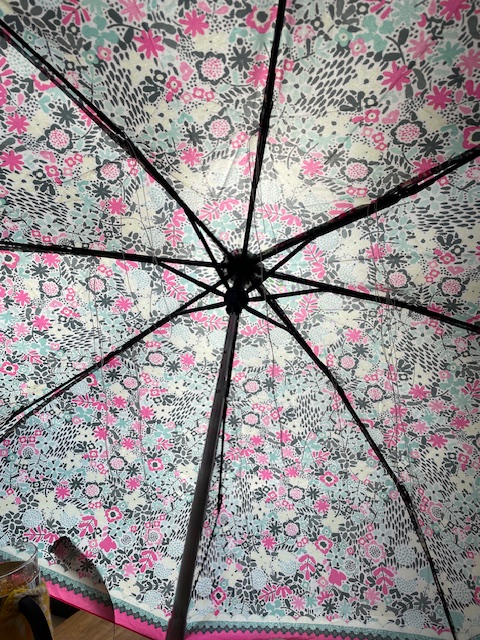
This is mine, photo by me. It’s a fairly ordinary design, I could’ve maybe gone for something a bit snazzier but this one was the only pattern on hand when I needed shelter. The threads hanging down are me having a go at fixing it. So far, I’ve reconnected all the innermost hinges to the fabric. When I’ve done all the hinges I’ll dot the repaired places with glue, maybe super glue. Then cut off the excess thread.
The long threads make it very easier to knot the threads after passing them twice through the holes in the spokes and twice through the fabric, then once around the sub-spoke. I’ve bypassed the really finicky job of sewing the spokes to the inner seam and instead have sewn the spoke to the fabric by drawing the thread to the outside and back in again. Similar to sewing on a button.
This all made me wonder how much assembly there had to have been by nimble young fingers? While I can see the frame being produced by machines, sewing the canopy to the frame … a machine? Not a chance.
Another form of intricate but boring labor by the modern enslaved workforce … I imagine each person in an assembly line having to sew an unending line of spokes to canopies … have you ever seen/been in an umbrella factory?
Cat Diary 29
My favourite way of gathering kibbles is from this thing that the old woman built from toy bricks.
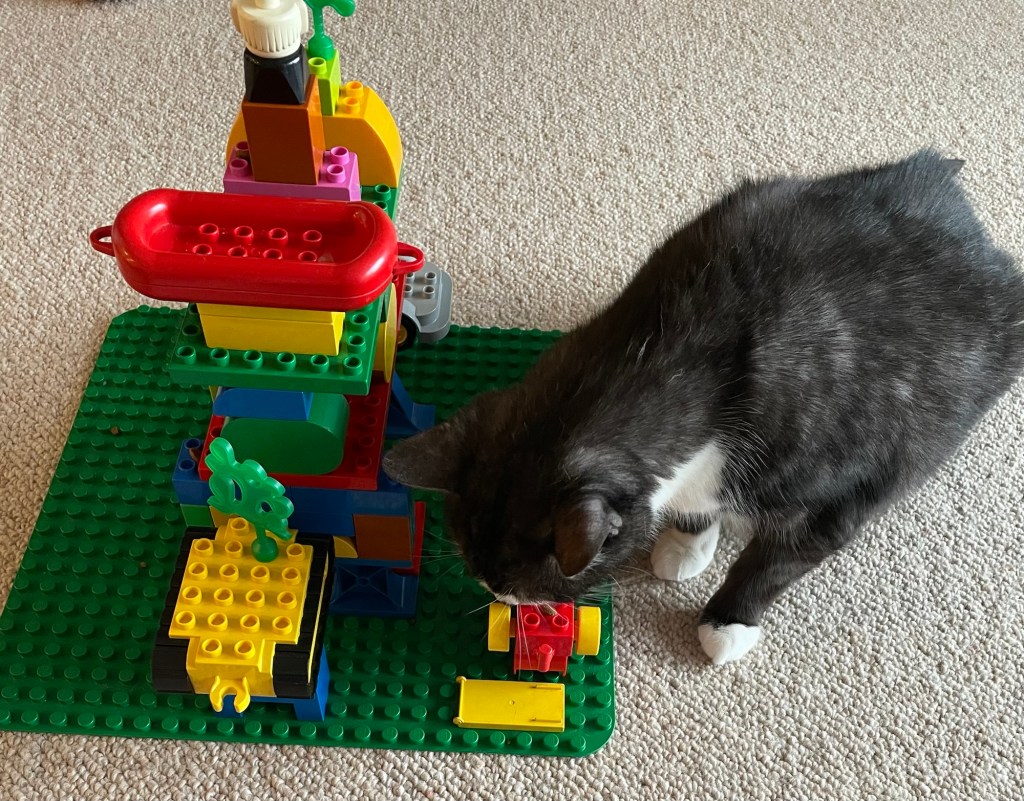
This is already the third version. It’s getting higher and today there are three things with moving parts.
This thing with the bits looking like wings took me ages to work out how to shift and she’s just added the crossbar but I think I’ll handle it. She leaves kibbles under the crossbar, or under the grey thing.
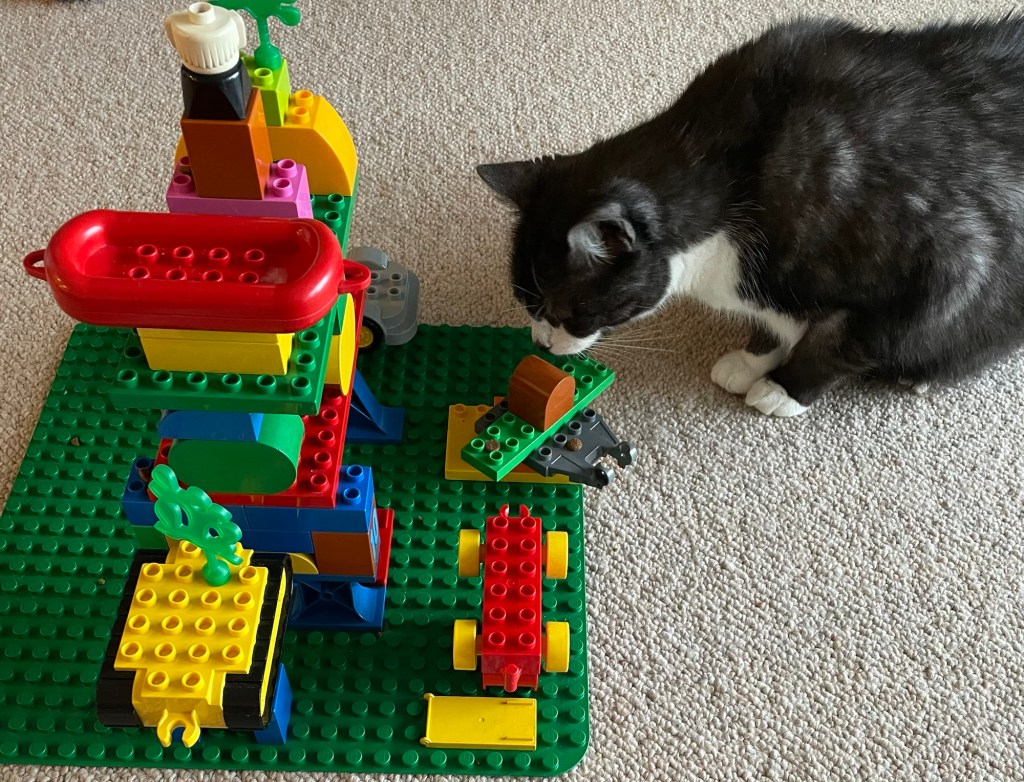
There are three sides … the front, the back and the top and I do them in that order. The front is my favourite.
The back is harder as the kibbles are always on the tiniest ledges where I need to grapple them from with my tongue.
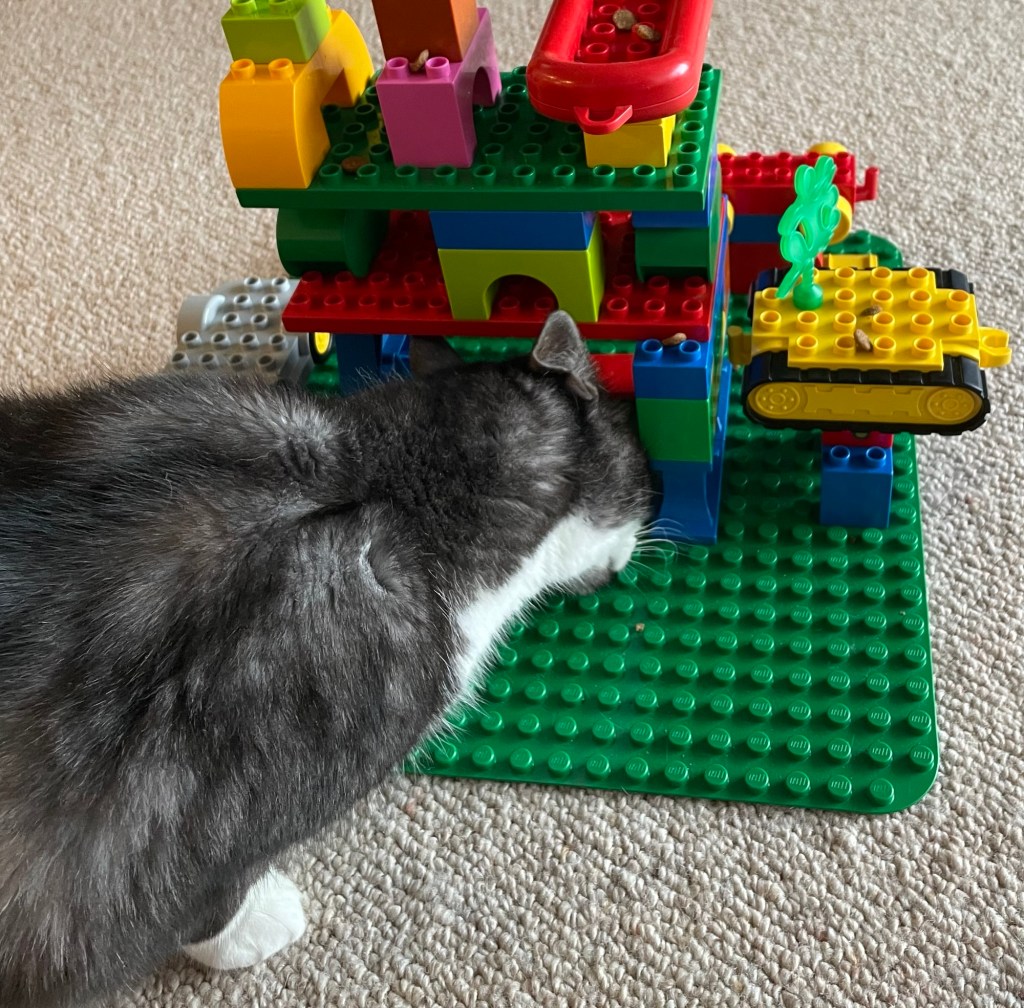
The top is the highest it’s been yet, but not a problem. I can still reach with all four paws on the ground.
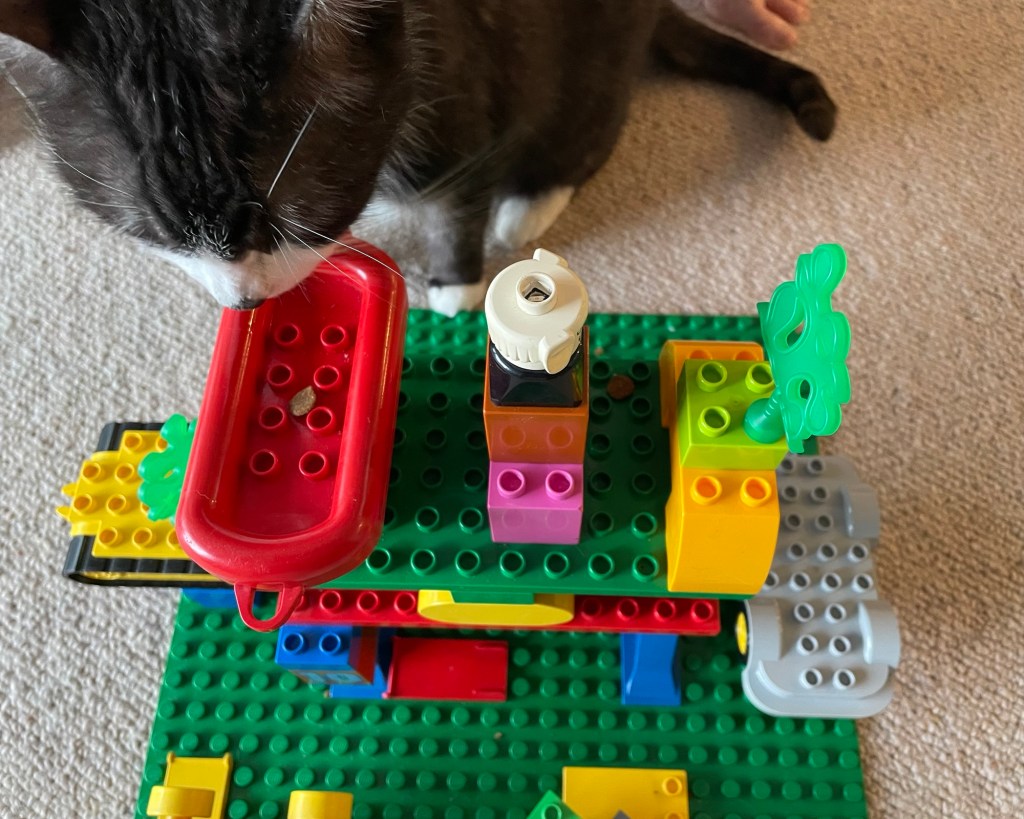
My Duplo puzzle board is my favourite kibble hunting ground!
The Blue Tumbler
Calling it that for want of knowing what its proper name is.

The theory is that filled with kibbles, a smart cat will be able to get them out by pushing or tweaking or pawing at the tumbler.
Moggy is far too smart, or shall we call that wily, to do this work herself. She waits, sitting there looking interested, until the human loses her patience and does it herself, and the tumbler spills its load. Then she doesn’t hesitate, then she steps forward and eats whatever kibble in sight.
It’s a stand-off. We’ve been doing this daily for a week and there appears to be no breakthrough yet.
Although, I shouldn’t forget that this morning she stared piercingly at the tumbler sitting innocent and half-empty nearby. That’s a miniscule bit of interest, what do you think?

So come training time, I had the idea of putting kibbles under the tumbler. See if she’d engage. And that’s as far as we’ve got today, she’ll push it with her nose to be able to grab the kibbles from under it.

I carefully arrange the holes and the tumbler so if she pushes hard enough one time, the thing will tip and spill a few kibbles.
That hasn’t happened yet.
‘The Mercy of Gods’
I’m going to try to talk about this without giving anything away since you too might want to read it. It’s worth it. Science fiction.

It definitely took me reading this tome twice before I could be sure that the title says what it says for a reason. And remember that if you’re a fast reader … like I am … it will probably need twice through before you get both the title and the reason for the incredibly detailed viewpoints. It did me.
Those were the two main things I took away from the second time through. I found the incredible nit-picky detail quite irritating the first time. Usually when I pick up a book for the first time, I consume it for its story. It’s a make or break reading and if it doesn’t come up to my expectations I’ll be leaving it in the laundry.
Lol, “leaving it in the laundry” is a euphemism for getting rid of it. Back in my youth when I lived on the road for three years, books were regularly left in a camp-ground’s laundry for swapping. You’d leave your excess luggage in the form of books and magazines there in exchange for things you hadn’t read yet. No mobile phones in those days. The really good books that I found in that way and that I couldn’t abandon like that, I would post home. Still have a couple that I collected that way.
Here at the retirement village, there’s quite an extensive library of books left by people not wanting to store them in their apartment shelves, I assume. I’ve left a few of my acquisitions there too. I’d say that’s the primary method of acquisition. Detective fiction is the most popular genre here.
The second time reading a book, since I already know the plot and outcome, I can concentrate on the detail. And in The Mercy of Gods there is a lot of talk and thinking by various characters. Some that irritated me first time round became a necessary flow-of-consciousness to enable me to negotiate–along with the character thinking the verbiage–the extremely difficult situations presenting themselves.
Situations that I might have glossed over first time round. [Yeah, I know. Glossing a novel is wasteful on a number of counts. What can I say? Chasing an outcome is my addiction.] The primary situation is a bunch of humans in a very alien situation. I take my hat off to the authors’ world-building and ability to explain what is happening in the extreme environments they’ve invented.
Another really great process … not topic, not event, not character … what’s left? Process? So, another really intricate and interesting process is the way the humans are made to pit themselves against what they think is the target which turns completely on its head. You just will not see that result coming. Even me telling you like this won’t help you, because if you are a normal human being you’ll be reading along waiting for something to happen. It’s dense, opaque and a great read! Go read a book review somewhere if you need spoilers.
My very first five-star read this year!
Gesso’ing …
Starting a large new project with a four x A3 length of gesso and tissue paper …
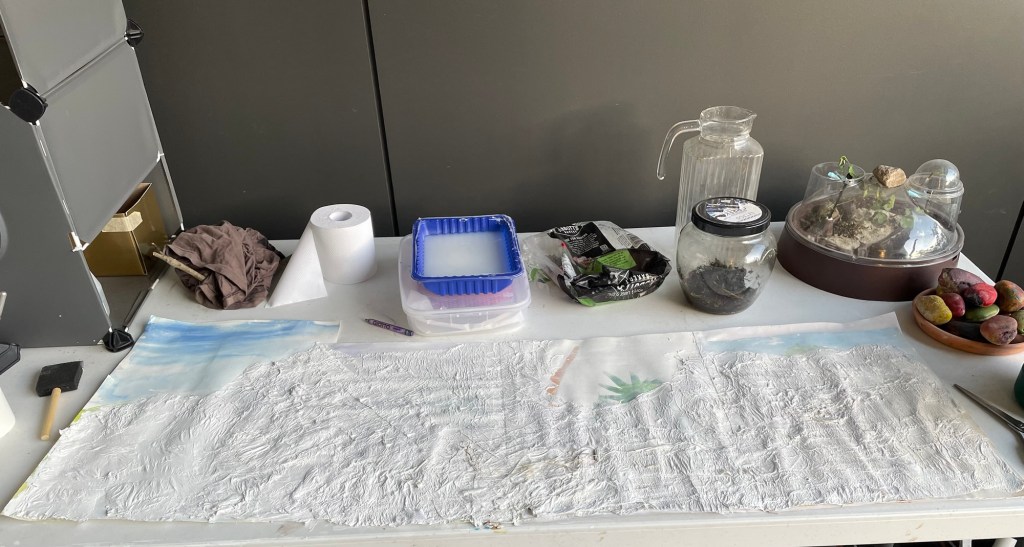
In other words, laying down a landscape and at the same time attempting to camouflage the joins.
The whole thing sodden with a mix of water and gesso. And that is a jar of medium strength watered-down gesso still possible to use as paint. s
A econd jar with a jellified gesso that had to be scooped out and softened to a paintable sloppiness … glad I got to it when I did as next week or month it mightve been to dry/hard to use.
As usual, I’m re-using remnants of an old project. I’m sorry to discover that the joins are very obvious in a photo.
The hope for this first stage is that the paper backing dries flat and I get rid of the big vertical … what would you call them? Not creases. Give me a hint? I can only think of a couple of Dutch words. ‘Rimpels’ and ‘golven’ spring to mind.
One of the things about old age is that ‘mother tongues’ IE the language a person grew up with, tend to come back. And I’m definitely noticing that. If I can’t think of an appropriate word in English, I’ll come up with a Dutch one.
 Rita de Heer