
Next up is a book I’ve been wanting to read for about 20 years. When it was first published, the title grabbed me … Matthew Flinders’ Cat. I already knew that Flinders had a cat he’d named Trim, and had seen the bronze statue of Trim at the State Library of New South Wales.
I didn’t research the story beforehand as nowadays I usually do, just looked forward to reading a blow-by-blow account of Matthew Flinders’ voyage mapping the coastlines of what was then New Holland, accompanied by his cat.
Usually I wait until a book comes out in paperback before buying it, so when I didn’t see it appear in the local bookshop a year later, forgot about it. Since then I’ve seen it a few times in libraries without there ever being an opportunity to borrow it, and a couple of weeks ago saw it on one of the two bookshops I now frequent.
And so bought it. Because I needed a new, chewy read, and for the expectations I just described, but still not knowing anything about it apart from the fact that Trim might be one of the main characters.
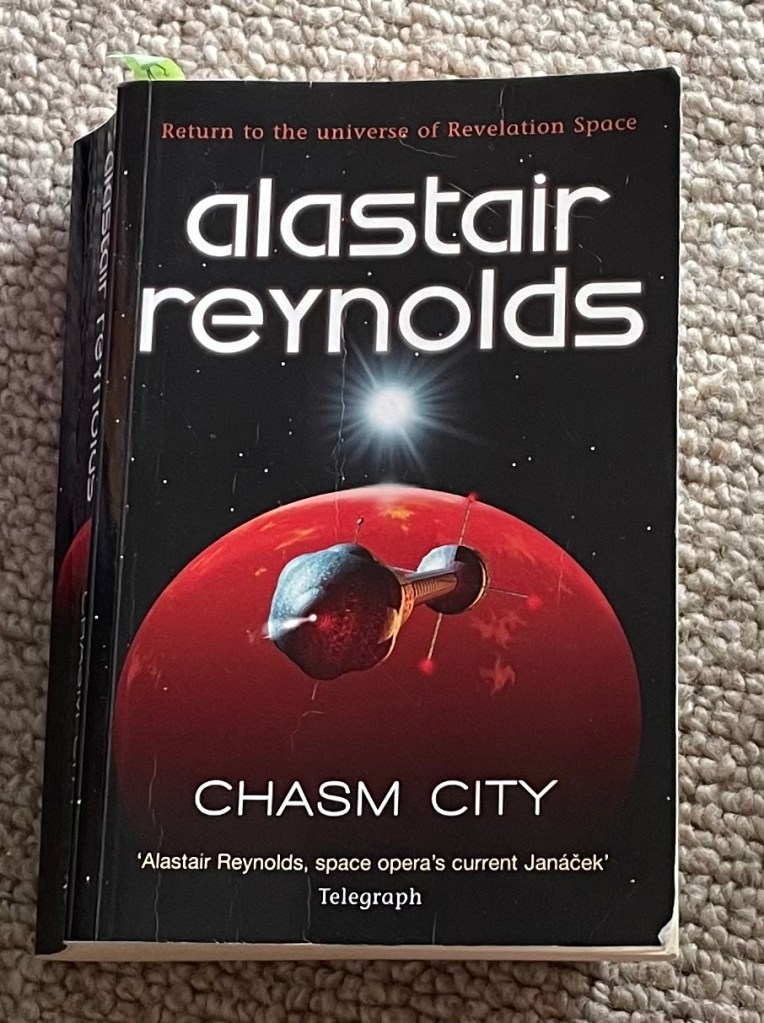
Book 10. Matthew Flinders’ Cat by Bryce Courtenay, this edition published in 2006 by the Penguin group.
How did I miss that it was written by Bryce Courtenay? I’ve read a few of his but generally don’t like his style. To me they’re the kind of book I might read if there is nothing else available.
Such as when stuck in a camping ground by the roads being flooded and Bryce Courtenay book is the only thing to be found in the camp laundry. That’s where I found The Potato Factory and read that. But that’s by the by.
Reading the first paragraph of this book I knew it wasn’t going to come to my expectations but, I reminded myself, that was my own fault. And since I had given out good money for it, I would read it.
‘Billy O’Shannessy woke to the raucous laughter of two kookaburras seated on top of adjacent telegraph poles.’
There is Billy O’Shannessy … Courtenay does this thing that I was taught as a new fiction writer, make the first two words about the the main character. In that same first sentence there is also setting the scene, in this case the Australian scenario with the two kookaburras. And there is the modernity of telegraph poles, if a slightly old-fashioned term for them telling us the story is set in the present. Telegraph poles might’ve been normal for 2002, when the book was first published. I don’t remember. The rest of the paragraph tells of his hangover and that the birds served as his ‘regular alarm clock’.
In the next paragraph I learned he was lying on a park bench with a canopy of leaves over him. It’s only on the third page that Trim gets a mention and then only his life-sized bronze statue on a window ledge of the state library
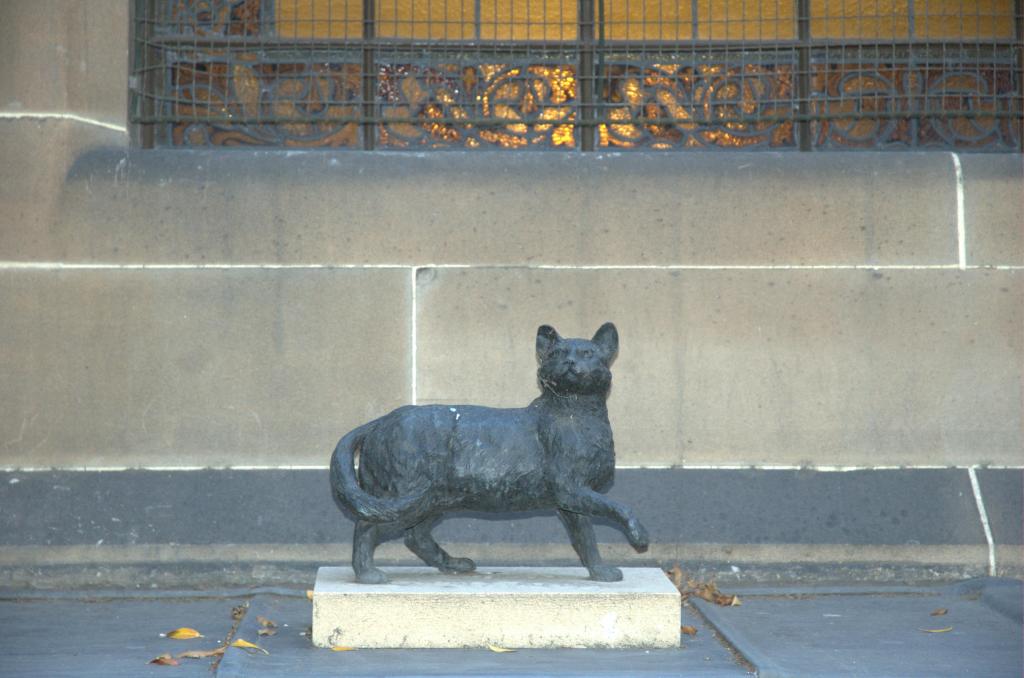
By en:User:PanBK – http://en.wikipedia.org/wiki/Image:Trim-the-illustrous.jpg, CC BY-SA 3.0, https://commons.wikimedia.org/w/index.php?curid=1182097
The Wikipedia page about Trim is interesting. He’s got several more statues, one in Donington, UK and one in Port Lincoln, South Australia, as well as a glowing epitaph by Matthew Flinders himself.
Alas, this book is not primarily about Trim, or even Matthew Flinders.
Purporting to be a novel, it seems to me to be written as a tribute to the Salvation Army, the Twelve Step Program to recover from drugs and alcohol abuse and rehab, and the many services helping homeless people and troubled children in Kings Cross, Sydney. All very worthwhile people and services, I’m not denying that.
Published two years after Courtenay’s divorce, I did wonder whether he was writing a semi-autobiographical novel, that he was a recovering alcoholic. The fact that it is his twelfth novel might explain why an editor would do less editing, leaving unchanged the info dumps, for example, consisting of half or three-quarter pages describing people and places.
But I’ve often wondered how people go about writing a tribute novel so in that respect this was an interesting read. First, he had a professional researcher … the results of research are big in this novel. There are screeds of explanations. Over pages 333-334 there’s a paragraph of over 200 words. That’s almost a whole page. Commonly called a wall of text. It seems very 19th century-ish.
In places it feels like Courtenay inserted a whole paragraph straight from the source. That can’t be right, of course. Courtenay was a well-respected author. I like to think there would’ve been at least one rewrite to make the material his own.
In addition, most professional people wouldn’t hesitate when approached by a famous author to tell them about their world, any extra mention is going to help promote their concerns, right? That also shows in the detail about organizations such as the Salvation Army. I imagine there’s a fine line between wanting to do one’s sources justice and keeping the story from dragging the weight of excess information.
The bits about Trim were the story Billy O’Shannessy told Ryan, the ten-year-old other main character. Trim is imagined in the talking-animal style with a lot of agency. Which left me wondering whether the adventures described had any truth in them. They read like fantasy.
Probably I’ll try to find something nearer to Matthew Flinders’ own account of his and Trim’s circumnavigation of Australia.
 Rita de Heer
