Reading, 6

Been home since yesterday and today assessing what I’ve been reading since last time I talked about books.

And that seems weeks ago. A lot has happened.

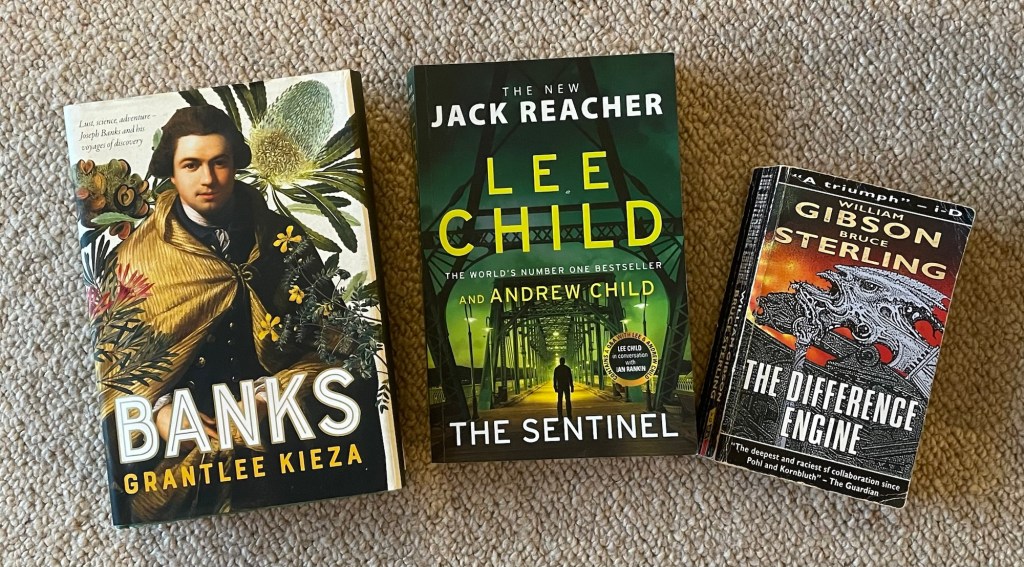
Book 15, Banks by Grantlee Kieza , published in 2020 by ABC Wave and HarperCollinsPublishers.

Though I’ve always been interested in Sir Joseph Banks and his plant discoveries in Australia, I had never read a biograpghy.

So was pleased to see this among the biographies in the Vista foyer. Started reading that night, full of vim and vigour.

My my! Did I get bogged down? I’ve seldom read a boggier book, such a disappointment. Kieza’s style is turgid, the first fifty pages are an unbroken list of namedroppings with numbers for endnotes. By page 50, there are 76 endnotes.

Normally, if a book doesn’t grab me by page 50, I give up. This time though, because it was about Banks I thought I should continue. After all, my thinking went, Banks himself is in the scene now. It isn’t just his friends and relatives tripping the stage.

On page 81 there is an interesting paragraph about the fitting out of the ship that was eventually to be named ‘Endeavour’. I must admit that here I appreciated the detail.

How a ship ninety eight feet long and twenty-nine feet and three inches wide could fit into it a crew of seventy, twenty scientists, dogs, cats, goats and poultry, is beyond belief.

The crew were alotted a space of fourteen inches wide for their hammocks. They’d have to swing top and tail, my reading buddy reminded me.

What I’m saying with these few facts … yes there are nuggets of gold in this book. They’re so far apart is the problem.

Book 16 The Difference Engine by William Gibson and Bruce Sterling. First published in 1990 by Victor Gollancz.

Started reading this when I hit another long slow chapter in Banks’ life.

The Difference Engine is a whole other kettle of fish. Fiction, of course, it’s said that with this story, Gibson and Sterling invented the cyberpunk genre.

Not a fast read either, but definitely interesting. The hold up here was the unusual terminology for what are normal concepts these days. So although you know you’re reading about a computer, it is called the difference engine.

The research done for this novel is astounding. Every kind of Victorianism is present and acounted for. Omnibuses, Hansom cabs, steam trains. Line-streamed aka stream-lined. China- hard platter of mud … many descriptions have been built using concepts right for the time.

The kind of story you want to read fast to see what happens next, but also slow to enjoy the richly described world. Quite a conundrum. I think probably in the goodness of time I will read it again.

After another couple of chapters of Banks, I picked up the so-called New Jack Reacher

Book 17, The Sentinel by Lee Child and Andrew Child. 2020 by The Bantam Press

I planned for this to be fast and thoughtless read. Pure relaxation. Didn’t turn out to be. The collaboration between these two gentlemen doesn’t work for me.

Lee Child’s normal style is spare and suspenseful. Andrew Child’s style slowed it down but not in a good way. Not by cranking up the suspense. Sentences are longer and sometimes there’s too much description.

I’m still supposedly reading Banks. Be hard to get back to it now. I might look for another biography about him
Reading, 3

The third post of this series already though I haven’t settled into a routine yet. Today had the better idea of what to do about the illustration. Instead of letting just one book have all the glory, why not give them all a chance to attract readers? Will give that a go shortly.

The longer without a routine the better, I used to think before I was pole-axed by ME/CFS. Come Easter, I’ll have lived with this malady for 29 years. Somewhere along the line I learned that making decisions is a stressor that saps my strength.

The idea out there—in the public domain—is that the more non-important decisions we encapsulate in routines the more energy we’ll have to make important decisions. It’s not wrong … routines enable me. Interesting article on decision-making … https://en.wikipedia.org/wiki/Decision-making

Then I thought what about at the end of the year? Won’t I want to know how many books I actually read? That is the project after all. I saw myself counting through the posts. Got to be an easier way. Just number them already. So … started that today.

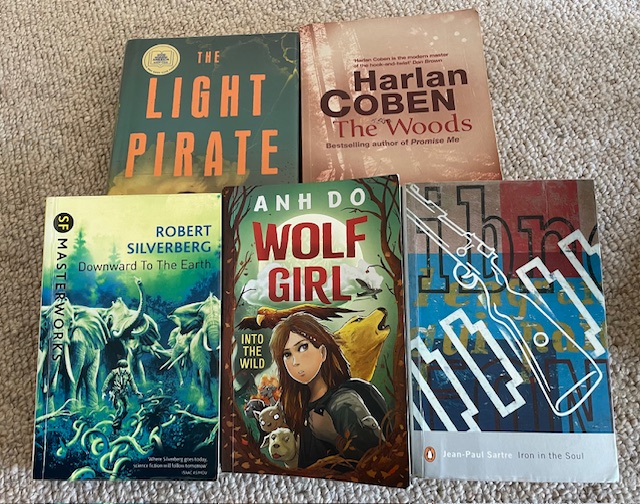
Book 5. The Light Pirate by Lily Brooks-Dalton, 2022. Published by Grand Central Publishing of New York.

This is the only book out of the five that I’ll recommend. I might’ve mentioned before on this blog that the climate change apocalypse, and its associated nightmare horsemen are my Sword of Damocles, and that the thread the sword is hanging by is wearing mighty thin and frayed.

The Light Pirate is set in the near-future and describes how the Florida coast is being engulfed the sea. It’s a blow-by-blow account of the way one family dies and adapts and is taken and finally evolves for a new existence. Ninety percent stark dark reality and ten percent luminous hope.

This is a book I would like to own. Read the good bits every now and then. This story speaks for everywhere there is low ground by the sea.

Book 6. Downward to the Earth by Robert Silverberg, 1969. First serialized in Galaxy Magazine it was published in 2015 by Gollancz in their SF Masterworks.

Although I’ve been reading science fiction since I was about 13, and Robert Silverberg has written hundreds of stories, I haven’t read all that many. Scanning through the titles in the front, I see only one that I own. Most don’t ring a bell. This little classic is said to … “blend mysticism, worldbuilding and literary references in an inventive mix …” from the backcover.

It’s probably about 60 thousand words, a common size in the 1970s, with a single storyline, the journey of the main character, Gundersen, returning to the planet after a ten year absence, out of guilt and needing to do penance for his mistreatment of the native species.

When I read old science fiction I’m forever fielding echoes. In this book I was reminded of some of Oscar Scott Card’s work. Comparing the dates of Silverberg’s and Card’s work, I think probably Card got his idea of the melding of the two species from Silverberg. Although, they could both have got the idea from Earth’s own panoply of creatures. Most insects, for example, have vastly different life-stages.

    Book 7. Iron in the Soul by Jean-Paul Satre, 1949. This edition translated by Gerald Hopkins and published by Penguin Classics, 2002.

    Despite that there was plenty of Jean-Paul Satre around when I was a young student, I was never tempted to read him then. Now I thought, browsing along the shelves at Carindale Library, why would Penguin choose to republish him as one of their classics if there wasn’t something to him?

    I read a few pages in the middle—that’s the way I test books for readability—and thought it might be interesting. A whole other viewpoint about the Second World War, this one from the POV of the rank and file of the French Army.
    Thousands were taken to Germany and, I read just now, more than ten thousand French soldiers fought alongside the Germans. I wonder if they were given a choice, fight for us or we shove you in a work camp? https://en.wikipedia.org/wiki/France_during_World_War_II

      Book 8. Wolf Girl: Into the Wild by Anh Do, 2019 with illustrations by Jeremy Ley, 2019. Published by Allen & Unwin.

      Seriously, was a bit of light relief, I zipped through this in about an hour. A story aimed at 8-10 year olds that my grandson lent me. I was interested to read how Anh Do, serious artist, translates into Anh Do, children’s author. His style reminds me of Enid Blyton’s.

      There are about a dozen installments. A money-spinner, if you ask me. And yet, Enid Blyton’s vast output was great for struggling readers, giving them lots and lots of practice of the plain vocabulary that they needed to become good readers. So perhaps this is the place for Anh Do’s output in Australia.

        Book 9. The Woods by Harlan Coben, 2007. Published by Orion Books.

        Returning a bunch of books to the in-house library in the community center, I picked up The Woods because Coben wrote it and I hadn’t read it yet. Pure indulgence. A fast forgettable read. Suspense? Of course. All the t’s crossed and the dots dotted? Yes. “The modern master of hook and twist,” says Dan Brown on the front cover. (Wonder what he got or did to get his name on someone else’s front cover?)

          Reading, 2

          The project continues.

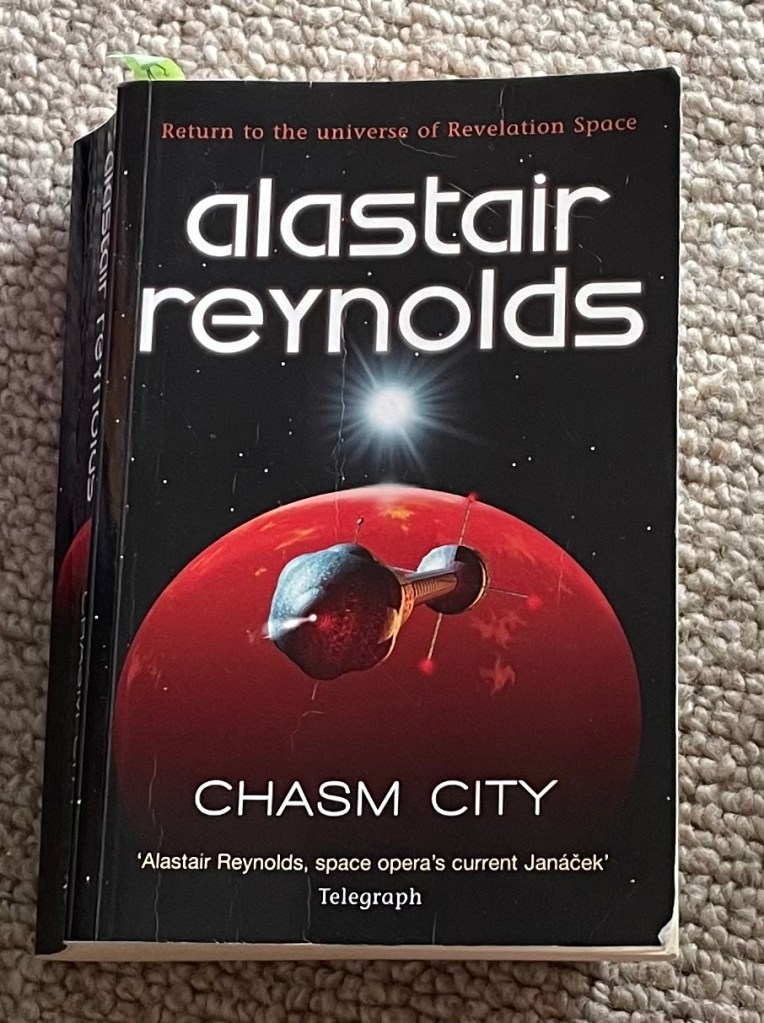
          Next up was Chasm City by Alistair Reynolds, published in 2001. “A hardboiled pursuit/revenge thriller set in the RS universe,” from the author’s website. RS = Revelation Space, which I don’t know anything about other than what I’ve just read. Thriller? Nah.

          An eight-day read, worked at diligently. Dense and detail rich. According to my research after reading it, this is Reynolds’ second published novel. And also second in reading order, it’s a ‘stand-alone’ as the Reddit experts tell it, but which surprised me as there seemed quite a bit of bloat. Stuff, that for the sake of the pace, readers could’ve done without. Stuff that I wanted to skim, but ended up plodding through because of not knowing what was essential to the plot.
          There goes my theory that editors don’t look as closely at authors with a lot of books already published.

          At times I thought I was reading about Mars. I think it was a case of stories bleeding into one another due to proximity. In this case, me watching The Expanse Series by James S A Corey on television. I think probably due to the sheer size of the chasm. Very Martian. Though in this case, it’s a planet called Yellowstone and a large part of the chasm is domed over.

          Life in the chasm is very interesting, regional. As can be expected the upper classes live in the Canopy, the slums are in the Compost. Travel is by semi sentient vehicles that claw their way up and down and along hanging vegetation and cables. The slum dwellers are all about making a living. The rich play at turkey shoots, where they free a prisoner and force them to run for their lives.

          The two main characters, with at first separate stories, eventually seem to meld into one another. The POV character keeps changing identities, and is as slippery as an eel to keep hold of. I found that quite disconcerting as the story is complex and I found it easy to get lost in. I did a lot of re-reading.

          Why didn’t this turn into a DNF read? (Did Not Finish for those of us at war with acronyms). It could’ve, to be honest. But Reynolds also wrote the Revenger trilogy… Revenger, Shadow Captain, and Bone Silence. Three of my favorite modern science fiction reads.

          Fantastic worldbuilding, great characters, piracy and treasure hunting, a gripping plot, a steampunk flavor. Rave, rave, rave.

          Reading Chasm City I kept wanting to give Reynolds more time to come good, to tell the story with as much verve and vitality he’d shown in Revenger. I think now, knowing the Chasm City was only his second novel, that he was still learning.