Touch …

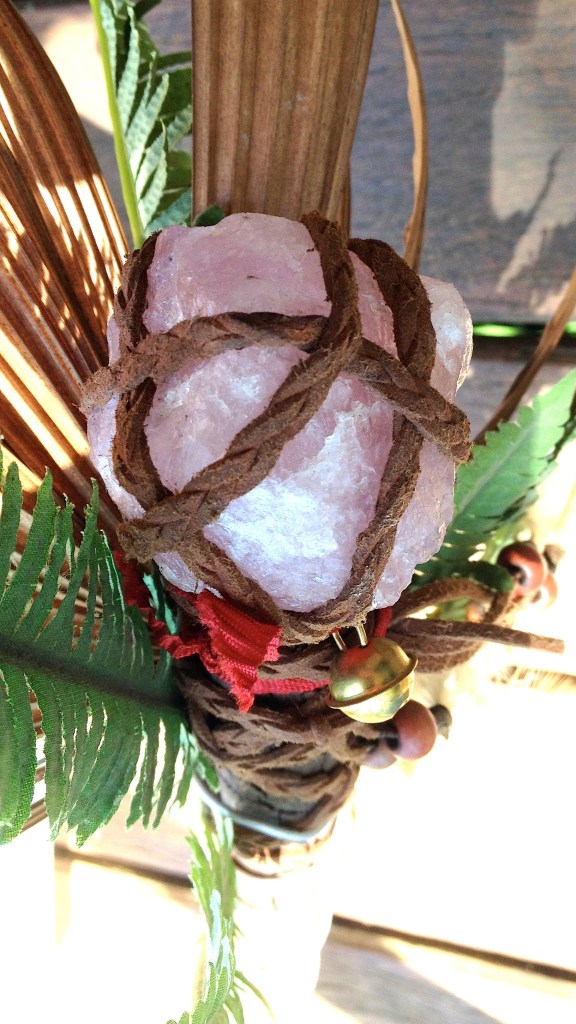
This crystal-topped staff hand-made by Alys Shilo (photo made in 2014) from various natural and machine-made objects, no plastic involved.

Caroline Ross’s post on Touch was a serendipitous discovery this morning, after a few weeks of thinking about my sense of Smell and Taste, worrying about them not coming back after the medical procedures I had last month. Both okay now, with my interest in how we use them enlivened by their possible loss.

Her list of five things to touch every day seems like a good start … Abbreviated to their headings by me … if you’re interested you can see the examples Ross gives in the article linked below.

  1. Entirely unmade
  2. Unmade but modified
  3. Handmade but unmade material source
  4. Machine made, unmade material source
  5. Machine made, artificial or mixed source materials

https://carolineross.substack.com/p/ultra-processed-things

Although it’s still only noon here, I’ve already touched dozens of objects in category 5 (table, couch, laptop, etc etc)nand quite a lot fewer in the first four categories.

Quite a few things I touch every day need a bit of analysis. For example, the carpet in these units is said to be wool. It’s obviously machine-made. But does it have a plastic backing? Yes. So it’s another thing in category 5 and here I thought I was walking on a natural substance.

Definitely in category 1 is my bit of polished wood that I picked up from Raglan Beach, North Island NZ about 50 years ago, and keep in my pocket.
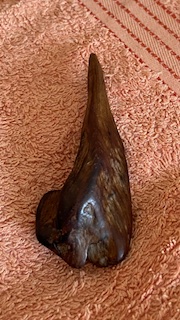
2. Unmade but modified. Hmmm. The examples are “ground coffee, stone paperweight, wooden walking stick, dried apple rings, raisins, a fallen log to sit on.” At breakfast I had currants on my cereal … and seeds, and various other unmade food-sources. Another easy one where food is concerned. Lol, a fallen log to sit on. Up here in my Level Two unit? Maybe not.

3. Handmade but unmade material source … that’s a hard one as I haven’t painted yet today and haven’t yet used ochre. or a handmade paint brush.

4. This one is easy for me. Machine made, but unmade material source. Wearing anything other than cotton, linen, silk, or viscose gives me hives and or eczema. Cotton, linen and silk are all unmade material sources.

That’s my five. How did you go?

Food: GF Bread

‘Falling off the Wagon’, is a phrase that originated in the Temperance Movement, according to Wikipedia.

Meaning falling of the water wagon back into alcoholism. Getting back onto the wagon means getting sober again. I’m sure I’m not telling you anything new.

Every so often I fall off my gluten free, dairy free, lowFODMAP and sugar free penny-farthing-bicycle and then I am in pain and discomfort.

Getting back onto my penny-farthing bicycle is a matter of figuring out where the bad stuff has crept in. While one teaspoon of gluten-containing flour in a loaf of bread is not going to cause any problems, a cup of 100% wheat flour will. And I’ve been mixing spelt flour in my baked goods to encourage yeast action.

And having that bread daily. Having anything you’re sensitive to daily, is another no-no for people with a lot of allergies, intolerances and sensitivities.

Having a particular food once every three days usually prevents a build up of the bad chemicals in the body. But sometimes all I want is to be able to eat something without worrying what it will do to my chemistry.

That’s when my penny-farthing slams to the ground and I fall by the wayside.

Which is why I’ve started experimenting with baking my own bread. Commercial gluten free breads tend to have a ‘stampede of ingredients’, and the breads that are any good aren’t always available. The phrase ‘stampede of ingredients’ … so appropriate to food intolrances … comes from the MooGoo people, who make natural skin care products.

Cutting gluten-containing flour from my diet only half-fixed my problem. I came to the conclusion yesterday it has to be a capsule filler causing me grief. I’m now taking 0.9 mg LDN daily, either a (3 x 0.2 + 3 x 0.1) dose equaling 6 capsules, or (4 x 0.2 + 1 x 0.1) equaling 5 capsules.

Meaning, I’m taking a lot of Avicel cellulose filler. And I’ve been reading in a pertinent group that this stuff gives a lot of people grief. They either have their capsules compounded with a different filler and that’s a minefield I don’t want to go into right now, or they throw the contents of their capsules in water. The LDN dissolves and the Avicel is the residue at the bottom of the glass, and then drinking the water.

That’s what I’ll be doing. I still have about one hundred and fifty capsules to work through before I can ask for a different filler. It’s a real “Good Grief, Charley Brown!” situation.

Lunch … couldn’t wait any longer. Wilted greens, avocado, a few olives and the equivalent of approx 2 slices of newly-baked bread. A third of an apple. A jug of hot salted water.

After stopping the bread machine for a minute, I hauled out the bucket and scooped out the equivalent of two slices of bread. Bucket back in to finish the cycle, 28 minutes to go. Going on the texture of the bread, it looks like it will be my most successful loaf yet.

Food Chemistry: Purines

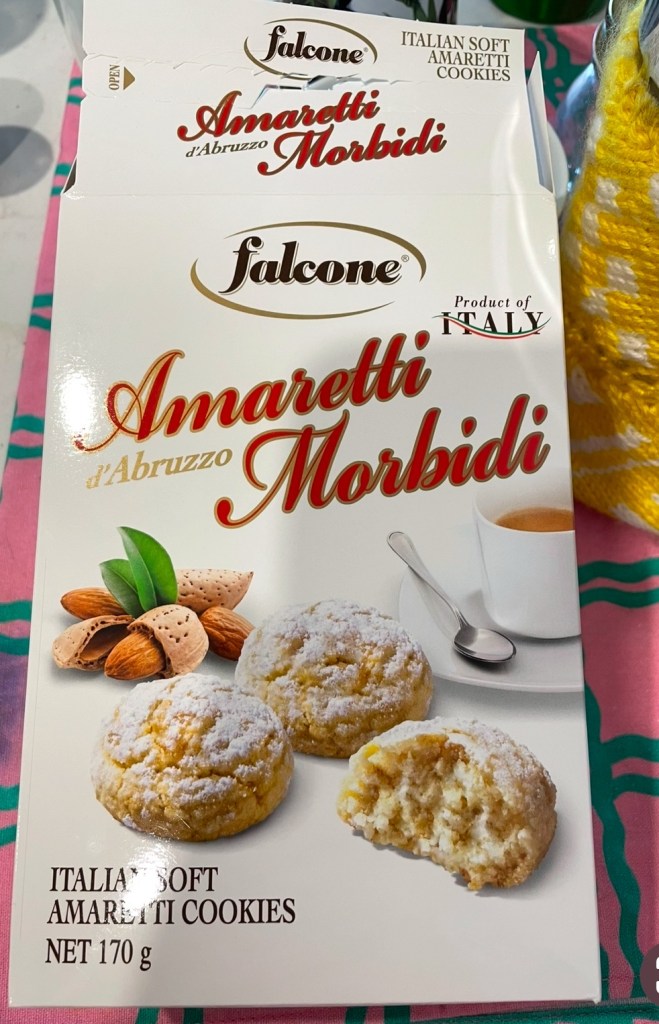
Round about Christmas time found these totally delish little bites. Bought them as my special treat since I can’t eat anything of the normal Christmas menu.

About halfway theough the twenty or so, eating no more than one or two per day … I’d call them biscuits you might call them cookies … I read the ingredients.

Huh?

First in the list, meaning there’s more of it than anything else, was apricot kernel flour. And I thought that was poisonous?

Diving down that rabbit hole, I discovered that raw apricot kernels are poisonous, containing cyanide; that cyanide is a biologically produced poison, in contrast to—for example—arsenic which is of mineral origin.

Cooking makes apricot kernel flour edible, and it is considered a health food as it has a high protein and needful mineral content.

At the end of January, I decided to get that packet out of the fridge, had been there long enough, how many to go? Four? I ate three. That night had an attack of gout in my left thumb and left big toe.

Gout is caused by the breakdown of purines into uric acid. Purines? Okay, they are important in that ‘cells use them to make the building blocks of DNA and RNA.’ (Courtesy of Google) I had already met excess uric acid once or twice in relation to eating too much red meat.

How could these scrumptious little bikkies be causing me such pain? Er, probably the baking agent? Ammonium hydrogen carbonate. One of my many many allergic reactions is to ammonia.

But, you know, I was still confused. What on earth has uric acid in common with ammonium that could be causing me such pain?

Nitrogen … they both have nitrogen in them.

And to make the whole deal worse (for me) all that happened on the same day that I chewed a single solitary coffee bean, thinking I’d ‘wire’ my brain to prevent the dizzies I’ve been having.

Caffeine is another example of a purine.

Unreal!

Back in the days of high school, I failed chemistry dismally. Give me a go now and I can probably pass.

All of it means, read the ingredients even closer.

Liminal Space

I’m in my accommodation for one maybe two nights at Isla House in Greenslopes, while my flat is emptied and my new apartment is furnished.

Gotto admit I made a few changes to this room. It’s not a regular motel room, so there is no water boiling or micrwave, all that’s in the kitchen down the corridor.

I brought in a cafe table from the verandah, borrowed a tea towel to cover the weathered top. Was able to fit my walker mostly in the wardrobe.

Doors open, I’m not a fan of everything out of sight, especially in teeny tiny room. Like a box.

A pano of my room tonight

Coffee!

After I read an article recently on how to make the perfect coffee1 I started to experiment on how to make ‘my’ perfect coffee. Coffee and I have had a troubled relationship for a while now. In my youth, say my 20s to 30s, I regularly drank up to 3 espressos for breakfast. I got into the espresso habit while traveling overseas. In many places cow’s milk was not available.

When middle age hit, I had to cut back on the amount of caffeine everyday as my heart and brain became more and more intolerant of its effects. For about six years, I could only drink green tea2 with only two or three tea-leaves in teapot.

Finally, I entered a time of falling over. Six falls with various injuries such as a broken wrist, and six months later a broken thumb. A General Practitioner stopping by my bed in hospital, told me to drink one cup of coffee a day, to wire me up, he said.

I started that and it works. The only time I have fallen since, was when I was unable to take the cure due to gastric illness. Another big plus is the taste. I love my long black.

However, now that I am in my seventies, I’m becoming intolerant again. It’s so frustrating to have to give up drinking coffee socially. If I have it at 11 AM, when most coffee meet-ups happen, it’ll interfere with my night’s sleep. Like, I don’t sleep that night!

A long black, with between 105 to 240 mgs of caffeine per a 250 mls mugs is way too strong for me now. It’s useless me buying them. A waste of money. I can only drink half or less and have to throw the rest away. At home I used to make myself a plunger coffee daily, with 8 grams of strong ground coffee. And that’s off the menu too now.

So I’m experimenting. Rather than decreasing my intake until I hit the sweet spot, I decided to work up from a lower than necessary level, to also re-establish my sleep pattern.

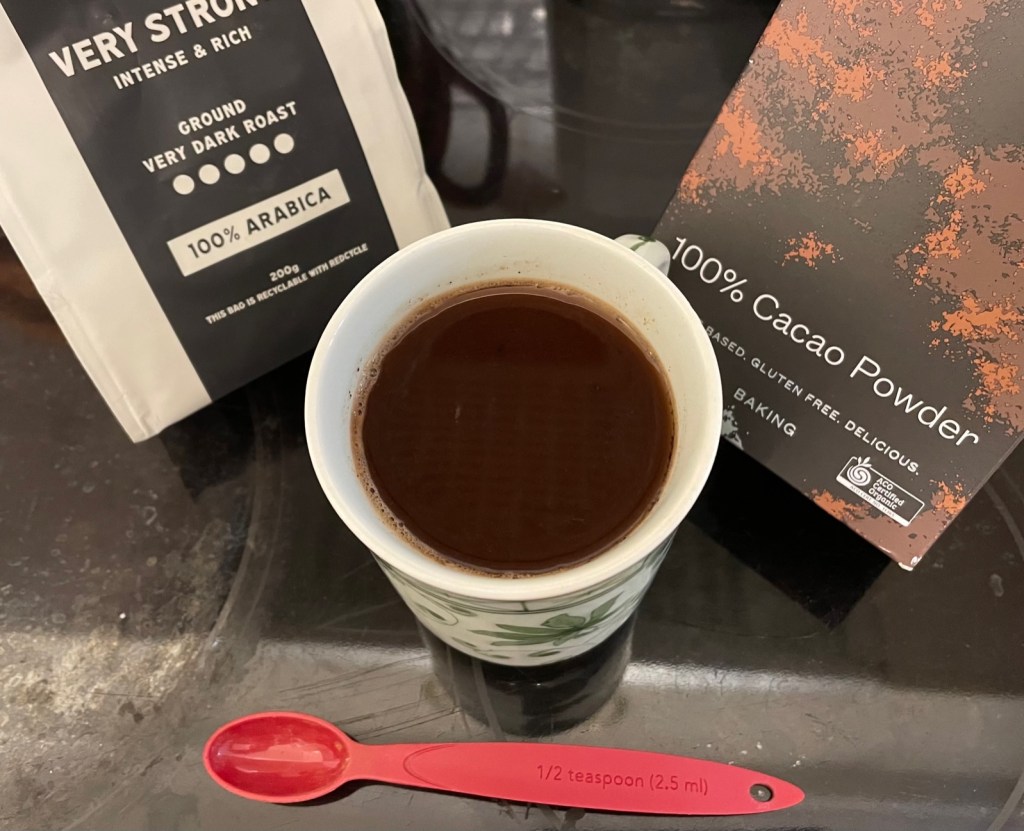
But, 2.5 grams of coffee does not make a very satisfying cup. [I decided to start with 2.5 purely based on the measuring spoons I have.] Then I read about a coffee and cocoa mix. How the cocoa flavanoids have a good effect on platelets, a blood component, and the caffeine content is lower than in coffee. Since I definitely need more platelets, having lost most of mine during chemo, I was looking for a way to add cocoa to my diet without sugar. So that’s my drink for the present.

2.5 grams ground coffee, 2.5 grams cocoa powder in a mug. Add hot water. Stir. Allow to brew. Don’t stir before drinking. The coffee grounds sink. Very mellow.

  1. https://www.abc.net.au/everyday/how-to-make-a-perfect-cup-of-coffee-at-home/11088316

2. https://www.betterhealth.vic.gov.au/health/healthyliving/caffeine