
I’ve been in two minds whether to include study and text books in this project.
In October 2023 I signed up with Dream School run by the This Jungian Life group.
For a year, I read course studies and completed online assignments, to start to learn how to interpret dreams. This followed on from months of nightmares and a short stint with a Jungian psychoanalyst.
After the end of the course, I continued with the analyst for another year. Which brought me to late last year. Since then I’ve been reading rather voraciously and, at the beginning of the year, beginning this project.
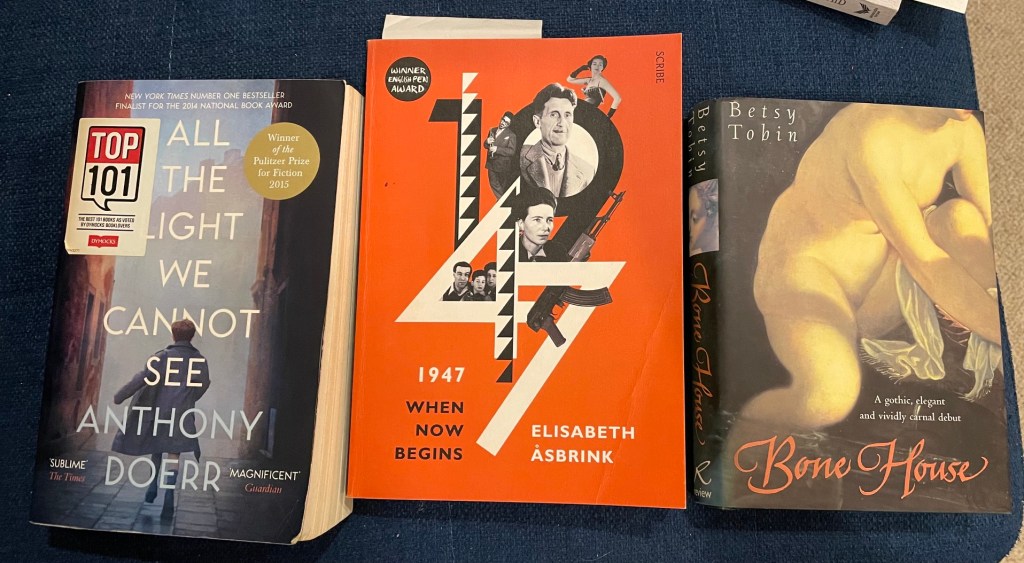
After I read Book 31 … Bone House by Betsy Tobin I was at a loss. Though I have plenty of other books lying around, a dozen un read and many many that could do with a second or third reading, I was feeling jaded. Like it was the end of a holiday.
I felt like I needed some chewier fare, a project with a bit of heft. Picked up MDR by Carl Jung, having had it on my shelves for about a year.
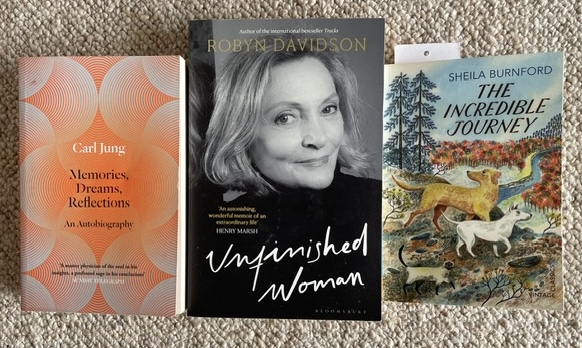
Book 32 … Memories, Dreams and Reflections: An Autobiography by Carl Jung translated from the German by Richard and Clara Winston, published by William Collins, a paperback edition in 2019.
This is not a book you can just read in one sitting, or even a week. It took me well over a month, the whole of May, I might as well say, there being plenty in it for me to think about.
When I started having nightmares back in 2023, I had already thought that I needed a way to think about what was happening in my mind. I wasn’t happy with the physical world of neuroplasticity, MRIs of people’s brains firing, the whole kit and caboodle of studying flesh-and-blood brains and what looks like is happening in them, and thinking that that is the be-all-and-end-all of how minds work.
So when I fell over Jungian dream interpretation by way of the This Jungian Life podcasts, I was stoked. Seemed to me that this was the lyric metaphoric way of thinking about what happens in minds that I could relate to. Been in that mode ever since.
(Stoked is an informal adjective meaning to be highly excited, enthusiastic, or exhilarated about something. Originating in surfing and skateboarding slang, it shares the same root as feeding or fueling a fire—meaning your energy and enthusiasm are burning brightly, Google)
Memories Dreams and Reflections, MDR for short, is both Jung’s autobiography and an account of his studies and discoveries. Despite what many people think, he went about his project of exploring what happens in our minds in a scientific way. He describes his experiments and the empirical results.
He named the personal unconscious that we all have, and discovered the deeper, archetypal unconscious we all have.
(Archetype is a Jungian psychology concept of an inherited unconscious predisposition, behavioral trait or tendency (“instinct”) shared among the members of the species …Wikipedia)
And then spent the rest of his life exploring how the unconscious works with the ego—your conscious mind. But he was writing in the early third to half of the 20th century and his turn of phrase, if anything, is quite esoteric, readable by only a small number of people, and somewhat turgid for the likes of me. I knew I would have to search out those interpreting him for more modern readers. And plus, I knew also that I’d be reading some light relief.
Book 33 … Unfinished Woman by Robyn Davison, published by Bloomsbury Publishing in 2023.
Picked this up from down in the Vista foyer where there’s a long shelf under the parcel bench, dedicated to memoirs, autobiographies and some histories.
Lol, love all these prepositions one after the other “up from down in” … makes sense, I hope?
The same Robyn Davison who lived Tracks and then wrote it. From the back cover, “In 1977, 27 year old Robyn Davison set off with a dog and four camels to cross 1700 miles of Australian desert to the sea.” I had that book for years. Don’t recall where I picked it up, second hand while traveling that same desert probably. Camp laundries are the best places to pick up good books.
I already had a soft spot for camels and loved the desert. I read that book more times than I can remember.
Davison was born on a cattle station, is quintessentially Australian, and the first modern woman explorer I read about. My heroine the minute I read about her. This memoir, about the forces that set her up to wander, to travel, to always be on the move, is a gripping read.
A poor childhood, her mother suicides, and Robyn thereafter is raised by her father and older sister in an outer Brisbane suburb. She was in London for the first time roundabout the same time I was in London.
After that she goes on to do all the romantic-sounding things that women in those days usually only could read about. Marrying an Indian prince. Living in London and writing. But, you know, there are always costs.
Book 34 … The Incredible Journey by Sheila Burnford, first published by Hodder and Stoughton in 1961. This copy by Vintage Books in 2013.
Bought this for a ninth birthday present and read it hoping to discover whether it could still rip my heart out. So many books written in the past lose their numinosity when set against more modern texts. Realizing this is a function not only of the language they are written in, but also the culture that nowadays washes through our minds.
It has this in the front as a prologue…
The Beasts by Walt Whitman (1855)
I think I could turn and live with animals, they are so placid and self-contain’d,
I stand and look at them long and long.
They do not sweat and whine about their condition,
They do not lie awake in the dark and weep for their sins,
They do not make me sick discussing their duty to God,
Not one is dissatisfied, not one is demented with the mania of owning things,
Not one kneels to another, nor to his kind that lived thousands of years ago,
Not one is respectable or unhappy over the whole earth.
Sounds modern, doesn’t it?
— — — —
The first three pages are a description of the setting, which I suspect may largely be skipped when reading them aloud. But still, the setting hasn’t suffered from the encroachment of modernity. I suspect only if you live right there will you know of the depredations of industries such as milling, mining and road-making.
The three animals are introduced in the next chapter. Two dogs and a cat. They’re being cared for by a friend of their human family and his housekeeper, Mrs Oakes, while their own family is overseas. A couple of weeks before the family is due back, the animals take off for home.
A distance of about two hundred and fifty miles separated the animals from their home, with plenty of dangers along the way. Bears, porcupine, floods, cold, snow, irascible farmers with shotguns. As well as just enough kindly humans to help the animals along.
I thoroughly enjoyed it. It hasn’t lost anything in the years since I read it to my nine year old. It’s a famous story. Disney made two movies of it, but to me it’ll always be a favorite read. And by that I mean a text I take in with my eyes.