[I see I’ve been resting on my laurels a bit, with my last post five days ago.]
Wikipedia’s definition: “An umbrella or parasol is a folding canopy supported by wooden or metal ribs that is mounted on a wooden, metal, or plastic pole.” And a little further in the article: “Generally speaking, parasols and umbrellas are small, handheld, personal use items.”
I first became interested in umbrellas when as a ten or eleven-year-old when as a special treat I was allowed to use the family’s Indonesian bamboo and oil-paper umbrella, called a ‘pajong’ to walk to a friend’s house through the rain.
We lived in Sumatra at the time (1958), in a small village called Indarung. [I looked it up on Google Earth and it still exists, but now as an outer suburb of Padang. In the 1950s it was a clearing in the forest.] And tropical downpours were a daily feature in the wet season.
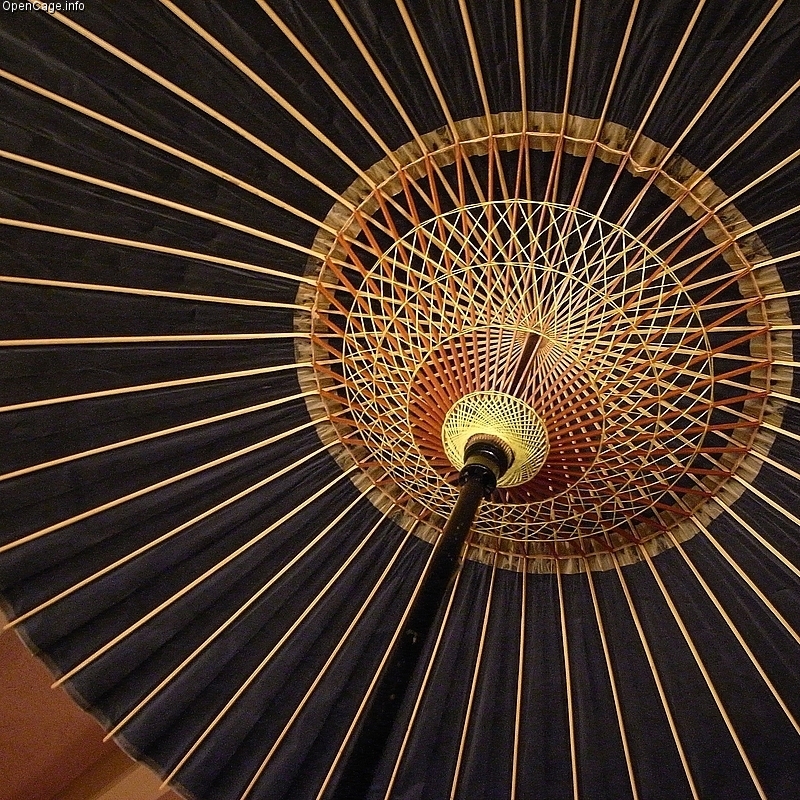
The most fascinating part about the pajong was the way the spokes were joined to the center and the ribs.
The above Japanese umbrella is way more complex than a simple ‘pajong’ made in a Sumatran village. Our umbrella had a greenish interior bamboo frame, oiled paper canopy, with a gold painted trim and point, with none of the extra basket-weaving in the above example. I remember the smell above all, of the oil applied to the paper to make it waterproof.
Both my present umbrellas have seen better days. The sun umbrella that I’m not calling a parasol as it isn’t dainty enough, has been all but unusable for years already, with one of the spokes bent and another broken. I’m hanging on to it as I aim to repair it.
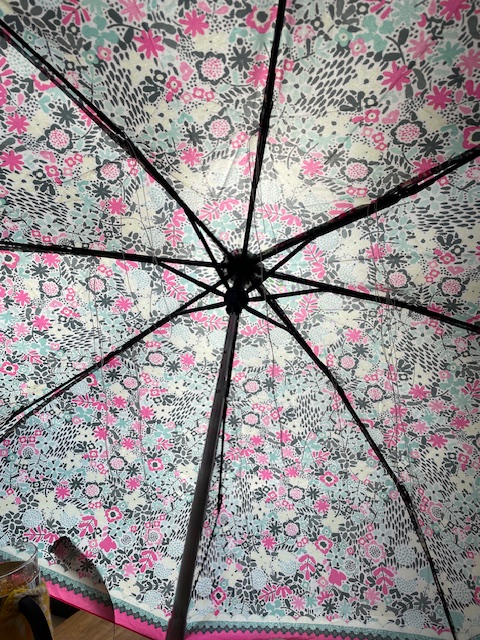
My fold-up rain umbrella was blown inside-out last summer and was a mess of bent spokes and torn-away fabric. Most people throw such wrecks straight into the bin but I can’t bear it. Fold-up umbrellas are amazing technological marvels. If you have one, have a good look, it’s fascinating.
This is mine, photo by me. It’s a fairly ordinary design, I could’ve maybe gone for something a bit snazzier but this one was the only pattern on hand when I needed shelter. The threads hanging down are me having a go at fixing it. So far, I’ve reconnected all the innermost hinges to the fabric. When I’ve done all the hinges I’ll dot the repaired places with glue, maybe super glue. Then cut off the excess thread.
The long threads make it very easier to knot the threads after passing them twice through the holes in the spokes and twice through the fabric, then once around the sub-spoke. I’ve bypassed the really finicky job of sewing the spokes to the inner seam and instead have sewn the spoke to the fabric by drawing the thread to the outside and back in again. Similar to sewing on a button.
This all made me wonder how much assembly there had to have been by nimble young fingers? While I can see the frame being produced by machines, sewing the canopy to the frame … a machine? Not a chance.
Another form of intricate but boring labor by the modern enslaved workforce … I imagine each person in an assembly line having to sew an unending line of spokes to canopies … have you ever seen/been in an umbrella factory?



 Rita de Heer