Reading, 7

This session started while I was in hospital. Trying for easy reading matter. Easy to put down when necessary, for example to have a blood test done, or connect me to the IV.

My reading buddy brought me a book that he had trouble with and that I put aside after only one chapter, no way was I going to be able to read that in a scene where I needed to interact with maybe fifty people a day.

By day three I was hungering for anything at all to read. I’d forgotten to bring my tablet, and I’d been down to the kiosk in the downstairs lobby twice, and that had only magazines and newspapers available. Over two days, I bought two dailies of a right-wing newspaper, read them from cover to cover and felt like a foreigner.

Then, during one of my afternoon perambulations on the ward, I saw and remembered the existence of a lounge or two in each ward in that hospital, where visitors could withdraw to wait out procedures on their loved ones, and that there often were a couple of books.

Day three I sallied out and found a book that I normally wouldn’t read in a pink fit but needs must, as the saying is. A Readers’ Digest Condensed Book, in the new century renamed Readers Digest Select Editions. Still ongoing, I was amazed.

These are collections of “Popular, bestselling novels condensed to remove subplots or descriptions without altering the author’s style or story,” according to Reddit users and eBay sellers, quoted by Google’s AI. Hence me not reading them in a pink fit. However, by the 2020s I’m suspecting, the novellas could be being written purposely for the series. The four stories I read certainly seemed so.

According to Wikipedia https://en.wikipedia.org/wiki/Reader%27s_Digest_Select_Editions
I probably read

Book 18 … Volume 395 – #6 – September 2023 with • The Hunter – Jennifer Herrer • Hello Stranger – Katherine Center • Play the Fool – Lina Chern and • The Last Lifeboat – Hazel Gaynor

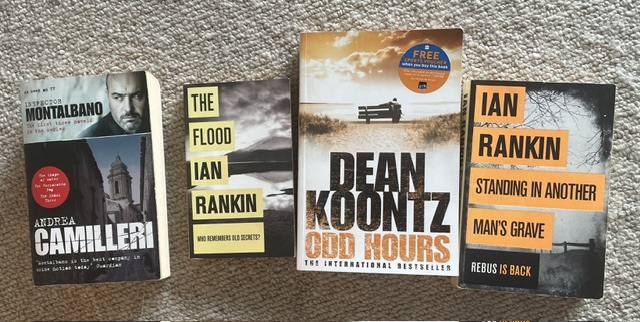
And because I was reading to pass the time, I have no clear memory of what all four stories were about except that one of them was about a bunch of newly-outed characters making the Titanic trip. By ‘newly outed’ I mean these people have not before featured in any of the Titanic fiction. And that they are probably completely fictional fictions. “IE did not appear in the passenger lists.” (Authorial note)

The other one I have some memory of is Hello Stranger, a thriller about a woman who has lost her memory. As this was the last story I read, I recall it best and it was good enough, in my opinion, not to give out any spoilers.

The remaining two stories? Can’t recall a word.

— — — —

After four nights, the days between, the two half-days fore and aft, and bells bells bells every minute of the night, I returned home. Blessed relief, with no bells clamoring all night I slept like a young thing.

Returned home with a prescription for another five days of antibiotics that had now to be taken by mouth, of course. And don’t bother with the probiotics yet was the word. The first couple of days I was quite well, getting stuck into the clean-up, and even managing to attend the weekly art class on Thursday morning.

By the Friday nausea began to rule. All the jobs I had begun slid into the background. There’s a pile of washed Duplo in front of me, another pile drying on the balcony. The grandkids have outgrown it, but some will still be useful to me for mountain-building. All of it needing sorting and I haven’t washed the plastic tubs yet.

Then there’s the laundry, one load ready to be folded, one load still in the washing machine, and another pile growing in a corner of the bathroom. Then there are the three days worth of dishes to be washed. Then … then …

I looked at my bookshelves, found something I hadn’t read yet, and promised myself time would pass. Five doses to go.

Book 19 … My Sister Rosa by Justine Larbalestier, published in 2016 by Allen and Unwin.

I picked this book up in the library in the village community center some time ago. The back cover promised me edge-of-my-seat reading and it was not wrong. I read it in one gulp, which took me till 1.30 A/M, and some time ago I’d sworn off that kind of read. Sleeping only about five hours does not agree with me these days. It’s like I’m hungover the whole next day.

Spending a bit of time at https://goodreadingmagazine.com.au/ about this one, reading reviews, I discovered that people either loved or hated the book. Also, that it’s classed as young adult fiction, which I just don’t see. Just because the POV character is a teenager does not necessarily make it a YA fiction.

Some readers thought the novel well researched, others thought it badly researched. I’m neutral about that. Just so long as the research doesn’t intrude into the reading experience I don’t mind what lengths writers go to get a readerly reality. I’ve paddled that sea myself, researching the ins and outs of surfing for my novel, Mongrel, for example. Body-surfing was the only kind of surfing I ever did and then only casually.

Some readers loved the supporting character, the ten-year-old psychopath, thinking her very realistic. Others thought her tricks were mere childishness. On that point I really don’t believe the average ten-year-old will try to talk a so-called friend into killing her twin for entertainment. People who thought that, I stopped respecting the minute I read their opinion.

Che, the older brother who told the story, was trying to be a normal teenager and not succeeding. Neither of the parents were ‘at home’, so to say, and his little sister became his responsibility. Of course in the past, it was normal for an eldest sibling to have the care of the younger brood. In my past it certainly was, and I often had three young kids trailing me. Nowadays, with families of only one or two kids it is much less common.

Book 20 … The Alchemist by Paulo Coelho. Translated by Alan R Clarke. Originally published in 1988. The first English language edition in 1993. This copy is a 25th anniversay edition published in 2014, by Harper One an imprint of HarperCollins.

Its publishing history is complex. In 1993 my son was eight years old and I was a keen library reader and thrift store customer. That would be one of the reasons this book completely passed me by. That library was struggling a bit, new books few and far between, and thrift stores feature the old and remaindered. Nor was I in any reading clubs where people raved about it. Small country town. Not even a bookshop in those days.

Nor would I have been psychologically mature enough in that time to read it. I hadn’t yet started my writing studies, and the only hero’s journey I knew about, was me eking out a living. Thirty three years later–now–I read The Alchemist with joy. I recognized so much. The hero’s journey, yes. There’s been so much said about the hero’s journey in film, literature, how-to books and descriptive critiques, most people will be familiar with its concepts.

But also some of the Jungian concepts I’ve been studying for the past couple of years. The Personal Legend, for example. Do you know yours? I’m not yet so familiar with mine that I can talk about it in detail, though I’ve received a few clues from dreams. If you don’t yet journal your dreams, start now. I recommend it.

Then there’s The Soul of the World. I know that as the collective unconscious, but described much more poetically. There’s more. The plot of the recurrent dream of treasure in a far off place that returns you to your original place? A plot that I’ve read in a couple of recently published novels. It was an aha moment and me thinking, So this is where they got that!

Even the title. The Alchemist. The alchemist is a wise man. The last thing he said to the boy? “No matter what he does, every person on earth plays a central role in the history of the world. And normally he doesn’t know it.”

This seemingly simple little book gave me a lot to think about.

Mongrel: 46, 47 and 48

Last three chapters. But not really THE END.

It was hard to figure out the cut-off point between Mongrel and Meld. In a way, the whole of Mongrel is Tardi’s backstory and set-up for his role in Meld.

I felt that, with at least the main character a familiar person, we might all be able to better understand the new scenario. Experience it through his senses, as it were. It was hard to write and it’ll be hard to understand. But I hope you’ll find it intriguing.

— — — —

I’ve seen most snakes in the wild, but never a death adder. Like most bush-walking Australians I was always on the look out for them. Very scary. I’ve known several people who thought they killed one, only for the animal to turn out to be a blue-tongue skink.

Image from https://wildlifeqld.com.au/common-death-adder/ Check out this link for all the variety of colors of death adders.

Reading, 4

Next up is a book I’ve been wanting to read for about 20 years. When it was first published, the title grabbed me … Matthew Flinders’ Cat. I already knew that Flinders had a cat he’d named Trim, and had seen the bronze statue of Trim at the State Library of New South Wales.

I didn’t research the story beforehand as nowadays I usually do, just looked forward to reading a blow-by-blow account of Matthew Flinders’ voyage mapping the coastlines of what was then New Holland, accompanied by his cat.

Usually I wait until a book comes out in paperback before buying it, so when I didn’t see it appear in the local bookshop a year later, forgot about it. Since then I’ve seen it a few times in libraries without there ever being an opportunity to borrow it, and a couple of weeks ago saw it on one of the two bookshops I now frequent.

And so bought it. Because I needed a new, chewy read, and for the expectations I just described, but still not knowing anything about it apart from the fact that Trim might be one of the main characters.

Book 10. Matthew Flinders’ Cat by Bryce Courtenay, this edition published in 2006 by the Penguin group.

How did I miss that it was written by Bryce Courtenay? I’ve read a few of his but generally don’t like his style. To me they’re the kind of book I might read if there is nothing else available.

Such as when stuck in a camping ground by the roads being flooded and Bryce Courtenay book is the only thing to be found in the camp laundry. That’s where I found The Potato Factory and read that. But that’s by the by.

Reading the first paragraph of this book I knew it wasn’t going to come to my expectations but, I reminded myself, that was my own fault. And since I had given out good money for it, I would read it.

‘Billy O’Shannessy woke to the raucous laughter of two kookaburras seated on top of adjacent telegraph poles.’

There is Billy O’Shannessy … Courtenay does this thing that I was taught as a new fiction writer, make the first two words about the the main character. In that same first sentence there is also setting the scene, in this case the Australian scenario with the two kookaburras. And there is the modernity of telegraph poles, if a slightly old-fashioned term for them telling us the story is set in the present. Telegraph poles might’ve been normal for 2002, when the book was first published. I don’t remember. The rest of the paragraph tells of his hangover and that the birds served as his ‘regular alarm clock’.

In the next paragraph I learned he was lying on a park bench with a canopy of leaves over him. It’s only on the third page that Trim gets a mention and then only his life-sized bronze statue on a window ledge of the state library

By en:User:PanBK – http://en.wikipedia.org/wiki/Image:Trim-the-illustrous.jpg, CC BY-SA 3.0, https://commons.wikimedia.org/w/index.php?curid=1182097

The Wikipedia page about Trim is interesting. He’s got several more statues, one in Donington, UK and one in Port Lincoln, South Australia, as well as a glowing epitaph by Matthew Flinders himself.

Alas, this book is not primarily about Trim, or even Matthew Flinders.

Purporting to be a novel, it seems to me to be written as a tribute to the Salvation Army, the Twelve Step Program to recover from drugs and alcohol abuse and rehab, and the many services helping homeless people and troubled children in Kings Cross, Sydney. All very worthwhile people and services, I’m not denying that.

Published two years after Courtenay’s divorce, I did wonder whether he was writing a semi-autobiographical novel, that he was a recovering alcoholic. The fact that it is his twelfth novel might explain why an editor would do less editing, leaving unchanged the info dumps, for example, consisting of half or three-quarter pages describing people and places.

But I’ve often wondered how people go about writing a tribute novel so in that respect this was an interesting read. First, he had a professional researcher … the results of research are big in this novel. There are screeds of explanations. Over pages 333-334 there’s a paragraph of over 200 words. That’s almost a whole page. Commonly called a wall of text. It seems very 19th century-ish.

In places it feels like Courtenay inserted a whole paragraph straight from the source. That can’t be right, of course. Courtenay was a well-respected author. I like to think there would’ve been at least one rewrite to make the material his own.

In addition, most professional people wouldn’t hesitate when approached by a famous author to tell them about their world, any extra mention is going to help promote their concerns, right? That also shows in the detail about organizations such as the Salvation Army. I imagine there’s a fine line between wanting to do one’s sources justice and keeping the story from dragging the weight of excess information.

The bits about Trim were the story Billy O’Shannessy told Ryan, the ten-year-old other main character. Trim is imagined in the talking-animal style with a lot of agency. Which left me wondering whether the adventures described had any truth in them. They read like fantasy.
Probably I’ll try to find something nearer to Matthew Flinders’ own account of his and Trim’s circumnavigation of Australia.

Mongrel, 36

I’m pretty happy with this image, another cut from a ceramic puzzle I once made. The original 30 centimeter tile broke across during storage, a risk associated with green-ware. IE not yet kilned. I took the pieces home over the Christmas holidays to decide what I was going to do with it.

Ended up breaking them into 13 pieces to try a different experiment on each piece. In this photo are four of the pieces representing a creek. As well as incising them, and painting them with ceramic slips, I searched one of the local bottle dumps and found fragments of old blue and old white glass to crush. Kilning the glassy fragments made the foamy creek water featured on these pieces. Below them the pieces that were inscribed with creek bank vegetation and fungi.

Reading …

Good resolutions at the beginning of a year aren’t my bag but this year I thought I would keep a record of what I read the whole year.

In my teens, with no TV at home, a boring school life–working well below capacity I think now–and an almost non-existent social life, I often read a book a day. A regular bookworm, I chewed through most of the high school library in the first year, and was then provided with the truly educational stuff by the high school librarian. That lady saved me.

Mrs Murray. A short, orange-haired dragon to every other student, she loaned me many interesting and exciting books from her own collection. Historical fictions, lives of explorers, a journal purporting to be by Marco Polo, good novels. It was with her support that I managed A grades in Art History, Geography and Biology, a credit in English in my finals. I never studied, I read whatever came to hand. All of it grist to the mill.

I went on to use that formula all my life. All my learning is done by reading around in a subject. Two years ago I started a course in Dream Interpretation and I’ve collected a library of about twenty books, long and short. Now, while I’m still recording my dreams and practicing their interpretation, I’m slowly falling back into my normal reading habits.

Last year I read some great fiction that I wish I remembered better. I prefer thinking it’s because I have a lot of stories always on the go, that I don’t remember everything I read as well as I used to, but of course it’ll also have something to do with ageing. Forbid the thought.

Or maybe it’s to do with needing to keep myself severely in hand, not over-excited, not over-do it, keep myself on an even keel etc etc to float my ME/CFS riddled carcass through the sea of life.

So, book one of the year was book four of a sequence I began round about Christmas time. Those Who Perish by Emma Viskic: A Caleb Zelic thriller published by Echo in 2022. I thoroughly enjoyed all four of these detective fiction/thriller tales. Not least because I’ve been channeling an elder of 150 years ago, the days before hearing aids.

My hearing aids are working at approx 20% and the repair place is not re-opening until Monday–two more sleeps–and can’t come soon enough. There are far more women in my world now than men, yet men’s voices I can hear, and women are like they are mouthing noiselessly and I am not a good enough lip-reader.

Caleb Zelic, though a frustratingly impulsive protagonist, is mostly deaf and his story is punctuated by mal-functioning hear aids, people who don’t move their mouths when they talk, or turn away and talk so he misses important clues, etc etc. All things I could totally relate to. He’s a well-drawn character, the events he gets involved in are realistic, while at the same time a gripping read.

Somewhere in there, also in the first week, I read another detective fiction, which was entirely forgettable as I had to scan the back cover just now to help me remember it. When She Was Good by Michael Rowbotham. Published in 2020 by Hachette. Although Robotham is one of my favorite detective fiction writers, this one left nothing behind in me except for an Albanian proverb. “Nobody values the truth more highly than a liar.” The primary protagonist is a Cyrus Haven, forensic psychologist, and he just doesn’t have the charisma of his colleague, Joseph O’Loughlin, Robotham’s first forensic psychologist. Maybe I’ll chase those up and re-read them.

While out grocery shopping I tripped over a bookshop. Fatal, as any bookworm will tell you. Normally I steer my trusty mule in a different direction but this time I had to pass it. I came away with a book I’ve had on my list for over ten years, more on that in the goodness of time, and The Gift of Not Belonging by Dr Rami Kaminski, subtitled: How Outsiders Thrive in a World of Joiners. Published in 2025 by Scribe.

Just reading the acknowledgements told me it was my kind of book … more on that next time.

This is the work of an otrovert. As such it cannot be the fruit of a team effort and presents a dearth of people to acknowledge. …