‘Spatter and Spray’

… is a way of painting with watercolors, I’ve discovered. And I’m in the throes of experimenting using the technique.

First came across it on Susan Cornelis’s blog. https://susancornelis.wordpress.com/wp-content/uploads/2025/03/googleeye.jpg

So I’ve fallen in love with granulating paints. My first effort was Miss Tabitha…

Ordered a couple more tubes of granulating paint and washed out a fine spray bottle originally used for a deodorant.

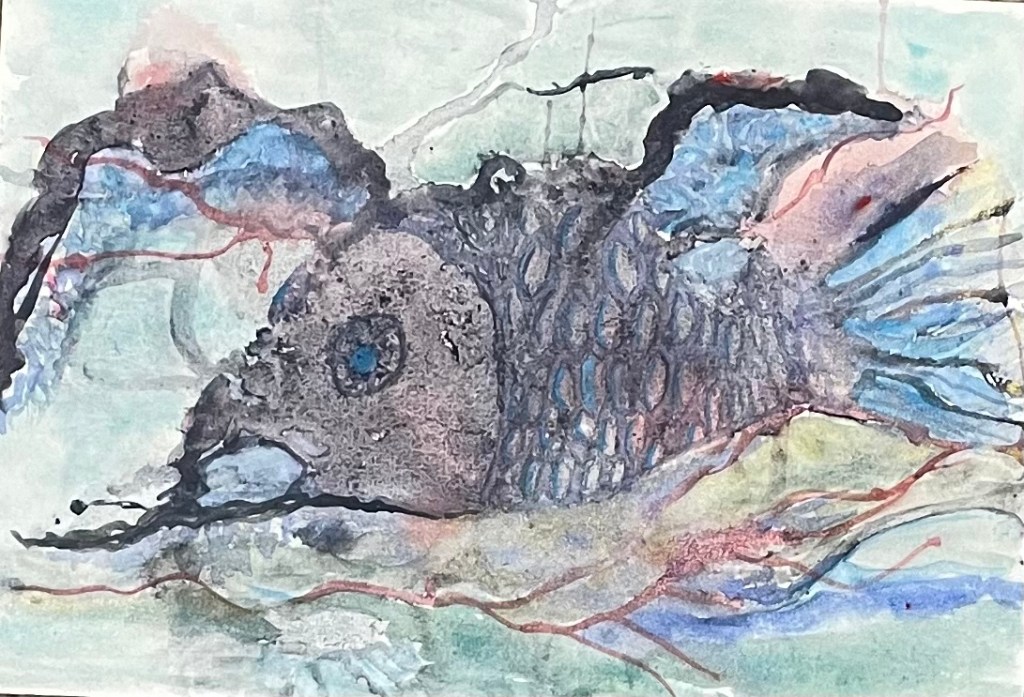
Second, this fish. I call it a bottom feeder, but may rename it … I’m having so much trouble getting this from my mobile … might have to do magic. Like, abracadabra … OK I’ve got it. Ended up saving it to the desktop … isn’t she beautiful? A spatter and spray painting barely touched up. Well, OK, I painted the scales. The rest is dabbed. Not yet sealed.
This is the top half of my third effort. I’ll tentatively call it The Aviatrix. The bottom half of this painting is still a problem. one thing is for sure, I’m learning a lot about gouache.

It’s hard to believe what you can get from spattering paint onto the paper then spraying it with water. But that’s only the first layer. You let it dry, then the next day, if the pattern you have doesn’t yet suggest anything to you, you do it again. Like I did with this one. The third day, this aviatrix lay there waiting for me. I painted some of the areas to increase that likeness and here she is.

The bottom half of her face needed work of a different sort. After my efforts first with gesso, then with gouache that’s still in the thought-pan, and another post.

As well as the spatter and spray technique, I’m experimenting with sealing my watercolor paintings with an acrylic varnish. I hate the look of paintings behind glass or the whole process of framing. Miss Tabitha has been varnished and the look is good.

And plus, I don’t have enough wall space to hang everything I paint. Nor will I foist amateurish experiments on my nearest and dearest. So, most must be stored. Varnishing them seems like a good option.

The varnish I’m using is water-based so easy to cut. A mixture of 25% acrylic varnish in 75% water seems to be working pretty well. Ideally this should be sprayed on but since I’m still only experimenting, I’m laying the varnish on the painting with a watercolor mop brush. A time-consuming procedure but the only one I can afford at the moment.

Colours/colors …

What do you see?

I see a warm red and a warm green watercolour reaching out for a 50/50 agreement.

I might be wrong though. The red is warm, I have no doubts on that score. But the green?

Apparently if a green leans to its yellow side on the colour wheel it’s classified as warm. And cool if it leans to the blue side.

Light yellowish green has always seemed greener to me, and so cooler. Blueish green on the other hand, felt richer and lush, and so warmer.

I’m about to do that exercise again using Alazarin Crimson, which leans towards its blue neighbour so is classified as cool, and Hooker’s Green wich also leans to the blue side.

And after that, a second trial with the so-called warm versions of red and green. I assume I’ll need to use a scarlet and green made with a warm blue and a warm yellow.

I expect neither of these exercises to resemble the above but we’ll see what we’ll see.

Transforming Paintings

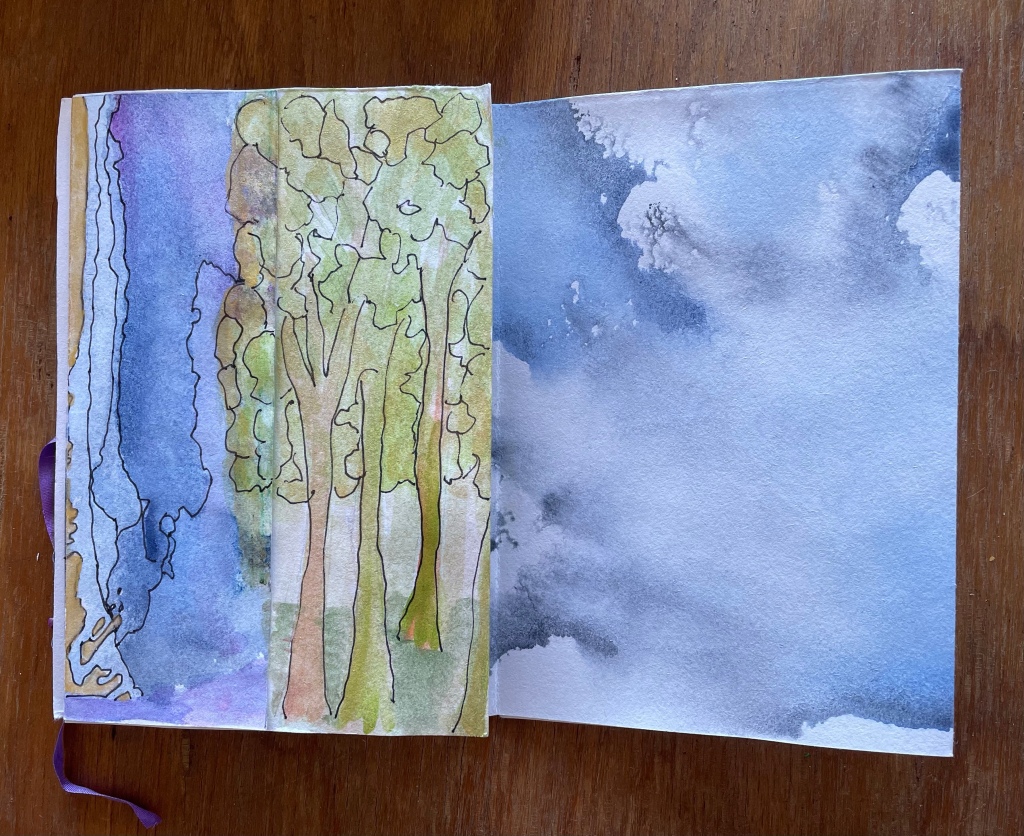
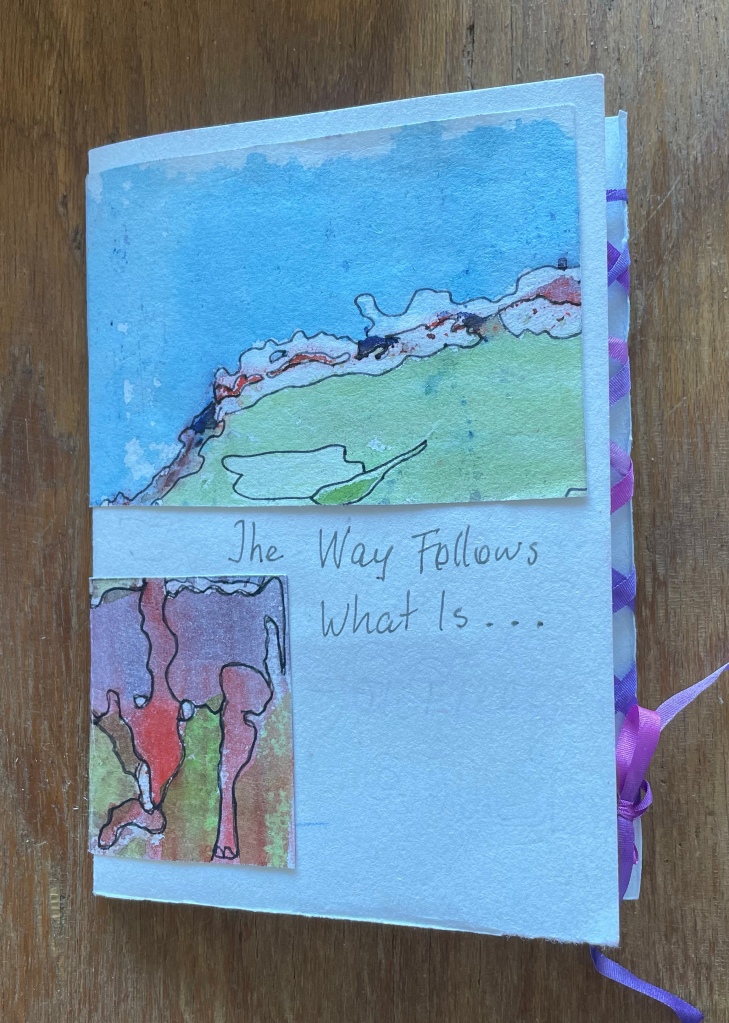
A thing I’ve been experimenting with is turning remaindered practice paintings into little books … seeing if judicious ‘analogue’ cutting and pasting can transform random images.

There was a left to right movement in this scrap … the two pages bound by ribbon had to stay loose from one another (ie not glued) or the whole booklet would’ve buckled.

Where are we? Help! I’m sliding … Uh oh where are we? Some kind of underworld?

is that a golden gate I see in the distance?. Maybe we can get there crawling …Turn the corner, quick …

In and out of the trees, I don’t feel safe in amongst all the vegetation. What’s all that gold doing to us?

Told you we changed. Let’s go already, it’s the wide blue yonder.

Guess we didn’t all get wings.

Back on Track

She has a lot of tracks you’ll be saying, and you’re not wrong. This particular track I’ve been on for only about six years and was off for over six to nine months.

This time last year I had a lot of nightmares, so much so that I thought to get some help figuring out why. First saw a dream analyst for about fourteen weeks. Fatigue reared its ugly head. The trip there and back by public transport once a week proved too wearing. I went to once a fortnight, then quit and looked for something online. (I am lucky to have so many good options.)

Found This Jungian Life podcasts and listened non-stop for a few weeks then signed up for their Dream School, Websites at end of the post. So for six months I painted my dreams and studied how to interpret them. That’s still going. The course is twelve months.

But once you’re taking notice, dreams come thick and fast and I only painted a few. Wrote the rest. The journal these days is a loose leaf folder with pages inserted when and where. And notes, because as you learn more previous dreams also suddenly get meaning.

The community committee organizes classes and groups. I joined a painting group. Two people are working in oils. Two in acrylics. The leader asked me what. I went home and fetched my watercolors gear. Painted a little scene.

Ordinary, compared to what came after, and there a few things I would’ve done different if I’d been more aware of what I was doing, and less concerned about where I was doing it. I’ve never painted in public.

Lol, there’s no planning in this landscape at all. I started at the top with the sky which worked OK. All the rest reminds me of the scenery of an early computer game, Robin Hood I seem to remember, forest in clumps suggesting paths where the merry men disappeared. A slope and a lake? River? Ice? That blotty bit in the middle? Was where I was distracted, painting in public as I said, and my brush hit the paper where it shouldn’t have, and I tried to blot off the marks.

Link to both Dream School and the This Jungian Life podcasts. This Jungian Life

Inktober, 2021

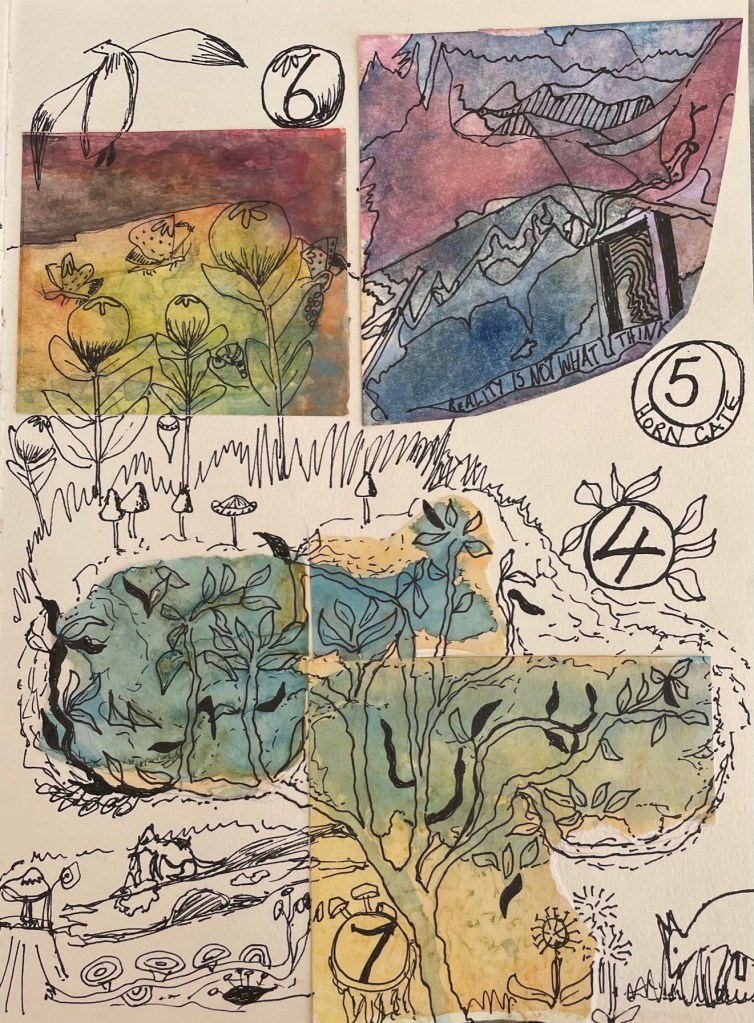
Day 4 to 7, Rita de Heer

Inspiration is everywhere but I like to start with a scrap of painted watercolor exercise, of which I have many. Tearing and cutting, I lay them out in a collage and hope I remember to glue them down before I start the drawing and sketching.

This page done with a uniball ink pen, which behaves very well on thickly coated mixed media paper. On the unpainted craftbook pages the ink sinks in and often wants to spread.

Art: #Huevember 2019

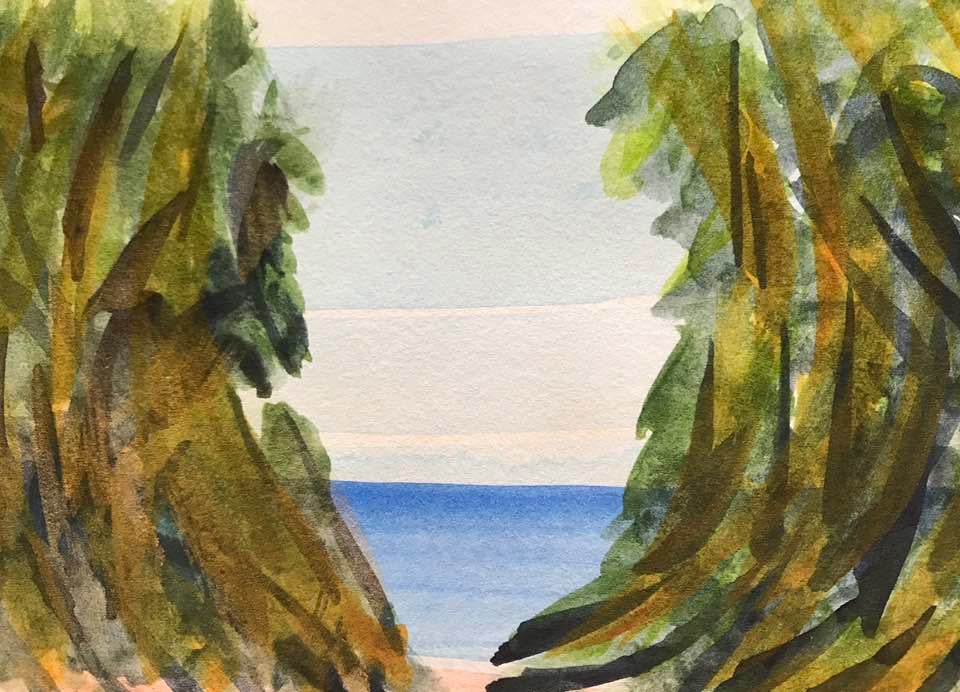
24. Path through to the Beach

This time last year, being under the mistaken apprehension that if I painted every day for thirty days that would then be a habit, and I would continue to paint every day.

But as we all know when the pressure is off, we tend to relax. I seem to recall I achieved an unbroken 24 day run of painting, followed by some patchy efforts thereafter.

During the time I painted for #huevember2019, I used postcard-sized paper and I’d have up to four scenes on the go at the same time. For that size paintings I need 2 or 3 passes with drying times in between.

On a particular day I’d take a look at what I had in hand, and decide which one to finish for that day. Above is the claustrophobic push through tall shrubbery to the beach. Of course, by the time ten surfers have pushed their way through, there is quite a well-delineated path.

I’m still such a beginner, that I’m always testing something. I think I was using the sepia for the first time that Sharon at the art shop talked me into. A greenish-olivey tint that she said she got more mileage out of than true sepia.

Mixed feelings about it then and now. Not that I’ve done any painting for the last six months. My paints are packed up with all the rest of my chattels, in storage.