Dogs: Jesse (1997 – 2009)

Jesse, Half-Staffie/Half-Australian Shepherd, loyal friend

Despite reading many wonderful novels with dogs and other animals as important characters, I didn’t try to write dog characters until I had raised a dog myself. That was Jesse, named by my son after one of the dogs in Footrot Flats by Murray Ball, a popular comic strip in the newspapers in the 1990s.

Our Jesse was a medium-sized half-Staffie/half-Australian Shepherd, according to the farmer who we bought her from. The Staffie part was dominant, except when it was a case of her habit of herding the poultry we also had at the time.

The first dog I wrote about was Jesse herself, for she was still a pup then, and I just described her and how she fitted into my life at the time.

Jesse lived just on twelve tempestuous years. Human mothers and fathers of dogs will know what I mean when I say that your children grow up but your dogs will always stay two and a half years old. A toddler, needing just as much input and supervision.

The times that the human parents relax their attention will be time when the dog suffers a collision with a moving car; or get a tick on her; or take fright at a Little Athletics starter gun when out walking; or, or, or … All these things happened to Jesse.

She broke her shoulder joint while still little more than a pup and was forever crippled. Mea culpa. She almost died of a tick that I didn’t find until almost too late. Due to the accident with the car she was always frightened of loud noises. The starter gun incident caused me—walking her in the wrong place at the wrong time—to be pulled to the ground and dragged behind her, clutching the lead.

When I finally was able to get to my feet, we returned home along the fastest way possible. Running along a creek bank, away from any activities by human people, in fact. After I had secured her in her beloved old laundry, with her head under her blanket, I had to go find my spectacles, lost from my face while I was on the ground.

She herded chickens, as I said. The little black bantams however were her equal, and would not be scared into running. The white silkies ran, here and there, and sometimes crashing into fences and gates. They hated it. Small children were herded without them realizing.

In 2003, Jesse’s favorite person in the whole world left home. He was eighteen, and needed to find casual work, get trained and then find permanent work. Even if he hadn’t been keen to leave home, our town of five thousand people was too small to support 300 school leavers every year.

Tibby on Jesse’s bed, establishing her dominance

From then on it was Jesse, me and the cat jostling for the top-dog-position. When the cat decided the dog’s bed would be hers, Jesse decided better make friends with the biggest person and we could fight the monster together. Our good times started then.

Jesse’s absolute favorite activity were our walks by the sea, though she mostly ran or swam. The Brunswick Heads Dog Beach was a 400 meters length marked out along the bay, south of the Surf club and ‘Main Beach’.

At times there were a hundred dogs there, playing together, socializing and generally racing around.

Jesse did not socialize—she had no patience for other dogs—and would snarl or snap her teeth at them to warn them away. Her work at the beach was to chase her stick into the waves, bring it out, drop it at my feet, and grin and wag her tail to encourage me to throw it again. I was very fit in those days bending over, picking up the stick, tossing it as far as I could.

We did low tide, high tide, storm tide. Even when the tide was so high that there was barely a beach to walk on, we were there, at our work. While swimming, Jesse’s crippled shoulder did not seem to bother her and she was as good in the water as any other dog. I always thought she must have some water-dog in her. A touch of Labrador genes, maybe.

Her end came more suddenly than I expected. She developed hiccups. They didn’t stop whatever I, or the staff at the vet clinic, tried. After twenty four hours, she was worn out. I let her go. The diagnosis was a brain tumor.

Thirteen years later, I still regret that I couldn’t bury her in our backyard. We lived on a floodplain and we were having a very wet year. The yard was a sea of water and mud. The vet took her away in a body bag.

Favourite Reads: Dog Boy

My favourite novel about dogs

For a long time the novel-version of The Incredible Journey (1963) was my favourite ‘read’ about dogs. Then, 2009 or there abouts, I was at The Writers Festival in Byron Bay. Heard, or heard about Eva Hornung’s then new book, Dog Boy. Bought it after the segment to leaf through it while taking time out, and lunch, in my car.

I’m not a fan of events with 45+/- thousand people … probably not that many … but enough that I didn’t meet any friends or acquaintances] Read about 60 pages, kissed the Festival goodbye, drove home and read the rest.

It’s worth all the accolades. Every hyped up adjective. It’s “confronting”. “Highly descriptive, confident and thought-provoking.” “Completely believable. Unrelenting.” “Meticulous research.” “Pared-down, non-sentimental writing.” “A tour-de-force of imaginative empathy.”

In my opinion, it’s the most moving, frightening, heart-breaking story of how a child, to survive, becomes a dog. It’s writing from the soul.

https://www.goodreads.com/book/show/6667541-dog-boy

Words: Dog (Canis lupus familiaris)

Grey wolf, Canis lupus, single mammal on snow, captive

Type ‘dog’ into your search engine and you will get the facts about dogs, their history of domestication, the variety of dog breeds, the origins of the word ‘dog’. Everything you might want to know about Canis lupus familiaris. https://en.wikipedia.org/wiki/Dog#Terminology.

There are hundreds of dog related metaphors. I wouldn’t be surprised if you know a few more than are described here: https://symbolismandmetaphor.com/dog-metaphors-similes-idioms/

BUT … all the above were not the concepts I had in mind when I started this research. I wanted to know how dogbox, dogger, dogging & dogman fitted into the word ‘cloud’ to do with dog. How these words originated. Have they anything to do with the canine subject of the title?

Apart from ‘dogger’ hard to find.

So. Dogger. Is not originally an English word. It’s an Old Dutch word for codfish. Pronunciation, I assume, is with the Dutch/Scottish -ch-. The boats the Dutch used to go fishing for codfish became known as ‘doggers’; then the place in the North Sea where they usually went fishing got the name Dogger Bank. Now sometimes known as Doggerland. Quite a bit if interesting reading about that: https://www.theguardian.com/science/2021/aug/01/doggerland-lost-atlantis-of-the-north-sea-gives-up-its-ancient-secrets

Dogbox, dogman and dogging. The only place i found mention of them is in the Australian construction industry.

“To safely sling a load, it requires an understanding of the suitability of the lifting gear, as well as what method of slinging is required. Further consideration of the nature of the load, such as its mass and centre of gravity, is also a factor. The Dogman course teaches you the basics to get the load moved safely.” https://constructiontraining.com.au/courses/dogging-courses.html

At the bottom of that page: “The simple explanation is that a dogman, colloquially known as a dogger, is the person. The actual task – the slinging techniques or guiding of loads mentioned above – is called dogging work.” The basket used to lift a load of smaller items is referred to as the ‘dogbox’.

Finally, back to Canis familiaris, in Australia someone culling feral dogs is also called a dogman.

Any other interesting uses out there of this three letter word?

Intertwined?

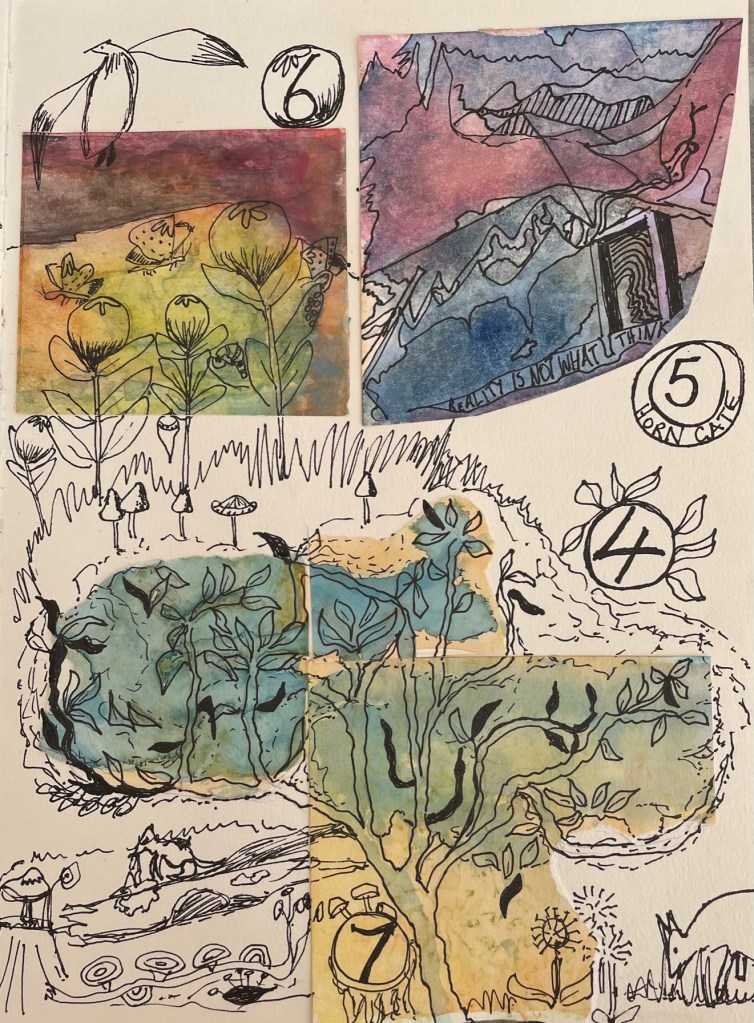
Days 4-7 of Inktober 2021, a cultural practice by Rita de Heer

Just how intertwined are we, with Nature?

Here, in this cultural practice of applying pigments to paper, pasting scraps to paper bound in book-form, and drawing over the top with an ink pen made of petrol-based polymer filled with petrol-based ink?

Not much at all. Because cultural practices are part of what we do in the World, right?

Pigments are powdered clays, lichens and mosses, madders and goldenrods, rust, verdigris, pewter and gold. Some of Nature’s bounty.

Bound with gums, latex, and oils.

En-tubed, slopped into pots, or dried in patties.

[Sold, which is a whole other story.]

Livened with water … the best is straight from the deep ground, unadulterated with unnatural chemicals such as chlorine and fluorides.

Applied to papers linens, canvas, parchments; wood panels, bone, and teeth; applied to stone.

Using brushes made of bunching the tail hairs of a myriad of different furry animals, as well as threads drawn from petroleum products such as nylon, rayon, polyesters: all of them products of the sun’s action on eon-old vegetation when you go right to the origin.

Air drying is preferable but takes a long time, so people who can’t wait use hair-dryers that often use a variation on the theme, electricity stoked with coal.

[If framed, that’s another story]

We are intertwined.