Reading, 2

The project continues.

Next up was Chasm City by Alistair Reynolds, published in 2001. “A hardboiled pursuit/revenge thriller set in the RS universe,” from the author’s website. RS = Revelation Space, which I don’t know anything about other than what I’ve just read. Thriller? Nah.

An eight-day read, worked at diligently. Dense and detail rich. According to my research after reading it, this is Reynolds’ second published novel. And also second in reading order, it’s a ‘stand-alone’ as the Reddit experts tell it, but which surprised me as there seemed quite a bit of bloat. Stuff, that for the sake of the pace, readers could’ve done without. Stuff that I wanted to skim, but ended up plodding through because of not knowing what was essential to the plot.
There goes my theory that editors don’t look as closely at authors with a lot of books already published.
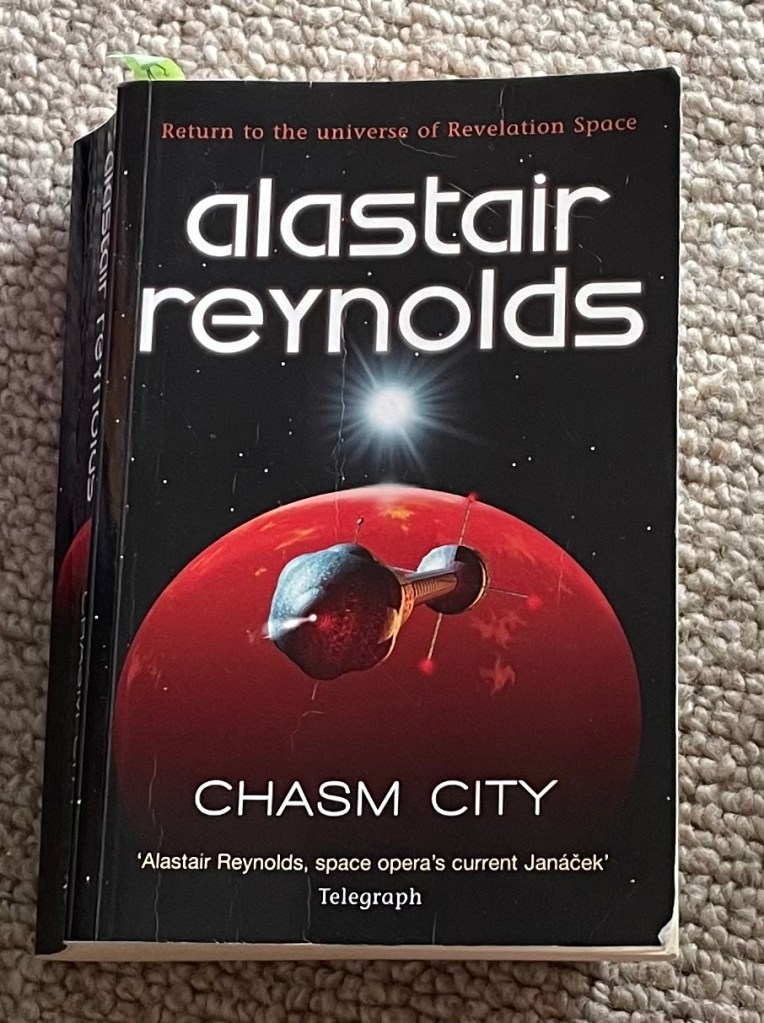
At times I thought I was reading about Mars. I think it was a case of stories bleeding into one another due to proximity. In this case, me watching The Expanse Series by James S A Corey on television. I think probably due to the sheer size of the chasm. Very Martian. Though in this case, it’s a planet called Yellowstone and a large part of the chasm is domed over.

Life in the chasm is very interesting, regional. As can be expected the upper classes live in the Canopy, the slums are in the Compost. Travel is by semi sentient vehicles that claw their way up and down and along hanging vegetation and cables. The slum dwellers are all about making a living. The rich play at turkey shoots, where they free a prisoner and force them to run for their lives.

The two main characters, with at first separate stories, eventually seem to meld into one another. The POV character keeps changing identities, and is as slippery as an eel to keep hold of. I found that quite disconcerting as the story is complex and I found it easy to get lost in. I did a lot of re-reading.

Why didn’t this turn into a DNF read? (Did Not Finish for those of us at war with acronyms). It could’ve, to be honest. But Reynolds also wrote the Revenger trilogy… Revenger, Shadow Captain, and Bone Silence. Three of my favorite modern science fiction reads.

Fantastic worldbuilding, great characters, piracy and treasure hunting, a gripping plot, a steampunk flavor. Rave, rave, rave.

Reading Chasm City I kept wanting to give Reynolds more time to come good, to tell the story with as much verve and vitality he’d shown in Revenger. I think now, knowing the Chasm City was only his second novel, that he was still learning.

‘Testament of Youth’ …

By Vera Brittain, first published in 1933, and with a long publishing history thereafter, has kept me reading for over a week.

This is not a book review in the formal sense as I’m sure thousands of those have been written over the ninety-one years of existence of this … what we nowadays might call a memoir. (If I understand correctly that such a thing is an autobiographical account of a period of time)

Vera Brittain was of the same generation as my grandparents, who all four were also born in the 1880s to 1890s. Brittain was born in the provincial middle class hinterland of what is now the UK, my grandparents were born and raised in the provincial middleclass hinterland in the Netherlands.

There the comparison ends, for neither of my grandmothers were rebels, and due to their nation’s neutrality, they did not experience the 1914-1918 years in the same way as most other people in Europe.

According to the histories I’ve read, it suited the powers surrounding the Netherlands to allow that nation’s neutrality to continue through the whole of the war, for their convenience.

While German troops crossed and recrossed Dutch territories at will, millions of Belgian refugees made their homes in the Netherlands through the war. Coal and other minerals from the Dutch colonies warmed British homes and kept factories going.

But there was no historical, personal detail from the four families, how they were affected by the fighting on their very doorsteps, they surely would’ve been close enough to hear the guns in Belgium?

And while I’ve read a few historical novels about the Great War, I’d never read an account written from a woman’s point of view. So ‘seized’ the opportunity.

The first most noticeable thing reading a book written in the 1920s is the brand of tortured English. Well, I’m calling it that.

There are always ten words where we, nowadays, can make ourselves understood with a mere five or six. All ten, or however many there are, of the English language’s verb tenses get a good work-out.

It’s noticeable in Brittain’s account when a noun is unadorned by one or two adjectives or a verb with at least one adverb. It feels bare then. Most sentences have more than thirty words. It’s exceedingly verbose and towards the end I skipped many half page paragraphs.

Why did I even keep going, you’ll be wondering? Brittain’s experiences during the war and her incredible, through thick and thin, correspondences with her lover, her brother and two friends of theirs until they died, either in action or after being wounded is the real story here.

How the Army kept the postal service going to all areas of the front would make an amazing read. The logistics to keep that going boggles my mind.

It’s astounding, the numbers of letters written by soldiers at war, sent, and received by relatives if Vera Brittain’s experiences are anything to go by. At one point she mentions that there were daily letters or postcards or even brief notes from men stuck in the trenches.

Brittain’s own experiences as a war nurse, working in hospitals right next to various battle fronts, where they triaged men with horrific wounds make you thankful to live now. I learned more about mustard gas than I knew. More about infection when there were no antibiotics. About gangrene. About … Medicine has come a long way in a hundred years.

I understand there have been a film and TV series made. If I’d seen the film first, I’d probably not bother to read the book. It is quite heavy going. But then I wouldn’t have read the rain of little diamonds sprinkled throughout the text. The words and images that I will treasure.

Such as when Vera visits first Roland’s grave and a few years later her brother’s grave. On the way there so many broken tree-trunks lay along the road bearing witness, that only the Omniscient Mmathmatician could count them.

There was a great deal to enjoy.

But have you noticed how unconsciously influenced I was by the wordy turgidity of Miss Brittain’s style? That passive voice will haunt me.

Typed one-fingered on my mobile, this will have to go out un checked and un-proofed. I’ll do that tomorrow.