Reading, 7

This session started while I was in hospital. Trying for easy reading matter. Easy to put down when necessary, for example to have a blood test done, or connect me to the IV.

My reading buddy brought me a book that he had trouble with and that I put aside after only one chapter, no way was I going to be able to read that in a scene where I needed to interact with maybe fifty people a day.

By day three I was hungering for anything at all to read. I’d forgotten to bring my tablet, and I’d been down to the kiosk in the downstairs lobby twice, and that had only magazines and newspapers available. Over two days, I bought two dailies of a right-wing newspaper, read them from cover to cover and felt like a foreigner.

Then, during one of my afternoon perambulations on the ward, I saw and remembered the existence of a lounge or two in each ward in that hospital, where visitors could withdraw to wait out procedures on their loved ones, and that there often were a couple of books.

Day three I sallied out and found a book that I normally wouldn’t read in a pink fit but needs must, as the saying is. A Readers’ Digest Condensed Book, in the new century renamed Readers Digest Select Editions. Still ongoing, I was amazed.

These are collections of “Popular, bestselling novels condensed to remove subplots or descriptions without altering the author’s style or story,” according to Reddit users and eBay sellers, quoted by Google’s AI. Hence me not reading them in a pink fit. However, by the 2020s I’m suspecting, the novellas could be being written purposely for the series. The four stories I read certainly seemed so.

According to Wikipedia https://en.wikipedia.org/wiki/Reader%27s_Digest_Select_Editions
I probably read

Book 18 … Volume 395 – #6 – September 2023 with • The Hunter – Jennifer Herrer • Hello Stranger – Katherine Center • Play the Fool – Lina Chern and • The Last Lifeboat – Hazel Gaynor

And because I was reading to pass the time, I have no clear memory of what all four stories were about except that one of them was about a bunch of newly-outed characters making the Titanic trip. By ‘newly outed’ I mean these people have not before featured in any of the Titanic fiction. And that they are probably completely fictional fictions. “IE did not appear in the passenger lists.” (Authorial note)

The other one I have some memory of is Hello Stranger, a thriller about a woman who has lost her memory. As this was the last story I read, I recall it best and it was good enough, in my opinion, not to give out any spoilers.

The remaining two stories? Can’t recall a word.

— — — —

After four nights, the days between, the two half-days fore and aft, and bells bells bells every minute of the night, I returned home. Blessed relief, with no bells clamoring all night I slept like a young thing.

Returned home with a prescription for another five days of antibiotics that had now to be taken by mouth, of course. And don’t bother with the probiotics yet was the word. The first couple of days I was quite well, getting stuck into the clean-up, and even managing to attend the weekly art class on Thursday morning.

By the Friday nausea began to rule. All the jobs I had begun slid into the background. There’s a pile of washed Duplo in front of me, another pile drying on the balcony. The grandkids have outgrown it, but some will still be useful to me for mountain-building. All of it needing sorting and I haven’t washed the plastic tubs yet.

Then there’s the laundry, one load ready to be folded, one load still in the washing machine, and another pile growing in a corner of the bathroom. Then there are the three days worth of dishes to be washed. Then … then …

I looked at my bookshelves, found something I hadn’t read yet, and promised myself time would pass. Five doses to go.

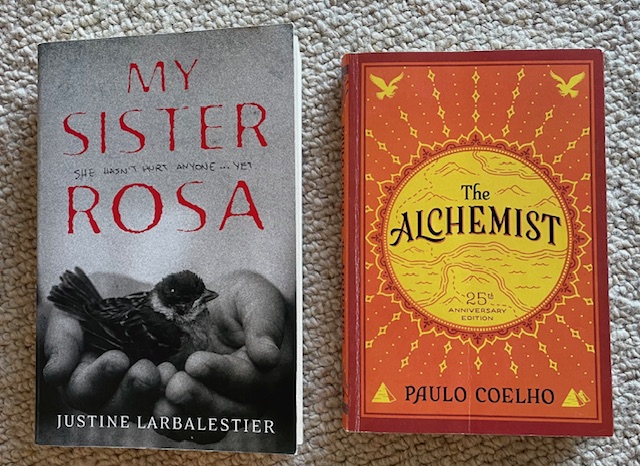
Book 19 … My Sister Rosa by Justine Larbalestier, published in 2016 by Allen and Unwin.

I picked this book up in the library in the village community center some time ago. The back cover promised me edge-of-my-seat reading and it was not wrong. I read it in one gulp, which took me till 1.30 A/M, and some time ago I’d sworn off that kind of read. Sleeping only about five hours does not agree with me these days. It’s like I’m hungover the whole next day.

Spending a bit of time at https://goodreadingmagazine.com.au/ about this one, reading reviews, I discovered that people either loved or hated the book. Also, that it’s classed as young adult fiction, which I just don’t see. Just because the POV character is a teenager does not necessarily make it a YA fiction.

Some readers thought the novel well researched, others thought it badly researched. I’m neutral about that. Just so long as the research doesn’t intrude into the reading experience I don’t mind what lengths writers go to get a readerly reality. I’ve paddled that sea myself, researching the ins and outs of surfing for my novel, Mongrel, for example. Body-surfing was the only kind of surfing I ever did and then only casually.

Some readers loved the supporting character, the ten-year-old psychopath, thinking her very realistic. Others thought her tricks were mere childishness. On that point I really don’t believe the average ten-year-old will try to talk a so-called friend into killing her twin for entertainment. People who thought that, I stopped respecting the minute I read their opinion.

Che, the older brother who told the story, was trying to be a normal teenager and not succeeding. Neither of the parents were ‘at home’, so to say, and his little sister became his responsibility. Of course in the past, it was normal for an eldest sibling to have the care of the younger brood. In my past it certainly was, and I often had three young kids trailing me. Nowadays, with families of only one or two kids it is much less common.

Book 20 … The Alchemist by Paulo Coelho. Translated by Alan R Clarke. Originally published in 1988. The first English language edition in 1993. This copy is a 25th anniversay edition published in 2014, by Harper One an imprint of HarperCollins.

Its publishing history is complex. In 1993 my son was eight years old and I was a keen library reader and thrift store customer. That would be one of the reasons this book completely passed me by. That library was struggling a bit, new books few and far between, and thrift stores feature the old and remaindered. Nor was I in any reading clubs where people raved about it. Small country town. Not even a bookshop in those days.

Nor would I have been psychologically mature enough in that time to read it. I hadn’t yet started my writing studies, and the only hero’s journey I knew about, was me eking out a living. Thirty three years later–now–I read The Alchemist with joy. I recognized so much. The hero’s journey, yes. There’s been so much said about the hero’s journey in film, literature, how-to books and descriptive critiques, most people will be familiar with its concepts.

But also some of the Jungian concepts I’ve been studying for the past couple of years. The Personal Legend, for example. Do you know yours? I’m not yet so familiar with mine that I can talk about it in detail, though I’ve received a few clues from dreams. If you don’t yet journal your dreams, start now. I recommend it.

Then there’s The Soul of the World. I know that as the collective unconscious, but described much more poetically. There’s more. The plot of the recurrent dream of treasure in a far off place that returns you to your original place? A plot that I’ve read in a couple of recently published novels. It was an aha moment and me thinking, So this is where they got that!

Even the title. The Alchemist. The alchemist is a wise man. The last thing he said to the boy? “No matter what he does, every person on earth plays a central role in the history of the world. And normally he doesn’t know it.”

This seemingly simple little book gave me a lot to think about.

What Happened …

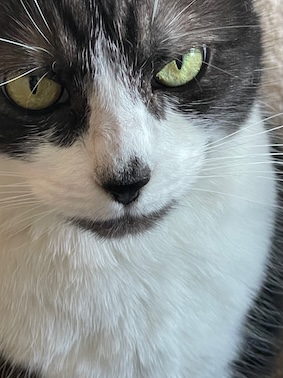
“Been home since yesterday” I wrote in a recent post. Today I’ve been home for five days. Sunday 22nd March my cat attacked me, in the early morning, on my way back from the bathroom when I was barely awake. Out of the blue, but something she had done four or five times before.

I blame myself. After caring for six successive cats previously in my life, as well as a dog, various poultry and a lamb, I believed a rescue cat would present no problems.

The fact that Moggy had been picked up of the streets and had spent 100 days in the shelter should’ve been a warning. I read that history on her hutch at the shelter and didn’t take in what that might mean. The fact that after all the paperwork was done and we said our goodbyes, the shelter’s staff said don’t bring her back … that should’ve been my second warning.

But what should I have done then, leave her sitting on the counter and demand my money back? I didn’t.

The first time she clawed and bit me was a few days in, when I picked her up to give her a cuddle. My whole left hand swelled up and that morning I was at the GP getting antibiotics and my hand dressed. Cured me of ever again trying to pick her up.

She did not allow me to pat or brush her. She scratched the furniture. She ripped up carpet. I trained her out of all those although patting and stroking her was always a dangerous move on my part. Having her sleep beside me sitting on the couch, laying so near she touched me with her back-end was as close as we got. Sometimes lately she allowed me to lay my arm over her back and just recently she allowed me to then scratch her under an ear.

In the day-times it seemed to me we were getting somewhere, me taming her, she training me.

Night times, she ruled the apartment except for my bedroom and the bathroom, both of which I shut her out of at night. I had to be so watchful all day I just wanted to relax at night. I wrote in my journal, then slept two or three times.

The short distance between the bedroom and bathroom was when she’d sometimes claw me, always at night or early in the morning, probably when she thought she should have food and I wanted to go back to bed. When she drew blood, I washed my wounds under running water, dressed them, and called them an unfortunate mistake on her part.

Some nights on my bathroom dash, I was aware and awake enough that I waved a towel at her or a shirt on a coathanger, both of which she respected as too weird for her to deal with. She would run off down the corridor.

Weeks would go by and I would forget to be watchful on those little trips. Lately I thought she had grown out of those measures. That she trusted me enough to know that she’d never go hungry. She’d become quite the heavy weight after all, and got plenty of food, was what I thought.

So Sunday 22nd March early a/m, she jumped me when I turned to go back into my bedroom, clawed me above my ankle and hissed! The hissing part was new and I was terrified! I nipped back into the bedroom, with information flashing through my mind, I’d be alright … I had antiseptic cream in the bedside drawer, cotton wool and sticky tape. The wound looked torn, a flap of skin—awful—I covered with everything I had at hand.

Wrong.

Should’ve called somebody for help then. An ambulance, maybe.

But. It was Sunday a/m and I was in the bedroom, would ambos even come into the flat knowing there was a feral animal in there? The whole thing would’ve escalated beyond what it was worth, in my opinion.

Naturally I did not sleep, feeling baled up, knew I was doing something wrong. Knew something had to change. I’d had Moggy for 20 months by then. I was getting older, more fragile and my skin was already thin. How many more times could I allow her to attack me like that?

I got up at 6.30 a/m, and after I fed the animal with her usual 20 kibbles in the usual way, washed my leg with a Wet One because the skin was torn and I didn’t dare to put it under running water, the pain alone would’ve caused me to pass out. At that time of morning I have very low blood sugar.

Anyway, didn’t hurt once I’d covered it with a large band-aid. Once again hoped for the best. Set to thinking how to manage the situation better.

Wrong.

Didn’t ask anybody for help. Could’ve called K, who would’ve taken me to ED. Thought I could last till Monday and see the GP. Which I did.

GP very unhappy with me. They cleaned wound and dressed it. Drew a circle around the infection, told me to go to ED if the infection went over the line. Put me on antibiotics. Then they put two elastic bandages over the whole lot, these were so tight that I knew if I took them off to see whether the infection expanded, I’d never be able to get them back on.

Monday night, W came to solve the problem of a feral animal which could not be taken back to the shelter. He took her away and I haven’t asked. Mea culpa.

The GP told me to come back on Friday but probably hoped I’d come to my senses and go to ED on Wednesday. I didn’t. I’d had to wait for an eye specialist appointment for four weeks already, I had a very sore right eye, I went to the appointment on Thursday. Went back to the GP on Friday.

The antibiotics hadn’t touched the infection. The whole thing was a pus-filled crater surrounded by a large angry tight red swelling. The GP angry though he did some digging in there and mopping up. With no local anesthetic so of course I flinched. He told me to go home, pack a bag, go to ED. I was by then angry with him because why no local? And why was he so squeamish? How did he even get through medical training?

I went to ED finally. They had a look, didn’t do any digging, put me on intravenous penicillin. Four nights. And sent me home with more antibiotics to take by mouth.

At this moment in time, Monday 6th of April, the wound has partially closed over, still a large band-aid. The antibiotics are now finished and here’s hoping the infection is gone. It’s been fourteen days.

Reading, 4

Next up is a book I’ve been wanting to read for about 20 years. When it was first published, the title grabbed me … Matthew Flinders’ Cat. I already knew that Flinders had a cat he’d named Trim, and had seen the bronze statue of Trim at the State Library of New South Wales.

I didn’t research the story beforehand as nowadays I usually do, just looked forward to reading a blow-by-blow account of Matthew Flinders’ voyage mapping the coastlines of what was then New Holland, accompanied by his cat.

Usually I wait until a book comes out in paperback before buying it, so when I didn’t see it appear in the local bookshop a year later, forgot about it. Since then I’ve seen it a few times in libraries without there ever being an opportunity to borrow it, and a couple of weeks ago saw it on one of the two bookshops I now frequent.

And so bought it. Because I needed a new, chewy read, and for the expectations I just described, but still not knowing anything about it apart from the fact that Trim might be one of the main characters.

Book 10. Matthew Flinders’ Cat by Bryce Courtenay, this edition published in 2006 by the Penguin group.

How did I miss that it was written by Bryce Courtenay? I’ve read a few of his but generally don’t like his style. To me they’re the kind of book I might read if there is nothing else available.

Such as when stuck in a camping ground by the roads being flooded and Bryce Courtenay book is the only thing to be found in the camp laundry. That’s where I found The Potato Factory and read that. But that’s by the by.

Reading the first paragraph of this book I knew it wasn’t going to come to my expectations but, I reminded myself, that was my own fault. And since I had given out good money for it, I would read it.

‘Billy O’Shannessy woke to the raucous laughter of two kookaburras seated on top of adjacent telegraph poles.’

There is Billy O’Shannessy … Courtenay does this thing that I was taught as a new fiction writer, make the first two words about the the main character. In that same first sentence there is also setting the scene, in this case the Australian scenario with the two kookaburras. And there is the modernity of telegraph poles, if a slightly old-fashioned term for them telling us the story is set in the present. Telegraph poles might’ve been normal for 2002, when the book was first published. I don’t remember. The rest of the paragraph tells of his hangover and that the birds served as his ‘regular alarm clock’.

In the next paragraph I learned he was lying on a park bench with a canopy of leaves over him. It’s only on the third page that Trim gets a mention and then only his life-sized bronze statue on a window ledge of the state library

By en:User:PanBK – http://en.wikipedia.org/wiki/Image:Trim-the-illustrous.jpg, CC BY-SA 3.0, https://commons.wikimedia.org/w/index.php?curid=1182097

The Wikipedia page about Trim is interesting. He’s got several more statues, one in Donington, UK and one in Port Lincoln, South Australia, as well as a glowing epitaph by Matthew Flinders himself.

Alas, this book is not primarily about Trim, or even Matthew Flinders.

Purporting to be a novel, it seems to me to be written as a tribute to the Salvation Army, the Twelve Step Program to recover from drugs and alcohol abuse and rehab, and the many services helping homeless people and troubled children in Kings Cross, Sydney. All very worthwhile people and services, I’m not denying that.

Published two years after Courtenay’s divorce, I did wonder whether he was writing a semi-autobiographical novel, that he was a recovering alcoholic. The fact that it is his twelfth novel might explain why an editor would do less editing, leaving unchanged the info dumps, for example, consisting of half or three-quarter pages describing people and places.

But I’ve often wondered how people go about writing a tribute novel so in that respect this was an interesting read. First, he had a professional researcher … the results of research are big in this novel. There are screeds of explanations. Over pages 333-334 there’s a paragraph of over 200 words. That’s almost a whole page. Commonly called a wall of text. It seems very 19th century-ish.

In places it feels like Courtenay inserted a whole paragraph straight from the source. That can’t be right, of course. Courtenay was a well-respected author. I like to think there would’ve been at least one rewrite to make the material his own.

In addition, most professional people wouldn’t hesitate when approached by a famous author to tell them about their world, any extra mention is going to help promote their concerns, right? That also shows in the detail about organizations such as the Salvation Army. I imagine there’s a fine line between wanting to do one’s sources justice and keeping the story from dragging the weight of excess information.

The bits about Trim were the story Billy O’Shannessy told Ryan, the ten-year-old other main character. Trim is imagined in the talking-animal style with a lot of agency. Which left me wondering whether the adventures described had any truth in them. They read like fantasy.
Probably I’ll try to find something nearer to Matthew Flinders’ own account of his and Trim’s circumnavigation of Australia.

Reading, 3

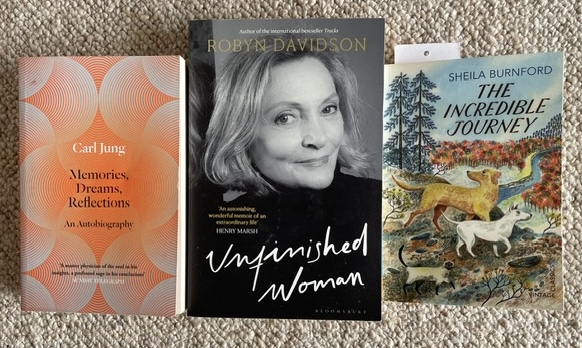
The third post of this series already though I haven’t settled into a routine yet. Today had the better idea of what to do about the illustration. Instead of letting just one book have all the glory, why not give them all a chance to attract readers? Will give that a go shortly.

The longer without a routine the better, I used to think before I was pole-axed by ME/CFS. Come Easter, I’ll have lived with this malady for 29 years. Somewhere along the line I learned that making decisions is a stressor that saps my strength.

The idea out there—in the public domain—is that the more non-important decisions we encapsulate in routines the more energy we’ll have to make important decisions. It’s not wrong … routines enable me. Interesting article on decision-making … https://en.wikipedia.org/wiki/Decision-making

Then I thought what about at the end of the year? Won’t I want to know how many books I actually read? That is the project after all. I saw myself counting through the posts. Got to be an easier way. Just number them already. So … started that today.

Book 5. The Light Pirate by Lily Brooks-Dalton, 2022. Published by Grand Central Publishing of New York.

This is the only book out of the five that I’ll recommend. I might’ve mentioned before on this blog that the climate change apocalypse, and its associated nightmare horsemen are my Sword of Damocles, and that the thread the sword is hanging by is wearing mighty thin and frayed.

The Light Pirate is set in the near-future and describes how the Florida coast is being engulfed the sea. It’s a blow-by-blow account of the way one family dies and adapts and is taken and finally evolves for a new existence. Ninety percent stark dark reality and ten percent luminous hope.

This is a book I would like to own. Read the good bits every now and then. This story speaks for everywhere there is low ground by the sea.

Book 6. Downward to the Earth by Robert Silverberg, 1969. First serialized in Galaxy Magazine it was published in 2015 by Gollancz in their SF Masterworks.

Although I’ve been reading science fiction since I was about 13, and Robert Silverberg has written hundreds of stories, I haven’t read all that many. Scanning through the titles in the front, I see only one that I own. Most don’t ring a bell. This little classic is said to … “blend mysticism, worldbuilding and literary references in an inventive mix …” from the backcover.

It’s probably about 60 thousand words, a common size in the 1970s, with a single storyline, the journey of the main character, Gundersen, returning to the planet after a ten year absence, out of guilt and needing to do penance for his mistreatment of the native species.

When I read old science fiction I’m forever fielding echoes. In this book I was reminded of some of Oscar Scott Card’s work. Comparing the dates of Silverberg’s and Card’s work, I think probably Card got his idea of the melding of the two species from Silverberg. Although, they could both have got the idea from Earth’s own panoply of creatures. Most insects, for example, have vastly different life-stages.

    Book 7. Iron in the Soul by Jean-Paul Satre, 1949. This edition translated by Gerald Hopkins and published by Penguin Classics, 2002.

    Despite that there was plenty of Jean-Paul Satre around when I was a young student, I was never tempted to read him then. Now I thought, browsing along the shelves at Carindale Library, why would Penguin choose to republish him as one of their classics if there wasn’t something to him?

    I read a few pages in the middle—that’s the way I test books for readability—and thought it might be interesting. A whole other viewpoint about the Second World War, this one from the POV of the rank and file of the French Army.
    Thousands were taken to Germany and, I read just now, more than ten thousand French soldiers fought alongside the Germans. I wonder if they were given a choice, fight for us or we shove you in a work camp? https://en.wikipedia.org/wiki/France_during_World_War_II

      Book 8. Wolf Girl: Into the Wild by Anh Do, 2019 with illustrations by Jeremy Ley, 2019. Published by Allen & Unwin.

      Seriously, was a bit of light relief, I zipped through this in about an hour. A story aimed at 8-10 year olds that my grandson lent me. I was interested to read how Anh Do, serious artist, translates into Anh Do, children’s author. His style reminds me of Enid Blyton’s.

      There are about a dozen installments. A money-spinner, if you ask me. And yet, Enid Blyton’s vast output was great for struggling readers, giving them lots and lots of practice of the plain vocabulary that they needed to become good readers. So perhaps this is the place for Anh Do’s output in Australia.

        Book 9. The Woods by Harlan Coben, 2007. Published by Orion Books.

        Returning a bunch of books to the in-house library in the community center, I picked up The Woods because Coben wrote it and I hadn’t read it yet. Pure indulgence. A fast forgettable read. Suspense? Of course. All the t’s crossed and the dots dotted? Yes. “The modern master of hook and twist,” says Dan Brown on the front cover. (Wonder what he got or did to get his name on someone else’s front cover?)

          Reading …

          Good resolutions at the beginning of a year aren’t my bag but this year I thought I would keep a record of what I read the whole year.

          In my teens, with no TV at home, a boring school life–working well below capacity I think now–and an almost non-existent social life, I often read a book a day. A regular bookworm, I chewed through most of the high school library in the first year, and was then provided with the truly educational stuff by the high school librarian. That lady saved me.

          Mrs Murray. A short, orange-haired dragon to every other student, she loaned me many interesting and exciting books from her own collection. Historical fictions, lives of explorers, a journal purporting to be by Marco Polo, good novels. It was with her support that I managed A grades in Art History, Geography and Biology, a credit in English in my finals. I never studied, I read whatever came to hand. All of it grist to the mill.

          I went on to use that formula all my life. All my learning is done by reading around in a subject. Two years ago I started a course in Dream Interpretation and I’ve collected a library of about twenty books, long and short. Now, while I’m still recording my dreams and practicing their interpretation, I’m slowly falling back into my normal reading habits.

          Last year I read some great fiction that I wish I remembered better. I prefer thinking it’s because I have a lot of stories always on the go, that I don’t remember everything I read as well as I used to, but of course it’ll also have something to do with ageing. Forbid the thought.

          Or maybe it’s to do with needing to keep myself severely in hand, not over-excited, not over-do it, keep myself on an even keel etc etc to float my ME/CFS riddled carcass through the sea of life.

          So, book one of the year was book four of a sequence I began round about Christmas time. Those Who Perish by Emma Viskic: A Caleb Zelic thriller published by Echo in 2022. I thoroughly enjoyed all four of these detective fiction/thriller tales. Not least because I’ve been channeling an elder of 150 years ago, the days before hearing aids.

          My hearing aids are working at approx 20% and the repair place is not re-opening until Monday–two more sleeps–and can’t come soon enough. There are far more women in my world now than men, yet men’s voices I can hear, and women are like they are mouthing noiselessly and I am not a good enough lip-reader.

          Caleb Zelic, though a frustratingly impulsive protagonist, is mostly deaf and his story is punctuated by mal-functioning hear aids, people who don’t move their mouths when they talk, or turn away and talk so he misses important clues, etc etc. All things I could totally relate to. He’s a well-drawn character, the events he gets involved in are realistic, while at the same time a gripping read.

          Somewhere in there, also in the first week, I read another detective fiction, which was entirely forgettable as I had to scan the back cover just now to help me remember it. When She Was Good by Michael Rowbotham. Published in 2020 by Hachette. Although Robotham is one of my favorite detective fiction writers, this one left nothing behind in me except for an Albanian proverb. “Nobody values the truth more highly than a liar.” The primary protagonist is a Cyrus Haven, forensic psychologist, and he just doesn’t have the charisma of his colleague, Joseph O’Loughlin, Robotham’s first forensic psychologist. Maybe I’ll chase those up and re-read them.

          While out grocery shopping I tripped over a bookshop. Fatal, as any bookworm will tell you. Normally I steer my trusty mule in a different direction but this time I had to pass it. I came away with a book I’ve had on my list for over ten years, more on that in the goodness of time, and The Gift of Not Belonging by Dr Rami Kaminski, subtitled: How Outsiders Thrive in a World of Joiners. Published in 2025 by Scribe.

          Just reading the acknowledgements told me it was my kind of book … more on that next time.

          This is the work of an otrovert. As such it cannot be the fruit of a team effort and presents a dearth of people to acknowledge. …

          Lego, Raft

          Underside of hull …

          This is the hull of Robbie Rafter’s new vessel. He will be meeting Boz … Boz in the rowboat in the shallow water, Robbie on the raft in the deep water … to discuss the forthcoming conditions.

          This is the first time I’ve come to grips with Studs Not On Top (SNOT) bricks and angled plates in one of My Own Creations (moc). The problem here was the two hulls needing to be used upside down and connected to the deck plates which of course are set studs up.

          Took me two and a half hours to produce the above and it is a fairly solid construction now. Although there are a couple of places where I may have used so-called illegal techniques, I was able to stabilize the area enough that elements aren’t falling off with handling.

          The different colors on the underside speak of the same old same old. While I now have two IKEA Alexes and multiple little trays to store my whole parts collection in … I still don’t have enough of parts and colors to be able to construct even one color coordinated build. But never mind, the characters themselves are good at explaining away these little irregularities.

          Top of as-yet-unbuilt-on hull … the dark grey platform will house the engine room, bridge, galley and the bunk room. The flaps at the ends are the gates/drive-on and off ramps. Similar to how a ferry works. The middle deck is for the cargo.

          The walkway two studs wide on the near side, will allow Robby to save fuel and his propeller by ‘walking’ the boat through shallows … setting his pole in the mud and forcing the boat to move by walking in the opposite direction to where he’ll want to go.