

If I had an extra hand or two I’d be able to show you that all the gear wheels that should go round do go round when I turn the handle … I’m tickled pink!
If I had an extra hand or two I’d be able to show you that all the gear wheels that should go round do go round when I turn the handle … I’m tickled pink!
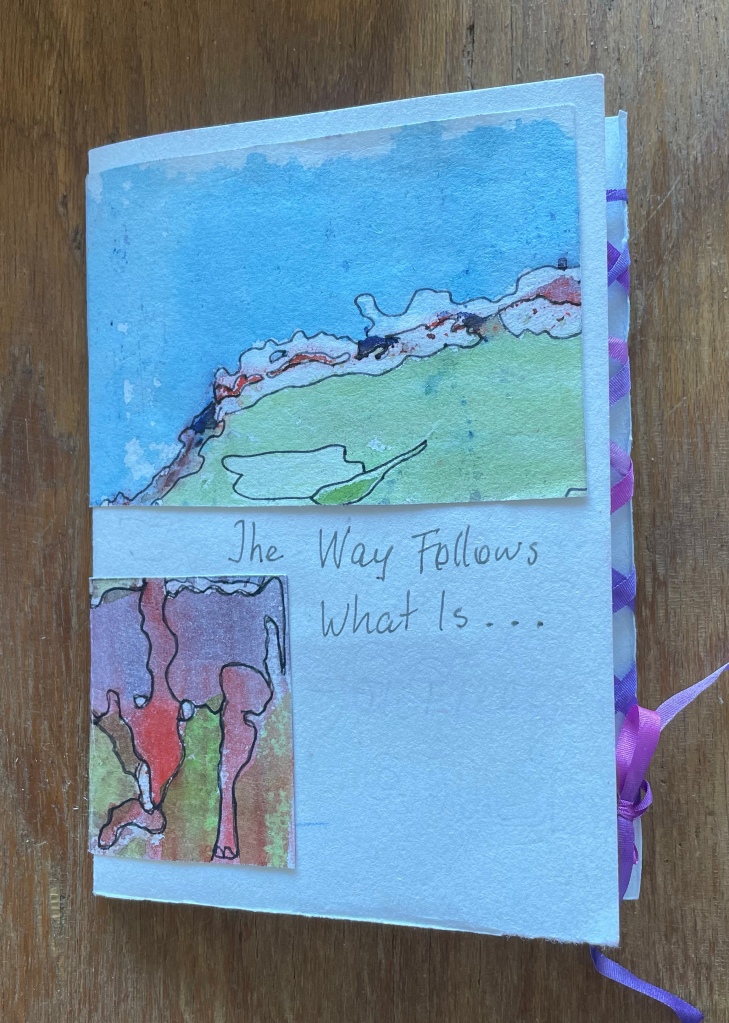
A thing I’ve been experimenting with is turning remaindered practice paintings into little books … seeing if judicious ‘analogue’ cutting and pasting can transform random images.

There was a left to right movement in this scrap … the two pages bound by ribbon had to stay loose from one another (ie not glued) or the whole booklet would’ve buckled.

Where are we? Help! I’m sliding … Uh oh where are we? Some kind of underworld?

is that a golden gate I see in the distance?. Maybe we can get there crawling …Turn the corner, quick …
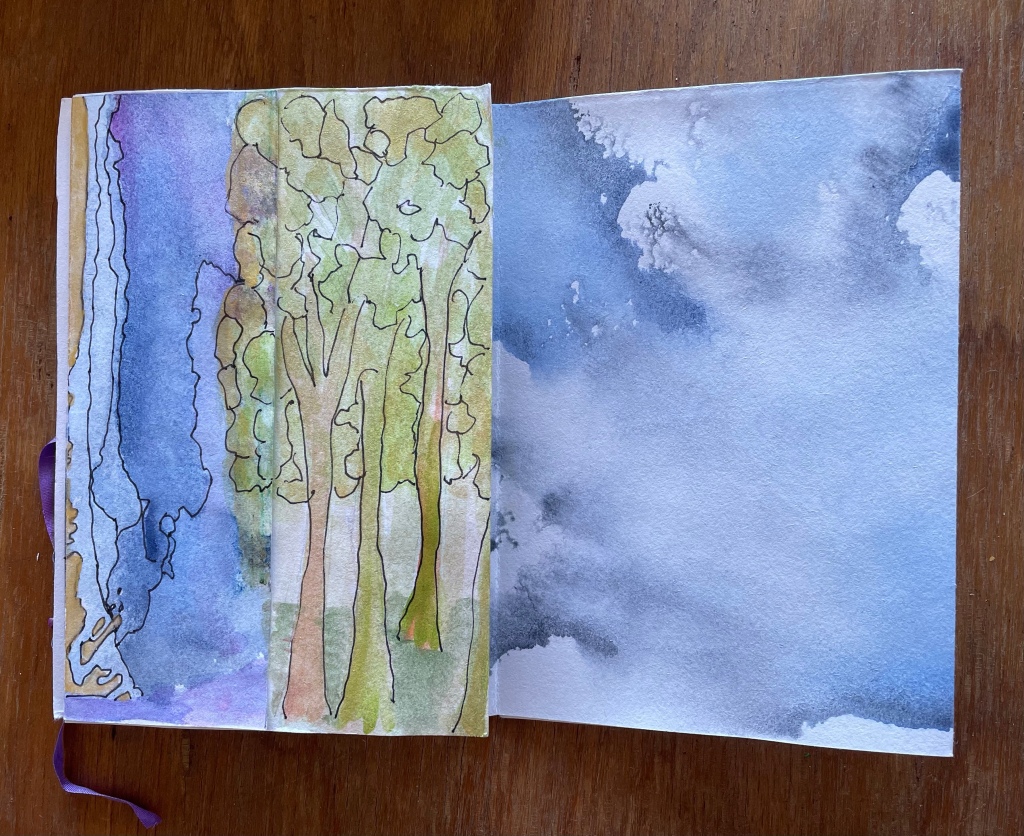
In and out of the trees, I don’t feel safe in amongst all the vegetation. What’s all that gold doing to us?

Told you we changed. Let’s go already, it’s the wide blue yonder.

Guess we didn’t all get wings.

The contents of Bag One of the Orrery, a Lego Technic set. Couldn’t wait any longer with building it, after having it in the house for over a week. I’ve been fascinated by orreries for a good few years.
‘An orrery is a mechanical model of the Solar System, in this case with the Sun, Earth and the Moon. More planets would’ve been good, but can maybe added later. I’m pretty sure some clever clancy will invent some add-ons.’ from This Wikipedia article which also shows a good selection.
Putting together the build so far took me about two hours of fiddling. My fingers not as young as they were nor the brain running them, lol. I’m still very doubtful about the position of the little blue piece parallel with the diameter, where the directions were unclear about its position. If there does turn out to be a hiccup, I’ll know where to look first.
The first Orrery I saw, and knew what I was looking at, was in the Sydney Powerhouse Museum at Ultimo, the Strasbourg Clock. Not sure if it is a replica.
One of the most intricate orreries I’ve read about featured in the science fiction Revenger series by Alistair Reynolds. That one featured hundreds of planets, mostly small to smaller, called the Congregation, in what was left of the Solar System.

Don’t worry, some time far in the future. Great premise, though. Above, the second book in the series. That orrery, I seem to recall, was a navigation aid.
What I’m writing now in Lodestar contains a few events that for better a better reading experience, should’ve had their beginnings seeded into earlier chapters. For example, you will meet Moab, one of the Marl-Family. He was thought lost/dead, never mentioned because that’s the herder/hunter folk’s tradition.
The chapter being wrangled into existence is one of my so-called bridges from section to section. The timeline is complex at this point. I may later post a map.
Snippet 2
Once everybody crossed the channel there was a confab among the Kuri-Family group. Since they were last to cross, their decisions would stay private a while longer. Jenk gave Moss, Kyle and Io his instructions, to explore the road west, mark the water-crossing somehow, and rest in the new grazing grounds. Discover its seasons. He gave more than half the herd into their care, consisting of most of the brood animals, young females and a few sires. Plus they had their own riding camels and stringers, of course.
“A few herdies wouldn’t go amiss,” Kyle said.
“Suggestions?” Jenk said tersely. …
“Lewit and Jeldie? Not her fault she’s a Jovat. Not his fault he’s a Lomack. Merin and Kier? Same again,” Kyle said.
“Marl-Fa might want to come totally,” Moss said. “What’s against asking him? I’m young for chiefing, anyone wanting to grab the chance will say. And then? We have exactly three defenders?”
“The Marl-Family and all their camels?” Jenk said. “We don’t know how much grazing there will be. But I hear you.”
“Jenk,” Kuri-Chief said. “Camp with them this side of the Red Channel. The tidal flats, sea-lettuce grazing will last a day or two. One or the other of the young men and Ivy can cross the water, see the lay of the land. The grazing, campsite near any freshwater supply. Once they return, you rejoin us.” She gestured at Kes and herself. “We’ll speak with Marl, Kier and Merin, when we arrive at the Party Camp.”
Kuri-Chief at the head of the column, and Kestrel at the rear, swung into east with the remaining third of their herd. Nearly all of the remaining animals were stringers and trained riding camels, carrying the Kuri-Family’s tent, a couple of annexes and also all the numbers fostering children. With a few additional animals destined for slaughter, they were a lean and mean herd.
How come when I post a teaser for a later, more comprehensive post, it’s not to be seen out in the published posts arena, but turns up in Draft? Wait, I think I published that teaser while on my mobile phone. Shouldn’t make any difference though, should it? The platform works seamlessly across different appliances?
And conversely, when I have a post sitting in Draft, it can collect Views and Likes? As though it’s been gamboling out in the public arena, and it is still only a haphazard collection of thoughts? While this is not the first time this has happened, it’s the first time that I’ve thought to follow the trail.
I thought Draft was the place where I could have things on hold, waiting for more info, more energy, more time and or everything else that I need to get a post happening? It’s the place where I save good topics, the possibility of long pieces, things I want to comment on, things that need editing. Not for public reading as yet.
This post was meant as a teaser: https://ritadeheer385131918.wordpress.com/wp-admin/post.php?post=2698&action=edit&calypsoify=1
It apparently has lived in Draft for the past two days, but managed to collect 2 Views and 3 Likes. How, I want to know?
I’m wondering whether you have a bunch of learner-bots out.
Yes. Having one of those days when all plans are having to be thrown out of the window. I have a ‘lurgy’ in the slang of my day and my time.
I’m sitting up sleeping at 4 PM, absolutely the worst time for an hour’s worth of sleep that will probably be traded in tonight for an extra hour of wakeful coughing. A ten minute nanna-nap or even a five minute power-nap would’ve maybe saved the night.
I can barely speak, and cough at the slightest exertion and it’s been over a week already, I’m over it, though when has that ever worked?
Days have been lonely while I’ve stayed home to not spread this bug through the facility. But, anyway, as more sitting down activities were required, I started the project I hit on during one of these wakeful nights.
Had a lot of notes already thinking I should remember these people somehow. Dots on the phone directory. Names and a couple of words on the calendar. Four people from this floor. Many I met while we all travel in the elevator.
I’m calling it my META project … which stands for Meet Everybody, Talk about Anything. So far, I’ve lived here for 70 days and have met and talked with 17 fellow residents, when the last nine days I’ve been in isolation.
About Lodestar Part IV
Lodestar, up to this point, was written from more or less one viewpoint per part.
This fourth installment is in effect a series of short installments (novellas, probably) where some of the main minor characters are sidelined and others drawn forward. One or two important characters are only just now being introduced.
The various people whom I asked to critique the series fifteen years ago, advised against introducing important new characters at this late stage. I thought it through at the time, but quailed at the work involved in the restructuring. Put The Lodestar series aside. Years passed while I worked on a new series. Different, I thought.
But my ‘unconscious’ a marvelous entity I am only now learning about, was well and truly in charge, and encouraged me to write multiple stories featuring a main character being invaded and controlled by a foreign influence.
I’m laughing now when I read those lines, knowing that I am absolutely ruled by my unconscious, as you are by yours whatever you may believe. Fifteen years ago, I wasn’t writing unknowingly about my own personal unconscious mind, but about an alien, about an invasive computer program, and about the implant.
Without me realizing, which is the part that still amazes me. Until I had three mostly polished novels, ready to be professionally edited. That’s when I realized. At the time I was poor and troubled, and could afford to have only one of them edited professionally. So I decided to forward the most recent work, which was ‘Mongrel’.
Five years ago my life fell apart as long-time readers will know, and after the chemo, when I set about picking up the pieces, I decided I was done with marketing. The stress of dealing with giant corporations was not doing me any good. I decided that life is too short to hanker after the pittance that I would earn for not writing in the mainstream.
That’s not to say I won’t publish them at all. They’d be a lot easier to read as novel lengths than a chapter at the time.
Fast forward to the idea of the ‘story-debt’. It really grabbed me, for after I labored over The Lodestar world for ten years, its characters and their lives stayed with me. It’s like they are real people somewhere out there. I wondered if by paying off my story-debt, by ‘publishing’ them here, on my blog, these characters would then stop haunting me?
t’s a work in progress. Below a snippet …
The Implant, 1
‘I can almost feel the textures of the nutrient jelly I rest in. I’ve imagined them so often it must be that I now feel them. The heat of my skin melts the material near me, making it silky and fluid. It’s firmer further out. A spider webbing of fibrous supports grows among and between my miniaturized cables.
Fresh nutrient mix is added to the bottom of my housing, its floor is gridded and sits on a saucer, the whole is very like the design for a bird-feeder I have somewhere in my memory banks, though the action of the nutrient mix is opposite to that in the bird-feeder.
I don’t like remembering that I don’t have a skin and that I still don’t have a body. It is not my imagination that I feel a frizzle of anger pass along my synapses. If I’d had a body to use, I would’ve been able to express myself more satisfactorily. Where is that minx Ahni? The speaker fitting is clogged and I cannot call out. I’m not happy with the level of carelessness in this place. Who is on duty? I shouldn’t have to worry about utilities. That was always the work of the host.’
 Rita de Heer