Reading Project, 8

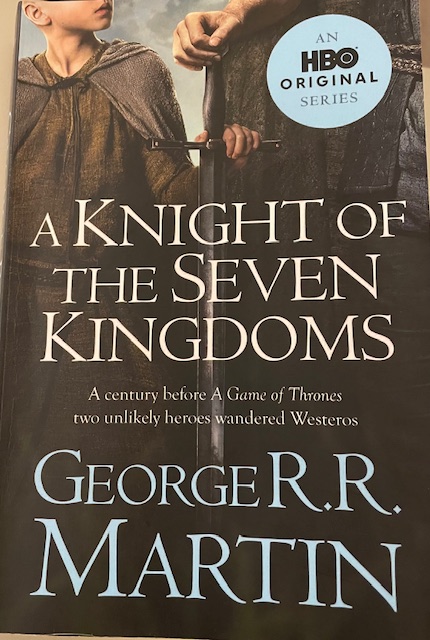
Book 21 … A Knight of the Seven Kingdoms by George R R Martin, with illustrations by Gary Gianni. This edition, being a collection of three novellas, has a complex publishing history but as a collection it was first published by Harper Collins in 2015.

After I saw the HBO TV version, I wanted to read the original, as print novels often are better at showing the complexity of characters. Which was a good move, for as well as the first story, The Hedge Knight, that the TV series is based on it, it gave me two more stories, that presumably will be televised in the goodness of time as installments 2 and 3.

A hedge knight is a knight not sworn to a lord or having land—such as Ser Duncan the Tall—and I guess would be equivalent to a ronin in the samurai tradition. Both are men who wander their countries and offer their swords in whatever battle that will give them food and shelter for a time.

Dunk (short for Duncan) is a young, tall, strong and inexperienced knight wandering the Seven Kingdoms with his squire, Egg. As soon as I read “Egg” I recalled Maester Aemon at the Wall in Westeros ( A Game of Thrones) talking about his younger brother Egg and spent quite a bit of time wondering how that worked. Forgetting that with the right question (ie prompt) Google’s AI would tell me in seconds.

Which it did. Aemon was two years older than Egg and Egg will rule as Aegon V. At the time of these stories Aemon is apprenticed at the Citadel learning to be a maester and he will serve at The Wall.

You have probably guessed by now that I am a Game-of-Thrones tragic. And you are right. I have the book series on my bookshelf. I was a member once of a huge fan club, forty thousand plus fellow tragics, industriously discussing all aspects. Though they worked out the Jon Snow is the son of Rhaegar Targaryen and Liana Stark puzzle and I still don’t know how. I confess I just took their word for it, never could find the proof in the books.

All this is getting side-tracked from the book I’m talking about, but have the excuse that the these stories brought it all back, because it is all connected. Reading it the first time round, it seems like a light read, though the battle at the tournament is quite complex. I had to read that a couple of times, nailing down who fought who and who bit the dust.

But wait, why am I saying it’s a light read? I’m changing that. Only the first story was a particularly light read and I suppose the fact that I already knew the story visually meant I just glossed the imagery in the words.

That’s the problem with visual media of all kinds and reading books after seeing related shows. By feeding viewers with media-ideas for what things look like, viewers who are also readers tend not to read stuff that will clash with pre-“recorded” visuals and as a result miss out on a lot of good metaphor.

Such as … “The spiked ball whirled round and round the sky and fell toward his head as fast as a shooting star. Dunk rolled.”

That didn’t happen in the tv series. Someone else wielded the spiked ball and not at Dunk. Why I can still appreciate it. The other thing to appreciate is a character’s thoughts. … I failed them. I am no champion. I’m not even a hedge knight. I am nothing…

I don’t mind those thoughts, they’re what anyone would think in the situation. But … He never saw dunk the lunk, though, did he?… the twenty-five times that Dunk thought that of himself … that grated on me after the fourth time. (Maybe not twenty-five, just felt like it.)

In the next story, The Sworn Sword, (p119) there’s less introspection as there is more interaction between Dunk and Egg. They are on the road, traveling to their next meal.

This story is book-ended by the two corpses hanging in a cage at the cross-roads where Dunk and Egg stop for a minute for a break and again on their way out. They’re to deliver a barrel of wine to a place called Standfast and happen to stay there, to help the inhabitants get out of a scrape they have with their neighbors about water rights, a complex quarrel. Dunc ends up fighting the opposition’s champion.

The third story is The Mystery Knight (p233). Coming away from Stoney Sept, Dunk and Egg are well supplied. As they near a town, they first see a traitor’s head on a spike on the town walls.

Two and a half pages of Dunk’s ruminations follow, about a law that allows septons to be decapitated for merely talking because … “words are wind” after all … he says. Egg puts his thoughts in where applicable and the whole is one of Martin’s stylistic manoevres to thicken up the story line with historical descriptions including the Targaeryan succession through Bloodraven.

Six days later they arrive at a ferry crossing. Here, again, as they ride toward the inn nearby, there are possibilities of informing the reader about money, as in how little they have, “twenty-two pennies, three stars, two stags, and an old chipped garnet, ser …” Egg informs us and Dunc.

All three stories give the feeling of meandering. The pace is slow while Dunc and Egg are traveling, they are on horseback, with the horses probably walking. Fights are fast blow by blow accounts of action.

Between the slow travel and fast battles unfold long sections of story needing close attention. There’s a lot of detail being slipped into every paragraph. Story-pearls are being seeded in at all times. Early in the story we learn about Bloodraven’s history. At the end we meet him, and learn that he is Egg’s cousin.

I found this book in the YA fiction section in the bookshop where I bought it. The book is probably classed as young adult fiction due to the single story line, the youth of the POV characters, and because it is illustrated.

The amount of detail in it, though, suggests an adult read. Words, phrases, clauses and sentences all contain seeds and reminders that these stories are part of the whole rest of the Westeros culture. It’s one of those books I read fast for the plot and again, slowly, for the complexity.
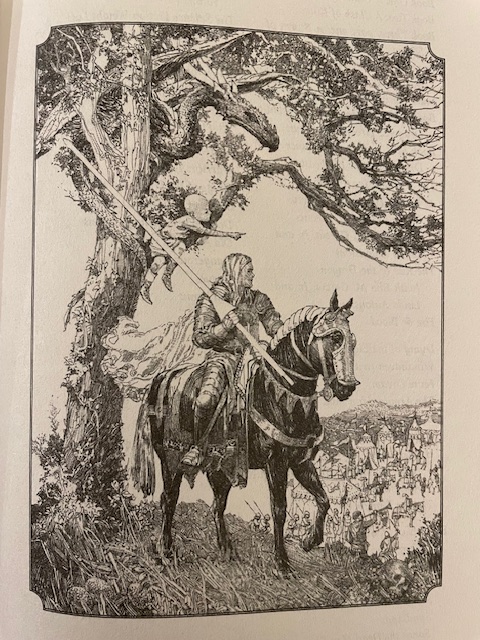
.Illustration by Gary Gianni.

Lodestar 61, Scrim

About five years ago, I reworked what would’ve been the next couple of chapters to submit to Worldbuilding Magazine, for an installment they were running on relationships, V3I3: Gender & Relationships

Since I was extracting the story from an ongoing Lodestar Saga and wanted eventually to be able to come back to it—as I am doing now—I changed Srese’s name and backstory. But, although she is called Kate in this chapter and has a whole different history, she is still Srese. As you will see.

Scrim’s parts in the whole deal have not changed, and that part of his life–as it is described here–fits in well with what’s coming for him.

Enjoy!

Cat Diary 4

Would you belive I’ve been here for almost two weeks?

This is me at my breakfast. The old woman gives me canned salmon for breakfast and dinner. Sounds special, I know. She thinks I’m too bony, the breeze will blow you away she said.

But she gives me titbits to try out at lunch time and if I don’t like them she’ll hide them in the fish at dinner time.

The other day I ate a scrap of omelette I’d politely left at the side of the bowl. She does not take no for an answer. One on her scorecard.

Mind you, I had a bit of cooked chicken today and it was delish. Bring it on. Right mow she’s out there on the balcony.

At her gardening. Where’s the garden I might ask, when it’s just leggy plants in pots, so elongated they might run away. We’re waiting for grow-lights to come in the post.

Lodestar 56, Scrim

[I didn’t want to post the whole chapter if I was going to be knocked back again.]

Scrim Learning his Ropes … Part 1
In the dawn the winkle-pickers dragged a couple of fighting screaming numbers from their hiding places. At Scrim’s hide they laughed. “You safe now, little love. See you in bits when the nubies get you.”

After the truck left, Scrim heard pigeons on the roof above him. He remembered the crust in his pocket and was chewing it without making a sound when a shining reflection flashed along the wall opposite and a high wild whistle, close enough to touch almost, dried the bread in his gullet.

Something big out there! Out the front. What did Mapmaker say? Scrim slid up to standing, pressed himself into the room’s angle, and fought crumbs from his lungs without coughing, gasping, or choking.

He breathed big to recover. Also without a sound. Then stopped breathing coz … Tick. Pause. Tick. Pause. Tick. Pause.

Claws? Clicking along the ground outside? The time between clicks made the thing sound like a giant tall enough to peer into Mapmaker’s three-high window. Ah-nui-bots, was the word Mapmaker said. 

Scrim wanted to gulp air. Min said when you’re frighted, breathe deep in and out by your nose. Calm y’self, Scrim, he thought in her snippy tone.

Thump! In the front room! His heart skittered.

The cat walked into his hide. Thin and grey, it nuzzled up to him.

In the front room—outside it—a small, nearly friendly whistle said, “Where you go?”

The cat butted against Scrim’s legs like it said, get off my bed.

Scrim lifted one foot. All the place he could spare.

The cat sat down in that corner and started washing itself.

The whistlers clicked away. So big! Where’d these things keep themselves? When he studied the city through Min’s telescope, he never saw anything but the numbers, and the transies in the square at the end of the maze, and the wall of houses-and-lanes lectrified with steel-ropes ringing the tall ruins of the city. He badly wanted to see them, these anubots, but he wasn’t in his own place. In the rubble he would of known every escape in the scene.

Next time, he promised himself. This place was more of a mystery than he expected. He sank down beside the cat and dared to put his hand on its soft back. It purring but after a time got rid of his hand with a blunt bite. Not nasty but saying, I got things to do. It started washing its back leg so Scrim busied himself with the sand.

At the hour of sundown the hooter called. The same as the kinnies always heard. The cat pricked up its ears. Scrim too, when he saw its attention. Soon after, he heard metal on metal squeaking and coming nearer and nearer. It stopped at the door. Door squealed opened. The metal thing came inside. The door closed.

The cat opened its eyes wide at Scrim. He didn’t dare move against that fierce light.
The man tocked himself up his stairs, came puffing and grey-faced into the room.

The cat released Scrim from its spell. Mapmaker had got no feet, just stubs of under-legs. He wore covers on his stumps and had a stick to help him along. He was shorter than Scrim.

“When I real little, before kinnie, I used to slide up the mud-slide with pulling on a rope.”

The man looked deep into Scrim. “That soft thinking is like you friend-gift me. Outside life is as hard as a true-stone. Soft is a gutted rabbit. For out there I say you pack that soft deep into you heart.”

Scrim thrilled to hear the man talking like a kinnie.

“Now tell me this maze you made. Show me what you know. I will talk in my normal voice because the transomatics hear me talking all night to my cat. But you must whisper so they won’t know when you leave.”

“Them tran-som-matics?”

“What you call transies. People what come to keep ahead of death by body transplant. What this city is known for, that and every other kind of transplant. Trouble is, when the transomatics first wake up, they are like new children and have to relearn everything— walking, talking, working. Once they are halfway back to normal, their keepers give them the night-streets for their learnings.”

“The ones catching new numbers is transomatics?”

“Yes. Though lots stay young and silly and are kept for making our lives a misery, it seems to me. The truth probably that such a disaster can’t easily be explained to the outside world, like the transy’s family and such. Probably the City keeps the young-and-silly to prevent it getting a bad name. One reason, I expect, they closed the gates to the world.”

“And for keeping the numbers in?”

“I know what you thinking, Scrim. Why still no way out? Scanning the wall with the telescope did you see the ones hanging burned on the wires?”

“All my kinnie-life the same rags. No new ones. Min says they are from the beginning.”

“When people that become numbers are took and all the people in their village are also took, they might think, where is home? They tell me that. And before they can get home, for a long way there is only rubble, desert, camel riders and crocodiles. They think, why not stay, instead making themselves so they are not what the customers want.”

“How?”

“One woman who comes to my stall, I paint her with soot and colors. At her hide she needles it in. She has a tree, leaves, fruit growing all over her.”

“It works?”

“The customers don’t like how she peers from among the leaves. Other times I paint a map of sun-sores. Nobody wants them either.”

“I bet.”

“And there’s hiding. Lots hide. Like you’ve got to. High-up is best when you know nothing yet. Out of reach of every kind of bad. Not near to the maze. I’m safe here because the nubies come to watch the flyers and the cat, and every transy is afraid of meeting a nubie one dusk. As you must be.”

While he looked for a hide, Scrim saw no nubies. He only had the time between the end of the day and the hooter letting the transies out, so he picked the first not-too-high place off the street. He slept. This time his bed was the bare floor.

Lodestar Over- and Under-Pass, 55.5

There were always going to be a few knotty sections in a mash-up of six novellas as the original plan was to tell the stories of each of the point-of-view characters separately. That intention got shoved to the wayside when Kes fell for Ahni and there threatened to be a lot of interaction. I let it happen, I confess. I wanted to see how the romance would pan out.

One by one the rest of the characters joined the fray. It seemed to go all right. I’m a pantser by nature, the kind of writer who slides by the seat of her pants, without too much planning. Like all pantsers I thought I could write myself out of any problem. ‘Pantser’, by the way, sounds uncomfortably like ‘Pantzer’ which I seem to remember is a type of artillery tank. Lol, one of those writers just pushes their way through! Or they tank in a deep wide trench!

We are now at a place where three viewpoint characters are in play—well, waiting in the wings—with another taking the stage. And he had to. Because if he isn’t at the appointed place at the right time, Srese will fail to be in the right place and time to meet Ahni and Kes.

This is Scrim I’m talking about, of course. He was one of the first characters who stepped into this saga, and that with just the two words at the end of his story. But don’t worry, a lot of new-miles, hours and days will be told before he says them. Most characters jump into their stories with a couple of lines of dialogue relating to their beginnings or middle events. Then it’s up to me to connect them.

Also, Scrim needs to meet up with Rockeater Ridge’s remaindered avatar. Remember him? Some of you may want to catch up with Sard before that happens. Link to Chapter One

There’s advice everywhere for budding novelists about the no-no of writing dialects. And yet, I wanted to try it. I wanted to see if it really would become a chore that readers would rather do without. Let me know if you hate Scrim’s turn of phrase?

Lol—as a reader—I just reviewed a book [link] where that became a chore very fast. My authorial defense for Scrim in Lodestar is that most of Scrim’s words are modern-day English, and it’s just that their combinations need interpreting.

Finally, if you know anything at all about sailors carving leopard seal tusks, and how the products are called scrimshaw, you will have been wondering about Scrim’s name. My lips are sealed. All will be revealed in the goodness of time.