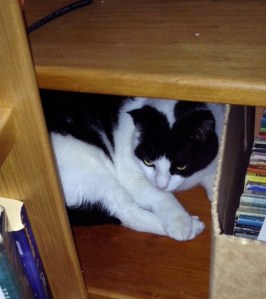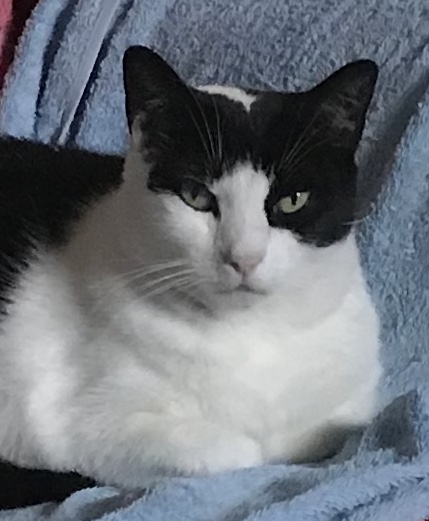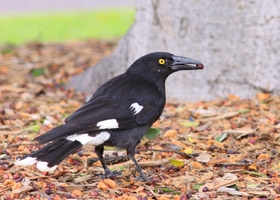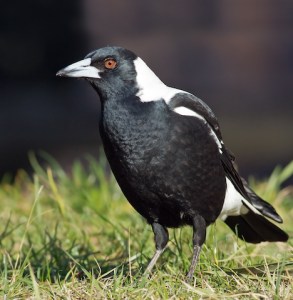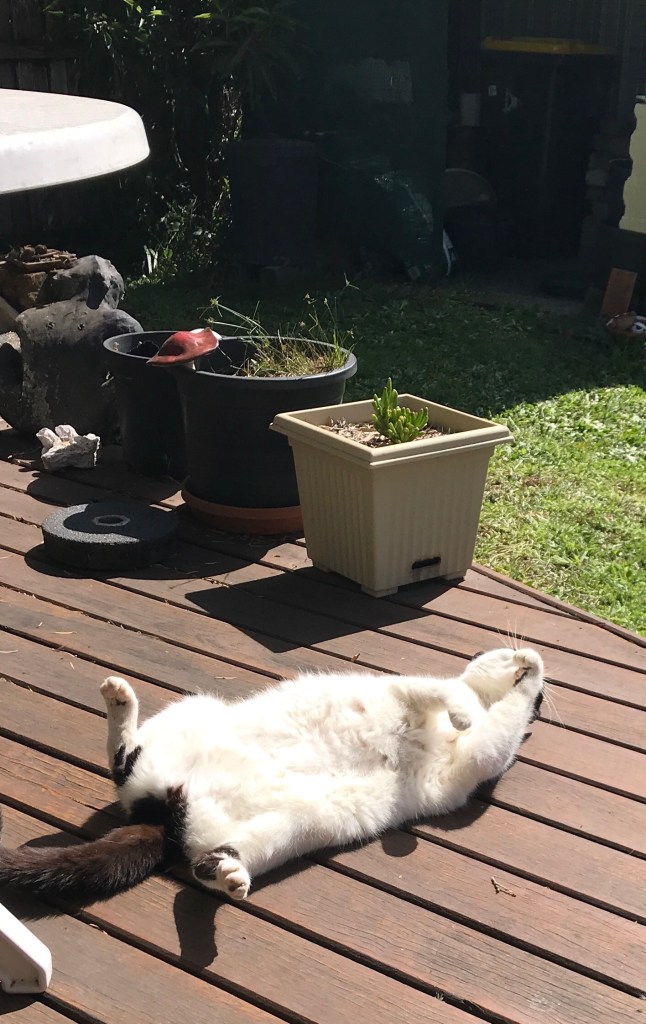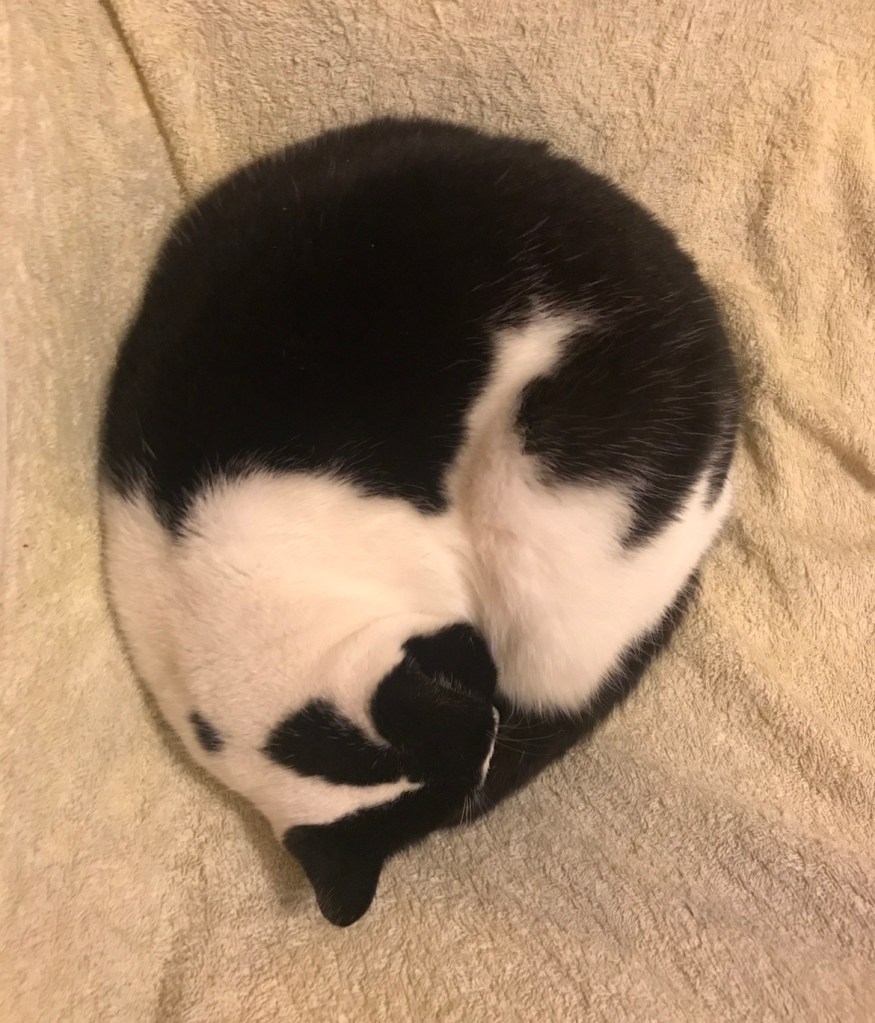
That’s me, Maggy Cat aka Hand-of-God, flashing down the roof
In the dawn while I was still comfortably hidden under the slope of the front roof, I heard a far-off rooster crowing about the sun about to rise. He at his natural work.
I had no time to compare my state to his as human, the pernickety old woman, thumped her feet onto the timber floor, as she always did, so that the whole house vibrated. I heard her stump to the bathroom.
Aaahh!!
She screamed? She never usually screamed going into the bathroom or slammed the door so hard and instantly. I pussy-footed from under my eave.
“Oh dear, oh dear,” my human said. She stumped to the back of the house and completed her ablutions in the laundry.
Oh dear oh dear what? My curiosity ballooned. I ran to the back of the attic, along one of the beams that held up the ceiling. I miaowed into the gap between the inner and outer wall, that the people installing the insulation hadn’t got to yet.
Silence.
“Is that you, Maggy Cat?”
I miaowed again, as loud as I could.
“Come along. Come along,” she said as she walked back to the front of the house.
I followed her voice.
She went out the front door
I went out the owl’s exit.
“There you are,” she said. “Run down the roof, along the porch roof and into my arms. Have I got a treat for you!”
My curiosity got the better of me. See me running down the roof?
She caught me in an old towel, ran into the house, shoved me still bundled into the bathroom. Shut the door with her on the outside.
When I’d wriggled free, a toothsome sight greeted me.
What can I say? I put the poor creature out of its misery. I’m not one of those cats that play with their food. Besides, I was hungry!
Me, Hand-of-God, sleeping in the contested red chair. On a towel because I shed black and white hair.
Last night, creating that havoc I promised, I ran and slid and skittered in the moonlight and shadows on the slippery wooden floors.
I took a running jump and leapt to the top of the tall wooden shelves in the living room. Lucky for me that they’re fastened to the wall. Dislodged books and ornaments thumped and clattered to the floor.
After each big noise I expected the pernickety old woman to come running from the bedroom in her nightdress. Shouting, maybe. I didn’t know her very well yet.
She stayed stubbornly in her room, the door stubbornly shut.
Is she deaf? I suspect that now. After a while I stopped my argy-bargy. It’s not much fun when there’s no reaction.
The pernickety old woman spooned in her usual breakfast fare while standing at the kitchen bench. Drank her tea as if she listened for something.
“Be a good cat today, Maggy,” she said.
But … yesterday’s doings were small stuff compared to my adventures to come! And there are no photos of any of it. Just our memories.
To help me be good, the pernickety old woman spread an old towel in the red velvet chair. “Sleeping is good,” she said.
Fine. I settled.
Then a man’s voice called from the front. “Okay if we bring a ladder in?”
The pernickety old woman went to the front door to talk with the man. He brought in the ‘ladder’ whatever the thing is. They decided that he could set it up under the guest room ‘manhole cover’. Another thing I’d never heard of.
A lot of to-ing and fro-ing followed, stumbling, swearing and apologies, and knocking on the wooden walls. The pernickety old woman stayed in the corridor while the person and his apprentice hauled in gear from their truck parked on the front lawn.
After a long time of barely dozing, I woke with a start. Silence in the corridor and guest room. I could hear the pernickety old woman talking at the washing machine, telling it what-for. My chance.
I soft-footed through the corridor. In front of me in the guest room stood a metallic set of saplings, with little shelves rising between the front pair, toward a yawning hole in the ceiling.
The aromas coming from the hole spoke of mice! And rats! And even birds! I climbed of course, and from the top little platform, jumped into the roof space.
While I explored up there, the men came back from their ‘smoko’. I ran to a little nook I’d found. Hid there, with my black back toward the men, making an extra shadow.
They worked at their mysterious project for hours. I have no idea what they did. High-pitched power saws came into play. They used chisels and hammers to ‘smooth edges’. Finally they left. They pulled the manhole cover back over the hole.
Then I heard the pernickety old woman calling me. “Maggy! Maggy! Where are you?” She rattled the kibble bin. “Dinner time!”
She stood at the back door. I was over the front corner of the house. She didn’t hear me and her feet went into the house. Small thuds. Cupboard doors clattered.
The roof space darkened with night. The pink fluffy floor was littered with tools and boxes. I explored a little longer but the animal aromas were overburdened with the chemical smell of the pink fluff and the tools.
So I hid away. What else to do? I listened to the night. I watched flitterings and an owl stalking a little bat. Eating it.
Then I saw where he’d come in. I growled, just a little. Owl took off, back into the night, flapping slow silent wings. I began to wait for dawn.
While this event is already past, I want to learn about the outcomes. Just reading the first few paragraphs, I’m sure I can learn ways to rephrase my messaging which seems to be falling on deaf ears at the moment.
Prior to my cancer scare I was a deep green greenie. I volunteered as a Landcare committee member, biodiversity co-ordinator, group leader and the local ‘fungi lady’.
Did talks in science week at schools, talk-and-walks about fungi in the local arboretum. Joined Knitting Nannas, an activist group. I fitted my house out with PV and a watertank.
When I woke after the end of the treatment, about July 2021, I was ecstatic that I had survived. And a few weeks later, very confronted by the seeming lack of concern about the climate emergency. My usual sources had dampened right down.
I had nothing left of any of the above, apart from an abiding fear for plants and wildlife and above all, how my very young grandchildren, and everybody-else’s descendents are mean to survive.
I had to relocate to the next state for the treatment, which all happened during covid. I’m in a rental with no control over the utilities. I have very little energy. No local contacts. But am still largely online.
My flavour of activism is being rejigged …
A unique discussion on the compelling intersections of art, climate change, and social innovation.
Climate change is a World-versus-Earth problem, I heard the other day.
Apparently people still don’t know how completely dependent on Earth our World is. The dragon will pass us by, and with a flick of its flaming tongue, or tail, will drag us with it into the inferno.
Earth is a planet that supports Life and is an inseparable part of it.
World is the human culture, the where and the what that we build and extract and dig and superimpose on the soil, that thinnest of layers between us and bed-rock.
The same bed-rock that we can not survive on without the natural services provided by sunlight, water, air, and soil. Is that really so hard to understand?
Air? Another thin thin layer. Above us. Blue where and when the Earth continues its work. A disgusting tan yellow where we think we have improved our lives. Where industry and wrong-living coughs out smoke and smog, dust and death. Dragons.
Water. Oh my people, Ocean is in so much trouble. We warm it. We degrade it. We dynamite and pillage, we fill it with cast-off refuse, we leak oil and bilge waters, spread disease and alien creatures, and still we expect whales, pristine rain, sparkling springs and sweet lakes of fresh water.
Life is the miracle that has become, and grown, and evolved over unimaginable distances and stretches of time. Life is the lives that by the millions have come and have gone, like stitches over and under, through the fabric of time.
We sapiens, living for ten or twenty thousand generations and perhaps two more, will dive under and also be gone.
So I read an article about World War III, how it’s already begun. I respect Stan Grant, the author, for his integrity so don’t find the content suspicious. Link included below for your interest. But the content of this article just aggregates with all the other anxiety-inducing news I’ve read since the Northern NSW floods.
I have an anxiety disorder and owe it to myself to not to step back onto the anxiety/immune system problems/inflammation treadmill after all the work I’ve done to get off it. I realize that to dampen down my increasing agitation, I need to back off from negative social media sensationalizing world problems.
I’m already doing what I can in relation to the primary challenge of our times–extreme climate change– and can’t do anything about the Russian invasion of the Ukraine. From this point on, I won’t be writing any letters to politicians, and I won’t be re-posting frightening, Earth-shattering scenarios.
I will be scrolling past all organizations asking for donations. I have my charities and will stick by them. I may post about real-world efforts towards mitigation, when and where I find them. I will continue to blog about science, art, story telling and story making, music and all the other things that tickle my fancy.
The four part program is the kind of reality TV that starts with a litter of puppies. It’s informative as well as good fun. The human handlers have been picked for their variety of work situation for their dogs to grow up in, and their personality and probable bonding with the pups.
The ‘plot’ is that five puppies of great breeding stock are transformed into working dogs in one year! When normally the training is up to three years. The question is, can it be done?
Last night I watched Parts 1 and 2 and saw the puppies transformed into 6 months old triers. Five passed their assessments easily, one having a few troubles including another dog in its pack having to be taken to the vet for snake-bite.
With over three thousand working dogs in Australia, muster dogs helping to manage cattle, goats, alpacas, sheep and even poultry is a reality in this country. Several of the people taking part in this ABC (Australia) series once mustered with humans-on-horseback, humans-on-motorbikes, and helicopter. Now working with up to twenty dogs, they say they’ll never go back.
The animals being managed are quieter, calmer, and not nervous and skittish. Mustering with dogs is time-saving, can be done in one day and can be done without a lot of forward planning such as needed with more people or machinery. Dogs are cheaper to run than helicopters and machinery, and a lot more love-able. Dogs are more sustainable and environmentally friendly as they are not as hard on the land as both horses and machinery.