The Hardware Store Rebuild:

Part One of a ‘Bric-Fic’ Fantasy

Despite the optimistic style of the title and subtitles, this is a story about ‘trying’ to publish a bric-fic fantasy. It’s been a zig-zag journey of dead-ends, so far, and I wrote this paragraph last because even WordPress is not productive when asked to do something a little different.

I’ve always wanted to name a new genre, and here it is. Little did I know it’d be in the arena of AFOLs (Adult Fans of Lego) but that is also what I am. An AFOL.

The genre has been in existence for a while, I’m sure, since the Lego Group has been going 90 years, and I can’t be the only one who’s ever seized on these bricks and the mini-figs to tell a story. But it’s hard to find them, to compare my work, without a genre label.

Let me know if there is a term already out there?

After producing a slideshow on my desktop, I’ve been trying to find a good place to publish. I’ve tried a FaceBook Page, an Instagram account, and a WordPress slideshow with varying success rates. None of them more ideal than daily FaceBook posts on my Feed.

The slideshow block on this site likes photos, but finds captions harder to deal with. It’s another learning curve of the two-steps-forward-one-step-back variety. Something like a muddy path.

A gallery of photos and text boxes may serve. We shall see.

You can see in the third pic that the caption continues beyond the bottom of the page. Conclusion? A gallery will not do. The ‘captions’ are often too long.

I need a structure to input once, not one that needs me to scroll to the place where it exists, for every photo and every caption, copy, then scroll back to where it’s wanted. Wondering now if a table will work …

Nope! A prefabricated WordPress table does not stretch or accommodate photos and long captions, the way a word processor table does. Lucky last for today, I’ll try the column block:
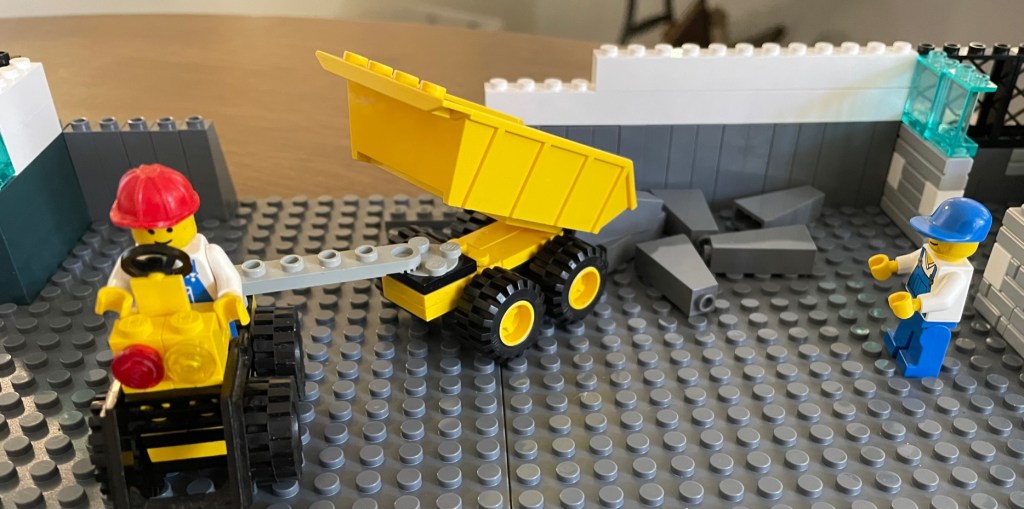
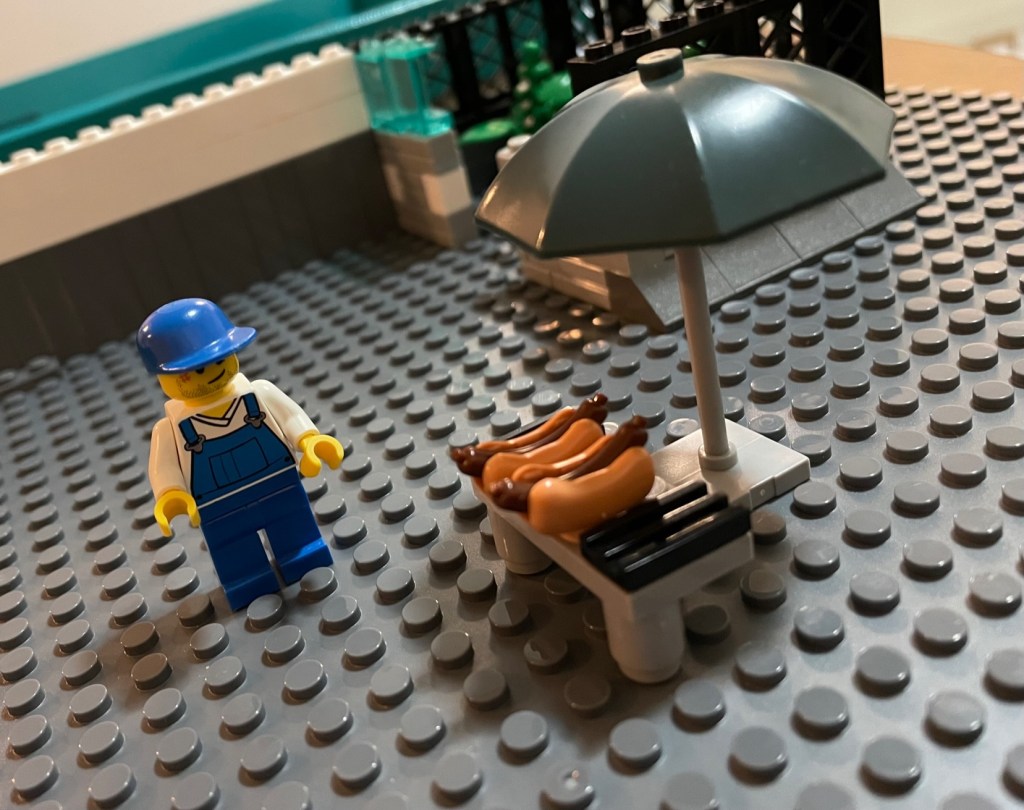
Scene 8:

“After I dump the foundation blocks, fetch what?”

“Park the run-about and help me install the blocks.”

“But Boss, the scaffolding is cluttering up the yard. I should get that first.”

“But Dan, nowhere here to put it until we get the blocks in place.”

Scene 9

Beep. Beep. Beep.

“Tip them out. Dan, I’ve got Drew here to help me. You go wrangle the forklift attachment. One of the sparkies will help you get the electrics connected.”

“Right-ee-oh, Boss. Hey Drew, don’t let him run you ragged!”

“Boss and I are good, Dan. We’re brothers.”

“Well, that’s good to know!”

And that is it … the ‘column block’ feature stops working after two photos. It lets me input more text, but refuses another photo.

THE END

In Health and in Sickness

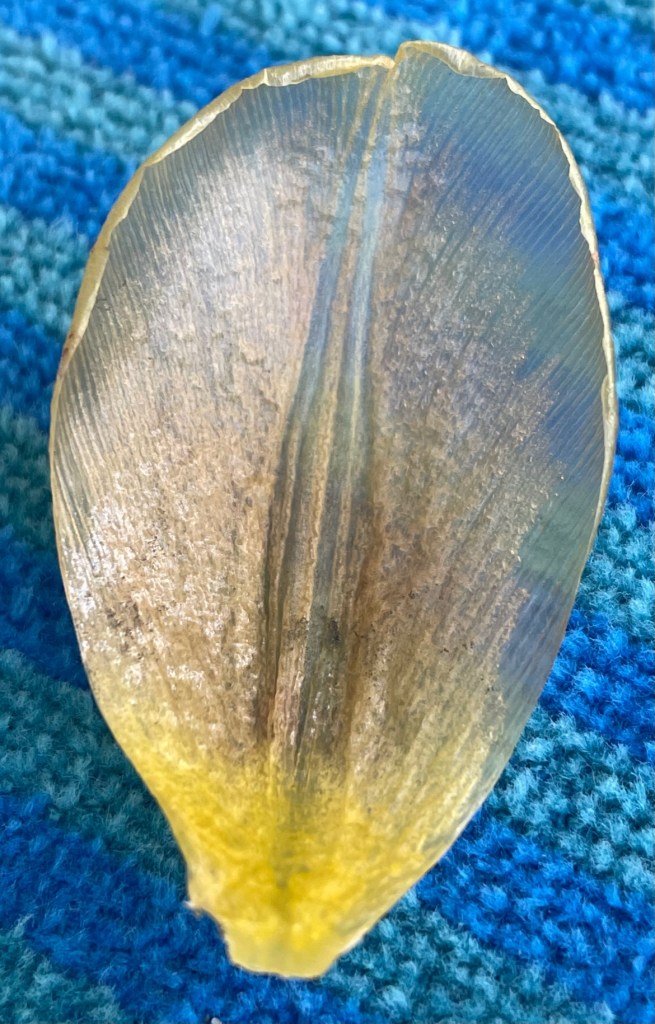
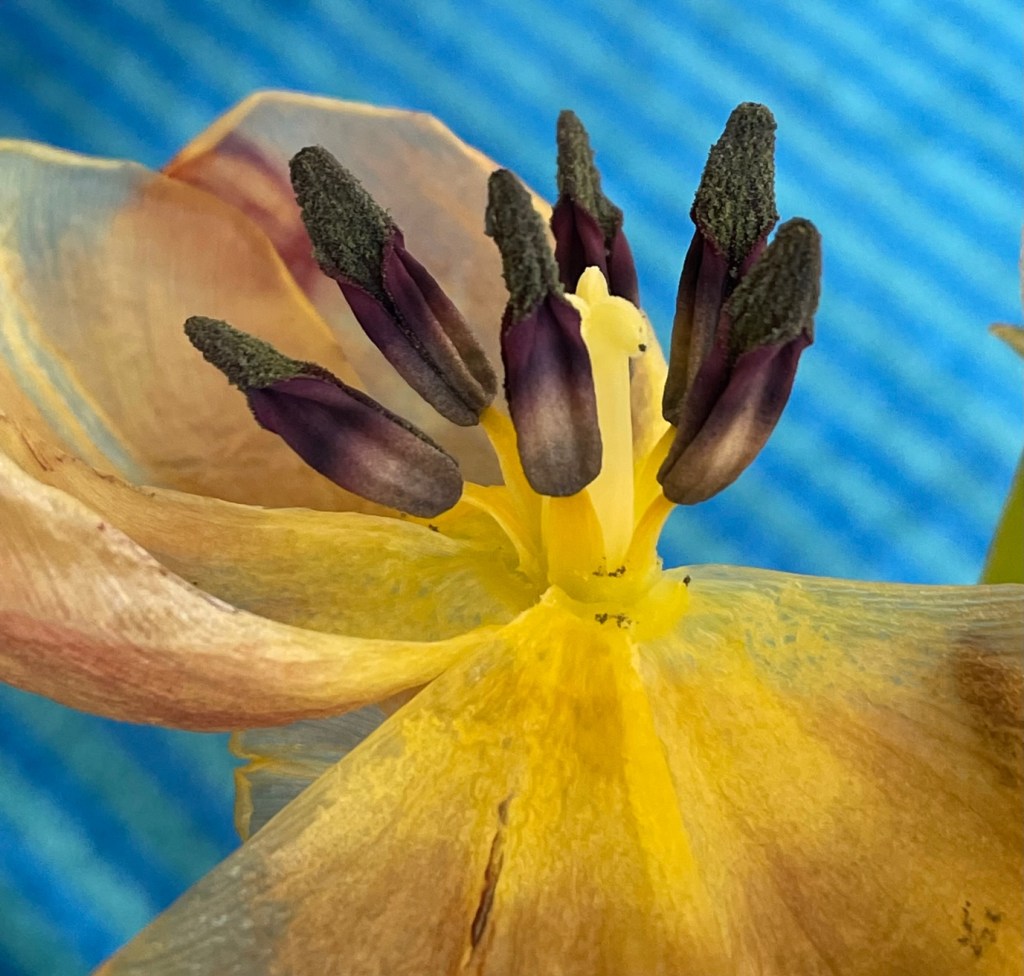
These almost-gone tulips startled me with their sere beauty. A good metaphor for how I feel sometimes … almost-gone; learning to love myself in better times and worse.

The previous couple of weeks or three I sat around with a cold, fatigue, a heart scare, more fatigue. Knitting was it while I was forced to sit around. Fatigue is a thing to be borne. There’s no hurrying it. It can be calculated. Six days of sickness, 12 days of fatigue.

In between all that, I spent the day in an Emergency Department to have my heart checked. Which meant blood tests and an ultrasound on my legs to check for blood clots. Nothing eventuated. It was just a scare, that’s all, I was told. These are the kind of diagnoses meant to comfort a patient.

This patient went home, not forgetting to ask for a copy of the the blood tests. Getting that was the best part of the day. The blood results confirmed to me that my continuing semi-isolation is in a good cause. My white blood cells are still well below what’s needed to fight off disease, platelets also very low, and red blood cells only just dragging themselves into the average range.

‘Imitation or Representation – Art Philosophy’ by …

https://artistcoveries.wordpress.com/2021/03/18/imitation-or-representation-art-philosophy/

My semi-abstract representation of an imaginary creature …

Dryad, After the Clear-Felling, Rita de Heer, 2017

Finally I learned the difference between imitation and representation in art. Thank you, Judith. These concepts have been bothering me for quite a while. When I first started to learn to paint with watercolors, I had to relearn everything I knew. About paint, how to apply the paint, how colors work when you overlay them on other colors, and how to represent the subjects I’m interested in.

I can say ‘represent’ with confidence now. I’ve always represented semi-abstract subjects using acrylics, pen, pencil. I’ve made embroidered, macrame and knitted hangings, and used a darkroom to change my photographs.

[I’m telling you, mobile phones are amazing. Can do everything I did then in the dark room, in the comfort of my arm chair, or on the bus. You know what I’m saying.]

Since I got interested in fungi about thirteen years ago, I have flirted with the idea to perhaps practice botanical drawing or painting. That would mean going back to the life drawing classes I studied in a Visual Media strand long ago … the pure art of imitation, copying the subject of study, stroke by pencil stroke, onto the paper.

Lately though I’ve been asking myself whether I’d have the patience for that now. It’d even more like meditation than laying water colors on paper. Not that that’s a bad thing. But am I ready to let go what I’m still learning?

Judith's avatarArtistcoveries

Recently I mentioned the connections between art and philosophy — a branch of study referred to asaesthetics. On this point, which deals with beauty and taste, I’m content to go with the conventional wisdom that says beauty lies in the eye of the beholder. You like what you like. I like what I like. Sometimes we’ll be in agreement as to what is beautiful and note-worthy; at other times we’ll have very different opinions. Still, all is well. We’re each entitled to our opinions.

My study oftonalism, however, has brought me a bit deeper into philosophy and art. I’ve been reading more about the life and work of Asher B. Durand, one of my favorite artists. Several years ago as I first began oil painting, I read Durand’s collection of “Landscape Letters”. While I enjoyed his essays on art, I was beset with questions. I…

View original post 621 more words

World vs Earth …

Back into the Ooze
Back into the Ooze 2019
by Rita de Heer

Climate change is a World-versus-Earth problem, I heard the other day.

Apparently people still don’t know how completely dependent on Earth our World is. The dragon will pass us by, and with a flick of its flaming tongue, or tail, will drag us with it into the inferno.

Earth is a planet that supports Life and is an inseparable part of it.

World is the human culture, the where and the what that we build and extract and dig and superimpose on the soil, that thinnest of layers between us and bed-rock.

The same bed-rock that we can not survive on without the natural services provided by sunlight, water, air, and soil. Is that really so hard to understand?

Air? Another thin thin layer. Above us. Blue where and when the Earth continues its work. A disgusting tan yellow where we think we have improved our lives. Where industry and wrong-living coughs out smoke and smog, dust and death. Dragons.

Water. Oh my people, Ocean is in so much trouble. We warm it. We degrade it. We dynamite and pillage, we fill it with cast-off refuse, we leak oil and bilge waters, spread disease and alien creatures, and still we expect whales, pristine rain, sparkling springs and sweet lakes of fresh water.

Life is the miracle that has become, and grown, and evolved over unimaginable distances and stretches of time. Life is the lives that by the millions have come and have gone, like stitches over and under, through the fabric of time.

We sapiens, living for ten or twenty thousand generations and perhaps two more, will dive under and also be gone.

Media: ‘Lost in Space’

https://www.netflix.com/au/title/80104198

I just finished watching Lost in Space, the 2018-2021 version, three seasons over about 2 weeks, and thoroughly enjoyed the series. One reason is that I manage suspense and stress by previewing story-lines. Spoilers are an unimportant concept for me, these days.

Since suffering the recent trauma of cancer, I’ve been unable to watch any really suspenseful fiction due, I think, to the ongoing uncertainties of real life. Will I die if/when I catch Covid? Will the cancer come back? Will we all go to perdition due to climate change? Will we frizzle up in a nuclear disaster?

While the Robinson family are portrayed as nothing less than super at their various jobs, they are also good people even when quarreling. That feels over the top, a bit. Then I remember series like this are not made for cynical old crones like me and I think, Just enjoy it.

When Maureen and John, the parents, become aware of their children’s emotional problems launch right into the right kind of positive affirmations the kids need to overcome their doubts. The realism is in the long time that it takes Maureen, for example, to discover her daughter Penny’s insecurities.

All these familial resonances happen at the same time that life-threatening decisions, intricate repairs, instant inventions, and numerous other events are having to be dealt with. Despite their rate of failure, they’re confident they’ll come through the next impossibly impossible technical problem. They always do because the show is so squeakily wholesome, death does not feature front and center.

The only person, other than robots, that I recall dying was on the screen for less than ten seconds before he was blown out of an airlock. And get this, the person who organized that, agreed to her just desserts. More than that I will not say, in case you do care about spoilers. The robots, where they did survive, were transformed from bad into good.

The ‘science’ was interesting and was made to seem logical. The actors were very convincing even when they obviously had to interact with a green-screen dummy representing Robot or Scarecrow or SAR.

Don, a space mechanic whose best friend was Debbie, his pet chicken, was a welcome contrast to the perfection of the three genius children, their genius mother and their ex-Navy SEAL hero father.

Dr Smith, while also extremely smart, was the frustrating antithesis to them all. Many were the times that she plain outwitted them. An extremely able antagonist, where the bizarre planets and even the robots were cast as forces of nature.

A clever enjoyable series.

Art: Dune’s Fremen & Sandworm

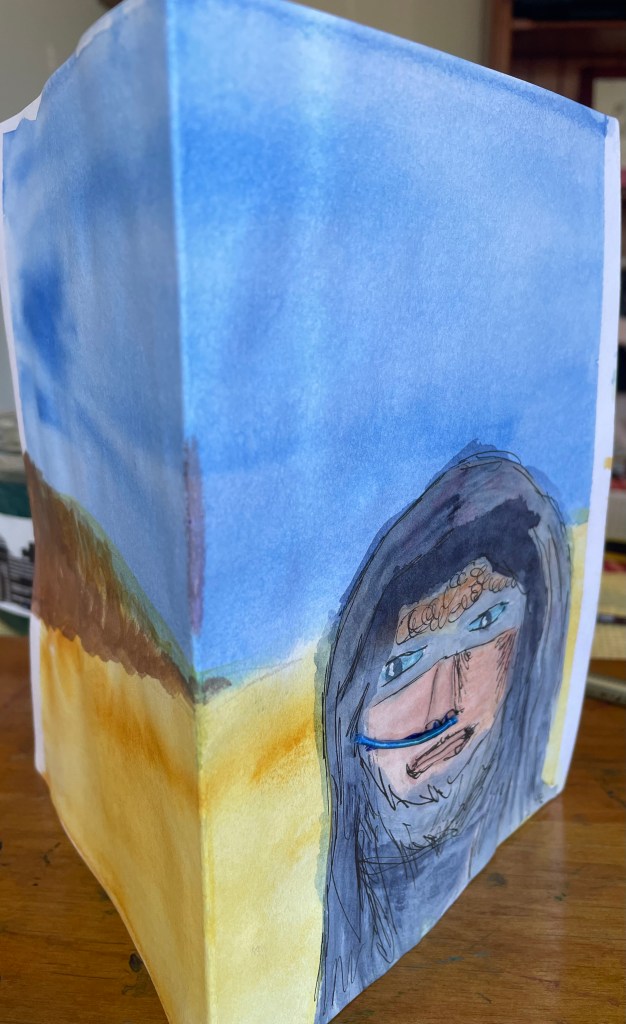
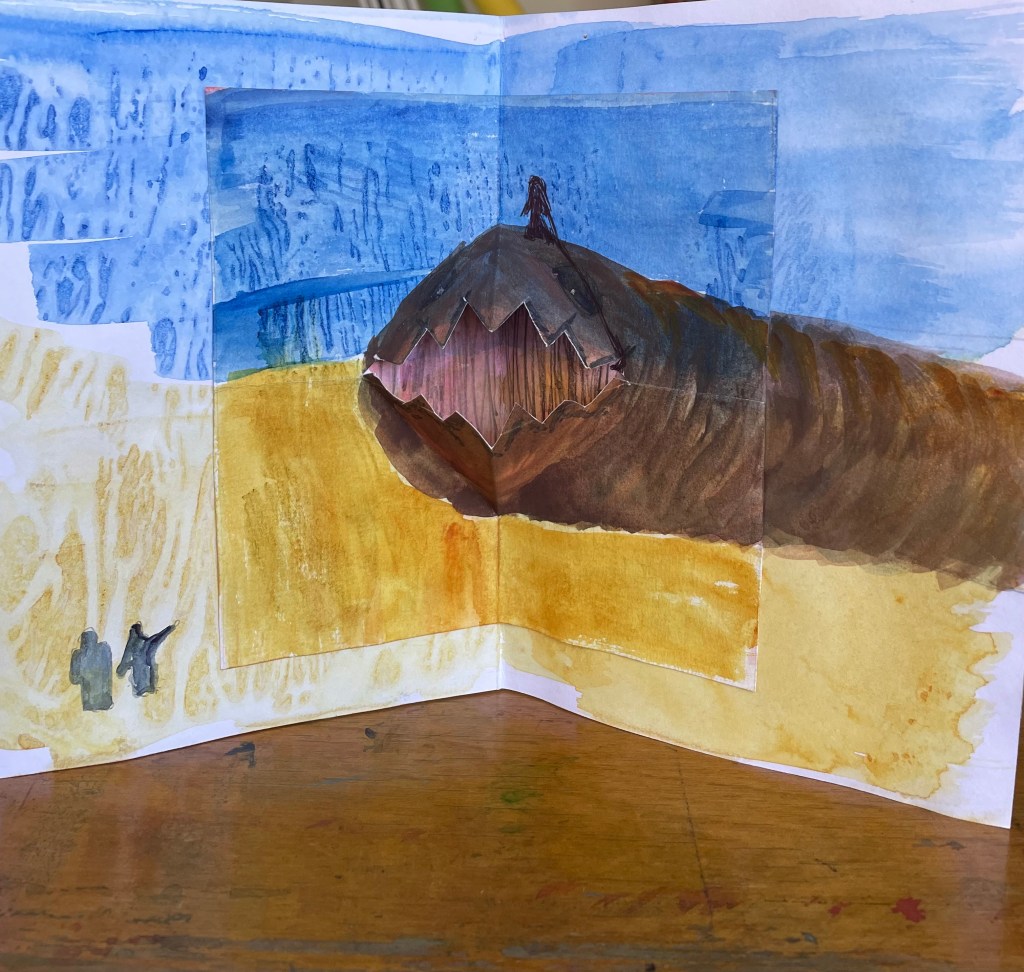
Front cover of card with close-up of one of the fremen warriors of Dune

A couple of the reviews I’ve read of the new film version of ‘Dune’ by Frank Herbert, have said how much better it was having read the book first. So ordered my near-and-dear co-SF reader a copy that would not make it in time for his birthday, supply chain troubles and so forth.

Decided to paint him a birthday card as a teaser, and whispered a promise to our four-year-old descendant–in a fit of over-the-top confidence–to make it a ‘pop-out scary-monster’ card.

Luckily, I had Youtube to help me. Pop-out cards are a favorite subject for craft and I soon found more than I needed.

Since this is the first pop-out I’ve ever made, I managed to stretch a four stage process into about ten steps.

But feel reasonably pleased with the result. {Had to make the sandworm more recognizably a monster … I know the maw is different in the movie.}

A Fremen on one of Dune’s Sandworms, hooking open its maw to stop it diving under the sand

Intertwined?

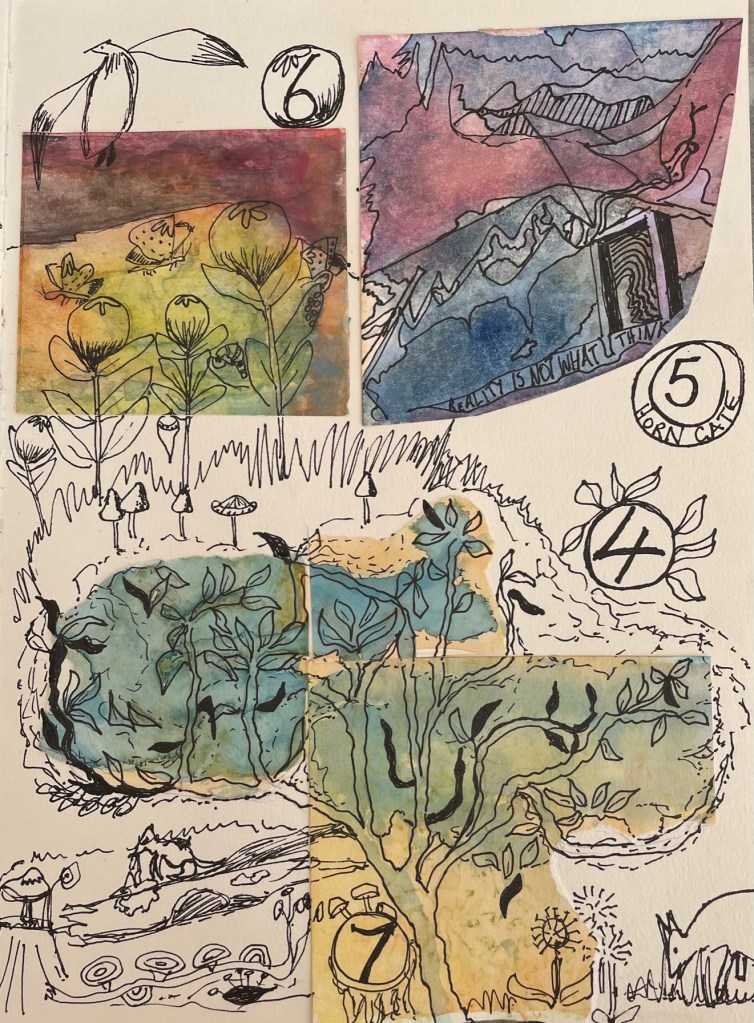
Days 4-7 of Inktober 2021, a cultural practice by Rita de Heer

Just how intertwined are we, with Nature?

Here, in this cultural practice of applying pigments to paper, pasting scraps to paper bound in book-form, and drawing over the top with an ink pen made of petrol-based polymer filled with petrol-based ink?

Not much at all. Because cultural practices are part of what we do in the World, right?

Pigments are powdered clays, lichens and mosses, madders and goldenrods, rust, verdigris, pewter and gold. Some of Nature’s bounty.

Bound with gums, latex, and oils.

En-tubed, slopped into pots, or dried in patties.

[Sold, which is a whole other story.]

Livened with water … the best is straight from the deep ground, unadulterated with unnatural chemicals such as chlorine and fluorides.

Applied to papers linens, canvas, parchments; wood panels, bone, and teeth; applied to stone.

Using brushes made of bunching the tail hairs of a myriad of different furry animals, as well as threads drawn from petroleum products such as nylon, rayon, polyesters: all of them products of the sun’s action on eon-old vegetation when you go right to the origin.

Air drying is preferable but takes a long time, so people who can’t wait use hair-dryers that often use a variation on the theme, electricity stoked with coal.

[If framed, that’s another story]

We are intertwined.