Moving a Town …

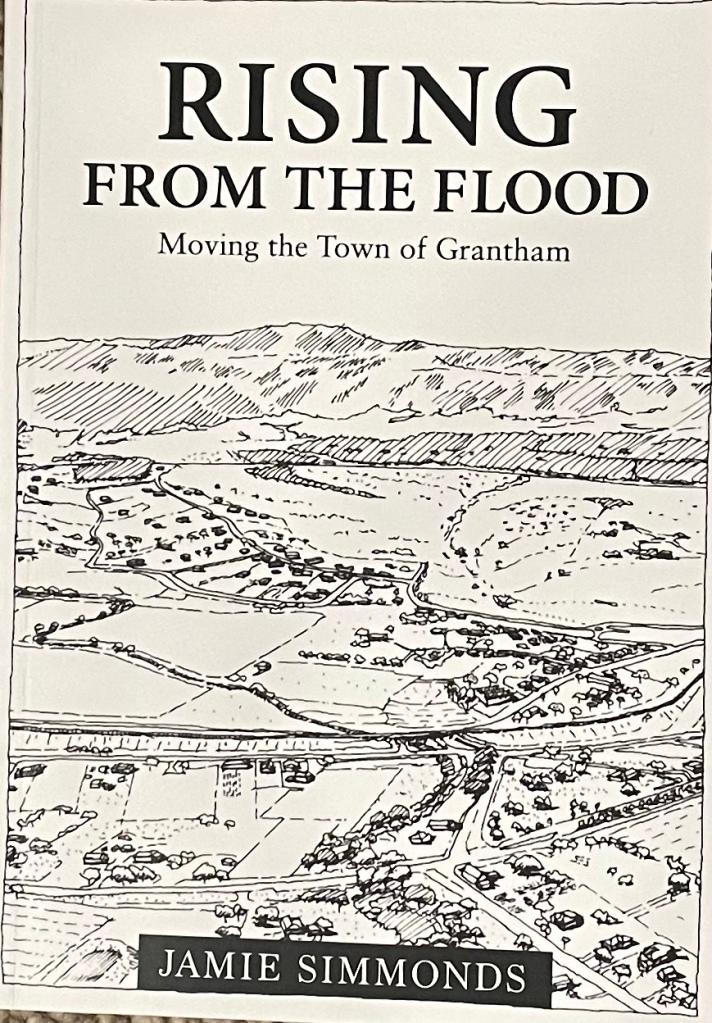
Though plainly written, Simmonds’s Rising from the Flood. is to me an engrossing account of shifting a town to higher ground. That flood in 2011. The book published in 2020.

I lived in Mullumbimby, Northern Rivers NSW, for thirty odd years and shopped, went to university, medical appointments and social occasions in our nearest biggish town, Lismore.

Lismore lies where the Wilsons Creek joins Leicester River becoming Wilsons River. I’m kind of amazed typing this because I’ve been under the impression for 35 years that Wilson’s Creek/River joined the mighty Richmond at Lismore.

That that’s why it is so flood-prone. (There possibly will be some editing later, after I’ve talked to a few locals, as I really dont trust Google on this) But anyway, we press on. In the time I lived the region, Lismore was flooded numerous times.

After every flood there was talk of moving the town to higher ground. After every flood people rebuilt in the same place. Then came the 2022 flood! A flood mightier than even the 1974 flood that inspired a town-wide memorial event in 2004.

I’d already moved to Brisbane by 2022, and only had the news and what people told me to go on. Though there was talk early on about moving the town to higher ground, nothing eventuated.

Now, two years later, Lismore doesn’t seem to have recovered that well. There are dozens of towns like it along the east coast along rivers on flood-prone land. And floods are set to increase in both number and severity.

So what does it take to move a town? Because I had heard that Grantham, in Queensland, had been moved. If it’s been done before it can be done again, right?

Chapter 21, Keys to Success, opened my eyes.

First thing needed is leadership. A strong charismatic leader has to be on the ground, already known as the town’s leader, at the event, ready to take on the work right then, with a strong team.

Grantham had their mayor, Steve Jones, and his team.

Speed is the next important key. Steve and his team promised Grantham’s people they’d move the town in eleven months! It was what kept the community behind them.

Third, the project was locally driven. Yes, of course they had help and funds from higher levels of government. But it was important that decisions and their implementation remained local, and I see that. A way of keeping hurting businesses working.

Last, according to Simmonds, a small and agile team. All of them leaders in their own scenarios, able to push through inertia, doubt and reluctance. Everybody gets tired, after all.

What about the existence of somewhere to move to, I would add. A farm on higher ground was being sold at the time. I don’t know how you would replicate that chance. Because that’s what that was, chance.

But after I read the whole story, I’m inclined to think that if you don’t have that leader, you can kiss that whole relocation goodbye. The fact that Grantham had a charismatic no-holds-barred leader in Steve Jones explains it all.

Overdoing it led …

To catching a bug

Which led to a respiratory inflammation

Which led to a fatigue, coughing, and everything else that goes with it event

Which led to a three week furlough

Today I thought I had recovered. Wishful thinking, obviously. Went to a meeting with about a hundred attendees. I was OK sitting down.

Then got a call. I’d forgotten to silence the little mobile beggar. Ran out to wring its neck, but ended up sitting outside in the solitary quiet taking the call.

And afterwards thought I should have a go at the greet and meet after the meeting. Found a chair, unfortunately just got in at the tail end of the last question about gardening.

Still, the development map on the drop-down screen showed a wide yellow road covering the place where I though to plant some veges. Guess I’ll rethink that one.

Suddenly everyone was up, either pushing to the front for the afternoon snacks and apparatif or toward the back to make their getaway. I drifted to the puzzles table and completed the roof of a shed in the time that it took for the scrum to subside.

When I looked up there were only people with a glass in one hand and juggling a plate piled with scones cake and cream puffs. But lots of them. I saw two people I’ve met but didn’t get to talk with them.

I found a the gluten free dairy free section and had a couple of meat balls and six grapes. The place to get a hotwater drink was inaccessible and anyway I had the weirdest feeling.

Like I was a square ball bearing, had a lot of people coasting wordlessly by me, my hearing aids did not cope either. You start questioning your sanity for even being there.

Found out a few facts. I am one of 133 new people these last 6 months. There are now 241 residents. I can totally understand that the people who were here last year are feeling swamped. I feel swamped with them.

But, not to forget, I’ve never been one for crowds. I’ve always run in the outer edges of the herd, where you can easily take time out.

On my way home met a couple walking their dog, which was a relief, and picked up my mail. Finally, A Little Course in Dreams by Robert Bosnak. Started reading it right away.

One of eight books with bookmarks in them. Plenty to write about. Though not today. Just finding a pic now to accompany this mournful screed.

Lego: Bosley & Co, 15

15. The Bunkhouse

Finally the day arrived when Bosley felt ready to put together the bunkhouse. He now had all the necessary elements stored here and there, and there was no reason, not even inclement weather, to hold off any longer.

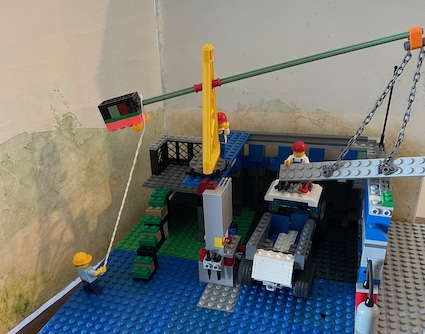
He, Drew and Dan and Dan’s trusty four-wheel drive moved the components of the shadoof to the garage. While Drew helped Bosley put the shadoof together, Dan fetched the front beam to tie the side walls together and support the roof over the garage.  

Drew and Dan between them managed that hiccup without Bosley’s input, though none were happy with the lack of control over the vertical movement. “Which is the bit that does the lifting, after all,” Drew said.

“Hmm,” Bosley said. “Think I’m going to need a lever. Have a holiday, Dan. It’s back to the drawing board.”

Dan went away and a little while later returned with Nin Wiz and the most northerly wall balanced on the truck. They stood it ready. Went back to fetch the south wall. Bosley and Drew took the shadoof arm off the upright frame and threaded a lever handle onto it. Stood the contraption back up.

With Nin Wizard supporting the walls as they were raised, the work proceeded so smoothly that Drew quite forgot to take the snapshots they’d decided on. He only remembered when Bosley said, “Stop. Wait.”

“What?” Drew said.

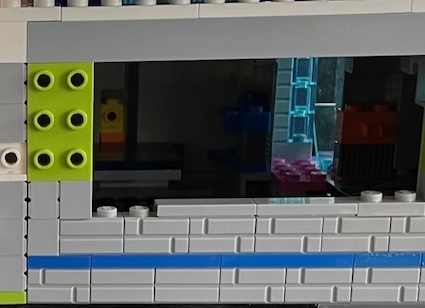
“I’m not happy about that window hole,” Bosley said. He pointed.

“We only have windscreens and French doors in our window store,” Dan said.

“Fine,” Bosley said. “In making do, we’ll invent something better.”

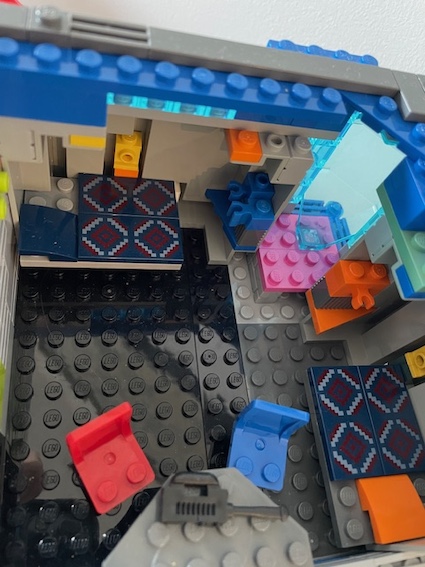
“We’ll sling a tarp and sleep up here,” Dan said. “I like what you did in the corner.”

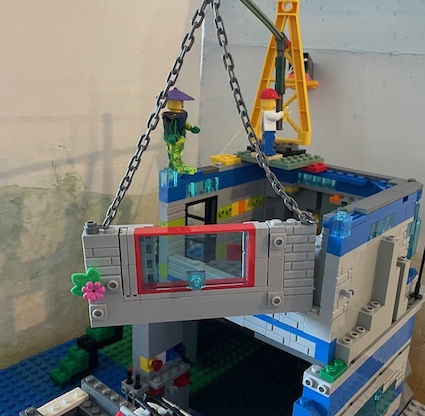
Next morning, while Dan, Drew and Nin raised a further two courses of bricks on the walls so that people wouldn’t hit their heads on the ceiling, Bosley invented his preferred front window using a glass door on its side and a few modified blocks.

After re-installing the shadoof, the front wall was lifted into place.

Then the furniture, with Drew back on the drag-line.

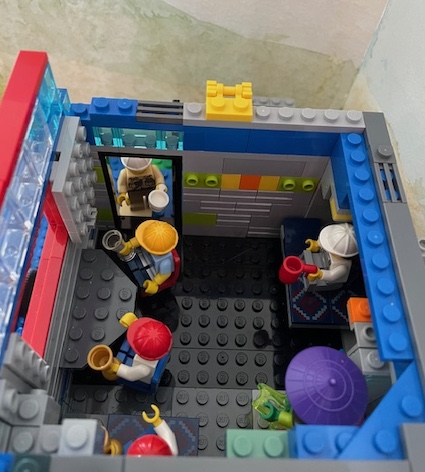
“Let’s celebrate!” Trish called. She brought a stack of cups and mugs while Tim followed with the bubbly. They admired the bunkhouse, Bosley & Co’s first permanent dwelling, and partied into the night.

And after they went to bed, nobody got any sleep, Nin Wizard so busy with his build.

Clatter bang rattle! Something fell a long way down.

“What was that?” Dan grumbled.

“You’re all right,” Drew said. “Sleeping in the bunkhouse. I’m just lucky it missed me!”

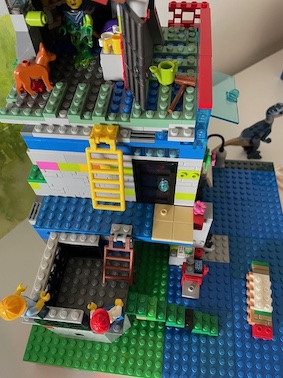
Next morning, they one by one climbed the two and a half ladders to compliment Nin on his new abode, and exclaim politely over the corner-post that had clattered all the way to ground-level.

Nin shrugged. Ran out of magic, he indicated. Only Trish stayed to plan the new bathroom annex and her and Nin’s share-garden, and have a cup of celebratory tea.

Eleven Weeks

Is how long I’ve lived in my new apartment.

You’d think there would be nothing new left to discover, but you would be wrong. Yesterday, while checking the height of the powerpoint above the fridge, I found a tap!

Tap? (Faucet I think you say in the US) But a tap up there? This is in the kitchen, in the place/gap left for a refrigerator?

No, wait. Some fridges come with ice-machines, I suppose they need a water supply.

And I suppose by giving residents these little luxuries, the designers and owners thought they could pull the wool over their residents’ eyes where ventilation is concerned.

Ventilation is a problem. In this apartment, the laundry is in a cupboard along the middle of the corridor. At one end of the corridor is the master bedroom and adjacent bathroom, and at the other end is the multi purpose room and so-called powder room. All three wet areas are provided with a ceiling fan.

The impending trouble is mold. Already there is often a smell of it in the laundry. I’m probably meant to run the laundry fan 24/7 but it’s noisy and uses a lot of electricity.

There is a Dry cycle on the aircon that I’ve used once, which is something to test out further. I’d like to know, though, whether and how the air in the apartment circulates? (I might wend to renew.com.au later to find out more about that.)

There are aircon vents and overhead vaned fans in the main room, the bedroom and the MPR. There’s no aircon vent in the corridor and it’s only possible to isolate the main room. The obvious solution is to run the aircon in the whole house to ventilate the corridor.

Without being sure that that will send air into the laundry. Because the laundry doors are bifold. Leave them closed for style and beauty? Leave them open for utility and inconvenience as they protrude into the corridor? Still can’t be sure. Air flow around obstacles is a mystery.

I’m seriously thinking about hiring a shed in the shed room, taking the laundry doors off and storing them in the shed.