Reading ‘Weaponized’

Reading Weaponized by Neal asher (2023) was a marathon.
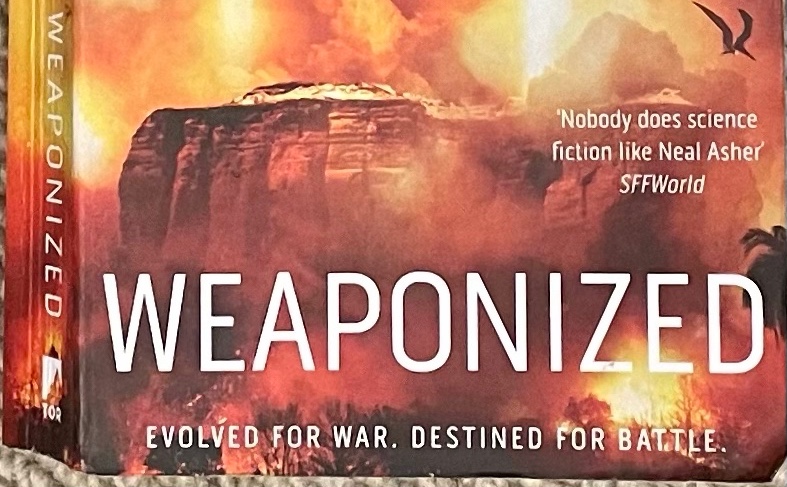
Section of the Front Cover

There are a couple of Asher’s novels I’ve enjoyed, The Skinner and The Voyage of the Sable Keech, for example, the first two instalments of the Spatterjay trilogy, published in the early 2000s.

I found those inventive and engrossing. I still think with fondness about the living ship. The Polity novels that intervene between those and Weaponized are set in a human universe ruled by AIs.

In Weaponized a bunch of human characters from the polity intend to colonize an outer planet. They’re all in their second or third century and are bored. They intend to go back to basics somewhere new.

Ursula Ossect Treloon is their leader. The plot is a relentless competition for superiority between the human would-be settlers, and the native wildlife.

Neither of them wins when both appear to be taken over by superior Jain technology, from yet another universe. The end is is circular, a mystery, when a fragment of Ursula is saved by the Polity mole.

Most of the story is the ‘science’ describing the adaptations that need to be made to continue the struggle to survive an ever evolving enemy.

And this is an evolution happening at a daily at most week’s pace. The actual plot was told with a series of one liners buried in the almost baroquely detailed descriptions of the technology. Non-stop action as the back cover promises.

By about a third of the way through, I was wishing for a bit of ordinary narrative, describing the settlers ordinary time. But if anything proceedings notched up, there was never any relief.

User-Friendly

Part Two of Blog Usability

Having a good night’s sleep often helps me to ‘think’ things through, with that kind of thinking being done in the unconscious. So while sitting down for breakfast this morning and checking the weather and my mail, I also checked how my latest blog post appears to people reading it on the their mobiles/cell phones or tablets.

First there are the four lines below: Title, Author, Categories and Date & Reading Time

Then the BLOG CONTENT, arguably the meat of the meal. My stats page tells me 8/10ths of people read just the email and they have the opportunity to Comment and or Like. Eight tenths of the time I do the same. Most mornings I have time to read things, but not comment.

People who click through and read on the Reader interestingly get the Tags in a header at the top. Nobody else does. Clicking through and reading on the Blog gets you the following list of additional bits and pieces.

Share this and Likes, another important bit. Then, Related posts. Then Tags, I was surprised to see. Then, the Published by … and About Me paragraph, followed by Leave a Comment. Finally, one after the other, the three new widgets. First the Search Box, followed by the mashed up Categories list and, finally, Recent Posts.

A lot of superfluous stuff in that list that I doubt anyone will read. One thing I dislike about the internet in the last 3 or 5 years … the amount of bloat and padding a reader needs to negotiate their way through!

It’s as if since no one is accountable for the amount of web-space being used … like we have vast distances of free geography to fill up and never mind the amount of electricity needed for cooling towers … and 3000 words looks far more impressive then 1500 words … repetition and padding are the new normal.

I grew up when paper newspapers and magazines were the go, when every inch of print had to be paid for, and flab, repetition and padding were cut ruthlessly. It seems to me we need to renew that contract. To save on cooling towers and save readers.

So. This is what’s going to happen. Starting at the end of my list, Recent posts is gone, as they are more or less taken care of in the Related Posts item. The list of Categories is gone, as the categories pertaining to that post are covered in the third line of the title block, and they are more useful to me in their nested format in settings.

While the Search Box is useful, I don’t know how useful it’ll be where it is. Wait and see is the go with that item. Then there’s Leave a Comment. I’m leaving that where it is.

Then, Published by … and About Me is starting to look rather jaded. It’s up for a make-over. Tags are said to be important but I often suspect the post’s title and categories are doing the grunt work. I might be able streamline Tags … they are a work in progress. Related Posts, Share This and Likes are all to stay.

Blog Usability, Part 1

Blog appearance has changed and hopefully, as a result, usability has improved.

Not like these Lego stairs. This is Tim working on them, he needs to transform the treads from three-tiles-high to two-tiles-high to improve usability.

After studying all the themes available and making notes on just one possible, had another look at my present theme … Independent Publisher 2 by Raam Dev … and discovered that it allowed me to insert the three widgets I wanted. I thanked Raam Dev and my lucky stars.

Over the years and on the various different blogs I’ve been involved in, I have tried quite a few themes. This one is my favorite and so I was glad I could hang on to it.

I’ve tried to do things a little like Tim is doing to his staircase, in the example above, to make this blog more user-friendly. For instance, by adding a search box to help find installments of the novels, and for me being able to find quickly if I have already posted up such-and-such story. I looked for Amble and did not find him other than a mention in another story. But that’s all right, he’ll keep.

I’ve cleaned up Categories. And oh boy, the list was endless. It needed me seeing the list in total to realize how unwieldy it had become. But what I’ve just noticed is that the new list of categories has mixed and matched subcategories as though they all have the same value. I’ll rejig that sometime, maybe tomorrow. I’ll also need to clean up the list of tags. I have 34! pages of tags. Tomorrow is a better day for that job, too.

Last is the widget for the five last posts. I don’t know how useful that is. Let me what you think? maybe I’ll replace it with a tag cloud.

Blog Appearance

Don’t necessarily need a new theme, but definitely a few more widgets.

I’ve been thinking for a while that with 320+ published posts, it’s getting a little difficult for readers to find what they might be interested in or read, for example, Avatar Remaindered sequentially … I see evidence of that frustration in the stats. For myself it’s the frustration in locating posts that I might’ve originally decided to amplify.

So, two things I need to do. One, is to re-jig the number of Categories. I haven’t decided yet what will be more efficient, an increase or a decrease. Second is to install the widgets that will give us a better reading and finding experience.

I can’t believe I don’t even have a Search Bar yet when I use it frequently on other people’s sites.

Clouds of Categories seem to work best on sites that specialize in a particular topic, and have relatively few categories. Although I enjoy using them, I will probably give that function a miss. Although just having seen one on the Locus Magazine’s site I may give it a go.

Comments on these matters are welcome.

Travelling (!)

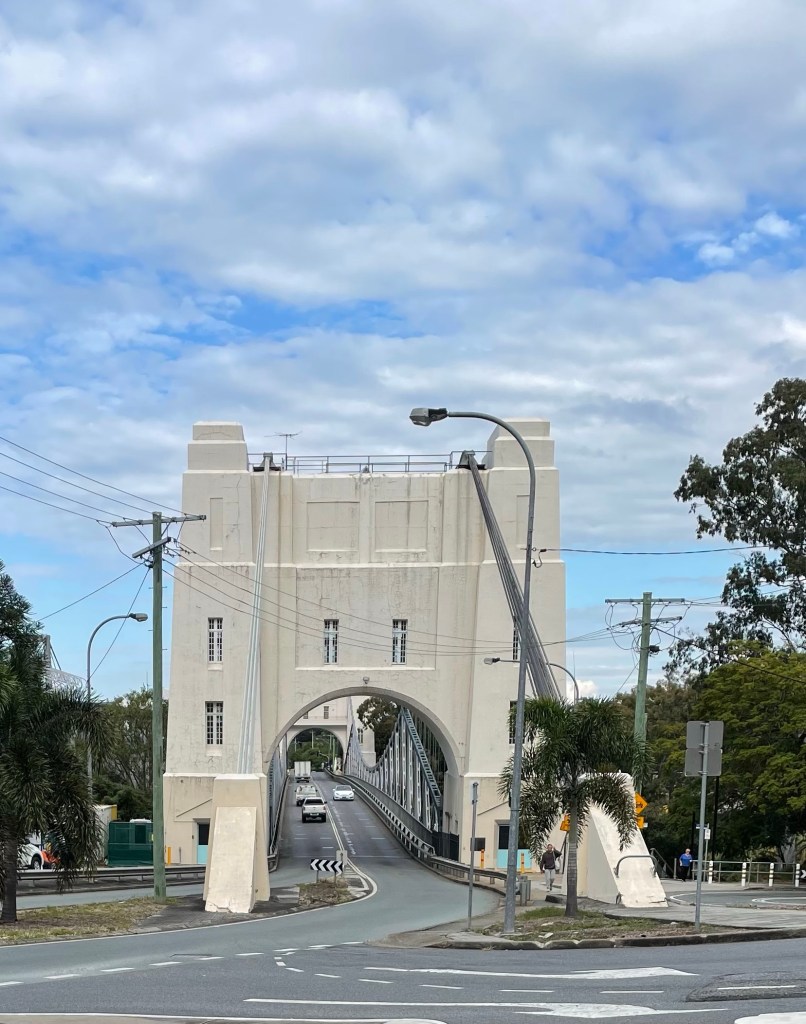
Walter Taylor Bridge, one of the many bridges across the Brisbane River. This one joining Chelmer on the southwest side to Indooroopilly on the northwest side.

I travelled 18 kilometres to Indooroopilly to finally have my hearing aid fixed. Eighteen kilometres that costs $55 and about forty minutes in a cab.

18 kilometres back again for an unknown amount on my senior’s Go-Card, but not more than about ten dollars, and two and a half to three hours by train, shank’s pony and bus.

I paid the cab fare on the way out there because I wanted to see how far along the roadworks had got. These the works relating to the new underground railway station and new railway tunnel under the river. It’s astounding how much of that work has to be done top-side. Made up for the cab fare by not spending anything on lunch.

On the way home, walked to the railway station—saw that nice piece of vintage infrastructure above—and waited at the station. Twenty minutes gone.

Roma Street Station still—by now it’s probably been five years of mess—at sixes and sevens due to the changes being made. But managed to find a human ticketing dispenser and was able to exchange my blue Go-Card for a brown seniors’ card. Forty five minutes at Roma Street.

Roma Street so frustrating in the end, I thought I might as well shank’s pony again (ie walk) to King George Bus Station and catch my ride home from there.

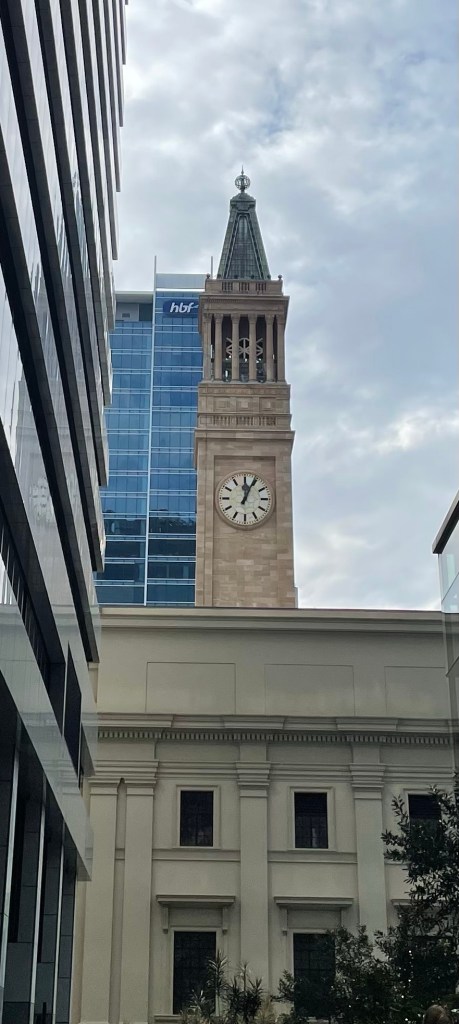
Sat down for a lunch snack and drink at 12 noon, just in time for this …

Post Office tower and how tiny it now looks! A short carrilion in keeping with the hour.

The bus 222 home to Carindale, a total of 4005 steps as well as all the other mileages. Left home at 10.00 am, got back at 1.30ish pm. Worth it?

Oh yeah! I can hear again. Missed listening to music, hearing phonecalls properly, not being surprised by squealing laughter, and birds … I can hear birds again!

Books …

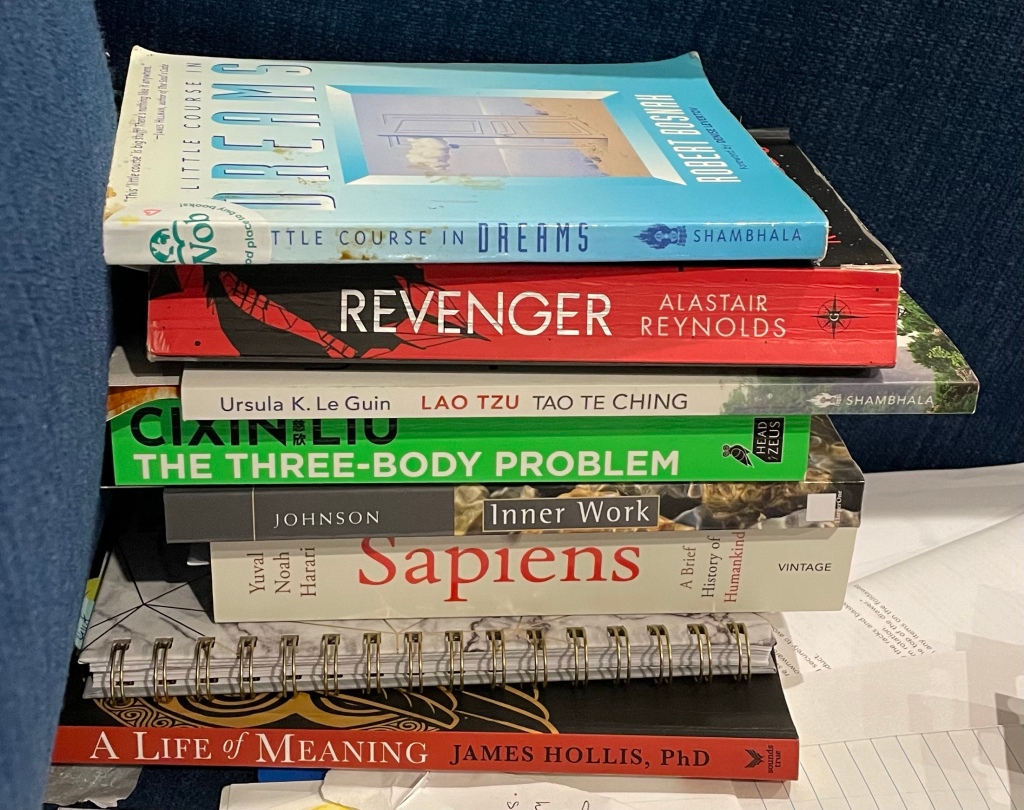
Some people keep their piles at their bedside. I don’t sleep when I read in bed. This pile —

is beside me, on my couch. Plenty of paperwork under them as well, as you can probably see. My tax return for 2022-2023, for instance. Late already, it’s very forgettable.

Three of the books relate to Interpreting Dreams, the online course I’ve been studying. I’m halfway through but seem to be marking time, like I’m stuck on learning about shadows, and getting side-tracked on a bunch of other interesting stuff.

Ursula K LeGuin’s Tao Te Ching is a wonderful interpretation that I wouldn’t like to do without now. I have three bookmarks in it but most often I “make my daily march with the heavy baggage wagon”. From 26, Power of the Heavy.

Second from the bottom is my health journal wherein I keep track of what my Low Dose Naltrexone regime is doing to me. Good things, so far. Much less inflammation.

Then Sapiens: A brief history of mankind by Yuval Noah Harrari. Have to admit I’m past what’s most interesting to me which is humankind’s early history. I’m struggling through Roman times and the age of the empires.

Next up, is The Three Body Problem by Cixin Lui, famous Chinese SF author. Translated by Ken Liu. Unfortunately I started watching the TV series of the same name before the book arrived via snail mail. While the TV series is an easy and engrossing watch, the book is every bit as cryptic as has been said. Reading it, I keep trying to match events in the TV series.

Last in the pile, there’s Revenger by Alistair Reynolds. It’s just as rich and baroque as the first and second times I read it. It’s meaty with a thick silky gravy, excellent food for my SF hunger. And in addition I’m on the watch-out for the pirate captain’s magnificent orrery that influenced me to purchase the much paler Lego version. My next purchase will probably be the third installment of this trilogy.

Moving a Town …

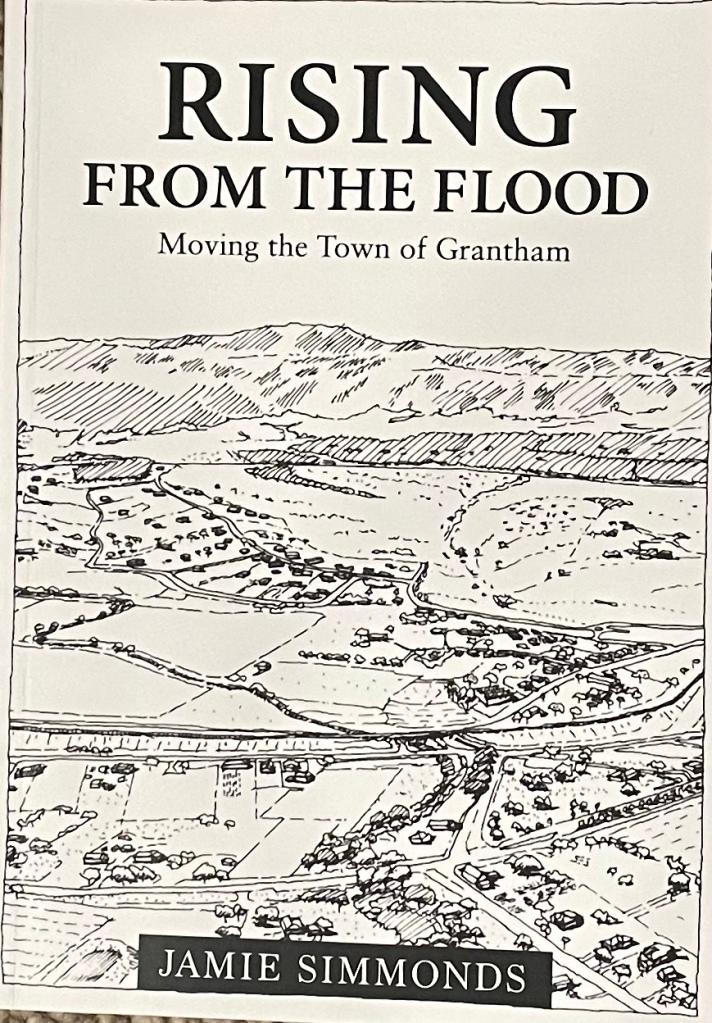
Though plainly written, Simmonds’s Rising from the Flood. is to me an engrossing account of shifting a town to higher ground. That flood in 2011. The book published in 2020.

I lived in Mullumbimby, Northern Rivers NSW, for thirty odd years and shopped, went to university, medical appointments and social occasions in our nearest biggish town, Lismore.

Lismore lies where the Wilsons Creek joins Leicester River becoming Wilsons River. I’m kind of amazed typing this because I’ve been under the impression for 35 years that Wilson’s Creek/River joined the mighty Richmond at Lismore.

That that’s why it is so flood-prone. (There possibly will be some editing later, after I’ve talked to a few locals, as I really dont trust Google on this) But anyway, we press on. In the time I lived the region, Lismore was flooded numerous times.

After every flood there was talk of moving the town to higher ground. After every flood people rebuilt in the same place. Then came the 2022 flood! A flood mightier than even the 1974 flood that inspired a town-wide memorial event in 2004.

I’d already moved to Brisbane by 2022, and only had the news and what people told me to go on. Though there was talk early on about moving the town to higher ground, nothing eventuated.

Now, two years later, Lismore doesn’t seem to have recovered that well. There are dozens of towns like it along the east coast along rivers on flood-prone land. And floods are set to increase in both number and severity.

So what does it take to move a town? Because I had heard that Grantham, in Queensland, had been moved. If it’s been done before it can be done again, right?

Chapter 21, Keys to Success, opened my eyes.

First thing needed is leadership. A strong charismatic leader has to be on the ground, already known as the town’s leader, at the event, ready to take on the work right then, with a strong team.

Grantham had their mayor, Steve Jones, and his team.

Speed is the next important key. Steve and his team promised Grantham’s people they’d move the town in eleven months! It was what kept the community behind them.

Third, the project was locally driven. Yes, of course they had help and funds from higher levels of government. But it was important that decisions and their implementation remained local, and I see that. A way of keeping hurting businesses working.

Last, according to Simmonds, a small and agile team. All of them leaders in their own scenarios, able to push through inertia, doubt and reluctance. Everybody gets tired, after all.

What about the existence of somewhere to move to, I would add. A farm on higher ground was being sold at the time. I don’t know how you would replicate that chance. Because that’s what that was, chance.

But after I read the whole story, I’m inclined to think that if you don’t have that leader, you can kiss that whole relocation goodbye. The fact that Grantham had a charismatic no-holds-barred leader in Steve Jones explains it all.