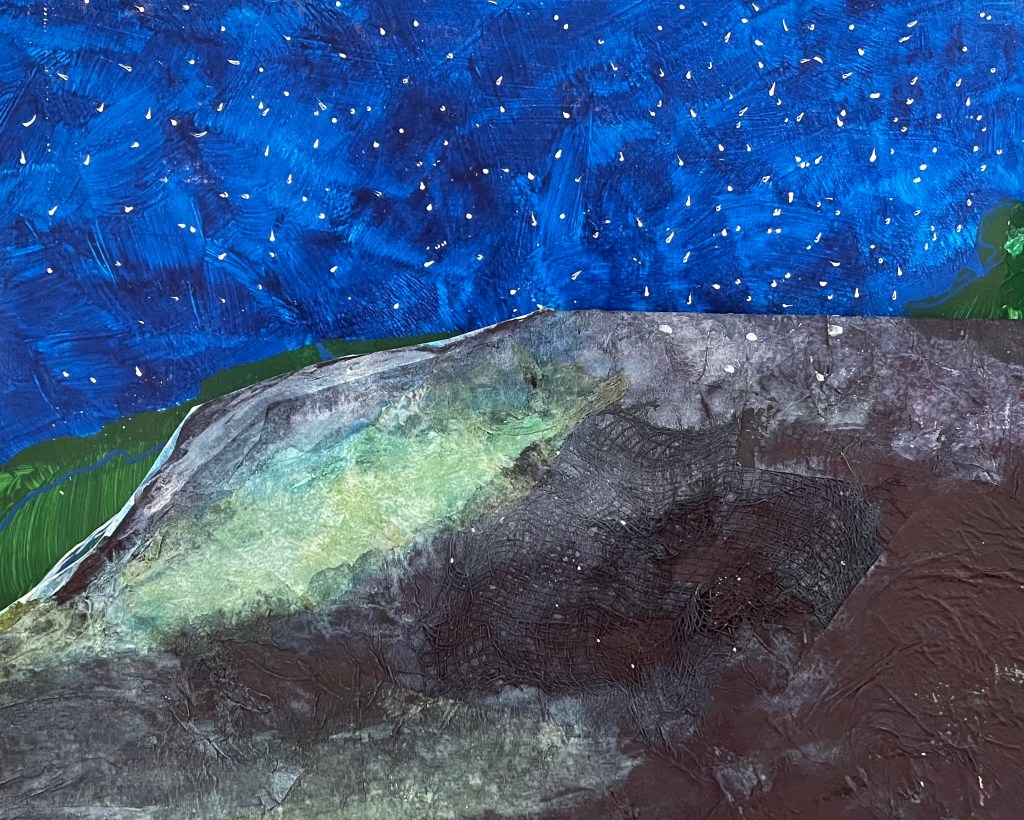
Ideas shining like stars and dulling past their use-by-date mixed media, Rita de Heer
I’ve been reading quite a bit about the ‘ideas debt’ (Jessica Abel) that many creatives allow themselves to be burdened with. Me included. And what to do about it as new creativity is slowed, and even stopped, while you figure out what to do with all this material that owns you, and what you owe it.
A form of emotional blackmail that you lay over yourself, I’ve started to think. Include here the people who know and love you, who know how much you invested in your project. There’s a chorus. But? But?
In my case this is where I spent twenty years learning to write novels, and then writing about a dozen interlocking science fantasy novels, most set in the same universe if not time span. Only one, maybe two, have been published. I see that I’ve left them behind so far already, that I don’t even recall whether I published that second one or not? Tch tch.
The recent two year gulf, gap, hiatus in my life put paid to any more work in that arena. I have no energy for finishing them … most are in the final chapters, or as far as beta drafts. The getting ready for marketing, and the marketing itself … exhausting.
I wonder if I have enough energy to turn each one into a pdf and post it as a blog installment, for example? Prefaced one and all with the same little letting-go story?
The minute I saw a Lego base-plate, I knew I’d have to find an alternative.
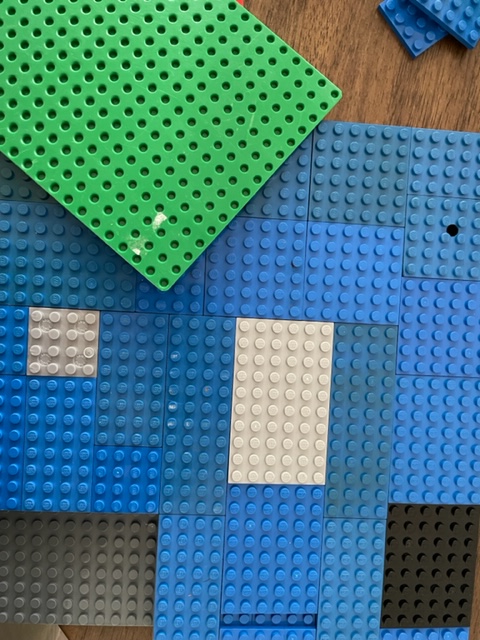
Underside of Lego base plate in green, my version of a MILS plate in blue etc
Most of the building I’m doing is on my smallish round dinner table. When I have guests stuff has to be able to be moved easily to shelves. Just how weak and bendy the original base-plates are was amply illustrated to me by Darryl of Bevin’s Bricks on Youtube cutting one up with a box cutter.
I already searched through possibilities like glueing base plates on cardboard and building on ordinary plates and joining those with other ordinary plates. Neither of which attracted me. The first because it’s hard to stay accurate. The second because of heavy and awkward builds springing apart when you least expect it. I’ve read about builds grievously falling apart while being transported from one table to the next. Not ideal, in other words.
Then, on one of the FB groups I joined, I saw mentioned the MILS plate as the next development in the search for a strong base plate. Following that up, I saw a good explanation on Bevin’s Bricks. [Though I have again forgotten what ‘MILS’ means. I have a life-long memory glitch in relation to acronyms.]
Me constructing a ‘proper’ MILS base plate right now would’ve meant ordering the required parts, and weeks of waiting on covid-struck postal services in several countries. Even getting supplies by post from my local brick resales outlet a few suburbs away, usually takes a couple of weeks.
Not helped this week that I’m house-bound again, waiting to be told whether I have covid or another lurgy. Well, I know I have a lurgy. Ten days of coughing.
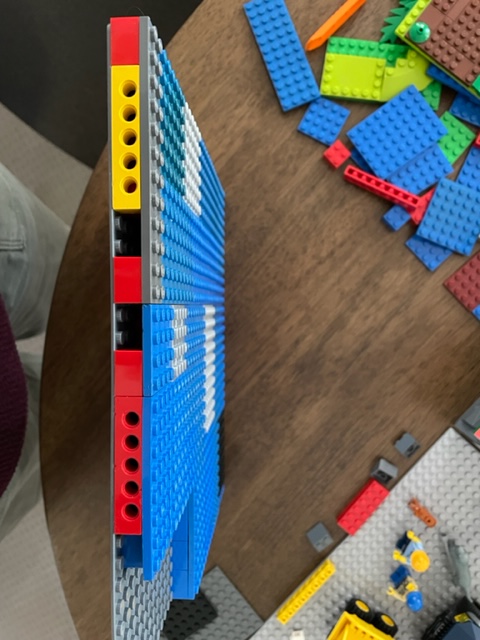
But … I have six alternate-lego base plates, lots of blue 2×2 bricks and red 2×2 bricks that I have no idea where to use, a few 30-year-old Technic 1×6 bricks, and a bunch of blue sun-damaged plates of all sizes. Can I achieve something with them?
I could. Very likely the ordered honeycomb of professionally built MILS base plates is not present in the internals of my sandwich base plate (below) because I spaced the reds and blues according to need, not design. I’m very happy with it and am aiming to put another one together tonight.
Yesterday I was reminded that Bosley & Co need at least 2 more hard hats to be able to pass building inspections. Off went another order to BrickResales.com.au for hard hats, a few other building site necessities, and a trio of frying pans for the new outdoor dining setup. LBT’s (Australian delicacy: lettuce bacon and tomato sandwiches) coming up.
While most of the structures I build are MOCs, aka My Own Creations–for the ongoing story– every so often I buy a set for what I can learn from them.
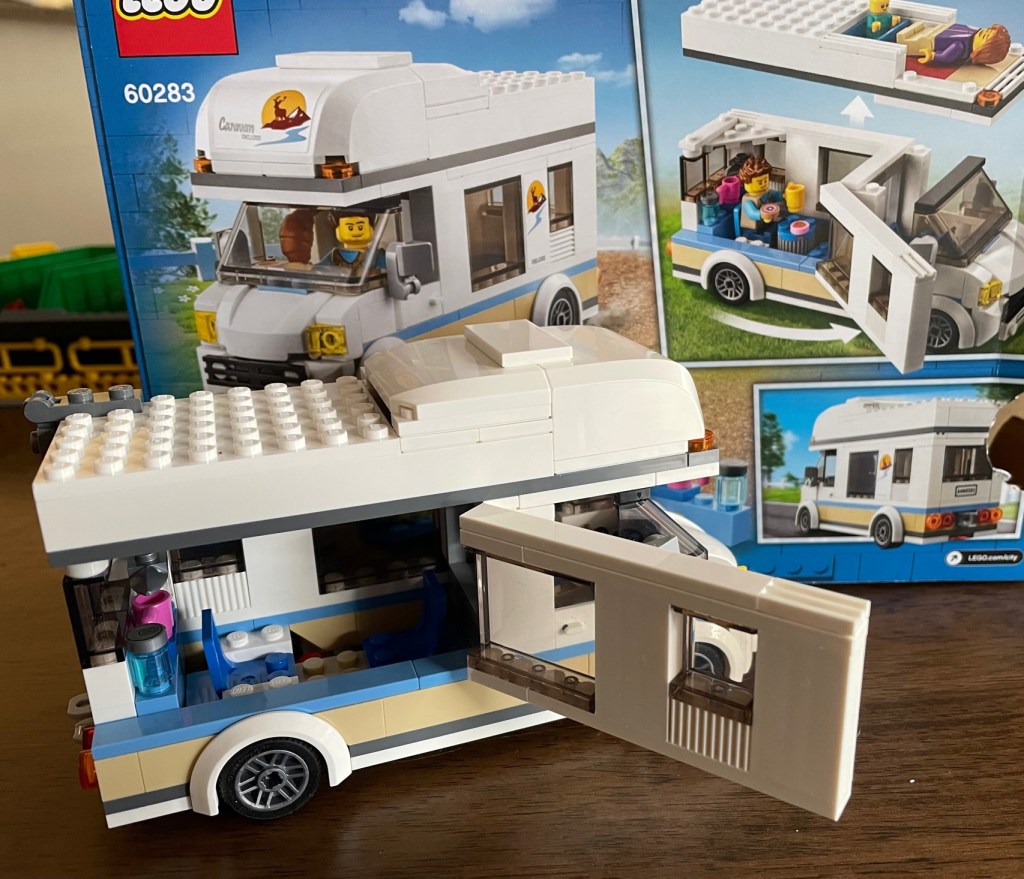
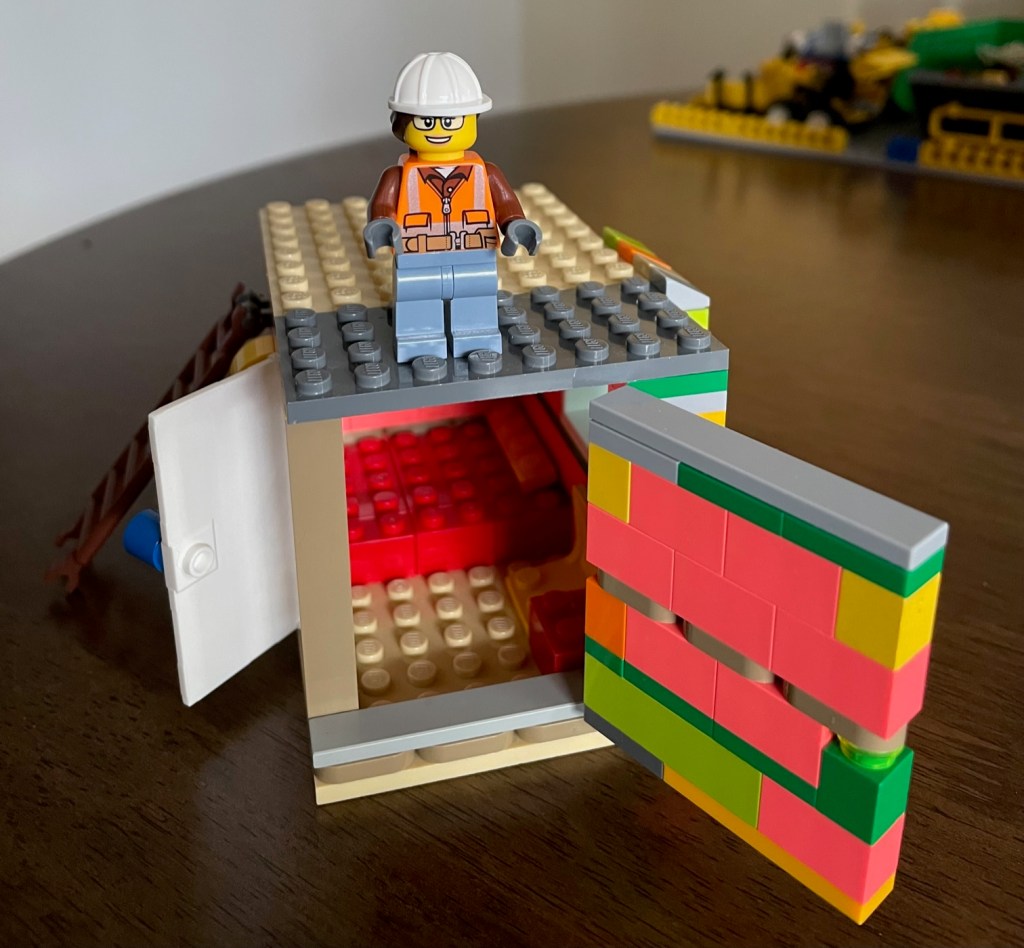
This week, I tackled the (shown above) Campervan Model #Lego60283. Took me a couple of thoroughly enjoyable hours to put it together at the same time learning two techniques that’ll help me keep the interiors of my own models accessible.
First there is the camper’s easily lifted off roof. This has made access to the vehicle’s roof spaces so easy, I’m planning to use the technique for some of the apartments in Bosley & Co’s proposed multi-storey build.
Starting with the ground-floor cabins, I discovered that once you put a roof on a place, the windows and doors are too small for adult fingers to access the interior. Furniture, for example, that needs to be installed inside, has to be done during the build, or the build carefully dismantled and done again with extras included.
In that mode, there are cabins on the site that have been built three times. Jackie and Jed Cranedriver’s now very fancy hut is a case in point. Version One looked like a grey box. Version Two had some color in it.
Third time, this time, it has a swing-open wall similar to the one in the camper-van. I love it. Though it will take further study to get the colors matching where they are meant to. I can foresee a fourth rebuild.
Despite the optimistic style of the title and subtitles, this is a story about ‘trying’ to publish a bric-fic fantasy. It’s been a zig-zag journey of dead-ends, so far, and I wrote this paragraph last because even WordPress is not productive when asked to do something a little different.
I’ve always wanted to name a new genre, and here it is. Little did I know it’d be in the arena of AFOLs (Adult Fans of Lego) but that is also what I am. An AFOL.
The genre has been in existence for a while, I’m sure, since the Lego Group has been going 90 years, and I can’t be the only one who’s ever seized on these bricks and the mini-figs to tell a story. But it’s hard to find them, to compare my work, without a genre label.
Let me know if there is a term already out there?
After producing a slideshow on my desktop, I’ve been trying to find a good place to publish. I’ve tried a FaceBook Page, an Instagram account, and a WordPress slideshow with varying success rates. None of them more ideal than daily FaceBook posts on my Feed.
The slideshow block on this site likes photos, but finds captions harder to deal with. It’s another learning curve of the two-steps-forward-one-step-back variety. Something like a muddy path.
A gallery of photos and text boxes may serve. We shall see.
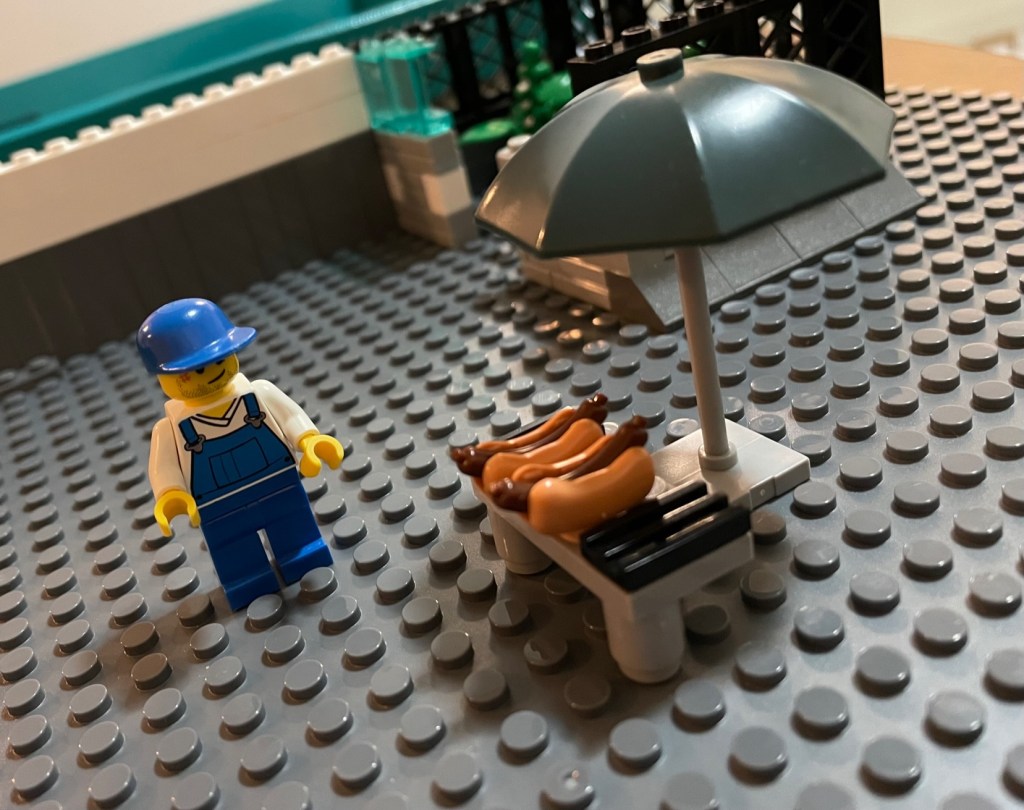
“That’s a laugh! I can’t fit through the door. There must be something wrong with the plans.”“At least these Sausage rolls are the right size.” “All right, people,” said Boss Builder. “You’ve all seen by now that the new build is either a joke or the plans are a misprint.” “Though the materials list matches the plans,” Dan said. “I trucked it all there and what? They think we’re building a club house for kids?” “I called the owners about it,” Boss said. “They’re convinced we have the plans for a full-size hardware store. So, Drew and I decided, we’ll build them that and charge them accordingly.”
You can see in the third pic that the caption continues beyond the bottom of the page. Conclusion? A gallery will not do. The ‘captions’ are often too long.
I need a structure to input once, not one that needs me to scroll to the place where it exists, for every photo and every caption, copy, then scroll back to where it’s wanted. Wondering now if a table will work …
Nope! A prefabricated WordPress table does not stretch or accommodate photos and long captions, the way a word processor table does. Lucky last for today, I’ll try the column block:
Scene 8:
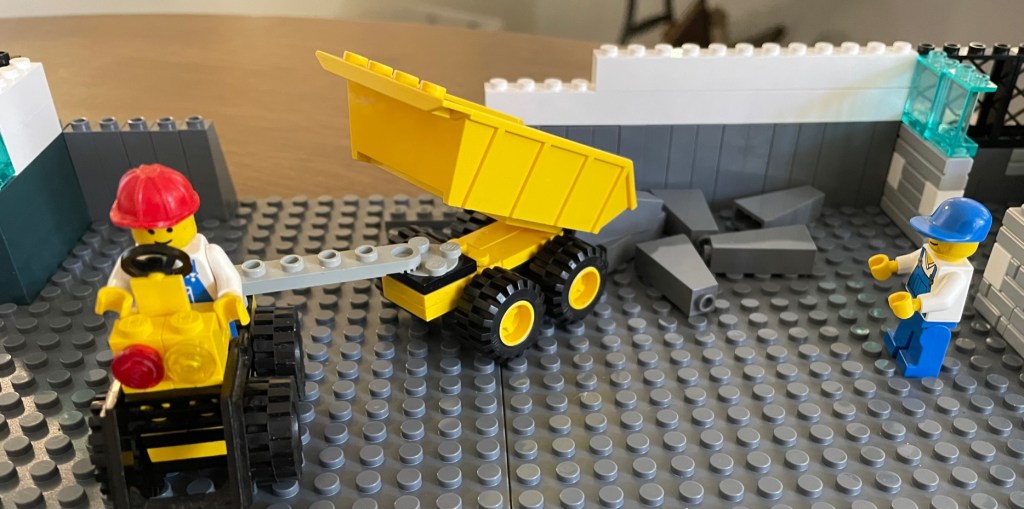
“After I dump the foundation blocks, fetch what?”
“Park the run-about and help me install the blocks.”
“But Boss, the scaffolding is cluttering up the yard. I should get that first.”
“But Dan, nowhere here to put it until we get the blocks in place.”
Scene 9
Beep. Beep. Beep.
“Tip them out. Dan, I’ve got Drew here to help me. You go wrangle the forklift attachment. One of the sparkies will help you get the electrics connected.”
“Right-ee-oh, Boss. Hey Drew, don’t let him run you ragged!”
“Boss and I are good, Dan. We’re brothers.”
“Well, that’s good to know!”
And that is it … the ‘column block’ feature stops working after two photos. It lets me input more text, but refuses another photo.
My Trusty Pack-horse by Rita de Heer (Day 12 of #Inktober 2021)
Yesterday, in snail-mode, I struggled to get out of the house, onto some transport — bus, train, cab, car-share. All coming with timetables, places to catch, and the last one impenetrably with a forgettable password and a pin. No-one else I know has trouble signing up to Uber!
When my eyes and mind are greedy, I start making promises to come here and there, this event that meet-up. I have great intentions. But, physically — 15 months post-chemo — I’m capable of about half of what I sign up for.
So, yesterday. Snail-mode is when I’m slow. Though it was a lovely day outside, sun shining with a nippy little breeze in the shade, I signed off on the event. Did not catch any of the above transport. Did not visit, nor explore further, my favorite building in Brisbane. Emailed the organizer my abject apologies.
And so, since the sun still beckoned me outside, and I didn’t want to dwell on the cop-out — what it felt like — I loaded my trusty pack-horse with my three-week-overdue books, pushed it to the Stones Corner Public Library. A good walk of four kilometres. The sun a benison.
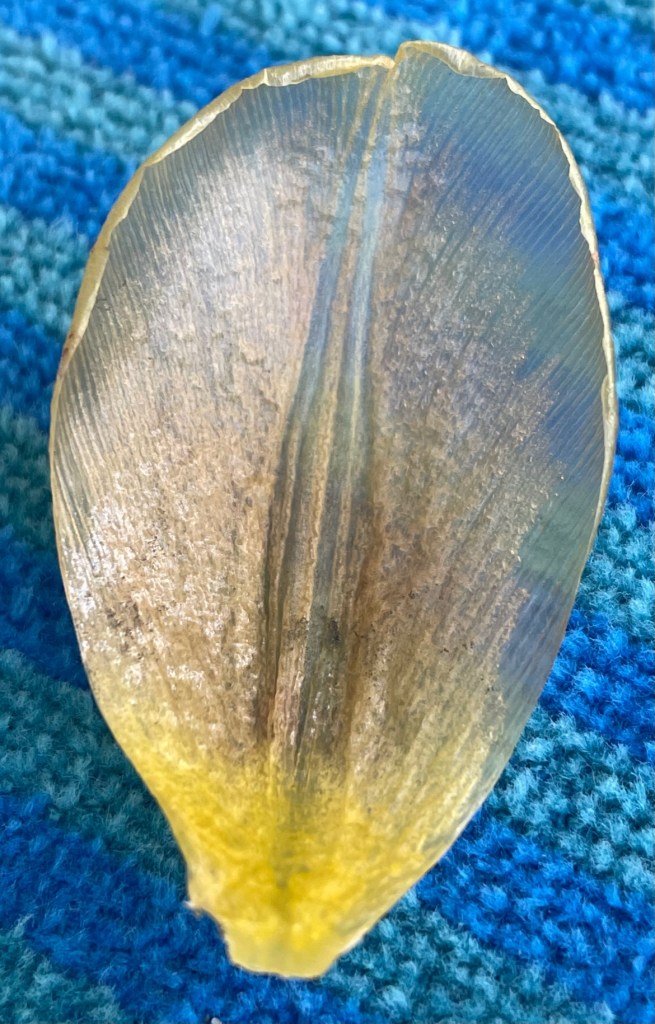
These almost-gone tulips startled me with their sere beauty. A good metaphor for how I feel sometimes … almost-gone; learning to love myself in better times and worse.
The previous couple of weeks or three I sat around with a cold, fatigue, a heart scare, more fatigue. Knitting was it while I was forced to sit around. Fatigue is a thing to be borne. There’s no hurrying it. It can be calculated. Six days of sickness, 12 days of fatigue.
In between all that, I spent the day in an Emergency Department to have my heart checked. Which meant blood tests and an ultrasound on my legs to check for blood clots. Nothing eventuated. It was just a scare, that’s all, I was told. These are the kind of diagnoses meant to comfort a patient.
This patient went home, not forgetting to ask for a copy of the the blood tests. Getting that was the best part of the day. The blood results confirmed to me that my continuing semi-isolation is in a good cause. My white blood cells are still well below what’s needed to fight off disease, platelets also very low, and red blood cells only just dragging themselves into the average range.
My semi-abstract representation of an imaginary creature …
Dryad, After the Clear-Felling, Rita de Heer, 2017
Finally I learned the difference between imitation and representation in art. Thank you, Judith. These concepts have been bothering me for quite a while. When I first started to learn to paint with watercolors, I had to relearn everything I knew. About paint, how to apply the paint, how colors work when you overlay them on other colors, and how to represent the subjects I’m interested in.
I can say ‘represent’ with confidence now. I’ve always represented semi-abstract subjects using acrylics, pen, pencil. I’ve made embroidered, macrame and knitted hangings, and used a darkroom to change my photographs.
[I’m telling you, mobile phones are amazing. Can do everything I did then in the dark room, in the comfort of my arm chair, or on the bus. You know what I’m saying.]
Since I got interested in fungi about thirteen years ago, I have flirted with the idea to perhaps practice botanical drawing or painting. That would mean going back to the life drawing classes I studied in a Visual Media strand long ago … the pure art of imitation, copying the subject of study, stroke by pencil stroke, onto the paper.
Lately though I’ve been asking myself whether I’d have the patience for that now. It’d even more like meditation than laying water colors on paper. Not that that’s a bad thing. But am I ready to let go what I’m still learning?
Recently I mentioned the connections between art and philosophy — a branch of study referred to asaesthetics. On this point, which deals with beauty and taste, I’m content to go with the conventional wisdom that says beauty lies in the eye of the beholder. You like what you like. I like what I like. Sometimes we’ll be in agreement as to what is beautiful and note-worthy; at other times we’ll have very different opinions. Still, all is well. We’re each entitled to our opinions.
My study oftonalism, however, has brought me a bit deeper into philosophy and art. I’ve been reading more about the life and work of Asher B. Durand, one of my favorite artists. Several years ago as I first began oil painting, I read Durand’s collection of “Landscape Letters”. While I enjoyed his essays on art, I was beset with questions. I…








 Rita de Heer