
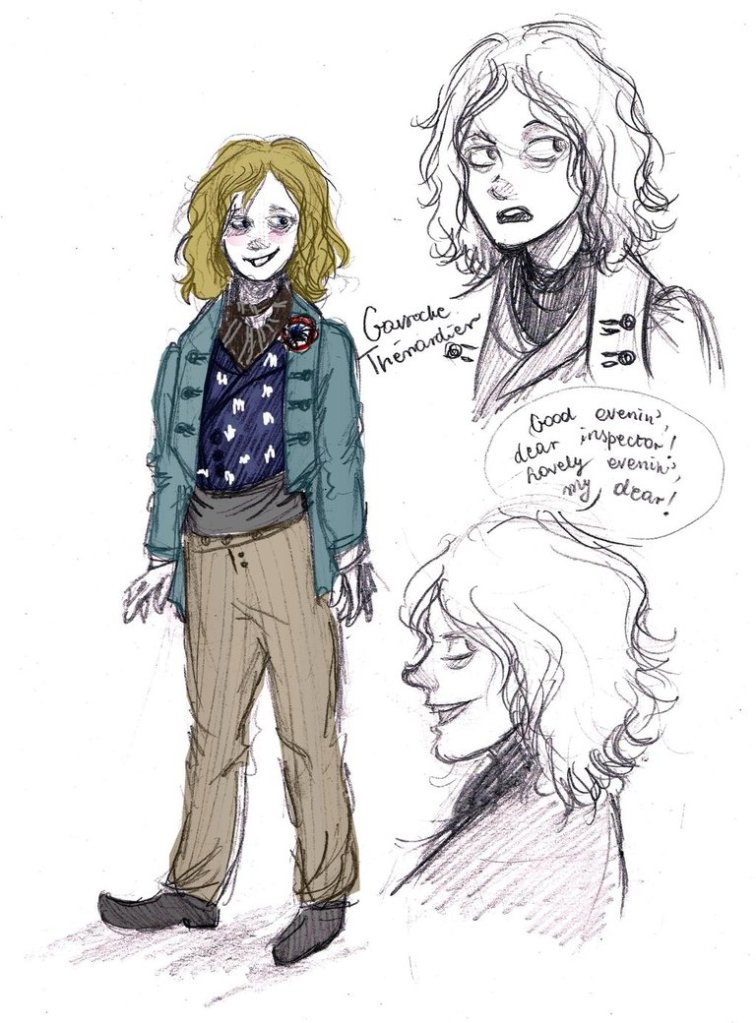
I’m pretty amazed at finding this image … these are exactly the sort of thing I imagined for the buggy’s attachments to the cables.

I’m pretty amazed at finding this image … these are exactly the sort of thing I imagined for the buggy’s attachments to the cables.
An image that I sourced from Deviant Art about five years ago. I don’t remember any more how I got it. Whether I downloaded it, for example. street_urchin_by_xxignisxx-d66m7xi
Lol, I should be writing Part 17 by now. I knew when I started this project I’d have a hard time keeping up with the Reports. And, the longer I leave the reports, the harder it becomes remembering what I thought about the books. Well, here goes.
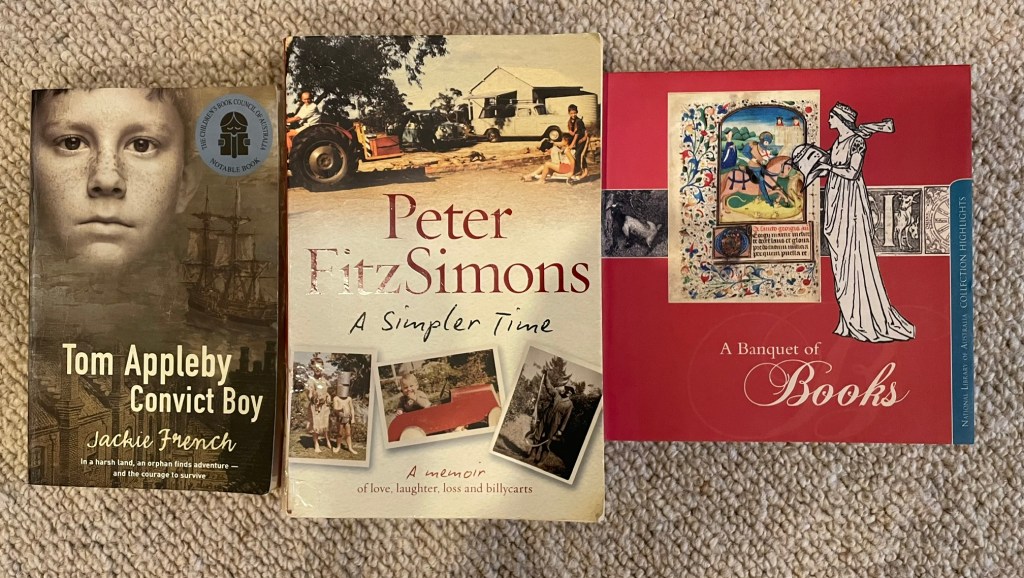
Book 48 … Tom Appleby, Convict Boy, by Jackie French, published in 2004 by Angus & Robertson, an imprint of Harper Collins Publishers.
When I read a book aimed at young readers, I’m often in the mode where I’m reading aloud. Asking myself whether it ‘sounds’ like an interesting read for both the adult reader and the young listener. And Tom Appleby sounds pretty good to my inner ear so I will be able to recommend it.
Although the main character starts off being only eight years old, his life will be so foreign to modern children being read to, there’s no flavor of childishness. And once the ships reach Port Jackson, Tom grows up a bit. He has to, in a community where hunger is the primary concern, and stealing food is not an option for him.
Tom is chosen by a sergeant in the marines for company for the sergeant’s son. The boys learn the skills necessary to survive together.
Though I’m not sure about the fact that they meet an old aboriginal lady who shows and teaches them native foods. Not sure how that would strike a modern Indigenous reader/listener.
Thirty years ago, Jackie French was a favorite source for read-aloud books. Seems like she could do with a revival. And the book has indeed passed on to its next home–the-adult-reader-and-young-listener combo.
Book 49 … A Simpler Time: a memoir of love, laughter, loss and billycarts, by Peter FitzSimons, published in 2010 by Harper Collins Publishers.
I’m glad FitzSimons called his book a memoir himself, saves me have to ponder once again about the differences between autobiography and memoir.
I saved this book from the dumpster because it’s set in the late 1950s and 1960s, and because the kids in it grew up at Peats Ridge, only about 39 kilometres by road and shorter as crows would fly from the suburb where my sisters and brothers and I were growing up in those exact years.
There’s even a possibility we might have met them at one or other time as we all would’ve traveled the same train services. Maybe in the school holidays or once we all graduated from our various high schools.
There were plenty of interesting comparisons and likenesses. The FitzSimon kids lived on a two-hundred-acre farm, where their parents had settled after WW2, to grow oranges, tomatoes and zucchinis. A seven days a week job.
We de Heer kids lived on a half-acre block carved out of the same kind of sandstone that supported Peats Ridge, covered with the same kind of bush that vegetated Peats Ridge. The de Heer father, also being a seven days a week man, chose to build our house himself on weekends, and after he got home from 12 hour days getting-there, working, and-getting-back.
There were five of them, there were six of us. The FitzSimons kids were boarders at Knox Grammar for Boys and Abbotsleigh Girls High. Both of them ‘flash’ private schools in the understanding of newbie immigrant kids like us. We went to state day schools like Asquith Girls High School and Asquith Boys High School, though one of my brothers managed to get a scholarship to attend James Ruse High School at Carlingford.
Our state primary schools, theirs and ours, would’ve been run by the same state education department, though theirs was a country school with only two classrooms and ours may have had 4 classrooms by then.
Peats Ridge. As soon as I picked up the book, it was like I recognized it and had to read it. Thoroughly enjoyed it and will send it to one of my youngest siblings for him to read.
Book 50 … A Banquet of Books: A Collection of Highlights, published in 2007 by the National Library of Australia.
I hardly know where I got this book. Must’ve been in the collection of secondhand books I saved from the dumpster. A job lot as they say. But an interesting little book, and about books you’d never ordinarily would see, hidden as they are among the collections or in the National Library’s acreage of store rooms.
After a brief intro, it is divided into three sections: Homegrown Historical Treasures; Masterpieces from Abroad; and Works of Art.
The introduction starts with one of the smallest books in the world—so small in fact that I don’t see how it could’ve been made—measuring 2.1 mm by 2.4 mm made in Germany in 2002. The largest book in the collection also gets a mention … Birds of America by James Audubon, 1785-1851. It’s a double elephant folio.
Part one’s Homegrown Historical Treasures includes a catalogue of fabrics (bark cloth or tapa) collected during the three voyages of Captain Cook. Part two, Masterpieces from Abroad, has a Book of Hours, and a leaf from the Gutenberg Bible and about fifteen more. Part three, Works of Art, contains Lionel Lindsay’s Twenty-One Woodcuts and Ann Muir’s Harvesting of Colour, from the 1990s, among a couple of dozen of historical maps, biographies, paintings by Gould, John Lewin, and other artists. I was amazed at the treasures the National Library has hidden away in its collections. Well worth visiting.
Book 51 … The Black Book by Ian Rankin, first published by Orion Books in 1993. This edition published in 1994 in the UK, but then printed in Australia in 2005 as far as I can make out.
I returned this to the library only yesterday and all I recall of it is that it’s the fifth in the Inspector Rebus series. Here a few more details by Wikipedia.
“The Black Book is a 1993 crime novel by Ian Rankin, [1][2] It is the first book to feature Siobhan Clarke, and the first one in which Morris Gerald Cafferty appears as a main character. It is also the first book in which Rebus is based at St Leonards police station.”
Neither awful nor fantastic, it delivered me a few hours of uninterrupted relaxation/reading when the stress of the previous couple of days meant my delayed fatigue forced me to rest up.
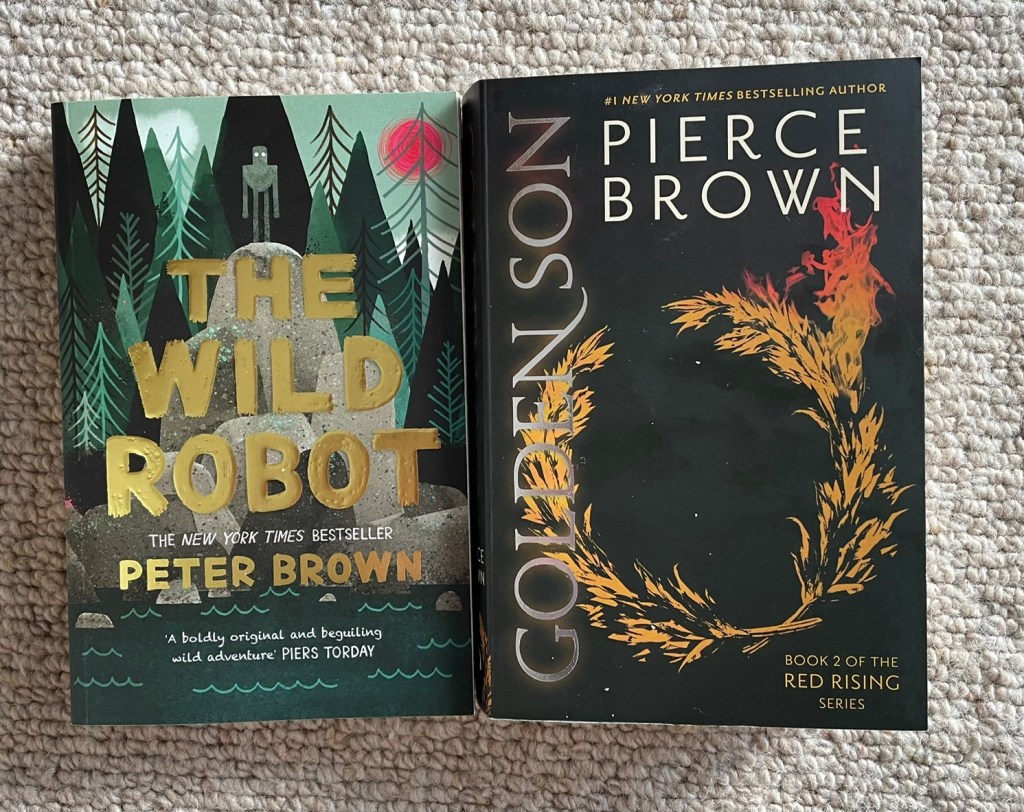
Just two of the books I read, the others I have already passed on.
After I reading the two navigator-explorers, Captains Cook and Flinders, I was ready for a bit of fiction. My SF reading buddy and I had been saying for a while that we needed a new series to get our teeth into, and couldn’t find one. With more time on my hands than he has I sourced a few 10 Best XYZ lists. Noted two or three series that all appeared on several lists.
One fine Saturday when I was grocery shopping, and then intending to look for a birthday book suitable for a nine-year-old, saw a 50% Fantasy and Science Fiction Sale at QBD (referring to Queensland Book Depot, I’m assuming).
Lol, what QBD apparently did, was mark down to 50% all first parts of series, leaving the rest of the series at the normal price. So I walked out with the book gift and three first installments of their respective series each of those between 10 and 12 dollars. How can they even produce books that cheap? Our idea being that which ever of the first installments catches our interest, we’ll continue with.
Book 44 … Mistborn, Book One of the Mistborn Series, by Brandon Sanderson, this edition published by Gollancz in 2009.
Mistborn was the first one I picked up to read. I’ve read somewhere it’s being turned into a feature film and thought I should read it before I see it as films rarely improve on books.
I find Sanderson tooth-grittingly hard to read. In my middle life I spent ten years editing undergraduate essays, an experience that has left me deeply disinterested in reading poorly phrased prose and Sanderson loves “thin alleys”!
What’s wrong with narrow alleys? And that’s just one example. I can’t believe Mistborn is being touted as literature!
Seems that I’m not alone in this, I was happy to discover. When I am alone in a complaint, there’s always the suspicion that I’m being elitist, or fussy, or or or … This time though, several Reddit commentators are of the same mind. Although one of them thought that Sanderson writes ‘flat prose’ purposely, to attract the largest possible following. In answer to that I say that George R R Martin, among others, didn’t have to resort to flattening his prose to attract a large following.
But flat prose aside, Sanderson’s ideas and inventions are fresh and capable of sending their stories into new unusual directions. Though this is not enough for me to want to read part two or more.
Book 45 … Red Rising, by Pierce Brown, first published in 2014 by Del Rey, an imprint of Random House.
Pierce Brown is one of the ‘many others’ I mentioned up there. No ‘flat prose’ in sight. This is one of those books where I hardly noticed I was reading. Some Reddit commentators have mentioned the many many short sentences and how they distract from a good read.
Others say short sentences are what makes audio books an intense listen. Oh, I thought. Audio. That’s why the short sentence style is taking over public writing. And plus, AIs seem to like it.
Red Rising read like a breath of fresh air to me, I never had to wonder what the author meant. Yes, it was a gallop. The worldbuilding, a society organized by colors and partly structured by a Roman underlay, go hand-in-hand with the plotting, and are frenetic.
Though it’s true that Darrow, the main character, is a bit of a superman, and always comes out on top despite his sometimes mistaken beliefs in the goodness of others. But never mind. I’ve read that this is the weakest of the series. If I can trust the commentators, things can only look up.
Book 46 … The Wild Robot, by Peter Brown, first published in 2016 by Little, Brown and Company, an imprint of Hachette.
The Wild Robot is the birthday book. A film is already out there and I think I’ve seen it. Which probably helped me choose the book. This is the story of a robot becoming marooned on a deserted island, and learning to live with nature, or part of nature. It seems a little moralistic but was the best that I could find without reading everything. Lol.
I despise books written purposely to teach kids morals. As if they aren’t learning them from their parents. Kids famously learn their morals by watching how their parents behave and behaving just like that. Teaching kids morals is like teaching fish to swim.
It’s increasingly hard to gloss a bookshop’s shelves for good kids’ books. It seems to me the golden age of children’s literature has gone the way of many other good things. I think Rosemary Sutcliffe’s books could do with reprinting. Penguin Books? Anyone?
I have quite a few of the really good middle grade fictions on my shelves still (some of which are forty plus years old, I confess) and although some of them are being reprinted—The Little House Series and The Rats of NIMH, for example—many others have just disappeared.
In the past, kids read about animals and their lives. Historical fictions. None of them around now. Too many good film documentaries, I suppose.
Book 47 … Golden Son, by Pierce Brown, first published in 2015 by Del Rey, an imprint of Random House.
Lol, this is not one of the three firsts that I bought. I couldn’t resist going in and buying Part 2 of the Red Rising Series. I guess I’m hooked.
However, it’s been a couple of weeks since I read Golden Son and a lot of Real Life, eg a light fling with Covid, has happened in the meantime. I will have to read Darrow’s doings again for the detail as I now remember very little as I raced through chasing the plot. A bad habit. The plot is intricate, detailed, a lot happens, there’s non-stop action.
At the end, I do remember thinking, with all that happened, and all the mysteries that have been outed, what is there left to say? How can there be all the subsequent installments? Is he going back to the beginning and start a whole lot of new threads? Re-inventing himself, no doubt.
Well, I just read a couple of articles on Wikipedia. Apparently Golden Son is the second installment of a trilogy. After Morning Star, the third one, there will be a second trilogy to make up the six books in the series so far.
I’m not sure whether I have enough puff to read any more in this arena after Golden Son. I enjoyed the two that I read, but it sounds like the next four are more of the same. And I’m pretty sure Darrow will win, somehow.
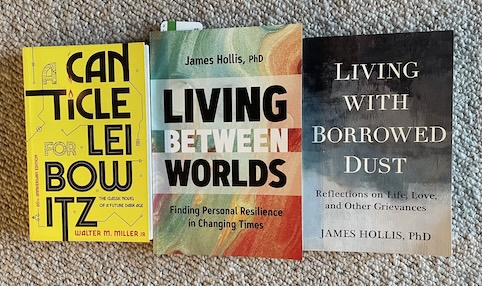
Book 35 … Living with Borrowed Dust: Reflections on Life, Love and Other Grievances by James Hollis PhD, published by Sounds True in 2025.
Had this unread on my shelves from last year. This time the title grabbed me, “living with borrowed dust.” That’s the dust of the stars we are all made of. I’ve read a few of James Hollis’s books by now, and reading this one, started to suspect that he’s regurgitating his material. And that once I’d read one I’d read them all.
That could be true about this one. It’s a kind of a autobiography/memoir—I can’t tell the difference between them. He has this aphorism, “Shut up; suit up; show up!” First time I read it, several years ago, I laughed. But took it on board. This is me, here, showing up in this project I set myself back in January.
When I read the quote above on page 106, I felt vindicated. Thought I should’ve saved my money. Because also in this little book Hollis quotes regularly from his previous books. So it’s hard to understand isn’t it, that my next read is also one of his?
Book 36 … Living Between Worlds: Finding Personal Resilience in Changing Times by James Hollis PhD, published by Sounds True in 2020
It’s an earlier book and while almost the same size, it’s weightier. Chewier. “Living between worlds” … I relate to that. I’m living between worlds, as we all are in the West. Yesterday I watched two thirds of a documentary about life in the climate-challenged parts of the world. Millions of people already impacted. And I can’t even let myself continue thinking about it all—takes too many spoons—I’m not strong enough.
But … This book. The two worlds are our inner struggles and our “modern human existence”. Looking back through it, I see I’ve underlined many sections, a sure sign I wrestled with it. In this book, Hollis is proving to us that we “human animals are equipped for survival”. With creativity, wisdom and connection, he means.
This is the kind of book I have lying beside me on the couch for a few months, to be able to read a couple of pages anytime I feel like I need to work out my mental muscles.
And this book is the reason I began a side project, painting various scenes from Theseus in the Labyrinth. Done two. More planned. Theseus turned out to be a non-hero to me. After he killed the minotaur, he abandoned Ariadne, and sailed off into the wide blue yonder. Typical for a rolling stone?
Book 37 … A Canticle for Leibowitz by Walter M Miller Jr, a 60th Anniversary edition published by Orbit Books in 2019.
I remembered starting to read this a good few years ago but could not recall why I didn’t finish it. Recently, a good friend recommended it—raved about it, in fact—saying it was the best, greatest sf novel of the 20th century. So I bought it since my local library has moved on.
Lol, might even send it to him. After I give my sf reading buddy a go at it though I seriously doubt he’ll be able to get into it.
Couldn’t remember anything about the Canticle after I confirmed it wasn’t the story about the monk who went underground in New Zealand and expected to come out in the northern hemisphere. That was a short experimental film I saw somewhere, also many years ago. I guess I conflated them since they are both about monks.
I can totally understand now why I didn’t finish it. Though, just for the heck of it, may re read it. Maybe next year. It could be one of those books that improves the better you know it. I have to give it that opportunity.
A review in Good Reading calls it a “seriously funny, stunning, and tragic, eternally fresh, imaginative, and altogether remarkable, A Canticle for Leibowitz retains its ability to enthrall and amaze.”
While a review in The Story Graph said: “There is a lot of science talk, but more in conversation/discussion rather than its use. Also there’s a lot of religious style quotes and I hate that writing style. And in general the writing style is boring and at times confusing because of huge jumps in time.”
It’s post apocalyptic, written in the nineteen fifties and probably the author went to war and had surfeit of battlefield memories he couldn’t get out of his head. There are huge time jumps and so there aren’t any characters I could get invested in. It even felt impersonal, like an overview.
Book 38 … The Messenger by Markus Zusak, published by Pan McMillan, this edition from 2023.
Tore through this in a couple of hours, a disappointingly lightweight read. Then learned it had been made into a TV series and can just about see that as a lightweight script as well, if I could be bothered viewing it. (And couldn’t find it for a pic.)
I’ve been in two minds whether to include study and text books in this project.
In October 2023 I signed up with Dream School run by the This Jungian Life group.
For a year, I read course studies and completed online assignments, to start to learn how to interpret dreams. This followed on from months of nightmares and a short stint with a Jungian psychoanalyst.
After the end of the course, I continued with the analyst for another year. Which brought me to late last year. Since then I’ve been reading rather voraciously and, at the beginning of the year, beginning this project.
After I read Book 31 … Bone House by Betsy Tobin I was at a loss. Though I have plenty of other books lying around, a dozen un read and many many that could do with a second or third reading, I was feeling jaded. Like it was the end of a holiday.
I felt like I needed some chewier fare, a project with a bit of heft. Picked up MDR by Carl Jung, having had it on my shelves for about a year.
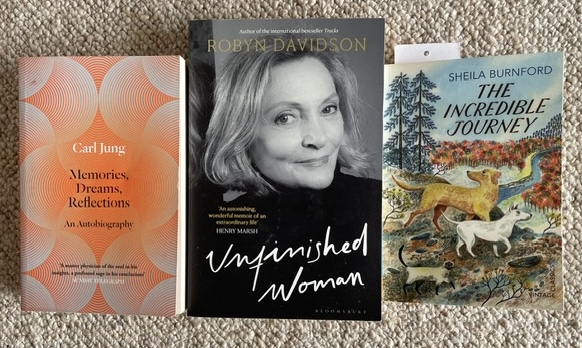
Book 32 … Memories, Dreams and Reflections: An Autobiography by Carl Jung translated from the German by Richard and Clara Winston, published by William Collins, a paperback edition in 2019.
This is not a book you can just read in one sitting, or even a week. It took me well over a month, the whole of May, I might as well say, there being plenty in it for me to think about.
When I started having nightmares back in 2023, I had already thought that I needed a way to think about what was happening in my mind. I wasn’t happy with the physical world of neuroplasticity, MRIs of people’s brains firing, the whole kit and caboodle of studying flesh-and-blood brains and what looks like is happening in them, and thinking that that is the be-all-and-end-all of how minds work.
So when I fell over Jungian dream interpretation by way of the This Jungian Life podcasts, I was stoked. Seemed to me that this was the lyric metaphoric way of thinking about what happens in minds that I could relate to. Been in that mode ever since.
(Stoked is an informal adjective meaning to be highly excited, enthusiastic, or exhilarated about something. Originating in surfing and skateboarding slang, it shares the same root as feeding or fueling a fire—meaning your energy and enthusiasm are burning brightly, Google)
Memories Dreams and Reflections, MDR for short, is both Jung’s autobiography and an account of his studies and discoveries. Despite what many people think, he went about his project of exploring what happens in our minds in a scientific way. He describes his experiments and the empirical results.
He named the personal unconscious that we all have, and discovered the deeper, archetypal unconscious we all have.
(Archetype is a Jungian psychology concept of an inherited unconscious predisposition, behavioral trait or tendency (“instinct”) shared among the members of the species …Wikipedia)
And then spent the rest of his life exploring how the unconscious works with the ego—your conscious mind. But he was writing in the early third to half of the 20th century and his turn of phrase, if anything, is quite esoteric, readable by only a small number of people, and somewhat turgid for the likes of me. I knew I would have to search out those interpreting him for more modern readers. And plus, I knew also that I’d be reading some light relief.
Book 33 … Unfinished Woman by Robyn Davison, published by Bloomsbury Publishing in 2023.
Picked this up from down in the Vista foyer where there’s a long shelf under the parcel bench, dedicated to memoirs, autobiographies and some histories.
Lol, love all these prepositions one after the other “up from down in” … makes sense, I hope?
The same Robyn Davison who lived Tracks and then wrote it. From the back cover, “In 1977, 27 year old Robyn Davison set off with a dog and four camels to cross 1700 miles of Australian desert to the sea.” I had that book for years. Don’t recall where I picked it up, second hand while traveling that same desert probably. Camp laundries are the best places to pick up good books.
I already had a soft spot for camels and loved the desert. I read that book more times than I can remember.
Davison was born on a cattle station, is quintessentially Australian, and the first modern woman explorer I read about. My heroine the minute I read about her. This memoir, about the forces that set her up to wander, to travel, to always be on the move, is a gripping read.
A poor childhood, her mother suicides, and Robyn thereafter is raised by her father and older sister in an outer Brisbane suburb. She was in London for the first time roundabout the same time I was in London.
After that she goes on to do all the romantic-sounding things that women in those days usually only could read about. Marrying an Indian prince. Living in London and writing. But, you know, there are always costs.
Book 34 … The Incredible Journey by Sheila Burnford, first published by Hodder and Stoughton in 1961. This copy by Vintage Books in 2013.
Bought this for a ninth birthday present and read it hoping to discover whether it could still rip my heart out. So many books written in the past lose their numinosity when set against more modern texts. Realizing this is a function not only of the language they are written in, but also the culture that nowadays washes through our minds.
It has this in the front as a prologue…
The Beasts by Walt Whitman (1855)
I think I could turn and live with animals, they are so placid and self-contain’d,
I stand and look at them long and long.
They do not sweat and whine about their condition,
They do not lie awake in the dark and weep for their sins,
They do not make me sick discussing their duty to God,
Not one is dissatisfied, not one is demented with the mania of owning things,
Not one kneels to another, nor to his kind that lived thousands of years ago,
Not one is respectable or unhappy over the whole earth.
Sounds modern, doesn’t it?
— — — —
The first three pages are a description of the setting, which I suspect may largely be skipped when reading them aloud. But still, the setting hasn’t suffered from the encroachment of modernity. I suspect only if you live right there will you know of the depredations of industries such as milling, mining and road-making.
The three animals are introduced in the next chapter. Two dogs and a cat. They’re being cared for by a friend of their human family and his housekeeper, Mrs Oakes, while their own family is overseas. A couple of weeks before the family is due back, the animals take off for home.
A distance of about two hundred and fifty miles separated the animals from their home, with plenty of dangers along the way. Bears, porcupine, floods, cold, snow, irascible farmers with shotguns. As well as just enough kindly humans to help the animals along.
I thoroughly enjoyed it. It hasn’t lost anything in the years since I read it to my nine year old. It’s a famous story. Disney made two movies of it, but to me it’ll always be a favorite read. And by that I mean a text I take in with my eyes.
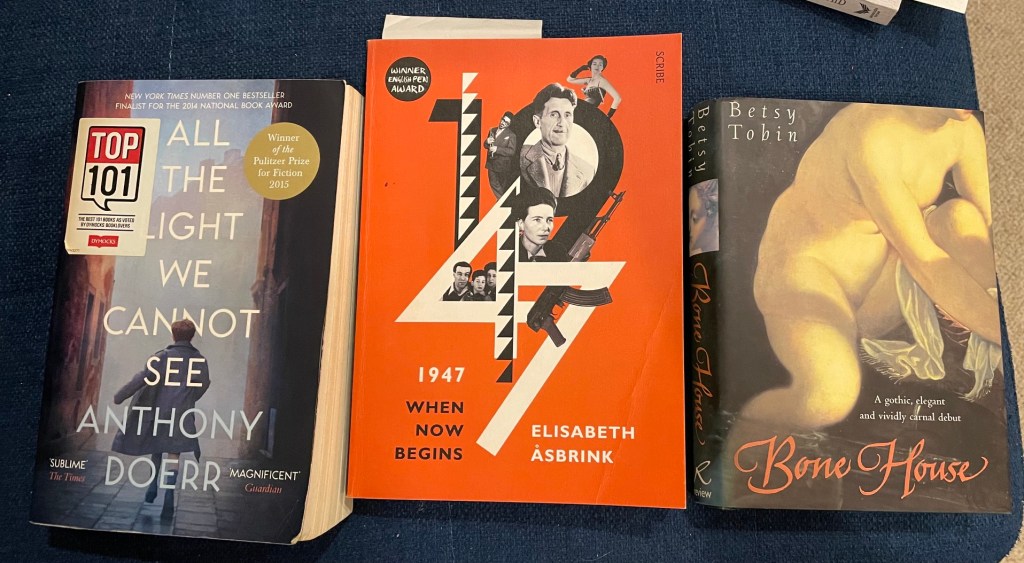
Book 29 … All the Light We Cannot See by Anthony Doerr, first published in 2014 by The Fourth Estate, an imprint of Harper Collins.
I read this a few months ago and to my shame could not recall a single thing about it when I picked it up to write this. But, when I turned to the back cover and read the synopsis, it all came rushing back.
Written in the first person present, a style I normally steer away from, it’s a gripping story. Set during World War Two, an abiding interest of mine. I was born three years after the end of that war to parents who didn’t talk all that much about their experiences. Only in my parents’ later years, did we, their children, get a few stories. A common experience from what I’ve read. But meaning that if you had any interest, you’d end up reading and researching widely.
The blind protagonist, Marie-Laure. The miniature maze her father made so she could learn the neighborhood. Their escape to ‘the walled city by the sea’ near the beginning of the Second World War. Doerr, the author uses a lyrical sensory style to portray Marie-Laure.
Werner, the German orphan and then Hitler Youth and radio operator, his story told in parallel, finally being ordered to that selfsame walled city. Where inevitably they meet.
No more spoilers for it’s a worthwhile read. The wikipedia article below will give you all the detail you might want about the reasons it was written, the style, the research, how long it took to write, etc etc.
https://en.wikipedia.org/wiki/All_the_Light_We_Cannot_See
Book 30 … 1947, When Now Begins by Elisabeth Asbrink, translated by Fiona Graham and published in 2017 by Scribe.
At the same time, but completely accidentally, I picked up this book which, while recounting the events of 1947, is really about the on-going fall-out of World War Two. Quoting from the back cover: “In 1947, Elisabeth Asbrink chronicles the creation of the modern world, as the forces that will go on to govern all our lives during the next 70 years make themselves known.”
1947 looks back as well as forward. And it tells the big story while all over Europe, people like my parents busied themselves setting up their new, very small lives and minding their own business, if and where they could.
One thing that made this read utterly topical is its description of the so-called Palestine question. Starting then! 79 years ago! The frightening partition of India into the smaller Hindu heartland flanked by the Muslim East and West Pakistans is also begun then.
I’m not sorry I read it and will probably keep it for a while. May want to read some of it again.
Book 31 … Bone House by Betsy Tobin, published in 2000 by REVIEW, an imprint of Headline Book Publishing.
This is another first novel and I have a soft spot for such, as you know. But it is also another book I forgot as soon as I read it. This time not even the back cover could help me. I do recall wondering why the “Bone House”? I mean, why call it that?
Learnt just now the two main meanings. The first as a charnel house where bones were kept—in small medieval times graveyards, graves had often to be reused before the previous occupants had melted into the ground—and second as a metaphor for the human body. Maybe that was what the title meant.
This is one of those novels where the illustrated book jacket with its voluptuous woman, Susannah Bathing, I believe, and suggestive byline gives completely the wrong idea about the book. Set in 1603, a town’s prostitute, beloved by all, is found dead. The daughter of the local midwife investigates the reason for the death.
Reading it, I had so many questions that were never answered. A weird little book.
Painting on book-jacket after Susannah Bathing, 1556, by Tinteretto

